

10 Local SEO Tools for SaaS and Digital Products
One platform rarely handles every local SEO task well. Listings distribution, Google Business Profile execution, reputation management, geo-grid measurement, and client reporting are separate operating jobs, even when vendors place them behind one login. A tool that distributes location data may not explain why visibility drops across a service area. A rank tracker may reveal the problem without helping anyone correct a review, category, or directory record.
That distinction matters for SaaS and digital-product businesses with local acquisition needs. A company selling software through regional partners, local sales teams, events, or distributed service providers may need location-level pages and reporting without operating like a traditional franchise. The right choice depends on the location model, team capacity, integrations, reporting depth, pricing structure, and ownership of recurring work.
The established framework still helps. The 2023 Whitespark Local Search Ranking Factors survey, which surveyed 44 local SEO experts across 149 potential ranking factors, found that local pack performance leaned most heavily on Google Business Profile signals, while local organic rankings were led by on-page signals at 36%, link signals at 26%, and behavioral signals at 9%. That separation explains why no single dashboard should automatically win every buying decision.
The tools below are compared as parts of operating workflows. Some are focused specialists, some are broad platforms, and some only make sense when paired with another system.
Table of Contents
- 1. Synup
- 2. BrightLocal
- 3. Whitespark
- 4. Moz Local
- 5. Semrush Local
- 6. Yext Listings
- 7. Uberall
- 8. Synup
- 9. Localo
- 10. Local Falcon
- 11. Birdeye
- 11 Local SEO Tools, Feature Comparison
- Build the Smallest Stack That Proves Impact
1. Synup
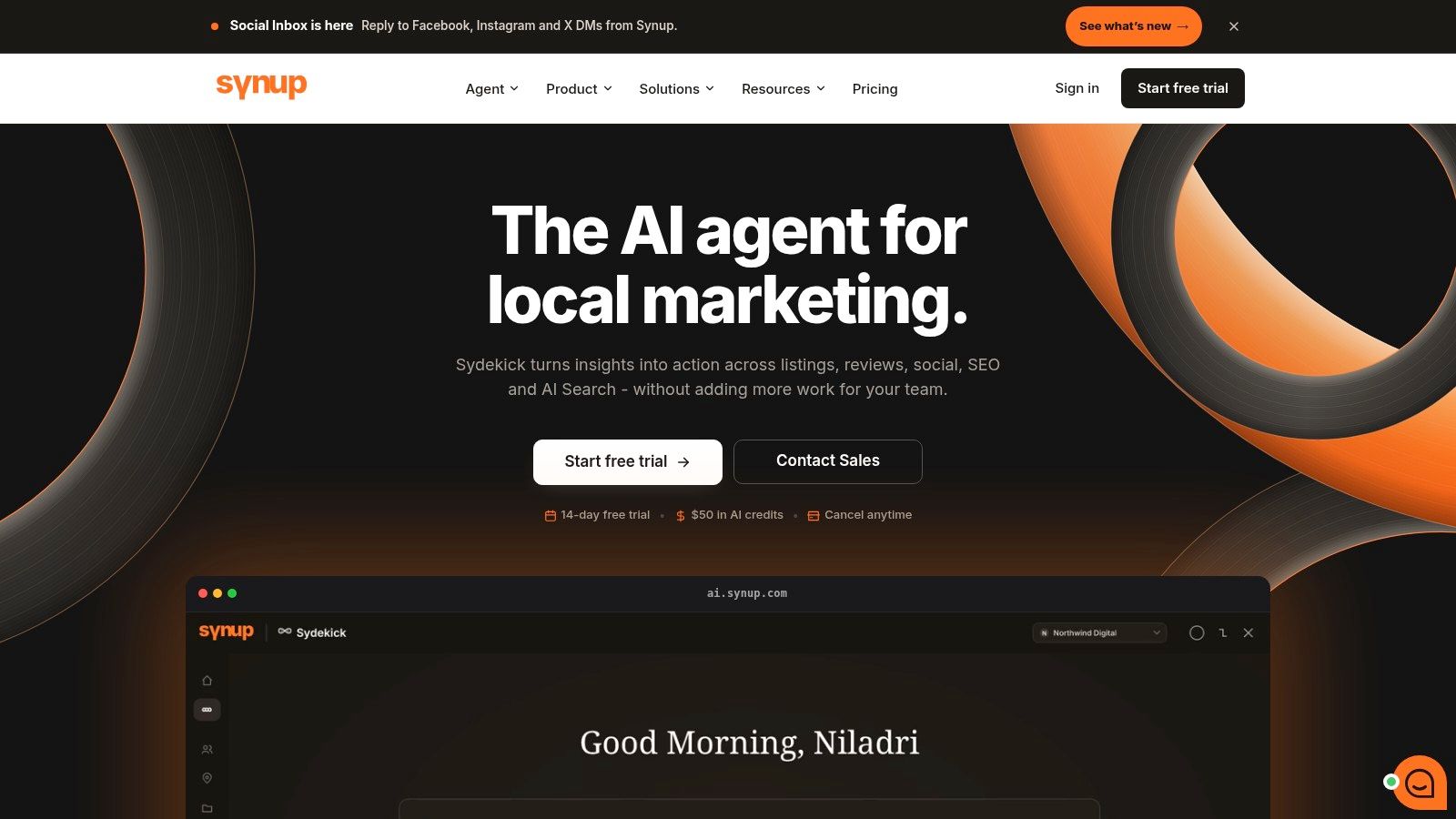
Synup is the strongest candidate here when a team wants to turn local SEO into a managed operating system rather than a collection of isolated tasks. Its platform combines listings, reviews, social publishing, local pages, rank tracking, reporting, and AI-assisted execution through Sydekick. You can explore the product through Synup's local SEO tools.
Where Synup earns its place
The practical advantage is workflow continuity. A team can keep business information synchronized across Google Business Profile, Apple Business Connect, Bing, Facebook, and a broad publisher network, then monitor review activity, draft replies, schedule location-level posts, and inspect local visibility from the same command center. That reduces the handoffs that cause stale hours, missed reviews, and inconsistent brand language.
Sydekick adds an automation layer, but the useful distinction is that it can work inside approval workflows and guardrails. It can research, propose content, prepare responses, and execute approved actions while preserving an audit trail. That matters for agencies and regulated businesses where “automated” cannot mean “unreviewed.”
Synup also goes beyond conventional listings management:
- AI visibility diagnostics: The AEO features evaluate presence in ChatGPT, Gemini, and Perplexity, helping teams identify citation gaps beyond conventional search and Maps.
- Location infrastructure: Store locators and location landing pages can live on a custom domain and remain synchronized with location records.
- Agency controls: White-label portals, scoped permissions, branded reporting, and multi-client management support packaged services.
- Integration flexibility: REST APIs, MCP support, model connectors, and BYOK or BYOM options make the platform easier to fit into an existing AI or marketing stack.
Practical rule: Let automation handle repetitive execution, but require approval for anything that changes brand claims, regulated information, or customer-facing responses.
Best fit and trade-offs
Synup fits agencies, franchises, software providers, and multi-location brands that need more than citation cleanup. It's especially compelling when one team owns listings, reputation, social updates, local pages, and emerging AI-search measurement. The ability to retain per-client memory and brand voice can reduce quality drift as account volume grows.
It may be excessive for a single-location operator that only needs clean directory information. It also requires governance. AI throughput, permissions, approval rules, and audit review should be defined before the team turns on autonomous actions. The platform can consolidate several tools, but consolidation only creates value when someone owns the combined workflow.
2. BrightLocal
BrightLocal is a practical all-rounder for small businesses and agencies that want rank tracking, citation work, reputation management, GBP auditing, and reporting in one local SEO environment. Its local SEO platform is broad enough to reduce tool sprawl without forcing an enterprise implementation.
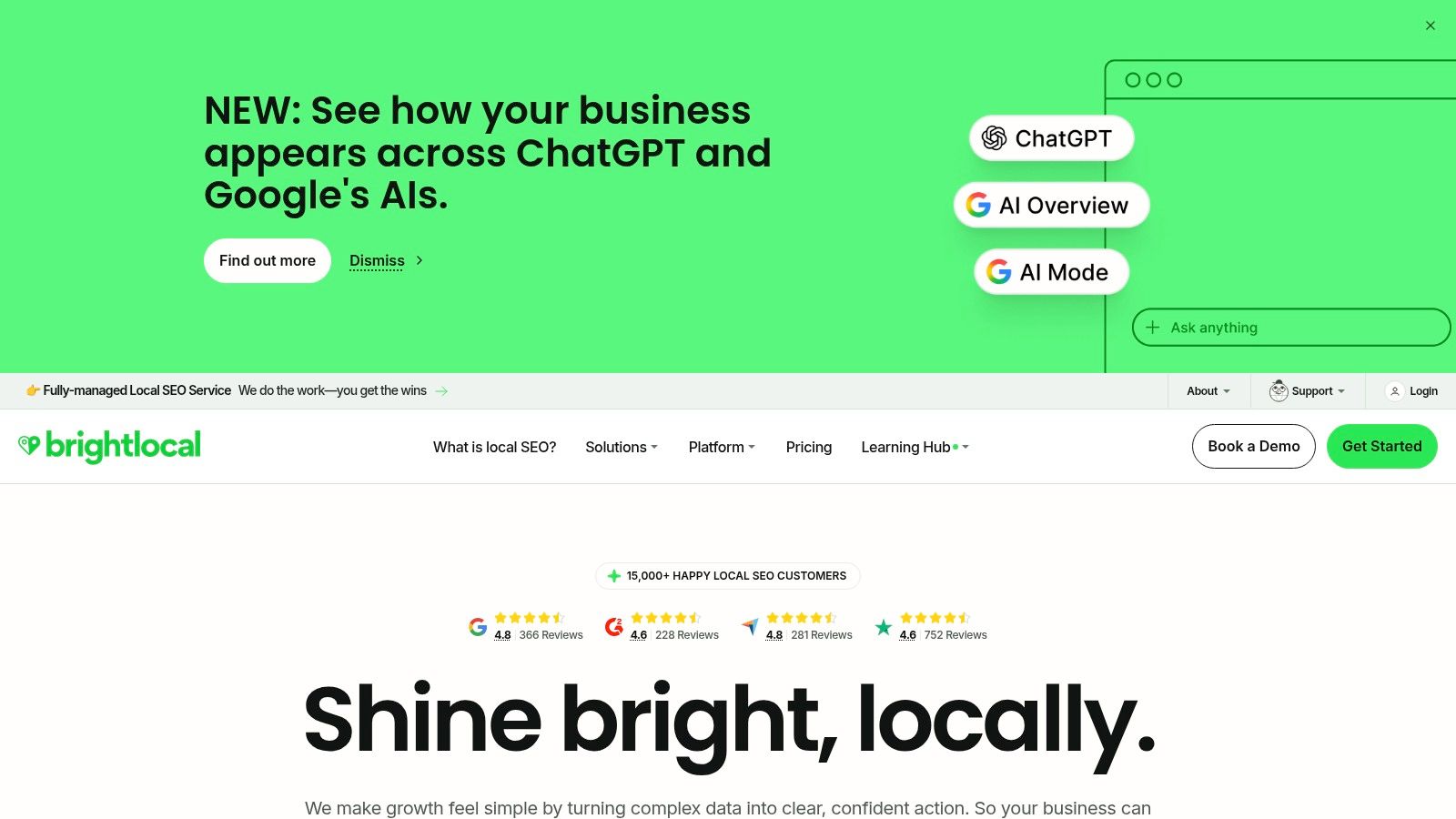
The Local Search Grid is useful because it replaces a misleading single ranking number with a geographic view of visibility. Its GBP audit and local SEO audit help turn the scan into an action list, while citation tracking identifies inconsistent or missing records. Agencies also benefit from white-label reports and client roll-ups that make recurring delivery easier.
The workflow I'd use is straightforward:
- Audit first: Connect each location, inspect GBP completeness, and document the largest citation and profile issues.
- Fix the data layer: Use citation tools or Active Sync for core business information, then confirm that important records reflect the approved source of truth.
- Measure the map: Run geo-grid scans around meaningful service areas rather than scanning indiscriminately.
- Close the reporting loop: Schedule a branded report that separates completed actions from visibility movement.
BrightLocal's main weakness is pricing complexity. Credits, limits, optional citation building, and data-aggregator costs can make the final operating cost less obvious than the subscription headline. Teams should map expected locations, scans, citation submissions, and review workloads before choosing a plan.
It's a strong choice for an agency that wants one general-purpose local workspace. It's less attractive when the team needs only precise rank measurement, or when enterprise governance and direct publisher connections matter more than accessible reporting.
3. Whitespark
Whitespark works best when the question is not “How many listings can we push?” but “Which local signals are we missing, and why?” Its local SEO tools are deliberately unbundled, so practitioners can use Local Rank Tracker, Local Ranking Grids, or Local Citation Finder without buying a broad platform.
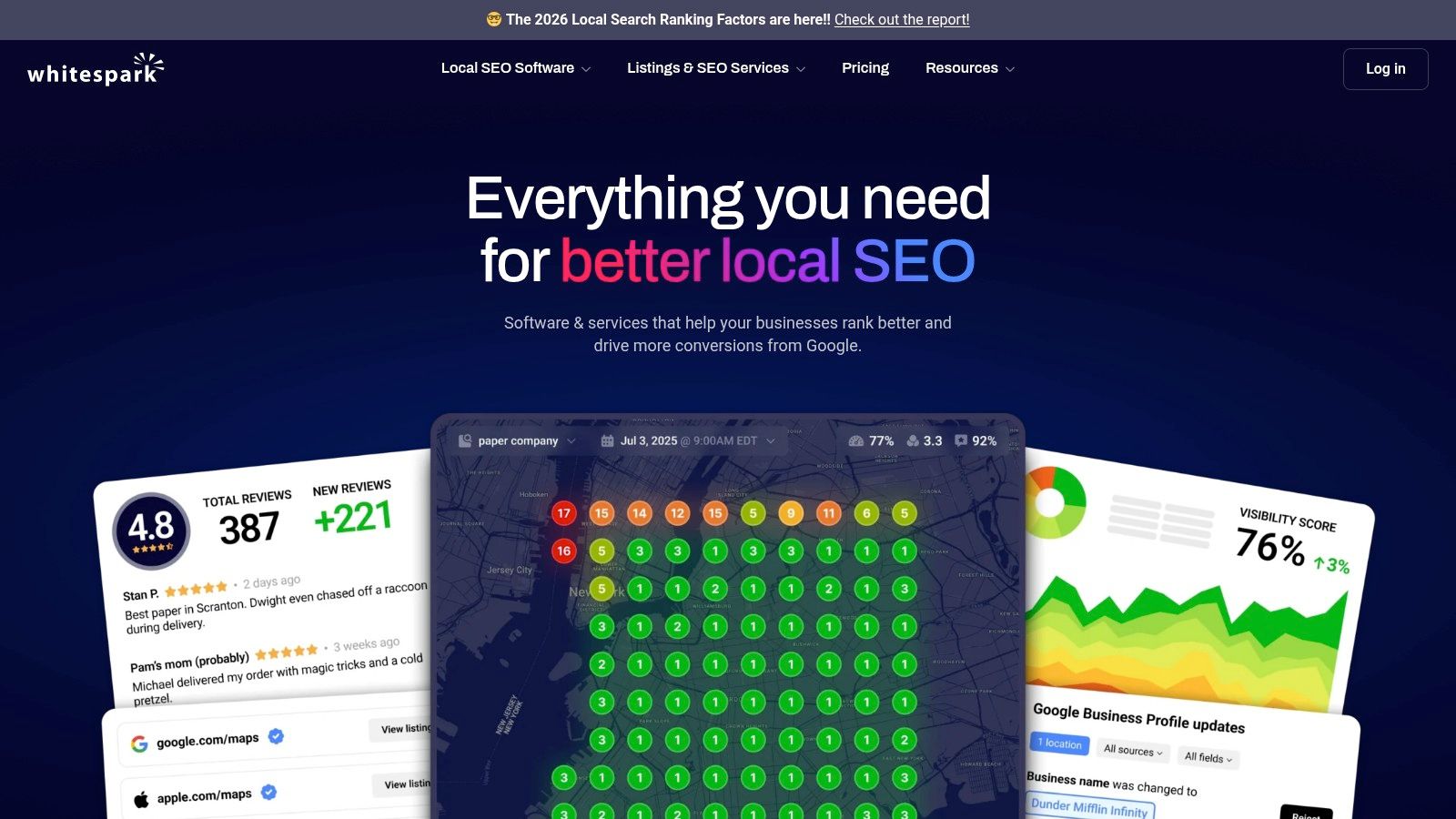
The citation discovery workflow is the standout. Suppose a local SaaS implementation partner ranks above your client for a high-value regional query. Rather than submitting the client to every available directory, use competitor-based discovery to identify relevant industry and city citations that the better-performing businesses have and your client lacks. That produces a more defensible cleanup plan than chasing raw citation volume.
Whitespark also separates Pack, Maps, and organic rankings, which helps prevent teams from treating every visibility issue as a GBP problem. Its geo-grid visuals and shareable reports are useful in client conversations, especially when a business performs well near its address but loses visibility across the wider service area.
The trade-off is operational. Whitespark is not primarily a continuous listings-sync platform. A team may need to pair it with Moz Local, Yext, BrightLocal, or another distribution system for ongoing data maintenance. Multiple modules can also mean multiple subscriptions and exports.
For agencies, that separation can be a benefit. The specialist tool provides a sharper diagnosis, while the listings vendor handles recurring corrections. Use this growth-hacking toolkit separately when the SaaS client also needs referral or partner acquisition workflows. It shouldn't be treated as a substitute for local SEO measurement.
4. Moz Local
Moz Local is the sensible choice when a small team's main problem is inconsistent business information across directories. Its local listings platform focuses on distribution, profile accuracy, review monitoring, and presence analytics rather than trying to become a full local operations suite.
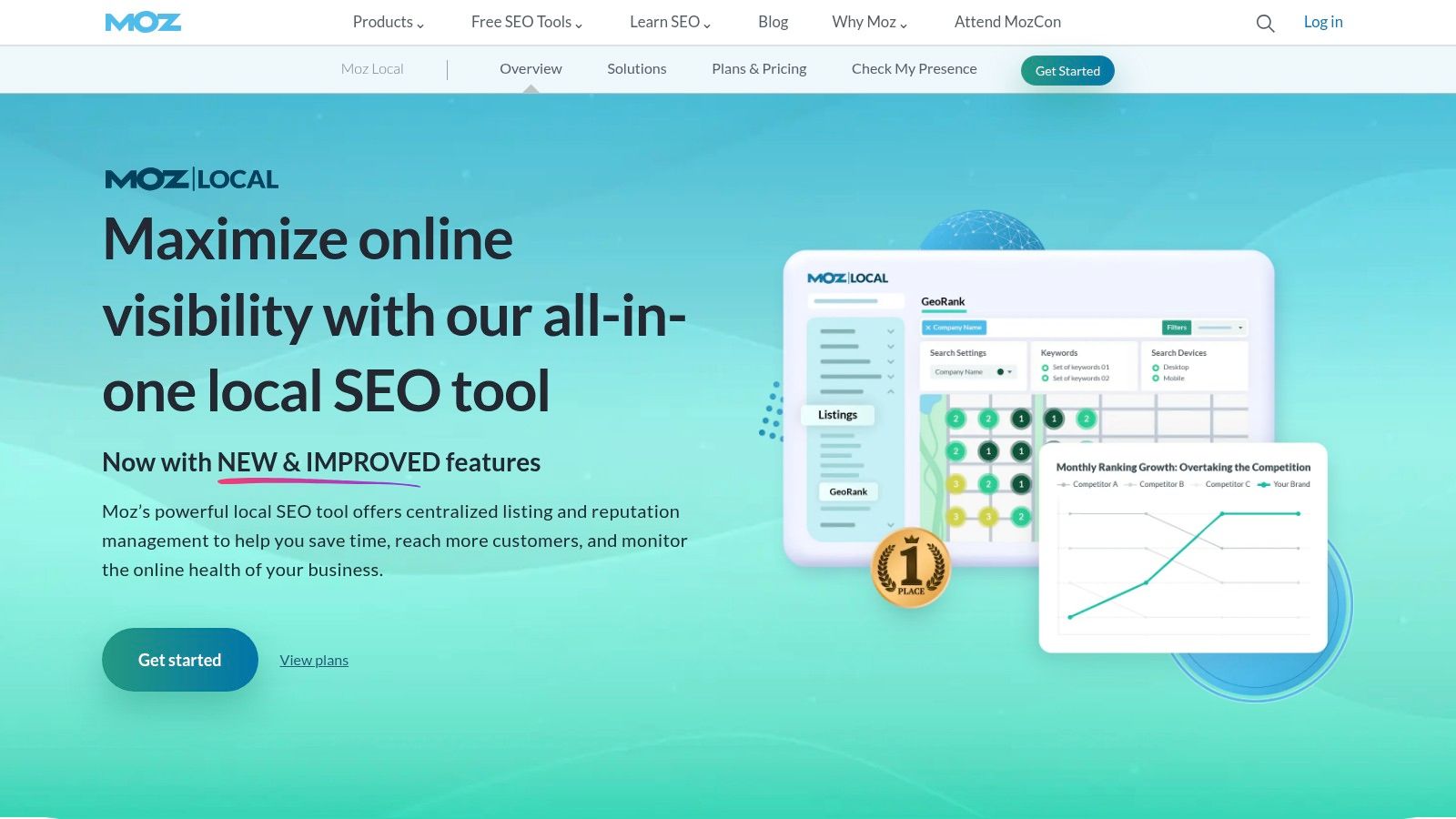
That narrower scope is useful. A local business with one or a few locations can enter approved business details, connect important profiles, and establish a repeatable data-health process without training staff on a complex agency platform. Review monitoring gives the team a reason to keep returning after the initial setup.
Implementation should include more than pressing “publish.” First, decide which business name, address, phone number, hours, categories, and URLs are authoritative. Then check the most important live profiles after synchronization, document duplicate or disputed listings, and assign someone to review data-health alerts on a recurring schedule.
Moz Local does not replace geo-grid measurement, advanced experimentation, or complex approval governance. It won't tell a franchise operator how visibility varies from one neighborhood to another, and it isn't designed for advanced autonomous workflows. That's why it pairs well with a dedicated tracker such as Local Falcon or Whitespark when measurement becomes a priority.
Its annual, per-location subscription model also deserves attention before purchase. Teams should confirm renewal terms, location counts, included monitoring, and what happens to listing maintenance if the subscription ends. For broader SaaS growth planning, this keyword research guide belongs in a separate organic acquisition workflow, not inside the local listings process.
5. Semrush Local
Semrush Local makes the most sense for teams already using Semrush for keyword research, technical audits, competitor analysis, and reporting. The Local Toolkit extends that existing environment with GBP management, listing distribution, review workflows, and Map Rank Tracker.
The operational benefit is shared context. A marketer can research regional demand, connect target terms to local projects, manage GBP posts, and bring local findings into broader SEO reporting without maintaining another primary login. For a SaaS company with regional landing pages and local sales initiatives, that connection can be more valuable than having the deepest specialist feature in every category.
GBP automation and review workflows help with recurring execution. Map Rank Tracker adds geographic measurement, but teams need to watch credit-based limits carefully. Heavy scanning can consume capacity faster than expected, particularly when multiple locations, keywords, and competitors are involved.
A sensible workflow is to use Semrush for strategic research and cross-channel reporting, then reserve local scans for questions that affect a decision. For example, scan before and after a category adjustment, a location-page launch, or a substantial review-generation initiative. Do not scan just because the system allows it.
The bundle is harder to justify for a team that wants only local functionality. In that case, a dedicated platform may provide more focused workflows with less unused capacity. Existing Semrush customers, however, can gain efficiency from keeping local data beside organic performance.
Use these digital marketing tools as an adjacent stack for SaaS growth operations, not as evidence that Semrush Local replaces referral, affiliate, or lifecycle systems.
6. Yext Listings
Yext Listings is built for organizations where data governance is a business requirement, not a convenience. Its enterprise listings platform distributes structured location data through a large network of direct publisher connections and provides controls for approvals, duplicates, permissions, APIs, and analytics.
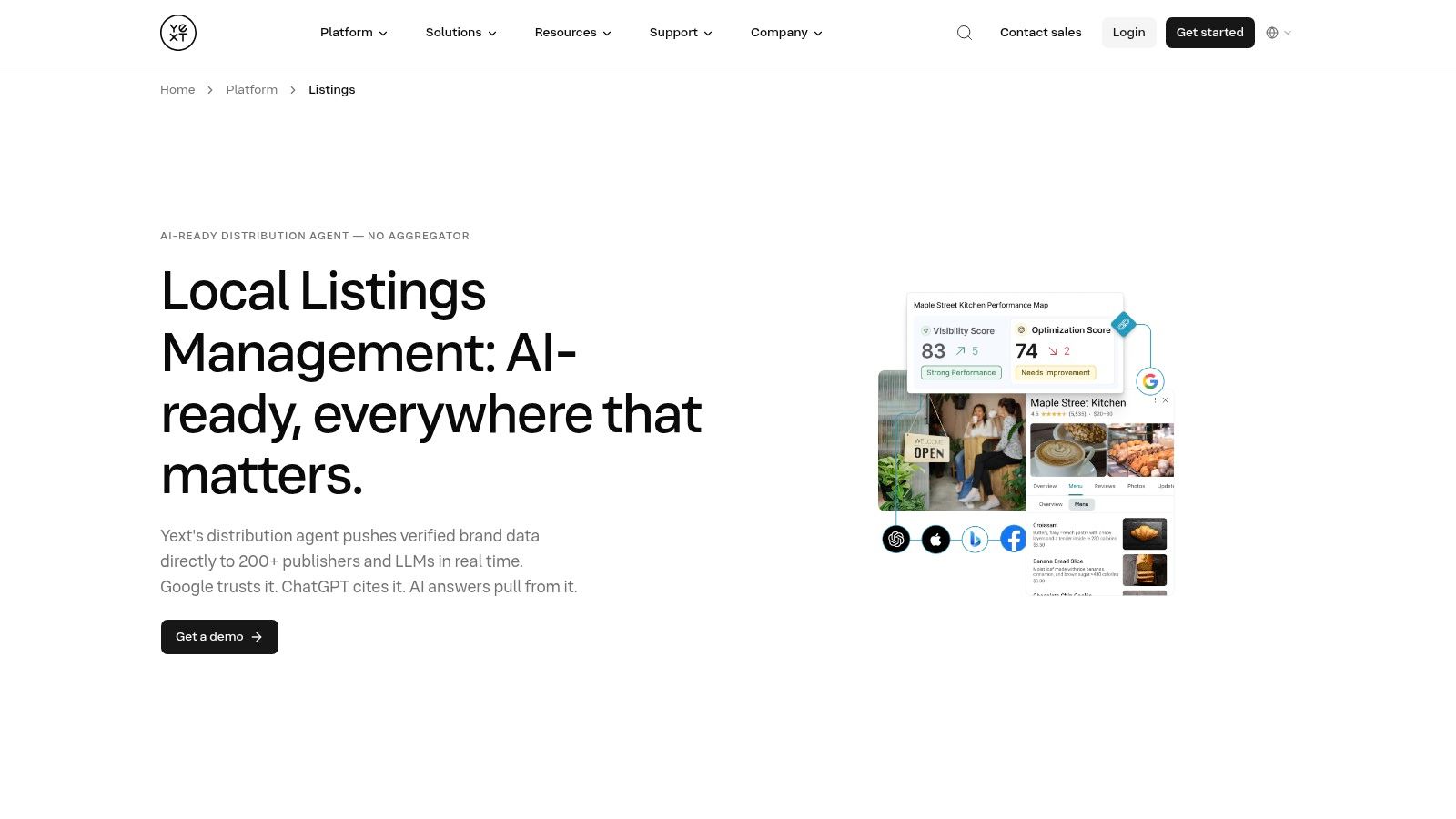
The distinction between direct publisher connections and ordinary aggregator workflows matters when a franchise or regulated organization needs centralized control. A headquarters team can define the source data, local managers can request changes, and approved edits can move through a documented process. Duplicate suppression and Listings Verifier add protection against fragmented or conflicting records.
Yext's analytics also help connect presence to actions such as impressions, clicks, calls, and direction requests. Those metrics are more useful when location owners know which corrective action follows a weak result. A dashboard without ownership just turns data into another queue.
Yext is not an obvious choice for a single-location business. Pricing is sales-led, and the broader governance layer is difficult to justify if one person can update a profile directly. The economics become more defensible when inaccurate listings create material operational risk, when approval bottlenecks delay changes, or when regulatory teams require auditability.
Before signing, ask for a location-level implementation plan. Confirm publisher coverage for the countries and industries involved, data ownership during migration, duplicate handling, user permissions, API access, reporting, and the consequences of cancellation. Yext is a platform for controlling a complex location system, not merely a way to submit citations.
7. Uberall
Uberall is another enterprise-oriented option for franchises, retailers, and multi-location brands that need listings, reviews, local social, approvals, analytics, and integrations in one operating environment. Its Listings product is best assessed against workflow requirements rather than a simple feature-count comparison with Yext.
A franchise implementation should establish ownership before importing every location. Headquarters can own core business data and brand rules. Local operators can own customer responses within approved guidelines. Regional managers can review escalations, while a central team controls publishing rights for sensitive updates.
That division allows Uberall's workflow approvals, review management, local social publishing, duplicate handling, and integrations to support real operations instead of creating a larger shared inbox. The app marketplace can be valuable when local data needs to connect with customer experience, CRM, analytics, or internal communication systems.
Uberall and Yext overlap in the problems they solve, but neither should be selected from a brochure alone. Compare publisher coverage, direct integrations, governance depth, API requirements, reporting, migration support, and pricing transparency. A franchise may prefer one platform because its existing technology stack or approval model fits better, not because one vendor has a universally superior feature list.
Public pricing is limited, and many plans are sales-quoted. That makes a structured proof of concept important. Test a representative group of locations, including one with duplicate records, one with unusual hours, and one with an active review workflow. Measure how quickly the team can approve, publish, verify, and report changes.
8. Synup
Synup's local SEO tools fit teams that need local execution tied to a broader marketing workflow, rather than another dashboard for checking rankings. Listings, reviews, social publishing, and AI-assisted tasks sit in one operating layer. The Synup platform therefore suits agencies managing recurring work, as well as SaaS or digital-product companies that support local acquisition for customers or partners.
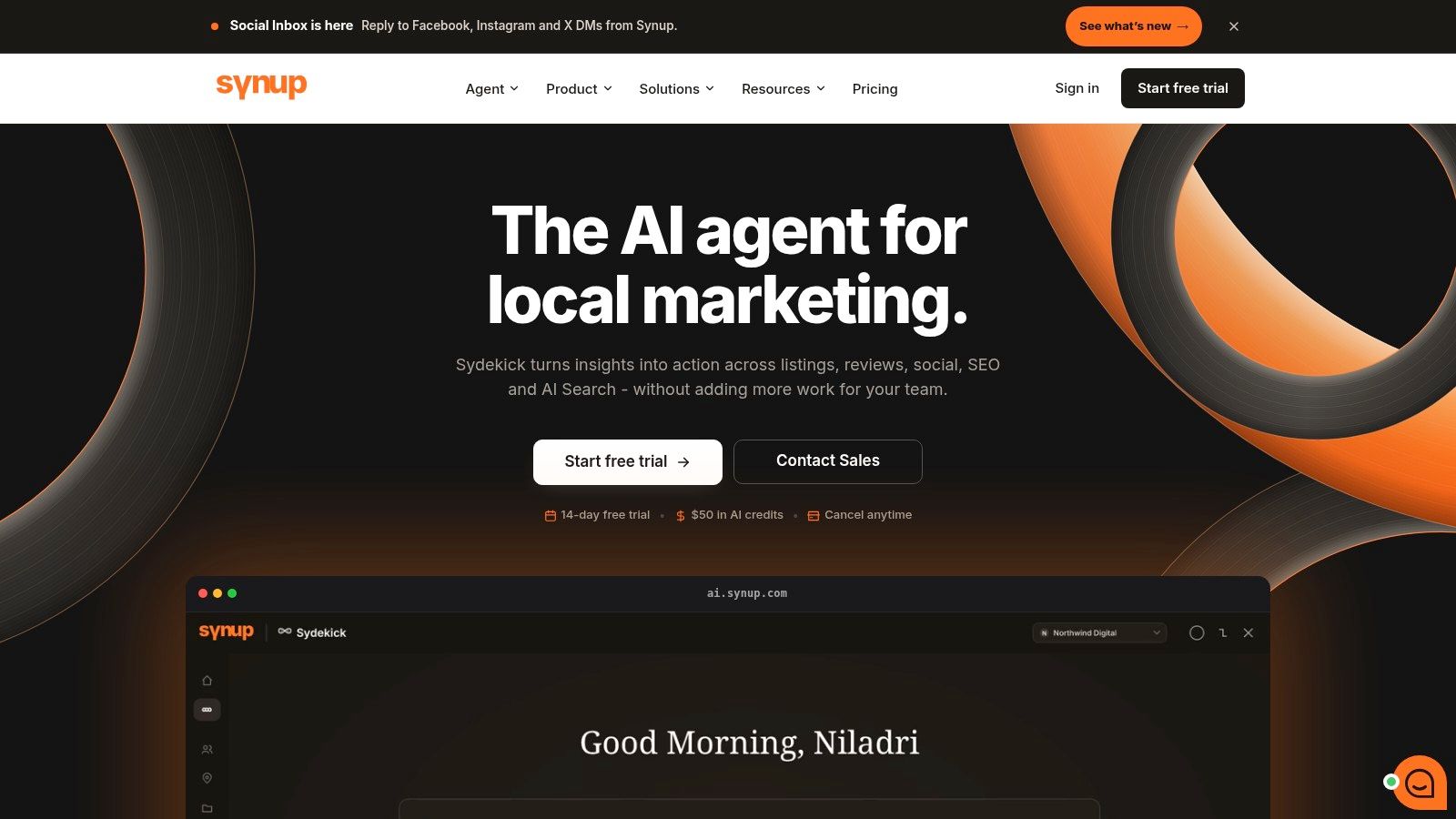
The strongest use case is coordinated execution. A single-location business can use it to organize profile corrections, review activity, and scheduled social updates without stitching together several specialist tools. An agency can turn those actions into repeatable client services, while a larger brand can separate location work from central marketing responsibilities.
The trade-off is operational discipline. AI can help prepare drafts, surface issues, and organize actions, but a person should review customer-facing responses before publication. A reply may be accurate while sounding generic, exposing unnecessary information, or mishandling a complaint. Set the approval owner, brand rules, and escalation path before increasing automation.
Synup also requires clear account boundaries. Agencies should define which tasks belong in each retainer, record usage by client, and limit scans, drafts, review requests, and publishing actions where credits or AI activity affect delivery costs. Single-location teams may find that setup unnecessary, while agencies can use it to protect margins.
Choose Synup when one workflow must connect local content, reputation activity, and recurring client delivery. Choose a narrower specialist when the team needs one task handled in depth, or when existing systems already cover the surrounding work. For agencies, the deciding factor is margin control: model per-action AI costs against retainer value before promising unlimited automation in a service package.
9. Localo
Localo is designed for operators who want guided Google Business Profile improvement without learning a large local SEO platform. Its local SEO software combines GBP tasking, competitor benchmarking, geo-grid tracking, posting, and review prompts in a more approachable workflow.
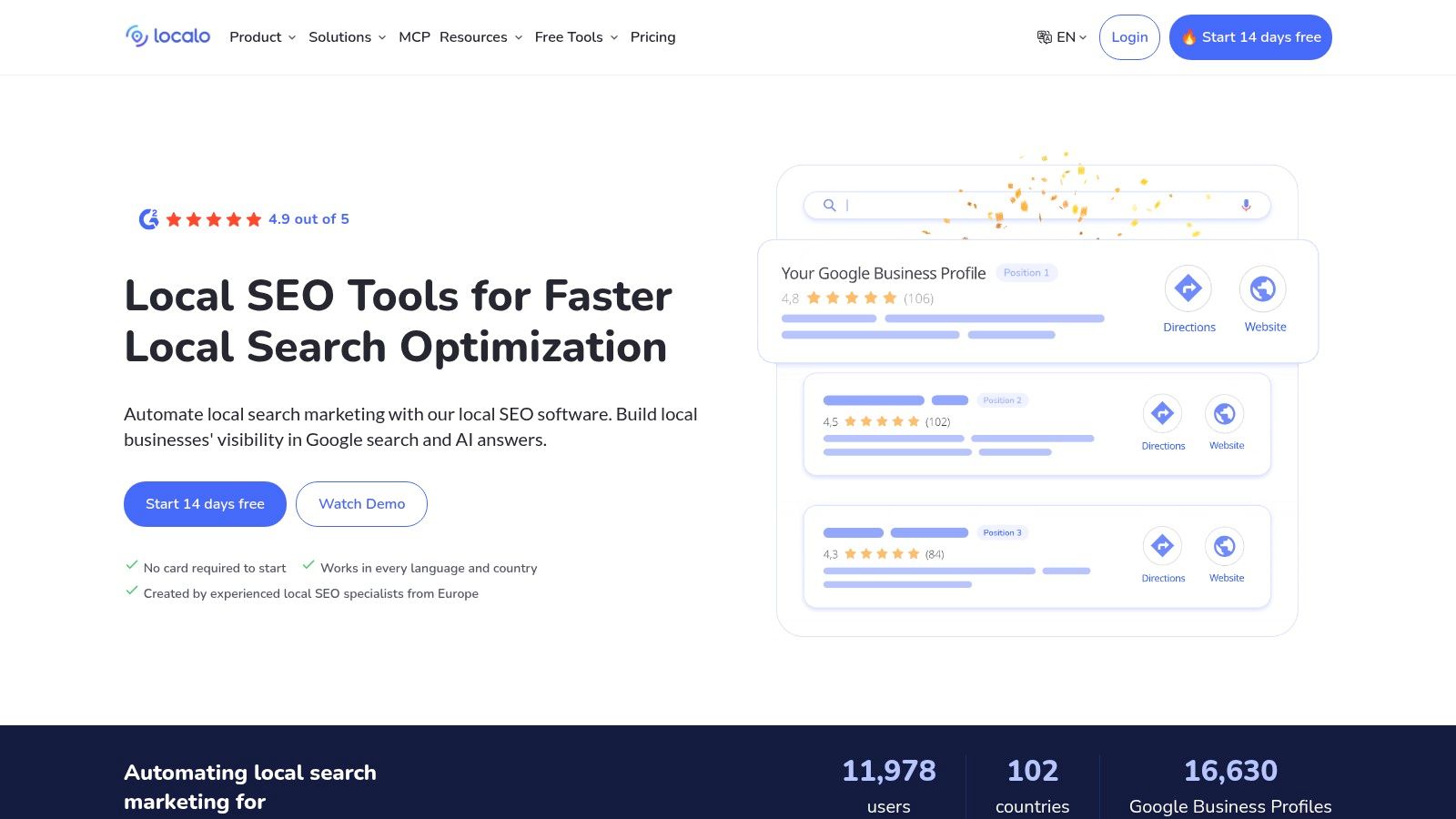
The guided model is the differentiator. Instead of handing a small business owner a dashboard full of unexplained metrics, Localo turns profile findings into prioritized actions. That suits a single-location operator, consultant, or small internal team that can complete tasks but doesn't have a dedicated local SEO specialist.
A useful first-week process looks like this:
- Establish a baseline: Record the current profile state, competitors, target services, and the areas where the business wants visibility.
- Complete priority tasks: Fix missing profile information, categories, services, media, and other recommended elements before adding experimental activity.
- Create recurring activity: Publish relevant updates and assign review monitoring to a named owner.
- Rescan after execution: Compare the geographic pattern after changes rather than judging success from one ranking position.
Localo is not a substitute for deep directory distribution, advanced enterprise permissions, or a mature multi-location data-governance system. It's strongest in Google-first scenarios where the main constraint is knowing what to do next and putting it into practice.
For a SaaS or digital product with local partners, Localo can help validate whether GBP activity supports partner discovery. It won't, by itself, connect that visibility to signups, purchases, or partner-sourced revenue. Those conversions need analytics and CRM instrumentation outside the local tool.
10. Local Falcon
Local Falcon is a measurement layer, not a complete local SEO platform. Its geo-grid rank tracker helps agencies and in-house teams visualize Google Maps and Apple visibility across a service area, compare competitors, schedule scans, and share understandable reports.
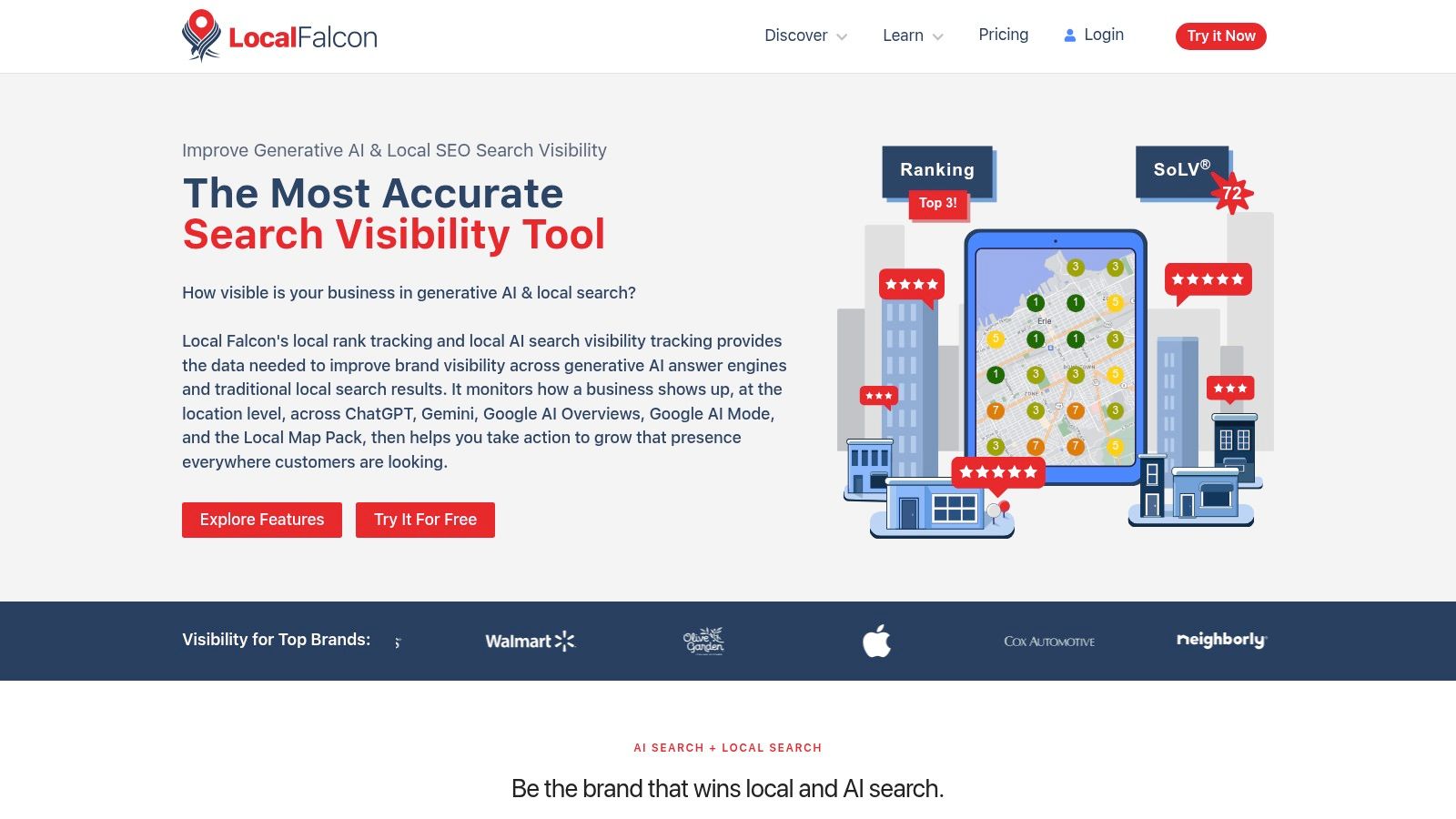
The tool is most valuable when a team has a hypothesis to test. For example, a location may change its primary category, improve a service page, strengthen review activity, or update its service area. Run a baseline scan, record the change, keep other major variables stable where possible, and compare later scans across the same geographic points.
That approach is better than scanning constantly and interpreting every fluctuation as a result. Credit-based usage makes scan design part of the operating discipline. Choose grid size, keywords, frequency, and locations based on decisions the team needs to make.
Local Falcon's visual reports are particularly effective for client education. A heat map can show why a business performs strongly near its address but loses visibility farther away, without forcing a client to interpret a spreadsheet of ranking positions. Competitive overlays add context by showing which businesses occupy the areas where visibility is weak.
The limitation is clear. Local Falcon can show where the problem is, but it doesn't fix listings, collect reviews, update GBP data, or create local pages. Pair it with BrightLocal, Moz Local, Whitespark, Synup, or another execution system. Integrations with Looker Studio, Zapier, n8n, and API access can help connect measurement to reporting, but they don't remove the need for a human optimization owner.
11. Birdeye
Birdeye is best understood as a customer-experience platform with local SEO capabilities, not as a specialist rank tracker. Its customer experience platform brings together listings, review generation, review responses, messaging, social publishing, unified inbox workflows, and analytics.
That model fits multi-location businesses where reviews and customer conversations are central to acquisition. A healthcare group, retailer, service network, or education provider may care less about adding another rank chart and more about ensuring that every location requests feedback consistently, routes messages quickly, and escalates serious complaints.
Implementation should define responsibility before automation:
- Assign review ownership: Specify who monitors incoming reviews for each location and who covers absences.
- Set response rules: Document tone, prohibited claims, privacy boundaries, and the situations that require approval.
- Create escalation paths: Route complaints, safety concerns, legal issues, and unresolved service failures to the right team.
- Connect reporting to action: Review ratings, response activity, messages, and listing engagement should lead to operational follow-up.
Birdeye can be more than a single-location business needs, particularly if the owner can manage reviews and listings directly. It may also be a weaker choice for an SEO specialist who needs highly configurable geo-grid experiments or detailed citation discovery.
Pricing is generally sales-quoted, so request a workflow-based demonstration rather than a generic product tour. Test review collection, response approval, inbox assignment, location reporting, and integrations with the systems the customer-experience team already uses. For SaaS companies building a broader acquisition engine, this digital marketing resource is adjacent to the local workflow, not a replacement for it.
11 Local SEO Tools, Feature Comparison
| Product | Core features ✨ | Best for 👥 | Quality ★ | Pricing/value 💰 | Standout 🏆 |
|---|---|---|---|---|---|
| Synup | Listings sync, AI agent (Sydekick), reviews, social, geo-grid, white‑label | Agencies, multi‑location brands | ★★★★☆ | Mix of plans; per‑action AI credits | ✨ Autonomous fixes + agency packaging |
| BrightLocal | Local rank/grid, GBP audits, citation builder, Active Sync | Agencies & SMBs with multi‑locations | ★★★★☆ | Transparent bundles; credits/add‑ons | 🏆 White‑label reporting & agency rollups |
| Whitespark | Local Rank Tracker, geo‑grids, citation discovery, exports | SEO practitioners & agencies | ★★★★☆ | Modular (buy tools needed) 💰 | ✨ Best‑in‑class rank accuracy |
| Moz Local | Listings sync (100+), review monitoring, data health, social (tiers) | Small teams & single locations | ★★★★☆ | Annual per‑location pricing 💰 | 🏆 Simple, reliable listings distribution |
| Semrush Local (Toolkit) | GBP automation, listing mgmt, Map Rank Tracker, Semrush integration | Teams already on Semrush | ★★★★☆ | Add‑on / credit‑based; bundle economics | ✨ Local + full SEO ecosystem integration |
| Yext Listings | 200+ direct publishers, duplicate suppression, RBAC, APIs | Franchises, regulated enterprises | ★★★★★ | Sales‑quoted; premium at scale 💰 | 🏆 Real‑time, enterprise governance & direct feeds |
| Uberall | Listings (150+), reviews, social posting, workflows | Franchises & retailers | ★★★★☆ | Sales‑quoted; enterprise focus 💰 | ✨ Franchise workflows + app marketplace |
| Localo (Surfer Local) | Geo‑grid tracking, GBP tasks, posting, guided tips | Solo owners & small teams | ★★★★☆ | SMB‑priced; approachable 💰 | 🏆 Guided, action‑focused GBP improvements |
| Local Falcon | Geo‑grid scans, scheduling, exports, API | Agencies needing visual rank testing | ★★★★☆ | Credit‑based scans; efficient at scale 💰 | ✨ Highly visual geo‑grid reporting |
| Birdeye | Listings, review generation/auto‑response, unified inbox, analytics | Multi‑location CX‑focused businesses | ★★★★☆ | Sales‑quoted; CX value for multi sites 💰 | 🏆 Unified review + messaging + CX reporting |
Build the Smallest Stack That Proves Impact
The best local SEO tool is the one that matches the operating model and removes the current bottleneck. A single-location business shouldn't buy enterprise governance because a vendor offers it. A franchise shouldn't rely on a lightweight GBP checklist when data ownership, approvals, and location-level accountability are already complicated.
Use Localo for a guided, Google-first starting point. It suits owners and small teams that need prioritized GBP tasks, lightweight measurement, and recurring prompts. Choose Moz Local when the immediate problem is straightforward listings accuracy and the team wants a relatively simple distribution workflow.
Choose BrightLocal when an agency or multi-location team needs broad local coverage, geo-grid measurement, citations, reputation workflows, and client-ready reporting in one environment. Choose Synup when the agency or brand wants a more connected operating layer across listings, reviews, social, local pages, automation, and AI visibility. The difference is less about which platform has more features and more about whether the team will own the connected workflow.
Use Whitespark when citation discovery and precise diagnosis matter more than all-in-one convenience. Use Local Falcon when the central question is geographic visibility and the team already has separate systems for execution. Those specialist tools can work well together because one reveals the opportunity while the other measures whether the chosen intervention changed the pattern.
For enterprise governance, compare Yext and Uberall through implementation requirements. Look at publisher coverage, approval roles, duplicate handling, APIs, analytics, integrations, migration, and contract structure. Neither is automatically the right answer. The defensible choice is the one that reduces the cost and risk of managing inaccurate data across a complex location network.
Choose Birdeye when reputation and customer experience are the center of the local acquisition workflow. Its value increases when review collection, messaging, response ownership, escalation, and reporting need to operate together. A pure SEO team may prefer narrower tools, but a multi-location operator with customer-experience accountability may benefit from the wider system.
SaaS and digital-product businesses need an additional layer of discipline. Local visibility may support partner discovery, regional sales, events, implementation services, or location-specific acquisition, but rankings alone don't prove commercial impact. Connect local visibility data to signups, purchases, qualified leads, partner-sourced opportunities, or activation events before adding more automation. If the business can't identify the conversion path, another dashboard won't solve the measurement problem.
Refgrow belongs beside that measurement system, not inside the local SEO category. For SaaS and digital-product companies that want an embedded referral or affiliate program, its in-app widget, analytics, integrations, and separate 14-day free trial can be evaluated as a partner-growth workflow. It supports a white-label in-app experience, revenue and payout tracking, payment connections, APIs, webhooks, and MCP capabilities, but those functions should be assessed separately from listings, GBP, reviews, and geo-grid measurement.
Start with this operating checklist:
- Define locations and owners: Record which business units exist, who owns each profile, and who approves changes.
- Select one primary measurement method: Use geo-grid visibility, local organic performance, review activity, or a clearly defined composite, but don't let every tool produce an unrelated “score.”
- Document recurring tasks: Assign responsibility for listings checks, review responses, posts, scans, local pages, and reporting.
- Set credit and subscription controls: Estimate scan frequency, AI actions, locations, users, and citation work before committing to a plan.
- Review results on a fixed cadence: Compare completed actions with visibility and business outcomes at a consistent interval.
- Add integrations only for proven bottlenecks: Connect CRM, analytics, reporting, or referral systems when the integration removes a real handoff or measurement gap.
Choose the smallest stack that lets the team maintain accurate location data, execute meaningful improvements, measure geographic visibility, and connect local discovery with revenue. Expand only after the workflow proves where additional complexity will pay for itself.