

AI Training Data: What It Is and Why It Matters
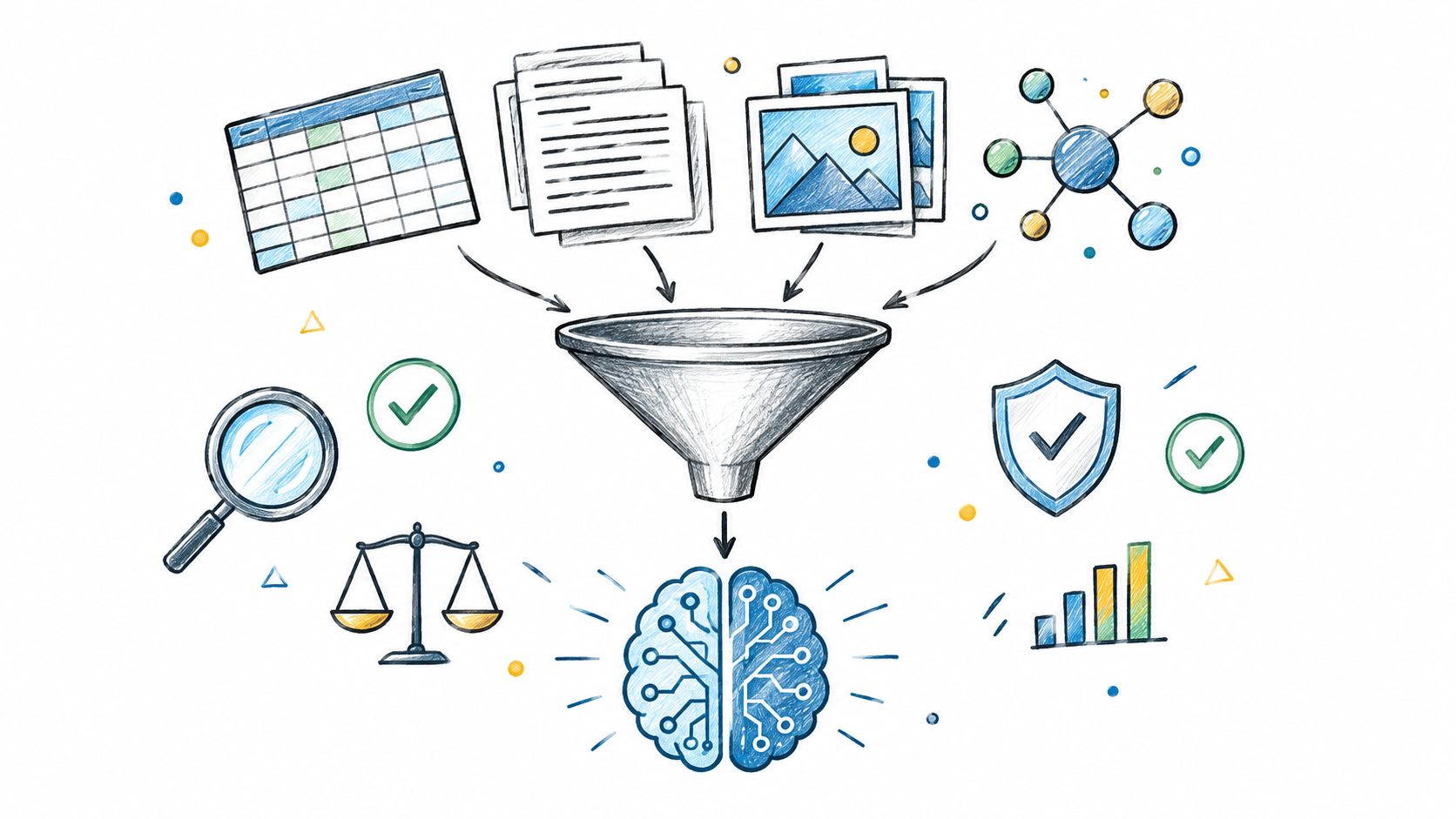
AI training data is the curated collection of examples used to teach machine-learning models patterns and behaviors, and quality typically matters more than dataset volume. ImageNet contains roughly 14 million images, yet a large-scale study found that removing duplicates reduced memorized text emissions by approximately 10× while models reached the same or better accuracy in fewer training steps.
That sounds counterintuitive because more data often feels like a safer investment. For a SaaS team, however, an enormous corpus can contain repeated records, weak labels, sensitive information, legal uncertainty, and examples that don't represent real customer behavior. A model trained on that material may appear capable in a benchmark while failing on the edge cases that matter in production.
Training data is therefore an operational asset, not just an input file. Teams need to decide what to collect, what to exclude, how to document rights, how to measure coverage, and how to monitor the dataset after launch. The strongest workflow treats data quality, governance, bias mitigation, and compute cost as one connected product problem.
Table of Contents
- Why Quality Trumps Quantity in AI Training Data
- What AI Training Data Really Means
- Measuring Training Data Quality
- How SourceX Can Help
- Data Collection Strategies for AI Teams
- The Synthetic Data Assumption and Its Risks
- Building a Training Data Governance Checklist for SaaS Teams
Why Quality Trumps Quantity in AI Training Data
Data quality outweighs raw volume. A large dataset with inconsistent labels, repeated examples, and irrelevant material can teach a model the wrong priorities. A smaller corpus with accurate labels, useful variation, and clear evaluation rules often gives the model a stronger signal.
Cooking is a practical analogy. Adding every ingredient in the kitchen doesn't guarantee a good meal. If the ingredients are spoiled, duplicated, or poorly balanced, a larger pot only produces more of the same problem. Training data works similarly. Each example influences the distribution the model learns, so low-value examples consume attention without necessarily adding useful information.
The most important question isn't, “How many records do we have?” It's, “What behavior does each record reinforce?” A support-classification system needs examples that reflect real customer language, product versions, escalation paths, and ambiguous requests. A document model needs reliable text, meaningful structure, and boundaries around confidential material. A recommendation system needs signals that reflect the decisions the product actually wants to improve.
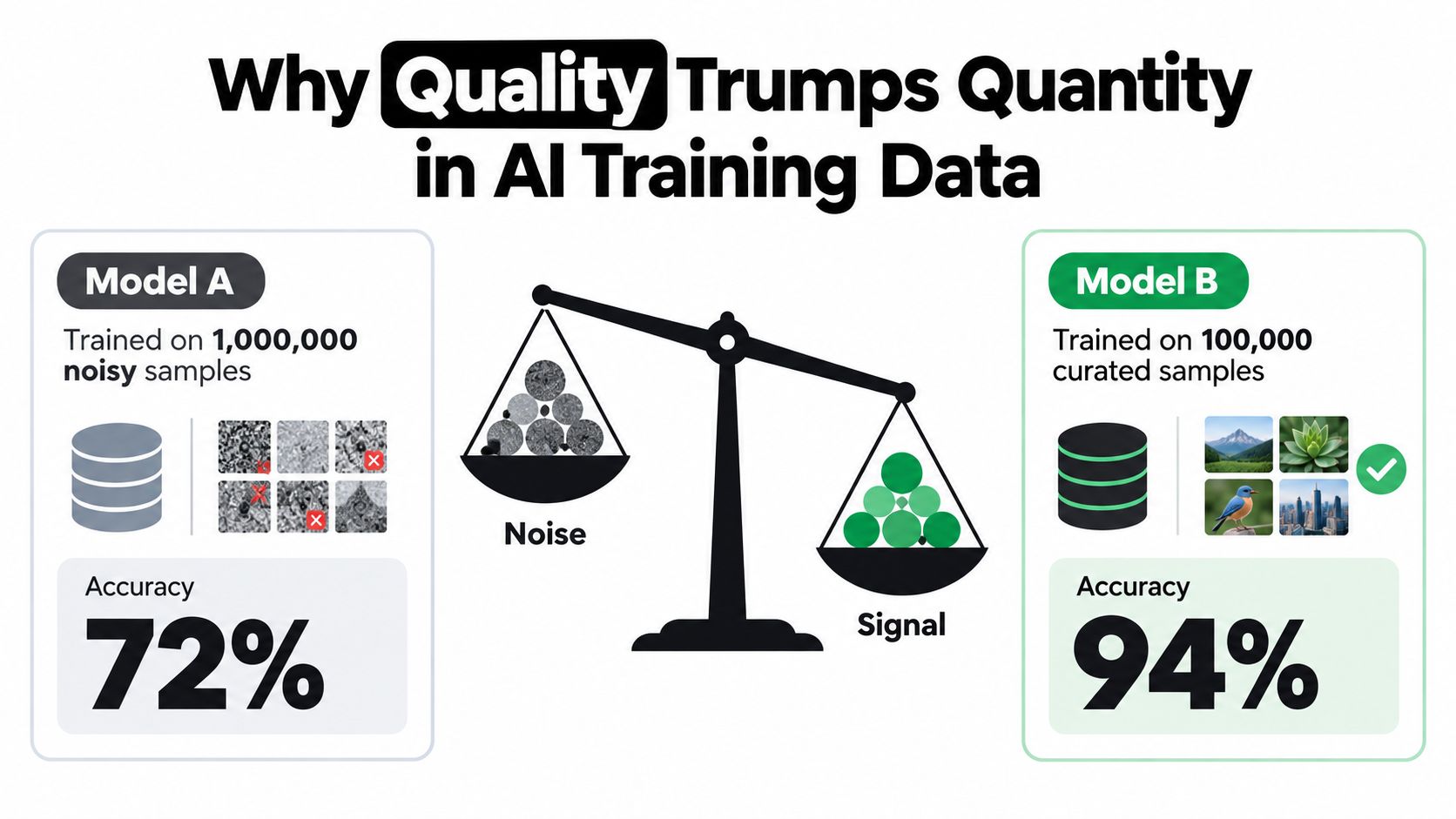
Noise creates hidden operating costs
Poor data creates costs before anyone sees a bad prediction. Engineers spend time investigating unexpected outputs, retraining models, and writing exception logic. Infrastructure teams pay to process and store records that contribute little signal. Product teams then inherit an unreliable feature that requires manual review.
Duplicate data is a particularly common source of waste. When the same or nearly identical document appears repeatedly, it receives more influence than its informational value justifies. The model may memorize wording instead of learning a transferable pattern. Duplicates can also leak into evaluation sets, making performance look stronger because the model has encountered identical or near-identical material during training.
A large-scale study found that deduplicating language-model training data reduced the frequency of memorized text being emitted by approximately 10×, while models required fewer training steps to reach the same or better accuracy. The study on deduplication and memorization supports a practical sequence: remove exact duplicates with hashing first, then use scalable fuzzy or substring matching for near duplicates.
Practical rule: Treat every repeated example as a sampling decision, not merely a storage problem.
Curated examples improve generalization
Quality also means coverage, not just cleanliness. If a dataset contains polished examples from one customer segment but omits unusual workflows, regional language, accessibility needs, or failure states, the model may perform well for the majority and poorly everywhere else.
Teams often confuse quantity with diversity. Adding more examples from the dominant category can increase the dataset while leaving the blind spot untouched. A better approach identifies the behaviors the model must support, then checks whether the data contains enough meaningful variation for each behavior.
ImageNet helped establish the value of scale because it combined large numbers of images with a structured taxonomy, distributed annotation, and repeatable benchmarking. Its historical lesson is not just to “collect millions of examples.” It is that label consistency, taxonomy design, and evaluation standards determine whether additional data becomes useful training signal.
For SaaS teams, that means defining quality before collection begins. Agree on acceptable labels, prohibited content, required metadata, representative cohorts, and the evaluation cases that will remain separate from training. A clean, well-governed dataset can reduce wasted computation and make model failures easier to diagnose.
What AI Training Data Really Means
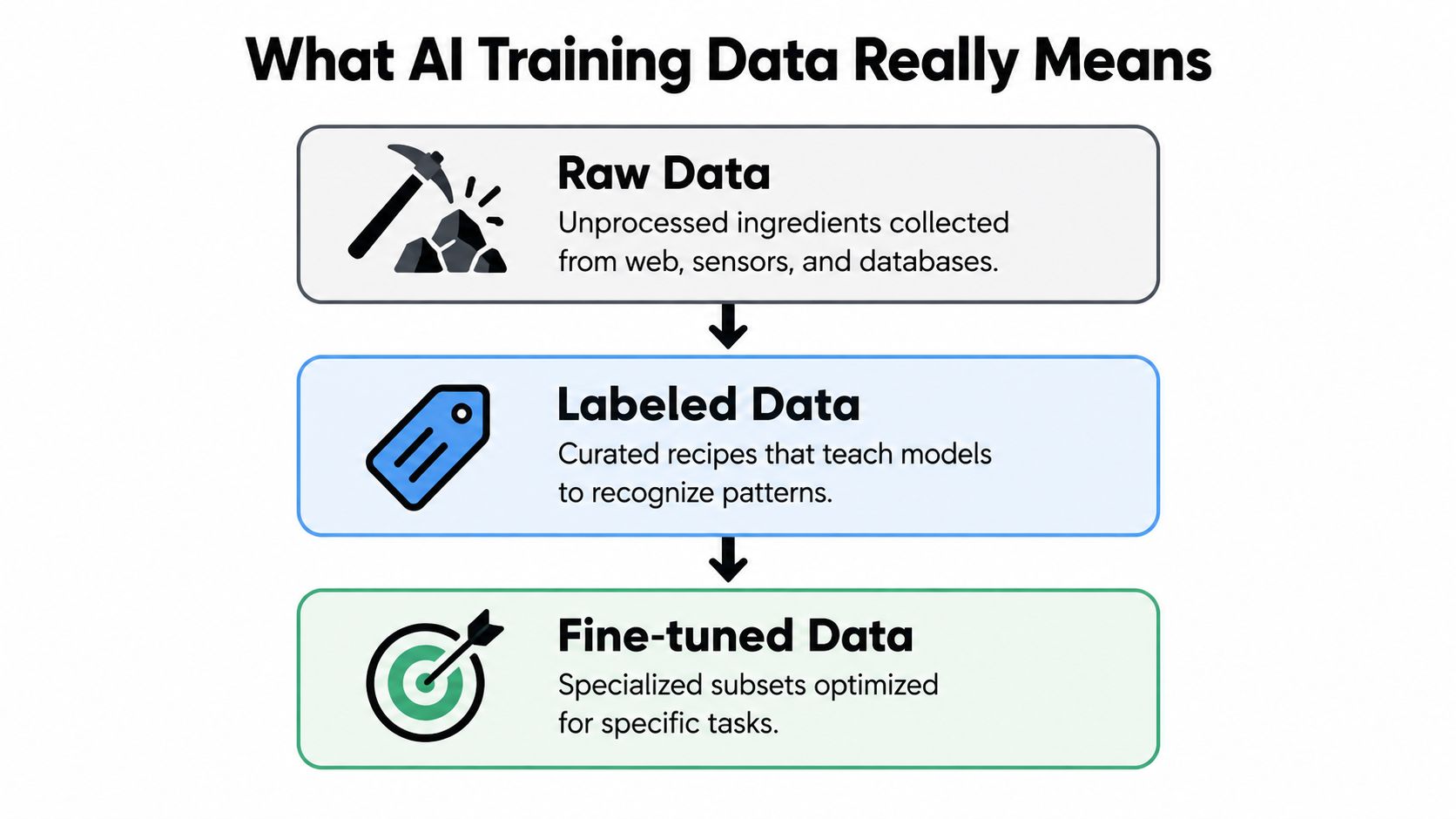
AI training data is easier to understand if you separate the stages rather than treating every file as equivalent. Raw records, labeled examples, and task-specific fine-tuning data serve different purposes. Synthetic data adds another category, but it should be handled as a controlled supplement rather than an automatic replacement for real observations.
Think of a SaaS product as a workshop.
Raw data is the supply of ingredients. It may include support conversations, product events, documents, images, code, sensor readings, or database exports. Raw data can contain valuable patterns, but it also carries formatting problems, irrelevant fields, duplicates, personal information, and unclear permissions. Collection alone doesn't make it ready for training.
Labeled data is the set of recipes. A label tells the model what an example means or what response is desired. In a ticket-routing system, a message might be labeled as billing, technical support, cancellation, or urgent escalation. In a generation task, the label may be a preferred answer, a correction, a ranking, or a structured output.
Labels need consistent rules. If one reviewer marks a message as “billing” and another marks the same type of request as “account access,” the model receives conflicting instructions. Labeling guidelines should explain ambiguous cases, provide examples, and define when a reviewer must escalate a decision.
Fine-tuning narrows the purpose
Fine-tuning data is a specialized subset prepared for a defined task, product voice, workflow, or domain. It might teach a general language model to produce structured customer-support replies, classify internal documents, or follow a company's escalation policy.
The narrower the task, the more important example quality becomes. A fine-tuning set shouldn't merely repeat everything available in a warehouse. It should represent the desired behavior, include difficult cases, and exclude examples that contradict current product rules.
A common mistake is to mix training objectives. Product documentation, casual customer conversation, internal notes, and outdated policy text may all be useful somewhere, but combining them without clear controls can produce inconsistent responses. Keep source types and intended uses visible in the dataset inventory.
Synthetic data is generated rather than directly observed. It can function like a lab-grown substitute, allowing teams to create rare scenarios, test privacy-sensitive workflows, or expand structured examples. It can be useful when authentic examples are scarce, but the generator may reproduce its own errors and assumptions.
Web-scale sources show why ingestion discipline matters. Common Crawl, founded in 2007, made public-web data available to researchers and organizations, and AWS reports a corpus of about 5 billion web pages available at no cost through Amazon S3. Approximately 82% of GPT-3's raw pre-training tokens came from filtered Common Crawl data, according to the AWS account of Common Crawl's role in AI training.
That scale makes filtering, deduplication, quality scoring, safety review, and provenance essential. Teams building a product don't need to replicate a web-scale corpus, but they do need the same mental model: ingestion is only the beginning.
For implementation details on preparing an LLM workflow, the LLM quickstart documentation can help teams connect concepts such as prompts, examples, and task-specific behavior to an actual product process.
Measuring Training Data Quality
A dataset earns its place in a training run by improving downstream behavior. File count, token count, and storage size are useful inventory measures, but they don't tell you whether the model is learning the right patterns. A practical quality program combines label accuracy, coverage, balance, uniqueness, provenance, and performance on trusted holdout data.
Start with the question your model must answer. For a classifier, that may be whether it assigns the correct category. For a retrieval system, it may be whether the right document appears for a user query. For a generative assistant, it may be whether the response follows policy, preserves factual detail, and uses the required format.
A working measurement framework
| Metric | What It Measures | Why It Matters |
|---|---|---|
| Label precision | Whether annotations match the team's defined rules | Incorrect labels teach contradictory behavior |
| Coverage | Whether the dataset includes important user groups, workflows, and edge cases | Missing scenarios become predictable production failures |
| Distribution balance | Whether dominant categories overwhelm less frequent but important categories | The model may optimize for the majority and neglect rare cases |
| Duplication rate | How often identical or near-identical examples recur | Repetition can increase memorization and distort sampling |
| Provenance completeness | Whether source, permission, transformation, and intended use are documented | Teams need evidence for governance and incident response |
| Downstream signal | Whether training examples improve performance on a representative holdout set | It connects data decisions to product outcomes |
Label precision deserves an explicit review process. Sample examples from each label, compare them against written guidance, and record disagreement patterns. High disagreement often means the taxonomy is unclear, not that reviewers need to work faster.
Coverage requires segmentation. Divide the evaluation set by product area, customer workflow, language, geography, account type, or other relevant dimensions. The exact segments depend on the product, but the principle is stable: aggregate performance can hide failures in smaller groups.
Distribution balance isn't the same as equal representation. A rare event may deserve careful retention because its business impact is high, while a common event may need fewer redundant examples. Retention rules should reflect risk and product priorities, not only frequency.
Pruning can beat accumulation
Research on data pruning reports that intelligently ranking examples for removal can produce better-than-power-law performance scaling, potentially changing the usual relationship between dataset size and model error toward substantially faster improvement when low-value samples are discarded. The research on data pruning also describes a practical constraint: some strong pruning methods require substantial computation and labels for every image.
That creates a trade-off. A quality score can reduce training tokens and infrastructure demand, but an imperfect score may remove rare examples that the model needs. The safest workflow combines inexpensive scoring with stratified retention constraints. Preserve minimum coverage for important domains, then compare models using both total examples and retained tokens.
Use a clean holdout set that isn't used to rank or filter training examples. Measure accuracy or task-specific quality on that set, then add memorization probes and contamination checks. A training pipeline that reduces data volume but harms minority-domain performance hasn't improved quality.
A product analytics workflow can make these comparisons visible to non-ML stakeholders. For teams building this layer into a SaaS product, embedded analytics for SaaS offers relevant context for presenting quality, usage, and outcome metrics inside the application rather than hiding them in engineering notebooks.
The useful unit isn't “records collected.” It's reliable product behavior per retained example and per unit of compute.
How SourceX Can Help
Some SaaS companies possess valuable operational records but lack a safe way to prepare them for licensing. Support histories, engineering discussions, sales workflows, and business documents may contain useful real-world patterns, yet they also require rights review, deidentification, structured inventory, contracting, and controlled delivery.
SourceX is an enterprise data transaction layer for companies that want to license operational datasets to AI labs and other data buyers. It handles fit assessment, data mapping, private inventory creation, provenance review, privacy preparation, pricing, negotiation, agreement execution, and delivery coordination. The supplier approves each step, and nothing is shared before explicit authorization.
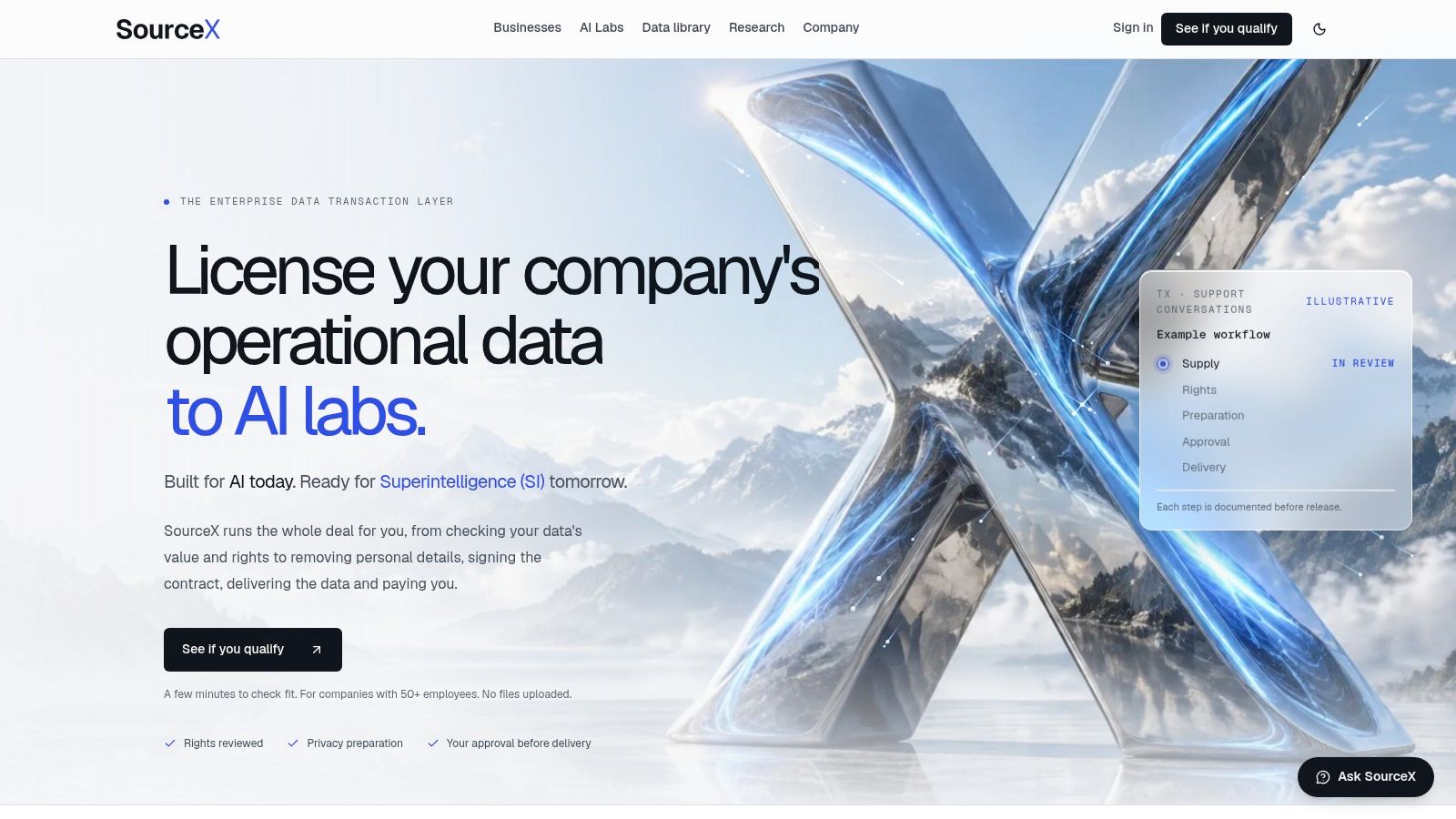
The strongest differentiator is chain-of-custody control. SourceX assembles an evidence packet describing the system of origin, licensing rights, defined purpose, and usage constraints before release. It also records dataset-specific deidentification work and expects suppliers to confirm lawful collection and licensing conditions.
This approach is useful when a team has real operational data but doesn't want to upload raw exports to an unknown marketplace or coordinate separate brokers, privacy consultants, lawyers, and buyers. The service can work with exports from platforms such as Zendesk, Salesforce, GitHub, Jira, SharePoint, and Google Workspace, which makes it relevant to established SaaS businesses with fragmented systems.
The trade-off is that licensing requires review and negotiation. It isn't the right shortcut for a team seeking instant, anonymous bulk data. It is a better fit when rights clarity, supplier control, and domain-specific authenticity matter more than obtaining the largest possible corpus quickly.
For a neutral overview of the process and the type of operational records involved, SourceX's guide to AI training data is a useful starting point for evaluating whether licensing fits your data strategy.
Data Collection Strategies for AI Teams
No single collection method wins on every dimension. Internal data offers relevance and control, third-party datasets can accelerate experimentation, web crawling provides breadth, and synthetic generation can fill carefully defined gaps. The right choice depends on the task, the legal basis, the required freshness, and the cost of cleaning and validation.
Internal collection
First-party data usually aligns most closely with the product. A SaaS company can collect support interactions, user-approved feedback, workflow outcomes, and domain-specific documents that reflect its own customers. The drawback is operational effort. Teams must design consent and retention rules, remove unnecessary personal information, define access controls, and maintain the pipeline as the product changes.
Internal records can also encode historical bias. If support staff handled one customer group differently, the model may learn that pattern. Data ownership doesn't automatically mean data quality.
Third-party purchase
A purchased dataset may offer clearer packaging, metadata, and delivery terms. It can help a team test a model before building an internal collection system. Procurement still needs to verify the supplier's rights, update practices, geographic coverage, permitted uses, and restrictions on redistribution or model training.
A polished catalog isn't proof that the underlying examples are representative. Ask for documentation about source systems, transformations, labeling methods, and known exclusions.
Web crawling
Public-web data offers broad topical coverage, but “publicly accessible” doesn't answer every question about copyright, privacy, accuracy, or permitted use. Web content also requires extensive filtering, deduplication, language detection, quality scoring, and safety review. A corpus can include stale pages, scraped personal information, malicious instructions, or content optimized to manipulate search and recommendation systems.
Teams should crawl only when the breadth is necessary and when they can support continuous quality and provenance controls. Otherwise, a narrower licensed or first-party source may reduce both engineering work and legal uncertainty.
Synthetic generation
Synthetic examples are fast to produce and useful for rare edge cases, privacy-sensitive simulations, and controlled tests. They shouldn't replace trusted real-world evaluation data. Generated content can inherit the blind spots of the model that produced it, and repeated generation can make the training distribution look more uniform than real user behavior.
ImageNet demonstrates the effort that high-quality labeled data can require. It was conceived in 2006 and labeled between 2008 and 2010 with assistance from approximately 49,000 Amazon Mechanical Turk workers. The dataset contains roughly 14 million images across 21,841 synsets, showing that taxonomy and annotation operations are central parts of data strategy, not clerical afterthoughts. The ImageNet dataset history provides useful context for why structured labeling matters.
For teams designing a first-party collection program, first-party data collection for SaaS provides a relevant product perspective on gathering information directly rather than relying entirely on external sources.
The Synthetic Data Assumption and Its Risks
Synthetic data isn't automatically safer, cheaper, or more accurate. It can extend a well-designed dataset, but it can't guarantee that the model sees the complexity of real customers, unusual workflows, or underrepresented communities.

The World Economic Forum warns that overreliance on synthetic data can cause model collapse, also called “model autophagy,” because generated examples may fail to preserve the complexity and diversity of real-world material. The World Economic Forum report on synthetic data also emphasizes provenance metadata, watermarking, cryptographic tracking, and dataset nutrition labels.
The operational question isn't “What percentage of synthetic data is safe?” There is no universal threshold. The useful questions are: which real-world behaviors must remain in the mix, which gaps can synthetic examples fill, and how will the team detect drift or collapse?
A procurement checklist
Before accepting synthetic data from a vendor or generating it internally, request:
- Generator lineage: Identify the model, version, configuration, and process that produced the examples.
- Source inventory: Record what data trained the generator, as far as the vendor can document it.
- Purpose limits: State whether the data may support training, evaluation, fine-tuning, or only testing.
- Real-data anchor: Maintain a trusted human-generated holdout set for validation.
- Coverage tests: Compare demographic, geographic, linguistic, and workflow representation against product usage.
- Contamination checks: Test whether generated examples reproduce protected text, personal details, or vendor-specific artifacts.
- Monitoring rules: Recheck quality when the generator, product, or user population changes.
Synthetic generation moves accountability upstream. If the source model learned from copyrighted or personal material, the generated dataset may still carry legal and reputational risk. A label saying “synthetic” describes how the record was produced, not whether its lineage is lawful or safe.
For teams creating generated marketing or support material, the distinction between scalable content production and trustworthy source material is also relevant to AI affiliate writing. The same principle applies: automation can expand output, but human review and source governance determine whether the output is fit for use.
A short visual explanation can help product and procurement teams discuss these risks consistently.
Building a Training Data Governance Checklist for SaaS Teams
Governance works best as a repeatable operating system. It should guide procurement, ingestion, annotation, training, evaluation, release, and deletion. A spreadsheet can start the process, but ownership and recurring checks matter more than the tool.
Create a dataset inventory
Give every dataset an owner and record:
- Source system and business purpose
- Data categories and fields
- Collection date or range
- Labeling method and annotation guidance
- Personal, confidential, or regulated information
- Transformation and deidentification steps
- Intended model, task, and environment
- Retention, deletion, and access rules
- Evaluation sets that must remain separate
The inventory should distinguish raw, labeled, synthetic, fine-tuning, and evaluation data. Without those distinctions, teams can accidentally train on material that was intended only for testing or internal review.
Verify rights before ingestion
A vendor contract should specify who may use the data, for what purpose, in which jurisdictions, and for how long. Check whether the supplier has rights to the underlying material, not merely permission to sell an export. Preserve licensing records alongside dataset versions so an auditor can connect a model run to the exact source and terms.
Synthetic data requires the same diligence. The European Union Intellectual Property Office cautions that a synthetic dataset's safety depends on the generator. If that generating model was trained on copyrighted works, synthetic outputs may still raise copyright concerns, as explained in the EUIPO analysis of generative AI from a copyright perspective.
Protect privacy and secrets
Minimize fields before they enter a training pipeline. Remove direct identifiers where they're unnecessary, redact sensitive text, and restrict access to raw exports. Deidentification should be dataset-specific because names, timestamps, rare combinations, and free-text context can identify people even after obvious fields are removed.
Run secret scanning and malware checks on code, documents, notebooks, and archives. A public dataset can contain credentials, private keys, or embedded instructions that have nothing to do with the intended task. Keep rejected records and removal reasons in an auditable log rather than silently overwriting the source.
Test for bias and contamination
Create evaluation slices that represent important customer groups and workflows. Compare results across those slices, inspect false positives and false negatives, and investigate whether the training distribution explains the differences. Don't rely on one aggregate score.
Contamination testing should look for overlap between training and evaluation material, repeated documents, copied answers, and generated examples derived from the same source as the benchmark. A model that succeeds because it has seen the evaluation content isn't demonstrating generalization.
Monitor after deployment
Governance continues after the training run. Track changes in user language, product features, policy rules, and error patterns. When the model fails, connect the failure to a dataset version or missing segment so the team can decide whether to relabel, collect, prune, retrain, or change the product workflow.
A dataset isn't finished when it ships. It's finished only when the team can explain what it contains, why it is allowed, how it was evaluated, and what happens when its assumptions stop matching users.
Assign clear decision rights. Product should define acceptable behavior, engineering should maintain the pipeline, legal and privacy stakeholders should review scope, and data owners should approve source use. A lightweight review cadence can examine new suppliers, dataset changes, evaluation drift, and deletion requests.
The best SaaS teams don't treat governance as a brake on model development. They use it to make experiments comparable, failures diagnosable, and vendor decisions defensible. That discipline also helps control cost because the team can remove low-value data before paying to process and train on it.
If you're building a SaaS product and want to turn trusted operational data into a controlled growth asset, start by mapping your sources, documenting permitted uses, and separating evaluation data from training data. Then use Refgrow's in-app referral software to launch a native partner program that keeps referrals inside your product, with a 14-day free trial and no transaction fees.