

How to Set Up Multi-Tier (MLM) Commissions for Your SaaS Affiliate Program
Most affiliate programs are straightforward: an affiliate refers a customer, a sale happens, the affiliate earns a commission. Simple. But what if your affiliates could also earn commissions from the sales generated by affiliates they recruit? That's the power of multi-tier commissions.
Multi-tier (sometimes called MLM-style) commission structures can supercharge your affiliate program's growth by turning every affiliate into a recruiter. But they come with real risks if implemented carelessly. This guide covers what multi-tier commissions are, when they make sense, how to set them up in Refgrow, and the pitfalls you need to avoid.
What Are Multi-Tier Commissions?
In a standard (single-tier) affiliate program, commissions flow in one direction:
- Affiliate shares a referral link
- Customer clicks the link and makes a purchase
- Affiliate earns a commission on that purchase
In a multi-tier affiliate program, there's an additional layer:
- Affiliate A shares a referral link
- Customer clicks the link and makes a purchase
- Affiliate A earns a Tier 1 commission (e.g., 30%)
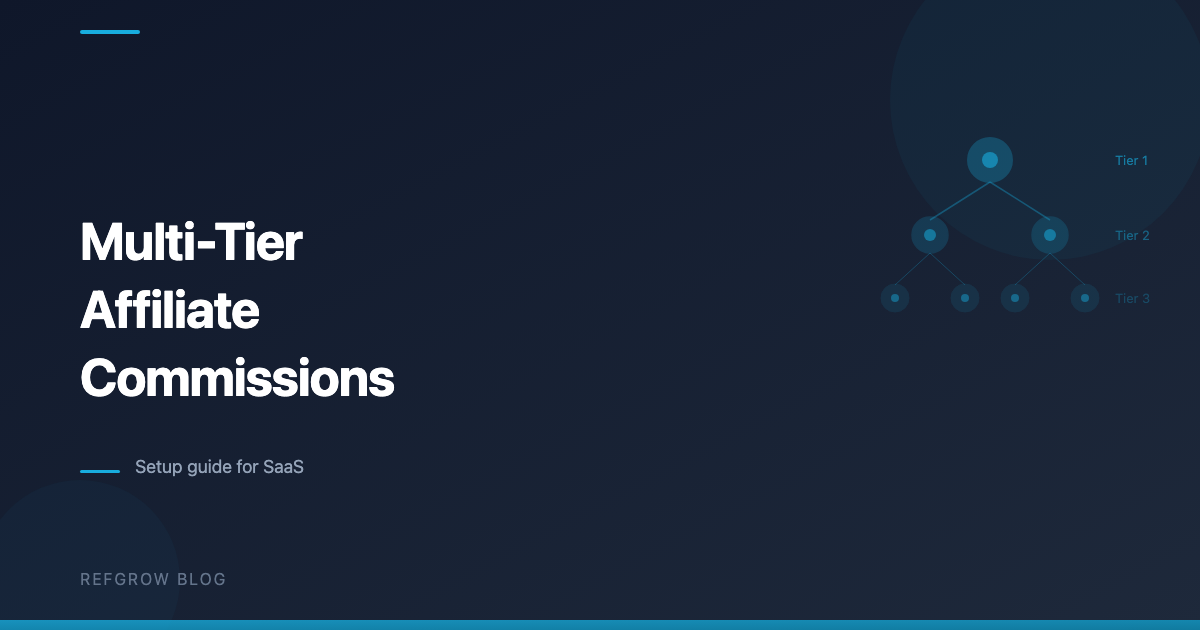
- Plus: The affiliate who recruited Affiliate A (let's call them Affiliate B) earns a Tier 2 commission (e.g., 10%) on the same sale
- Plus: The affiliate who recruited Affiliate B (Affiliate C) earns a Tier 3 commission (e.g., 5%)
The key distinction: the customer pays the same price regardless. The commissions come from your revenue, not from the customer's pocket. This isn't about marking up prices — it's about how you distribute your affiliate budget.
How Is This Different from MLM?
Multi-tier commissions share a structural similarity with multi-level marketing (MLM), which understandably makes some people nervous. Here's the critical difference:
- Legitimate multi-tier affiliate programs: Commissions are generated by real product sales to real customers. Affiliates earn based on the revenue they and their downstream affiliates generate through actual customer acquisitions.
- Pyramid schemes / predatory MLM: Income primarily comes from recruiting other participants, not from selling products to end users. Participants often need to purchase inventory or pay fees to join.
As long as commissions are tied to genuine product sales (which is the only way Refgrow works — commissions are triggered by verified payment events), you're on solid ground.
When Multi-Tier Commissions Make Sense
Multi-tier commissions aren't right for every SaaS. They work best in specific scenarios:
Good Fit
- You want to scale your affiliate network rapidly. Multi-tier incentives turn every affiliate into a recruiter. Instead of you finding all the affiliates, your existing affiliates find new ones for you.
- Your product has healthy margins. You need enough margin to pay commissions at multiple levels without going negative. If your product costs $100/month and your COGS is $20, you have room for generous multi-tier payouts.
- Your affiliate base includes influencers with audiences. Top-tier affiliates (bloggers, YouTubers, community leaders) can recruit dozens of smaller affiliates. Multi-tier commissions reward them for this effort.
- You're in a niche with active communities. Developer tools, marketing SaaS, ecommerce platforms — niches where people actively share and recommend tools to each other.
- You want to compete with affiliate programs that offer higher base commissions. Instead of matching a competitor's 40% commission, you can offer 25% base + tier bonuses, which may end up being more attractive to serious affiliates.
Bad Fit
- Your margins are thin. If you're already offering 30% commissions and your margins are tight, adding Tier 2 and Tier 3 payouts could make the economics unworkable.
- You have a small, curated affiliate program. If you hand-select 10 high-quality affiliates and don't need more, multi-tier adds unnecessary complexity.
- Your audience is sensitive to MLM associations. In some B2B markets, anything resembling MLM can damage your brand reputation.
- You're just starting your affiliate program. Get the basics working first. Add multi-tier later when you have a proven program and understand your unit economics.
Designing Your Multi-Tier Commission Structure
Before you configure anything, you need to design a commission structure that's sustainable and motivating. Here's a framework:
Rule 1: Total Payout Should Not Exceed 50% of Revenue
Add up the maximum possible commission across all tiers. For a single conversion, the worst case is when all tiers are filled:
If Tier 1 = 30%, Tier 2 = 10%, Tier 3 = 5%, then maximum total payout = 45%.
Make sure this total leaves you with enough margin to cover your costs and make a profit. For most SaaS products, a 40-50% total maximum payout is the upper limit.
Rule 2: Each Tier Should Be Significantly Less Than the Previous
The drop-off between tiers should be steep enough that the system emphasizes direct sales over recruitment. A good ratio is 3:1 or steeper between adjacent tiers:
- Aggressive: 30% / 10% / 5% (3:1 ratio between each tier)
- Moderate: 25% / 8% / 3%
- Conservative: 20% / 5% / 2%
If Tier 2 is too close to Tier 1, affiliates will focus on recruiting other affiliates instead of making direct sales. That's the behavior you want to avoid.
Rule 3: Limit to 2-3 Tiers Maximum
More than 3 tiers is almost never justified for SaaS affiliate programs. Each additional tier:
- Adds complexity that affiliates struggle to understand
- Dilutes the economic incentive at each level
- Increases the risk of looking like an MLM scheme
- Makes your commission math harder to reason about
Two tiers is the sweet spot for most programs. Three tiers can work if your margins support it and you have a large affiliate base.
Example Structures by SaaS Price Point
| Price Point | Tier 1 | Tier 2 | Tier 3 | Max Total |
|---|---|---|---|---|
| $29/mo (low-ticket) | 30% | 10% | -- | 40% |
| $99/mo (mid-ticket) | 25% | 8% | 3% | 36% |
| $299/mo (high-ticket) | 20% | 5% | 2% | 27% |
Higher-priced products can afford lower percentages because the absolute dollar amount per commission is larger. A 20% commission on a $299/mo plan ($59.80/mo) is more motivating than a 30% commission on a $29/mo plan ($8.70/mo).
Setting Up Multi-Tier Commissions in Refgrow
Now let's walk through the actual configuration. Refgrow makes multi-tier setup straightforward.
Step 1: Navigate to Commission Settings
- Go to your Project Dashboard
- Click Settings
- Navigate to the Commission Structure section
Step 2: Enable Multi-Tier Commissions
- Toggle "Enable Multi-Tier Commissions" to ON
- Select the number of tiers (2 or 3)
Step 3: Configure Commission Rates
Set the commission percentage for each tier:
- Tier 1 (Direct): The commission the referring affiliate earns directly. This is your standard affiliate commission. Example: 30%
- Tier 2 (Recruiter): The commission the recruiting affiliate earns when their recruited affiliate generates a sale. Example: 10%
- Tier 3 (Super-Recruiter): The commission earned one level up from the recruiter. Example: 5%
Refgrow shows a total payout preview so you can immediately see the maximum commission you'd pay on a single conversion across all tiers.
Step 4: Save and Test
- Click Save Changes
- Create a test affiliate chain: Affiliate C recruits Affiliate B, who recruits Affiliate A
- Process a test conversion through Affiliate A
- Verify that commissions are correctly attributed to all three affiliates at the right percentages
Real-World Scenarios
Let's walk through some concrete scenarios to show how multi-tier commissions work in practice.
Scenario 1: The Blogger Network
You run a project management SaaS at $49/month. Sarah is a popular productivity blogger who joins your affiliate program. She writes about your tool and brings in customers directly (Tier 1: 30%, earning $14.70/month per customer).
But Sarah also mentions your affiliate program to three smaller bloggers in her network: Mike, Lisa, and Tom. They each sign up as affiliates under Sarah's referral link.
When Mike refers a customer to your SaaS:
- Mike earns $14.70/mo (30% Tier 1 commission)
- Sarah earns $4.90/mo (10% Tier 2 commission) — because she recruited Mike
If Mike, Lisa, and Tom each bring in 5 customers per month, Sarah earns $73.50/mo in Tier 2 commissions alone — on top of whatever she earns from her own direct referrals. This gives Sarah a powerful incentive to actively recruit and support other affiliates.
Scenario 2: The Community Leader
You sell a developer tool at $99/month. A DevOps community leader, Alex, joins your program and starts recommending your tool in his community. He doesn't generate many direct sales himself, but he recruits 20 affiliates who collectively bring in 50 customers per month.
Alex's monthly earnings from Tier 2 alone: 50 customers x $99 x 10% = $495/month.
Without multi-tier commissions, Alex might not have joined your program at all — he's a connector, not a direct seller. Multi-tier commissions unlock this type of affiliate.
Scenario 3: The Affiliate Network Effect
With a 3-tier structure (30%/10%/5%) on a $199/month product:
- You recruit 5 top affiliates (Tier 3 earners)
- Each recruits 10 affiliates (50 Tier 2 affiliates total)
- Each of those recruits 5 affiliates (250 Tier 1 affiliates total)
- Each Tier 1 affiliate brings 2 customers
Result: 500 customers ($99,500 MRR) with a commission cost of:
- Tier 1: 500 x $199 x 30% = $29,850
- Tier 2: 500 x $199 x 10% = $9,950
- Tier 3: 500 x $199 x 5% = $4,975
- Total: $44,775 (44.9% of revenue)
That's a lot in commissions, but you've built a 500-customer base with zero advertising spend. And the Tier 2 and Tier 3 affiliates are actively invested in growing your program because their income depends on it.
Potential Pitfalls and How to Avoid Them
Multi-tier commissions are powerful, but they come with real risks. Here's what to watch for.
Pitfall 1: Pyramid Scheme Perception
The risk: Potential affiliates or customers see your multi-tier structure and think "pyramid scheme." This can damage your brand reputation.
How to avoid it:
- Never require affiliates to pay to join or purchase anything
- Emphasize that commissions are based on real product sales to real customers
- Keep the number of tiers low (2-3 maximum)
- Use neutral language like "recruitment bonuses" or "network commissions" instead of "MLM" or "downline"
- Make Tier 1 (direct sales) the dominant earning opportunity — if your affiliates earn more from recruiting than from selling, you have a structural problem
Pitfall 2: Unsustainable Commission Costs
The risk: Your total commission payout exceeds what your margins can support, especially if you have deep affiliate chains.
How to avoid it:
- Calculate your maximum possible payout (sum of all tier percentages) and ensure it leaves healthy margins
- Limit tiers to 2-3
- Monitor your actual blended commission rate monthly — not every conversion will trigger all tiers
- Set commission caps if needed (e.g., Tier 2 commissions max out at $50/month per downstream affiliate)
Pitfall 3: Recruitment Over Sales
The risk: Affiliates focus entirely on recruiting other affiliates and don't actually sell your product. You end up with a large affiliate network that generates no revenue.
How to avoid it:
- Keep Tier 2 and Tier 3 percentages low relative to Tier 1
- Require affiliates to generate a minimum number of direct sales before earning Tier 2 commissions
- Recognize and reward top direct sellers, not just top recruiters
- Monitor the ratio of active-selling affiliates to total affiliates — if fewer than 30% are making direct sales, your incentives may be misaligned
Pitfall 4: Tracking Complexity
The risk: Multi-tier attribution gets complicated. Who recruited whom? What happens when affiliates change their upstream? How do you handle disputed chains?
How to avoid it:
- Use a platform (like Refgrow) that handles multi-tier tracking automatically
- Set clear rules: recruitment chains are permanent (or have a clearly defined change process)
- Keep your tier structure simple — the more complex the rules, the more disputes you'll handle
Pitfall 5: Legal Considerations
The risk: In some jurisdictions, multi-tier commission structures are subject to regulations designed to prevent pyramid schemes.
How to avoid it:
- Ensure your program is focused on product sales, not recruitment
- Never require affiliates to make purchases or pay fees
- Consult with a lawyer familiar with affiliate marketing regulations in your primary markets
- Document that all commissions are tied to verified product sales
Multi-Tier Commission Best Practices
Based on what works across successful SaaS affiliate programs:
- Start with 2 tiers, not 3. You can always add a third tier later. Starting with 2 keeps things simple while you learn how the dynamics play out.
- Make Tier 1 the primary incentive. Direct sales should always be the most lucrative activity. If your Tier 2 commissions are too generous, affiliates will game the system.
- Communicate the structure clearly. Create a simple visual (like the diagram at the top of this article) that shows affiliates exactly how they can earn at each tier. Confusion kills participation.
- Provide recruitment tools. If you want affiliates to recruit, give them the tools to do it — email templates, landing pages, and a clear value proposition for potential sub-affiliates.
- Monitor and adjust. Track your blended commission rate (total commissions / total revenue from affiliate-referred customers). If it's creeping above your target, adjust tier percentages.
- Celebrate both sellers and recruiters. Leaderboards that show both top direct sellers and top recruiters create healthy competition in both dimensions.
- Review your structure quarterly. As your affiliate program grows, the optimal commission structure may change. Don't set it and forget it.
- Be transparent about changes. If you need to adjust tier percentages, communicate the change in advance (30 days minimum) and explain the reasoning.
When to Launch Multi-Tier (The Right Sequence)
Here's the recommended path for most SaaS companies:
Phase 1: Launch a Single-Tier Program
Get the basics right first. Set up your affiliate program with a straightforward commission structure. Learn what works. Build your first 10-20 affiliates. Understand your unit economics.
Phase 2: Identify Your Top Performers
After 2-3 months, you'll know who your best affiliates are. These are the people who would benefit most from multi-tier commissions — they have audiences, networks, and the motivation to recruit.
Phase 3: Add Multi-Tier as a Growth Lever
Enable multi-tier commissions and announce it to your existing affiliates. Position it as an upgrade: "You're already earning X — now you can also earn from affiliates you bring into the program."
Phase 4: Optimize Based on Data
After 3-6 months of multi-tier data, optimize your percentages based on actual performance. You'll have real data on recruitment rates, downstream conversion rates, and total commission costs.
Refgrow's Multi-Tier Advantage
Multi-tier commissions is a feature that most affiliate platforms either don't offer at all, or charge significantly more for. Here's what makes Refgrow's implementation stand out:
- Included in all plans: Multi-tier commissions aren't a premium add-on. They're available on every Refgrow plan, starting at $29/month.
- Automatic tracking: Refgrow automatically tracks the full affiliate chain and distributes commissions to the correct tiers. No manual calculation needed.
- Flexible configuration: Set different tier structures per product or per affiliate group. Test different configurations to find what works.
- Real-time visibility: Both you and your affiliates can see tier commissions in real time. Affiliates can track their downstream network and earnings from each tier.
- Fraud protection: The same fraud detection that protects direct commissions also applies to multi-tier commissions. Self-referral chains and suspicious patterns are flagged automatically.
Ready to Add Multi-Tier Commissions?
Multi-tier commissions can transform your affiliate program from a steady growth channel into an exponential one. The key is to implement them thoughtfully: start conservative, monitor closely, and adjust based on real data.
If you already have a Refgrow account, you can enable multi-tier commissions in your project settings right now. If you're new to Refgrow, multi-tier is just one of many features designed to make SaaS affiliate programs simple and powerful.
Start your free 14-day trial and launch a multi-tier affiliate program that grows itself. No credit card required, full access to all features including multi-tier commissions from day one.