

10 Tiered Pricing Strategy Examples to Maximize SaaS Revenue in 2026
Choosing the right pricing model is one of the most critical decisions a business can make. It dictates revenue, influences customer perception, and ultimately defines your growth trajectory. A well-designed tiered structure is not just about charging more for more features; it is a strategic tool that aligns customer value directly with your business goals. It creates a clear path for customers to upgrade as their needs evolve, turning your pricing page into a powerful, automated sales engine.
This guide moves beyond surface-level descriptions to dissect 10 battle-tested tiered pricing strategy examples from industry giants like Slack, Stripe, and HubSpot. We will uncover the strategic thinking behind each model, breaking down the specific tactics that make them successful. You will learn how they segment customers, package features, and use psychological triggers to drive conversions and expansion revenue.
Whether you are launching a new product or refining an existing one, these examples provide a masterclass in turning pricing into a powerful competitive advantage. We will provide actionable insights and replicable frameworks you can apply directly to your own business, helping you build a model that scales with your customers and accelerates growth.
1. SaaS Freemium to Premium Tiering (Slack Model)
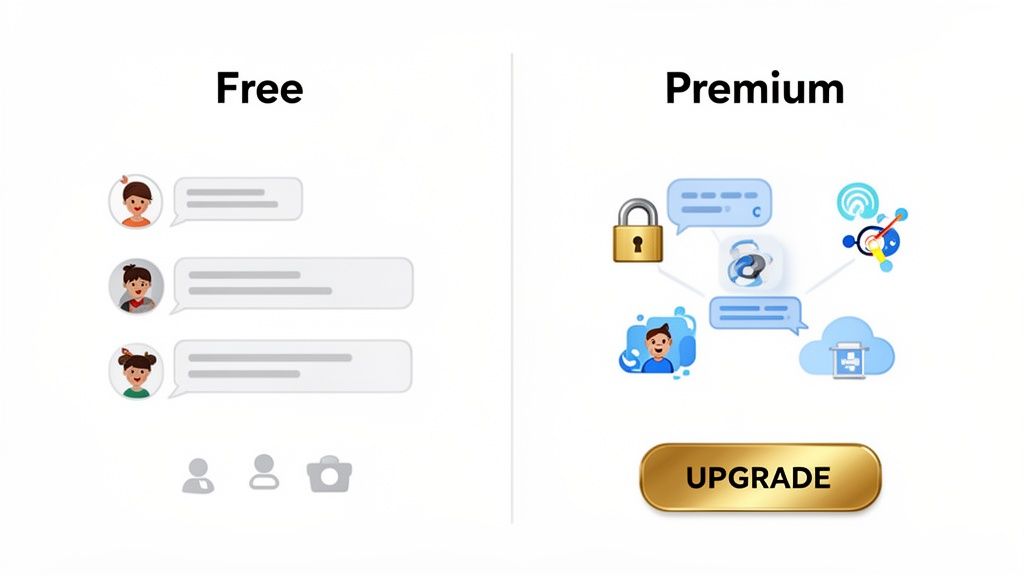
This model offers a free core version to drive viral adoption and paves a low-friction path to paid tiers unlocking advanced integrations, storage, and security. Slack pioneered this by limiting message history and features in the free tier, converting teams into premium subscribers as they outgrew constraints.
Analysis of the Slack Model
- Core strategy: Offer 80% of daily value for free and reserve 20% of power features for paid tiers
- Limits drive upgrade urgency without blocking basic usage
- Integrations and history retention act as natural upgrade triggers
“Design upgrade moments inside workflows so users discover premium value at the point of need.”
Tactical Insights
- Set free tier limits (message history, blocks, task runs) using the 80/20 rule
- Track free-to-paid conversion closely; sub-2% signals pricing misalignment
- Embed upgrade prompts in daily workflows for seamless upsells
Learn more about SaaS Freemium to Premium Tiering (Slack Model) on refgrow.com:
Learn more about topic on domain.com
Actionable Takeaways
- Audit feature usage to find upgrade hotspots
- A/B test limit thresholds to balance adoption versus monetization
- Use in-app banners and email nudges when free limits are reached
When and Why to Use
- For product-led growth teams aiming for viral reach
- When onboarding friction must be minimal
- Ideal for community platforms, API services, and collaboration tools
2. Usage-Based Consumption Pricing (Stripe Model)
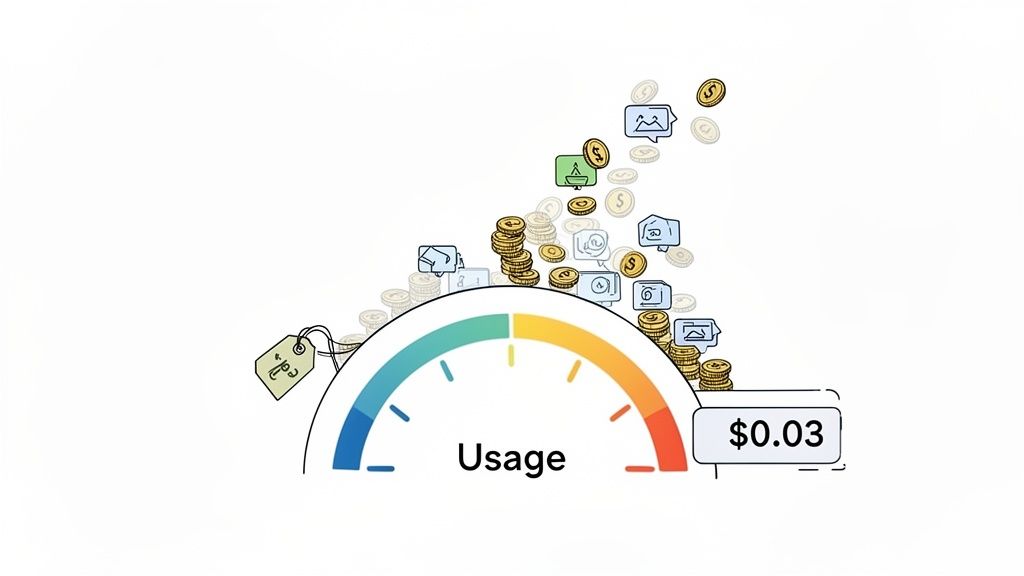
This model charges customers based on their actual consumption of a service, aligning price directly with value received. Instead of a fixed fee, costs scale with usage metrics like API calls, data storage, or transactions processed. Stripe mastered this by charging a small percentage plus a fixed fee per transaction, making its powerful payment infrastructure accessible to businesses of all sizes.
Analysis of the Stripe Model
- Core strategy: Tie revenue directly to customer success and consumption
- Lowers the barrier to entry, as customers start small and pay as they grow
- Creates a transparent and fair pricing perception, as costs match usage
“Align your success with your customer’s growth by making your core metric their core metric.”
Tactical Insights
- Define a clear and understandable "unit of value" (e.g., transaction, API call, GB stored)
- Implement usage monitoring and provide customers with a real-time dashboard
- Create tiered discounts for high-volume users to incentivize deeper adoption
Learn more about Usage-Based Consumption Pricing (Stripe Model) on stripe.com:
Learn more about topic on domain.com
Actionable Takeaways
- Establish precise unit economics before launch to ensure profitability at every level
- Offer usage forecasting tools to help customers predict and manage their costs
- Send proactive usage alerts to prevent unexpected bills and build trust
When and Why to Use
- For API-first products and infrastructure-as-a-service (IaaS) platforms
- When customer usage can vary significantly month-to-month
- Ideal for services like payment processing (Stripe), communications (Twilio), and cloud computing (AWS)
3. Feature-Based Tiering with Role-Based Access (HubSpot Model)
This strategy organizes pricing tiers around distinct user personas and their job functions. Instead of generic usage limits, each tier unlocks a specific feature set tailored to the needs of different teams, such as marketing, sales, or customer support. HubSpot excels at this, allowing customers to purchase the exact "Hub" their team requires, which drives adoption across departments and creates clear expansion revenue paths.
Analysis of the HubSpot Model
- Core strategy: Align pricing tiers with specific customer roles and their unique workflows.
- Creates a "land and expand" motion where a company starts with one Hub and adds others as needs grow.
- Value is tied directly to job-specific outcomes, making the ROI clearer for each team.
“Map your features to the jobs-to-be-done for each core user persona, then build your tiers around those specific value paths.”
Tactical Insights
- Research customer personas deeply to understand their distinct feature requirements and willingness to pay.
- Use product analytics to identify which features drive the most value and trigger cross-departmental expansion.
- Create clear tier naming that implies progression and function (e.g., Marketing Hub, Sales Hub) rather than generic labels.
Actionable Takeaways
- Conduct persona-based interviews to validate feature packaging before launch.
- Design an integrated platform experience that encourages teams to adopt additional Hubs.
- Create marketing content that speaks directly to the pain points of each specific persona.
When and Why to Use
- For complex SaaS platforms serving multiple departments within a single organization.
- When your product has distinct feature sets that solve different business problems.
- Ideal for CRM, marketing automation, and all-in-one business software.
4. Volume-Based Discounts with Commitment Pricing (Enterprise Model)
This model offers significant discounts for customers committing to higher volumes or longer contract periods. Common in B2B enterprise software, this strategy reduces the perceived price while securing predictable annual recurring revenue (ARR). Customers often receive 15-40% discounts on annual commitments versus month-to-month pricing, incentivizing larger, more stable deals. Salesforce and Microsoft 365 exemplify this with annual plans priced significantly lower than their monthly equivalents.
Analysis of the Enterprise Model
- Core strategy: Trade a lower per-unit price for higher contract value and longer customer lifetime value (LTV)
- Annual commitments create a powerful retention moat, drastically reducing churn
- Predictable revenue streams improve financial forecasting and business stability
“Secure the long-term relationship first. The discount is a tool to lock in future revenue and increase customer investment.”
Tactical Insights
- Calculate customer acquisition cost (CAC) and LTV to ensure discounts maintain healthy profit margins
- Offer flexible mid-contract scaling options to reduce customer hesitation about long-term commitments
- For channel sales, create special 12-month commitment discounts for high-volume affiliate partners
Learn more about Volume-Based Discounts with Commitment Pricing (Enterprise Model) on refgrow.com:
Learn more about incentive plan structures on refgrow.com
Actionable Takeaways
- Model the financial impact of annual discounts on cash flow and ARR
- Clearly display the savings percentage on your pricing page to highlight the value of commitment
- Track cohort analysis to confirm that annual customers have higher net revenue retention (NRR) and lower churn
When and Why to Use
- For B2B SaaS companies with high-value customers and longer sales cycles
- When revenue predictability is a key business objective
- Ideal for platforms where customer usage and value grow over time
5. User Seat-Based Pricing with Unlimited Seats Alternative (Figma/Miro Model)
This model combines traditional per-user pricing with a premium "unlimited seats" tier. Organizations pay for each user until they reach a scale where a flat-fee enterprise plan for the entire company becomes more economical. Figma and Miro exemplify this by removing seat-based friction at the enterprise level, encouraging organization-wide adoption without incremental cost concerns.
Analysis of the Figma/Miro Model
- Core strategy: Scale revenue with team growth via per-seat pricing, then capture full organizational value with an unlimited-seat enterprise tier.
- Removes purchasing friction for large, expanding teams.
- Positions the product as an essential, standardized tool across the entire company.
“Price the enterprise tier to enable entire departments, not just count individual users. The value shifts from single-seat access to organizational standardization.”
Tactical Insights
- Set per-seat tier pricing based on typical team sizes (e.g., 5-50 users).
- Position the unlimited tier as a strategic "team enablement" or "collaboration hub" package.
- Monitor seat utilization in per-user plans; customers adding seats they don't actively use signal an opportunity to upsell to the unlimited tier.
Actionable Takeaways
- Calculate your target Average Contract Value (ACV) from an ideal enterprise client and price the unlimited tier accordingly.
- Frame the enterprise offering around features like advanced security, dedicated support, and administrative controls, not just seat count.
- Create a clear upgrade path from a nearly maxed-out per-seat plan to the unlimited option.
When and Why to Use
- For collaboration tools where value increases with network effects (e.g., design, whiteboarding).
- When targeting both small teams and large enterprises with different budget structures.
- Ideal for products that can become the standard operating tool for entire departments or companies.
6. Freemium with Hard Paywall Feature Lock (LinkedIn Premium Model)
This strategy provides a valuable free product but places high-value, distinct features entirely behind a hard paywall. Unlike models with usage limits, there is zero access to premium capabilities like LinkedIn’s InMail or Advanced Search for free users. This creates a clear value distinction and pushes power users to upgrade for specific, professional-grade tools.
Analysis of the LinkedIn Model
- Core strategy: Offer a robust, standalone free platform while reserving entire feature suites for paying subscribers.
- Value is defined by function, not usage limits.
- The free product drives network effects, making the premium features more valuable.
“Gate your most powerful, specialized tools behind a hard paywall to convert your most committed users without alienating your free user base.”
Tactical Insights
- Identify "power user" features that solve a niche, high-intent problem.
- Clearly communicate the benefits of the locked features on the upgrade page.
- Use data to pinpoint users who repeatedly show interest in premium features.
Actionable Takeaways
- Create in-app prompts that highlight the specific problem a premium feature solves.
- A/B test which features to place behind the paywall to maximize conversion.
- Offer monthly and annual subscription options to cater to different user needs.
When and Why to Use
- For platforms with distinct user segments (e.g., job seekers vs. recruiters).
- When premium features require significant resources or data to operate.
- Ideal for professional networks, marketplaces, and data-intensive SaaS tools.
7. Outcome-Based Pricing with Revenue Sharing (Performance Model)
This model charges customers based on the results achieved, not the inputs provided. Instead of a flat subscription fee, the vendor earns a percentage of the revenue or success they help generate. This approach perfectly aligns vendor and customer incentives, as the vendor only profits when the customer succeeds, making it a powerful tiered pricing strategy example.
Analysis of the Performance Model
- Core strategy: Link pricing directly to customer ROI, creating a true partnership
- Eliminates upfront risk for the customer, boosting acquisition rates
- Tiers are based on performance thresholds, incentivizing mutual growth
“When your revenue is tied to your customer’s success, your entire product roadmap naturally aligns with creating value.”
Tactical Insights
- Structure revenue share tiers with volume discounts to encourage scaling (e.g., 20% share for the first $10k in revenue, 15% for the next $40k)
- Build transparent dashboards to show customers exactly how fees are calculated
- Ensure attribution tracking is flawless; disputes over performance data can quickly erode trust and ruin the partnership
Learn more about Outcome-Based Pricing with Revenue Sharing (Performance Model) on refgrow.com:
Learn more about revenue sharing models on refgrow.com
Actionable Takeaways
- Offer hybrid models (low base fee + rev-share) for more predictable revenue
- Implement a minimum fee floor or guarantee during customer ramp-up periods
- Clearly define the metrics that determine "success" in your service agreement
When and Why to Use
- For platforms where ROI is directly measurable and attributable (e.g., affiliate marketing, ad tech)
- When you want to radically differentiate from competitors charging high flat fees
- Ideal for marketplaces, payment processors, and performance-based tools
8. Tiered Add-On Marketplace Model (Zapier/Integrations Approach)
This strategy offers a core platform at a fixed price tier, complemented by a marketplace of modular add-ons and integrations available à la carte. Customers can purchase only the specific features they need, creating a highly customized solution. Zapier exemplifies this by offering core automation plans while charging for premium integrations and advanced features separately.
Analysis of the Zapier Model
- Core strategy: Sell a valuable core product and monetize expansion through high-value, optional enhancements.
- Customization empowers users, increasing stickiness and lifetime value.
- Creates multiple, independent revenue streams beyond the base subscription.
“Let customers build their perfect solution. The more they build, the more invested they become.”
Tactical Insights
- Price add-ons at 20-30% of the core subscription to encourage impulse buys without devaluing the feature.
- Create strategic bundles, packaging 3-4 related add-ons at a small discount to guide upsells.
- Track adoption curves for each add-on to identify popular combinations and inform future development.
Learn more about Tiered Add-On Marketplace Model (Zapier/Integrations Approach) on zapier.com:
Learn more about topic on domain.com
Actionable Takeaways
- Develop an API to encourage a third-party developer ecosystem for new add-ons.
- Promote popular or new add-ons within the user dashboard.
- Use add-on purchase data to segment users for targeted marketing campaigns.
When and Why to Use
- For platforms with diverse user needs that a one-size-fits-all plan cannot serve.
- When you want to capture revenue from specific, high-value power features.
- Ideal for CRMs like Salesforce, automation tools, and e-commerce platforms.
9. Growth-Triggered Automatic Tier Upgrades with Expansion Revenue (Plaid Model)
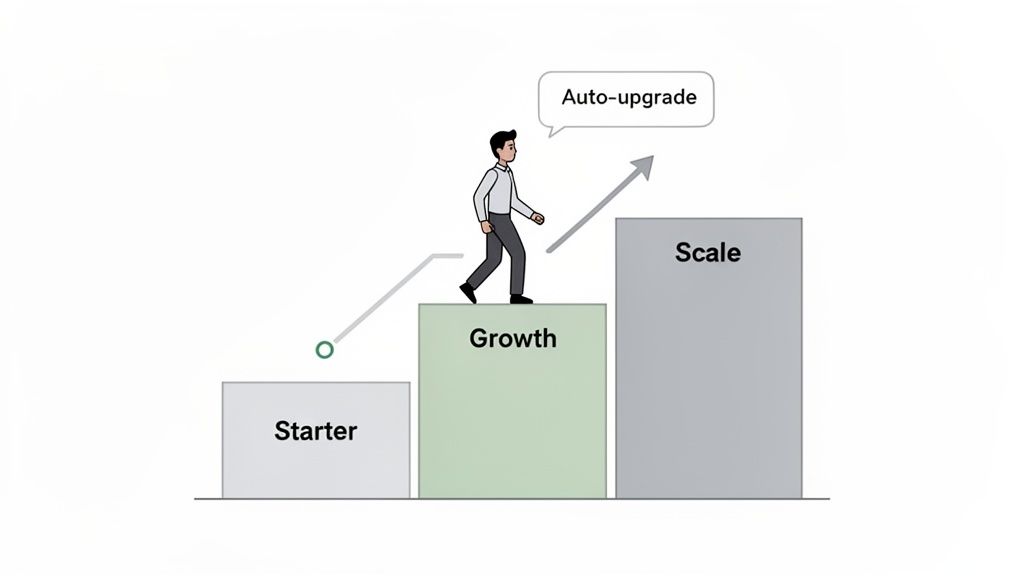
This strategy automatically graduates customers to higher tiers as they reach specific usage thresholds, removing friction from the upgrade process. Instead of relying on sales outreach or manual plan changes, the platform scales pricing alongside the customer’s growth. Plaid exemplifies this by moving clients to higher-cost plans as their API call volume increases, aligning their costs directly with the value they receive.
Analysis of the Plaid Model
- Core strategy: Tie pricing directly to a core value metric and automate upgrades to capture expansion revenue seamlessly.
- Aligns your revenue growth with your customers' success.
- Reduces churn by making upgrades a natural consequence of positive growth, not a painful sales decision.
“Automate the upgrade path to make expansion revenue the default outcome of customer success.”
Tactical Insights
- Provide a 30-day advance notice before any automatic upgrade takes effect to ensure transparency.
- Create a usage dashboard that projects when a customer might hit the next tier, preventing surprises.
- Offer a one-time, 30-day grace period for customers who are not ready to upgrade.
Actionable Takeaways
- Identify a single, clear value metric (e.g., API calls, monthly tracked users, active affiliates) to anchor your tiers.
- Implement automated alerts to notify both your team and the customer as they approach a tier limit.
- Such models are designed not just for initial acquisition but also to maximize long-term expansion revenue, directly contributing to a higher Customer Lifetime Value.
When and Why to Use
- For usage-based products where value scales directly with consumption.
- When you want to minimize sales friction and automate revenue growth.
- Ideal for API-first companies, data platforms (like Segment or Mixpanel), and infrastructure services.
10. Industry/Vertical-Specific Tiering with Custom Pricing (Enterprise SalesForce Model)
This strategy tailors pricing tiers to the unique needs, value perception, and economic models of different industry verticals. Instead of a one-size-fits-all approach, companies like Salesforce create distinct packages for segments like nonprofits, government, and commercial enterprises, each with features and pricing that align with that vertical's typical use case and budget.
Analysis of the Salesforce Model
- Core strategy: Segment the market by industry and create bespoke pricing tiers that maximize value capture from each distinct customer profile.
- Vertically-aligned features and SLAs justify price differentiation.
- Custom pricing enables penetration into markets with different willingness-to-pay.
“Price based on the value delivered to a specific industry, not just on the features you provide.”
Tactical Insights
- Conduct deep willingness-to-pay research for each target vertical before setting custom prices.
- Build dedicated sales and support teams with expertise in each industry to communicate value effectively.
- Tailor feature sets in each vertical plan to solve industry-specific problems, such as compliance for government or fundraising for nonprofits.
Actionable Takeaways
- Create vertical-specific landing pages and marketing collateral to speak directly to each segment.
- Audit your customer base to identify clusters of similar industries that could become your first dedicated verticals.
- Develop case studies that highlight the ROI for customers within each specific industry.
When and Why to Use
- For mature companies targeting multiple distinct market segments with varying needs.
- When your product has broad applicability but delivers specialized value to certain industries.
- Ideal for enterprise SaaS, B2B platforms, and API services with diverse customer bases.
Top 10 Tiered Pricing Strategies Compared
| Model | Implementation complexity 🔄 | Resource requirements ⚡ | Expected outcomes 📊 | Ideal use cases ⭐ | Key tips 💡 |
|---|---|---|---|---|---|
| SaaS Freemium to Premium Tiering (Slack Model) | Medium — feature gating & conversion flows | Moderate–high infrastructure & support for free users | High user acquisition; low free→paid conversion (~2–5%); strong network effects | Product-led SaaS, collaboration tools, viral apps | Set free limits at 80/20; embed upgrade moments; monitor conversion closely |
| Usage-Based Consumption Pricing (Stripe Model) | High — metering, billing, real-time dashboards | High engineering & billing/analytics investment | Revenue scales with usage; short-term revenue variability | APIs, infra, developer platforms, pay-per-use services | Define unit economics before launch; provide alerts and forecasting tools |
| Feature-Based Tiering with Role-Based Access (HubSpot Model) | High — RBAC + persona-driven feature bundles | Significant product design, sales enablement, support | Strong cross-team adoption and expansion revenue | CRM, marketing suites, multi-department SaaS | Research personas; clear tier names; use analytics to find expansion features |
| Volume-Based Discounts with Commitment Pricing (Enterprise Model) | Medium — contract/discount management | Sales, legal, forecasting resources for contracts | Predictable ARR, lower churn, larger initial deals | B2B enterprise customers with high volume | Ensure CAC vs discount yields profitability; offer mid-contract scaling |
| User Seat-Based Pricing with Unlimited Seats Alternative (Figma/Miro Model) | Low–medium — seat management & optional flat tiers | Billing for seats, usage analytics, support | Simple buy-in; higher LTV with unlimited tiers; risk of account sharing | Team collaboration/design tools; org-wide adoption | Price per typical team size; position unlimited as enablement; monitor utilization |
| Freemium with Hard Paywall Feature Lock (LinkedIn Premium Model) | Medium — robust free core + strict paywalls | Strong product development & analytics to identify paywall points | Clear paid product differentiation; potentially lower conversion but higher paid ARPU | Professional networks, content platforms, products with clear pro features | Ensure free core is valuable; test paywall timing; track power-user behavior |
| Outcome-Based Pricing with Revenue Sharing (Performance Model) | Very high — attribution, outcome-linked billing | Robust analytics, legal, customer success resources | Deep incentive alignment; vendor revenue tied to customer performance | Affiliate platforms, performance marketing, agency services | Use tiered revenue-share; consider hybrid fee+share; make attribution airtight |
| Tiered Add-On Marketplace Model (Zapier/Integrations Approach) | High — marketplace billing & partner integrations | Partner management, billing infra, product ops | High expansion revenue potential; flexible adoption but pricing complexity | Integration-heavy platforms, automation tools, extensible products | Price add-ons ~20–30% core; bundle strategically; track add-on adoption |
| Growth-Triggered Automatic Tier Upgrades (Plaid Model) | Very high — auto-escalation logic + billing integration | Sophisticated metering, billing, notification systems | Seamless capture of expansion revenue; reduced friction; bill-shock risk if mismanaged | High-usage APIs, platforms with measurable usage metrics | Provide advance notice, projection dashboards, and grace periods |
| Industry/Vertical-Specific Tiering with Custom Pricing (Enterprise Salesforce Model) | Very high — multiple vertical pricing + tailored bundles | Deep market research, vertical sales teams, custom engineering | Maximized willingness-to-pay per segment; complex GTM & operations | Vendors serving diverse industries or large enterprises | Conduct WTP research per vertical; make pricing transparent; assign vertical account managers |
From Theory to Tiers: Choosing Your Winning Strategy
As we’ve explored through these diverse tiered pricing strategy examples, the most impactful pricing models are not just numbers on a page; they are a direct reflection of a company's deep understanding of its customers and the value it delivers. From Slack's masterful freemium-to-premium journey to Stripe's pure consumption-based model, each approach is meticulously crafted to align cost with perceived value.
The central lesson is clear: pricing is a product feature. It dictates who can access your solution, how they perceive its worth, and what their growth trajectory looks like. Your pricing tiers should tell a story, guiding a user from their initial problem to their ultimate solution, with each tier representing a new chapter in their success with your product.
Key Strategic Takeaways
Reflecting on the models from HubSpot, Figma, and Salesforce, several core principles emerge as universally applicable for any business owner or product team looking to refine their approach:
- Value Metric is King: Identify the single metric that best represents the value customers receive. Is it users (Figma), features (HubSpot), usage (Stripe), or outcomes (revenue sharing)? This metric should be the foundation of your entire tier structure.
- The "Free" Tier is an Acquisition Channel: As demonstrated by Slack and LinkedIn, a free tier isn't just a giveaway. It's a powerful, self-service marketing engine designed to capture a wide audience, demonstrate core value, and create a natural upgrade path when a user or team hits a growth trigger.
- Psychology Drives Upgrades: The most effective pricing tiers leverage psychological anchors. They create a clear "good, better, best" scenario that makes the middle tier feel like the safest, most logical choice. They also use feature gating and usage limits to create a tangible sense of need for the next level up.
- Pricing is a Continuous Process: Your first pricing model will not be your last. The market evolves, your product changes, and customer needs shift. Treat pricing as a dynamic system that requires regular review, A/B testing, and iteration based on data, not just gut feelings.
Your Actionable Next Steps
Moving from theory to implementation can seem daunting, but you can start making progress today. The first step involves deep customer analysis. Interview your power users, analyze usage data to see which features correlate with retention, and survey churned customers to understand where the value proposition broke down.
This initial research phase is critical for validating your core value metric. For those launching new products or ventures, similar principles apply. When moving from theoretical models to practical application, consider insights into developing a robust pricing strategy for crowdfunding campaigns, as the fundamentals of audience understanding and value alignment are universal.
Ultimately, the goal is to architect a system where your customer's success is directly tied to your own. As they grow and use more of your product, they naturally move up the tiers, creating a seamless expansion revenue stream. By thoughtfully applying the lessons from these tiered pricing strategy examples, you can build a powerful engine for sustainable, long-term growth.
Ready to apply these pricing strategies to your affiliate or partner program? Refgrow provides the flexible platform you need to create custom, feature-based tiers for your partners, implement performance-based commission structures, and scale your growth channels. Stop using one-size-fits-all tools and start building a partner program that aligns perfectly with your business model.