

A Founder's Guide to Competitive Pricing Analysis

Competitive pricing analysis is simply the act of systematically studying what your competitors charge and how they structure their pricing. This isn't about mindlessly matching their numbers. Instead, it’s about using that intel to strategically position your own product to drive profit and growth.
Why Pricing Analysis Is Your Most Underrated Growth Lever

So many SaaS founders I've seen treat pricing as a one-and-done task. They pick a number that feels "about right" and move on. The problem is, this approach leaves a staggering amount of growth on the table. A proper competitive pricing analysis isn't just a defensive tactic; it's one of the most powerful offensive tools you have for understanding your market.
This process forces you to look beyond a simple price tag. You start to dissect the entire value proposition your rivals are offering, which in turn helps you answer the tough strategic questions that directly hit your bottom line.
Uncovering Strategic Advantages
When you map out the competitive landscape, you're shifting from pure guesswork to making decisions backed by solid data. The real goal here is to pinpoint exactly where your product fits and figure out how to best communicate its value. A deep-dive analysis helps you do a few critical things:
- Avoid Common Pitfalls: You can sidestep the classic startup mistakes of either underpricing your product and devaluing your work or overpricing it and scaring everyone away.
- Identify Market Gaps: You'll start to see underserved customer segments or unique feature bundles that your competitors have completely missed.
- Justify Your Price Point: It gives you the evidence needed to build a compelling story about why your product is worth every penny you charge.
Take the affiliate marketing space, for instance. A sharp pricing analysis is non-negotiable for survival. The global industry is on track to hit $31.7 billion by 2031, and the B2B affiliate marketing niche alone is projected to reach $5.7 billion by 2025. That kind of explosive growth means fierce competition. Platforms have to nail that balance between affordability and powerful features to win over both merchants and affiliates. You can find more data on the industry's trajectory on affiliatestatistics.marketing.
A well-executed competitive pricing analysis isn't just a spreadsheet of numbers. It's your roadmap to market positioning, customer acquisition, and long-term profitability.
At the end of the day, this isn't just about setting a price. It’s about deeply understanding the relationship between your product, your customers, and the market you're in. It gives you the clarity to build a sustainable business that truly connects with your target audience and carves out its own space.
Defining Your Goals and Identifying True Competitors
A competitive pricing analysis without a clear objective is just a jumble of numbers. Before you even think about looking at a competitor’s pricing page, you have to ask one crucial question: what are we actually trying to achieve here?
Your answer completely changes how you see the market. Are you the new kid on the block trying to find a way in? If so, your goal is probably to pinpoint a price that helps you grab market share, fast. On the other hand, if you're an established brand looking to justify a premium price, your focus will be on proving you deliver far more value than the cheaper options out there.
Setting Sharp Objectives
Vague goals like "be more competitive" are useless. You need specific, measurable objectives that will actually guide your analysis and lead to real business outcomes. This turns a simple research task into a powerful strategic tool.
Here are a few examples of what a sharp objective looks like:
- Launching a new product: Find a launch price that undercuts key competitors by 10-15% on a specific feature set to drive early sign-ups.
- Stealing market share: Pinpoint the competitor with the highest churn and create a plan that delivers 20% more value (like more seats or higher API limits) for the same price.
- Justifying a premium price: Identify the unique features that save your customers an estimated $500/month and build your entire value prop around that ROI to support a higher price tag.
To get the full picture and frame these goals correctly, you really need to ground them in a solid SaaS competitive analysis. It provides the context you need to set objectives that make sense.
Who Are You Really Competing Against?
Once you know what you're aiming for, you need to figure out who you're really up against. It’s easy to get tunnel vision and only focus on the companies that look and sound just like you, but the real competitive landscape is almost always wider and messier than that.
Your customers are the ultimate arbiters of who your competitors are. If they are considering another solution to solve the same problem—regardless of its format—that solution is your competitor.
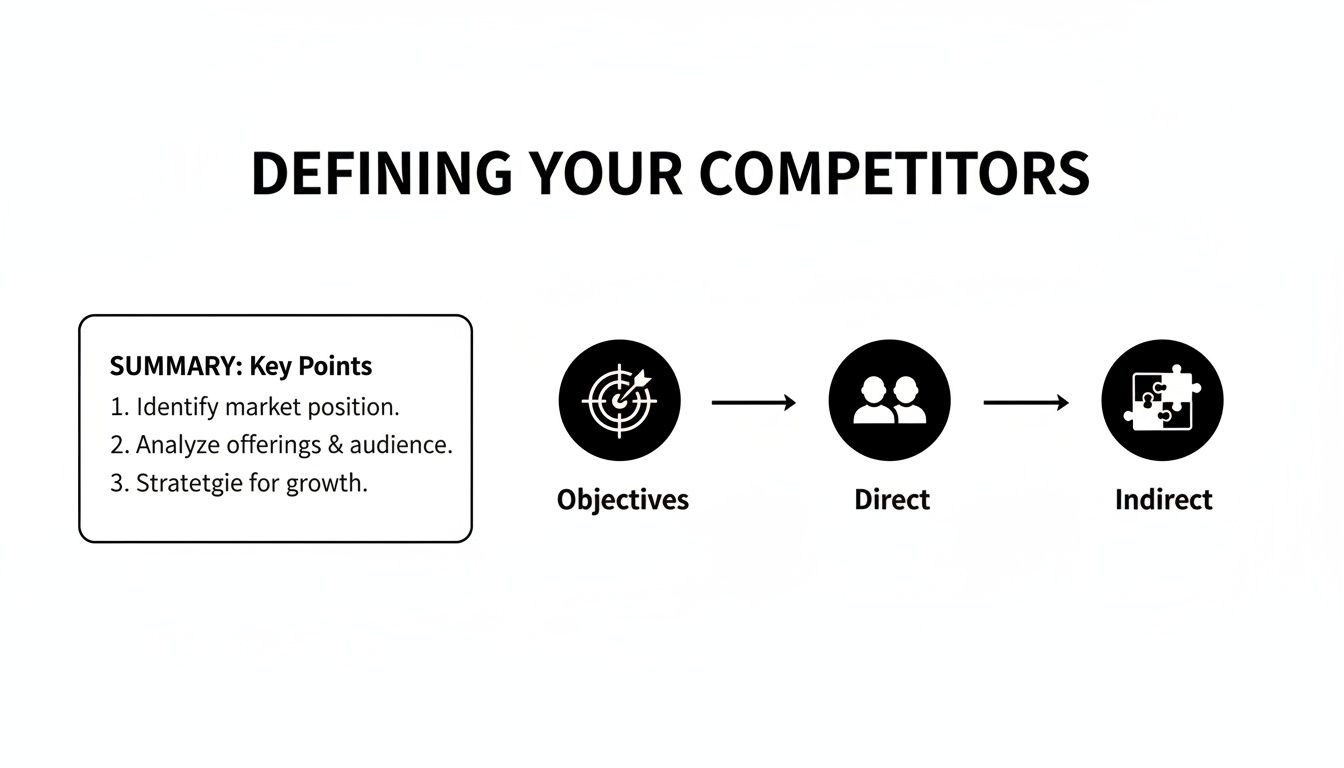
Thinking this way helps you slot your rivals into three distinct buckets. This ensures your analysis is comprehensive, not just a surface-level glance.
Direct Competitors: These are the obvious ones. They offer a very similar product, go after the same customers, and solve the exact same pain point. Think Asana vs. Monday.com.
Indirect Competitors: These companies solve the same core problem, but they do it with a different type of product or a different angle. For an email marketing platform like Mailchimp, an indirect competitor could be an all-in-one CRM like HubSpot, which also happens to do email.
Aspirational Competitors: These are the big dogs, the market leaders you want to become. You might not be competing with them on price today, but studying their strategy shows you where the market is going and what customers are willing to pay for at scale.
Building Your Competitor Intelligence Dashboard
When you’ve nailed down your objectives and shortlisted your rivals, the real work begins. Gathering data isn’t a quick glance at price tags—it’s about assembling a robust, consistent dataset that becomes your single source of truth. Think of this as crafting a living document that you’ll revisit and refine as the market shifts.
Imagine you’re piecing together evidence at a crime scene. Every detail—from listed fees to hidden add-ons—matters. Your mission is to unearth what drives actual costs and shapes perceived value. Only then can you make comparisons that hold water.
Key Data Points For Each Competitor
Focus on a core group of metrics. This keeps your analysis focused and ensures you’re comparing apples to apples.
- Pricing Tiers: Capture every plan name along with its monthly and annual cost.
- Feature Distribution: List which features appear (or don’t) at each level.
- Billing Cycle Discounts: Translate offers like “two months free” into a clear 20% savings.
- Free Trial & Freemium Limits: Note trial lengths (for example, 14 days) and any usage caps (say, 1,000 contacts or 1 user).
- Overage Fees & Hidden Costs: Scrutinize charges for extra API calls, data storage, or additional seats.
Great analysis stands on the backbone of solid data. Skip the deep dive now, and your conclusions risk crumbling later.
Competitive Data Collection Framework
Before you build your dashboard, sketch out a template. Below is a framework that organizes key data for every competitor. Tweak it to match your unique offerings or niche.
| Competitor | Pricing Model | Lowest Tier Price | Highest Tier Price | Key Feature in Tier 1 | Key Feature in Tier 2 | Billing Cycle Discount | Free Trial/Freemium? |
|---|---|---|---|---|---|---|---|
| Competitor A | Flat Rate | $10 | $100 | Basic reporting | Team collaboration | 15% | 14-day trial |
| Competitor B | Per Seat | $8/user | $80/user | Unlimited projects | Priority support | 20% | Freemium (1 project) |
| Competitor C | Tiered | $12 | $120 | Custom dashboards | API access | 18% | 30-day trial |
Use this table to track emerging offers or changes in real time. It’s your blueprint for a clear, comparable view of the market.
Turning Data Into A Living Dashboard
Once your data points fall into place, a simple spreadsheet or a purpose-built tool will do the rest. Assign each competitor to its own row, and turn every metric into a column. You’re constructing a dynamic dashboard that reveals:
• Gaps in the market—say, one rival offering unlimited users at the base tier while another caps at five.
• Strategic priorities—where competitors are betting on add-ons versus core functionality.
• Pricing sweet spots—insights on which discounts or bundling tactics resonate most.
This dashboard becomes your north star for deeper analysis. To polish its design and ensure clarity, follow these dashboard design best practices. A thoughtfully structured dashboard transforms raw figures into strategic decisions.
Decoding Pricing Models And Value Metrics
Once your intelligence dashboard is full of competitor numbers, the real work begins. Instead of stopping at “they charge $X,” you want to ask “how did they land on that figure?” and “who are they really serving?” That’s where the strategy hides.
A pricing model isn’t just math—it’s a window into what your competitors believe matters most to their customers. When you decode that, you unlock clues for your own positioning.
Understanding Common SaaS Pricing Models
Scan your dashboard and you’ll spot a handful of familiar approaches. Each one caters to a different buyer profile and packs its own tactical punch.
- Per-User Pricing. You pay for each seat. It’s clean, predictable and often the go-to for collaboration platforms.
- Tiered Pricing. Features stack up in Basic, Pro or Enterprise bundles. This guides customers along a clear upgrade path.
- Usage-Based Pricing. Your bill mirrors actual consumption—API calls, gigabytes stored or contacts managed. It ties cost directly to delivered value.
If every major player in your niche sticks with tiered plans, rolling out pure usage-based pricing can make you stand out. Yet the choice of model only tells half the story.
A pricing model speaks your customer’s language. Listen closely.
Identifying The All-Important Value Metric
Beneath every model sits a value metric—the “per” in “price per.” It’s your competitor’s wager on what customers will pay extra for.
- Charging per user? They’re convinced team size drives value.
- Charging per project? They see the payoff in completed work.
That nuance is huge. It shows how each product ties its price to a real outcome. And once you map that, you can refine your own value connection and boost customer lifetime value.
In affiliate marketing—take Refgrow as an example—the mix of industries you serve shifts the game. Below is a quick breakdown of market share across major verticals:
| Vertical | Market Share |
|---|---|
| Retail | 44% |
| Telecom | 25% |
| Travel | 16% |
Each segment carries unique margin expectations. A one-size-fits-all price tag often leaves money on the table. Understanding these splits is essential when you’re crafting a pricing strategy that scales across diverse customers.
Pinpoint the “per” that matters. That’s where you turn analysis into advantage.
Turning Your Analysis Into a Winning Pricing Strategy

You've done the hard work of gathering the data. Now what? A competitor intelligence dashboard full of numbers is useless until you turn it into a clear, profitable plan. This is where you connect the dots and finally answer the big questions: Where do we fit in this market, and how can we win?
The first move is to step back and find the story hidden in the data. You're looking for patterns and, more importantly, gaps. For example, maybe you've discovered that every single competitor uses a complex, per-seat pricing model. That’s not a rule; it's an opportunity. You could be the one to introduce a simple, flat-rate plan that instantly clicks with teams tired of confusing pricing.
From Data Points to Pricing Tiers
With that kind of insight, you can start sketching out your own pricing structure. The goal isn't to just copy what everyone else is doing. It’s to use what you’ve learned to design tiers that play to your strengths and fill the gaps you found.
- The Entry-Level Tier: Think of this as your foot in the door. It needs to solve a real, specific pain point for a customer segment that bigger competitors might be ignoring, like startups or small teams.
- The Mid-Tier (Your Sweet Spot): This is where most of your revenue will likely come from. It should offer the perfect mix of features and value, clearly showing your ideal customer why your product is the best choice for them.
- The Premium/Enterprise Tier: This is for your power users. Pack it with your most advanced features, white-glove support, and anything else that justifies a much higher price.
The intelligence you gather here doesn't just inform price tags; it’s fundamental to building a comprehensive B2B marketing strategy that actually communicates your value.
Your pricing page is a strategic document, not just a menu. Each tier should tell a story that guides a specific type of customer to the perfect solution for their needs.
Setting Prices and Measuring Success
Once your tiers are defined, it's time to put a number on them. Your analysis gives you the market's acceptable price range, but you need to make sure your numbers are profitable. This is where you absolutely must factor in your own costs—especially your customer acquisition cost. If you haven't nailed this down, our guide on how to https://refgrow.com/blog/calculate-customer-acquisition-cost is the perfect place to start.
Keep in mind that markets aren't monolithic. Pricing pressure can vary wildly by region. For instance, with North America making up about 40% of the global affiliate marketing space, competition there is fierce. A one-size-fits-all global price will fail. You have to be competitive where it matters most.
Ultimately, you’re not carving your prices in stone. You're launching a hypothesis—one that you need to test, measure, and refine as you grow.
Answering Your Top SaaS Pricing Analysis Questions
As you dive into competitive pricing, you'll find a few questions pop up time and time again. Let's get ahead of them. Sorting these out now will help you focus on what really matters: turning all that data into a pricing strategy that actually works.
How Often Should I Revisit My Pricing Analysis?
Your pricing analysis isn't a "one-and-done" project you can just file away. It’s a living document. I always recommend a deep, comprehensive review at least once a year, but you can't let it sit on a shelf for 12 months untouched.
A quick quarterly check-in on your top 3-5 direct competitors is a smart rhythm to get into. This keeps you from being blindsided by smaller shifts in their strategy.
That said, you should drop everything and do a full-scale review immediately if:
- A major competitor completely overhauls their pricing page.
- You’re about to launch a significant new feature or product tier.
- Your business is expanding into a new market or customer segment.
The goal is to stay agile. Markets don't stand still, and neither should your pricing.
I've seen it a hundred times: the biggest mistake is blindly copying a competitor's pricing. You have no idea what their cost structure, target customer, or value proposition is. What works for them will almost never be a perfect fit for you.
What Are the Biggest Mistakes to Avoid?
Beyond just copying your rivals, another huge pitfall is getting fixated on the price tag and completely ignoring the value surrounding it. What kind of support are they offering? Is onboarding included? What unique features are bundled into that price? The number itself is just one small piece of the puzzle.
Also, be careful not to fall into "analysis paralysis." So many founders get stuck trying to gather perfect, exhaustive data on every competitor out there. Your goal isn't to write a flawless academic paper. It's to gather enough solid information to make a well-informed, strategic decision that you can test in the real world.
How Do I Price My Product's Unique Features?
This is where you make your money. Your unique, standout features are the reason you can—and should—charge a premium. They are the absolute last thing you should ever discount just to match a competitor’s lower price.
The trick is to quantify their value for the customer. How much time do these features save them each month? How much more revenue can they generate by using them? You need to anchor your pricing for higher tiers directly to that tangible return on investment.
When you build your pricing page, make these differentiators the stars of your premium plans. Highlight them, bold them, and make them impossible to miss. This builds a clear, compelling upgrade path that’s based on the unique value only you deliver. It shifts the conversation from a simple price comparison to a discussion about real business outcomes.
Ready to turn your pricing insights into a powerful growth engine? With Refgrow, you can launch a fully native affiliate program inside your SaaS in minutes, not months. See how over 1,600 businesses are scaling with our partnership tools.