

The SaaS Founder's Guide to Commission Payment Software

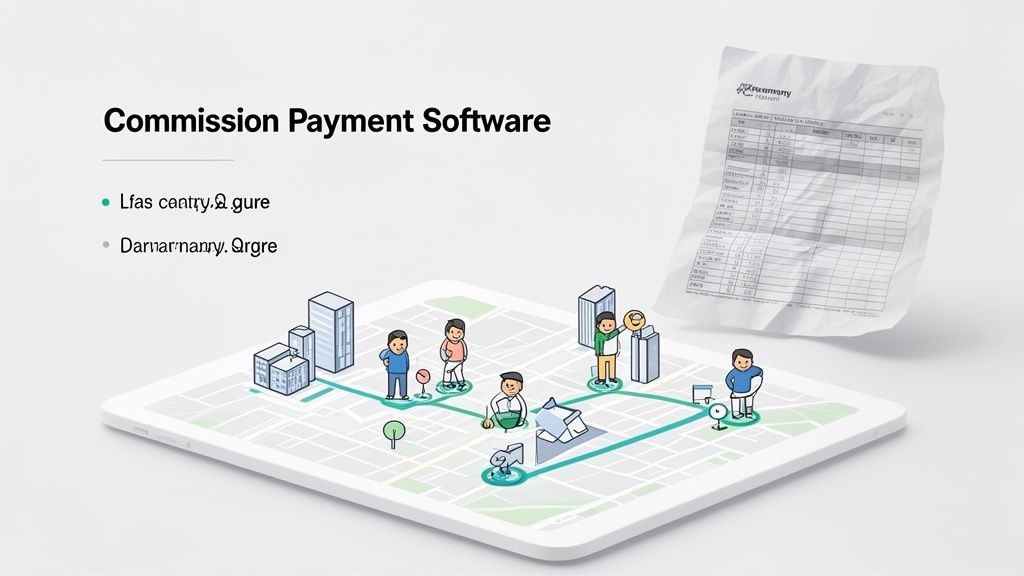
Trying to manage partner and affiliate payouts with a spreadsheet is like navigating a packed city using a crumpled paper map. Sure, you might get there eventually, but it's going to be a slow, manual grind filled with wrong turns and costly mistakes. Commission payment software is the modern GPS for this journey, built to automate the entire partner payout process, from the initial sale all the way to the final payment.
Your Growth Engine for Partner Payouts
For SaaS founders and product-led growth teams, this kind of software is much more than a simple financial tool—it's a critical engine for growth. It helps you turn your customers, partners, and affiliates into a motivated, self-sustaining sales force that practically runs on its own. Instead of getting buried in manual calculations and administrative chaos, you can stay focused on what really matters: building a great product and scaling your company.
The entire point of this software is to automate every single step of the affiliate and partner lifecycle. It takes care of everything from tracking a referred sale to calculating the exact payout and sending the money, all without you having to lift a finger.
From Manual Chaos to Automated Clarity
Without a dedicated system, managing a partner program quickly turns into a massive operational headache. You end up wrestling with common, frustrating problems that kill growth and can even damage the relationships you have with your valuable partners.
Modern commission payment software is designed to solve these problems head-on by delivering:
- Accuracy: It gets rid of human error when tracking sales and figuring out commissions. This means every partner gets paid the right amount, on time, every time.
- Trust: Partners get their own transparent dashboard where they can see their referrals, track earnings, and check payout status in real-time. This visibility builds huge confidence in your program.
- Scalability: It doesn't matter if you have ten partners or ten thousand. The system is built to handle the complexity, letting your program expand without piling on more administrative work.
At its heart, commission payment software converts a complex, error-prone manual process into a simple, automated system. It replaces spreadsheets and manual bank transfers with a reliable engine that fuels partner trust and business growth.
A Focus on Native SaaS Integration
This guide will zero in on how modern, embeddable solutions fit seamlessly right into your own SaaS product. This approach is all about creating a native, branded experience for your partners. It gets rid of the friction of sending them off to some clunky, third-party portal.
By embedding the affiliate dashboard directly into your own application, you create a powerful, unified experience that boosts adoption and drives real product-led growth. This is the key to building a partner program that feels professional, cohesive, and ready to scale with you for the long haul.
Core Features Every SaaS Team Needs
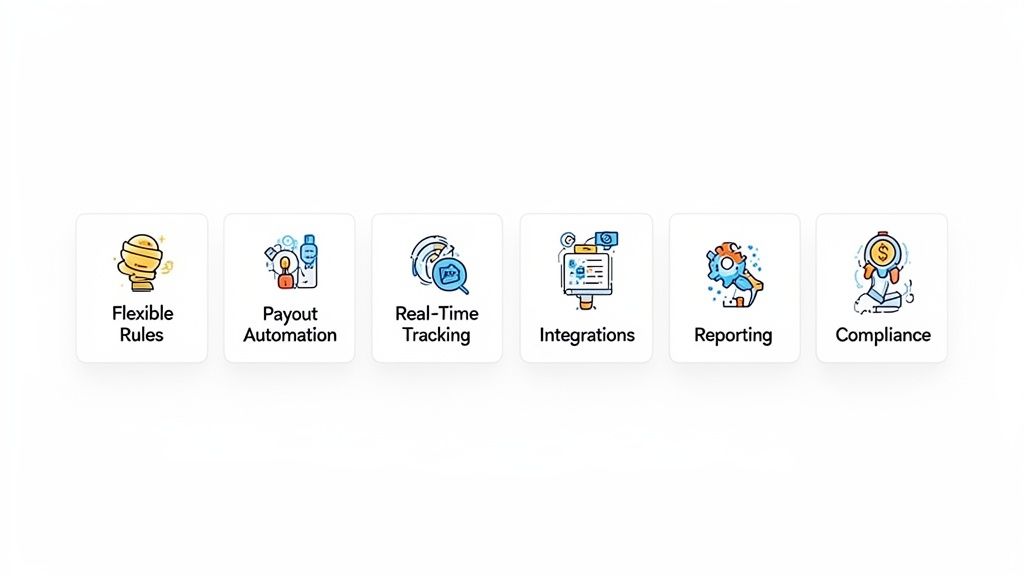
When you're shopping for commission software, it's easy to get distracted by flashy dashboards. But the real power lies in the core features that solve the unique challenges of a SaaS business. A successful partner program for a subscription product hinges on a foundation built for recurring revenue and product-led growth.
These aren't just nice-to-haves; they're the non-negotiables. Each one is a building block. Without a solid base, you'll find your program quickly becomes a manual, time-sucking chore instead of the growth engine it’s meant to be.
Let's break down what truly matters.
Flexible Commission Rules
SaaS revenue isn't a one-and-done deal. Your commission rules have to mirror the reality of your business—recurring payments, different pricing tiers, and the lifetime value of a customer. A rigid system that only understands one-off sales just won’t cut it.
Think of it this way: a basic commission plan is like a simple on/off switch. But a modern SaaS business needs a whole mixing board of controls. The best software gives you that flexibility, letting you design and automate virtually any compensation model you can dream up.
Look for tools that can handle structures like:
- Recurring Commissions: This is the gold standard for SaaS. You pay partners for the initial sale and every renewal that follows, motivating them to bring in high-quality customers who stick around.
- Tiered Commissions: Reward your top performers by bumping up their commission rates when they hit certain goals. For instance, maybe partners get 20% on their first ten sales and jump to 30% for every sale after that.
- Lifetime Commissions: You can tie a customer to a partner for life. This means the partner earns a commission on every single purchase that customer ever makes, including future upgrades and add-ons.
Getting the incentive right is everything. To see what might fit your product, you can dive into our guide on commission structure examples.
Payout Automation
Paying partners by hand is a classic scaling mistake. It might work when you have five affiliates, but what about fifty? Or five hundred? The administrative work of calculating and sending payments balloons into a full-time job, and it’s a minefield for costly errors.
Payout automation makes this entire problem disappear. The right software connects directly to payment gateways and handles everything on a set schedule—weekly, monthly, or whenever a partner hits a payout threshold. No human intervention needed. This guarantees your partners get paid correctly and on time, which is the single most important factor in building a trustworthy program.
Real-Time Tracking and Attribution
Trust is the currency of any partner program. Your affiliates need to know, without a shadow of a doubt, that they’re getting credit for every single referral they send your way.
That's where real-time tracking and attribution come in. When a partner shares their unique link, the software should instantly track the clicks, sign-ups, and eventual conversions. This data has to be visible to both you and the partner in a clear, easy-to-read dashboard. It removes all the guesswork and empowers partners by showing them exactly which of their efforts are paying off.
Transparent, real-time attribution isn't just a feature; it's a statement. It tells your partners that you value their contribution and are committed to a fair and open relationship.
Seamless Payment Integrations
Your commission platform absolutely must play nicely with the financial tools you already use, especially payment processors like Stripe and LemonSqueezy. This isn't just a convenience; it’s essential for accurate, automated tracking.
A deep integration allows the software to "listen" for payment events using webhooks. For example, when a charge.succeeded event fires in Stripe, the commission platform instantly catches it, attributes the sale to the right partner, and calculates the commission. This completely eliminates the need for manual CSV uploads or trying to reconcile data between two different systems.
Actionable Reporting and Analytics
You can't improve what you don't measure. Strong reporting and analytics turn a flood of raw data into clear, actionable insights that show you the true ROI of your partner program.
To get a clear picture of your program’s health, you need a quick way to generate reports on things like:
- Top Performers: Who are your rainmakers?
- Commission Volume: How are your total payouts trending over time?
- Referral Conversion Rates: Which partners are sending the highest-quality traffic?
This data helps you make smarter decisions, like offering exclusive bonuses to your top affiliates or creating better resources for partners who are just getting started.
Compliance and Tax Management
Paying partners, especially if they're in different countries, means wading through a maze of tax forms and regulations. Manually collecting W-9 or W-8BEN forms and then trying to generate 1099s at the end of the year is a massive administrative headache.
Good news: the best commission platforms automate all of this. They can collect the necessary tax forms from partners right when they sign up and then generate the required year-end reports for you. This saves countless hours and, more importantly, keeps you compliant with tax laws around the world.
Comparing Native vs External Implementation Models
When you're ready to bring commission payment software into your SaaS, you'll hit a fork in the road. This is a big decision, and it’s one that will fundamentally shape your entire partner experience. Do you go with a native, embeddable solution that lives right inside your product, or do you choose a traditional external platform that operates as a separate website?
This isn't just a technical choice—it defines your entire relationship with your partners.
Think of it like this: an external platform is like sending your affiliates to a generic, third-party office building to manage their work. It's functional, sure, but it feels completely disconnected from your brand and your product.
A native solution, on the other hand, is like giving your partners a dedicated, fully-branded desk right inside your own office. The experience is seamless, cohesive, and sends a clear message: they are a valued part of your team. This distinction has a huge impact on user experience, brand trust, and how smoothly your program runs.
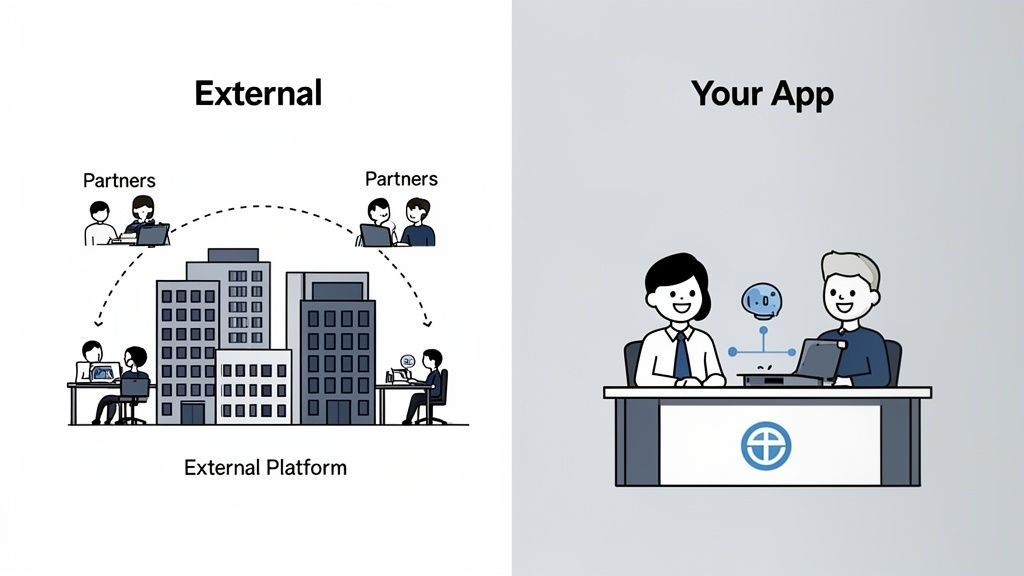
To make this choice clearer, let's break down the key differences between the two approaches.
Native Embeddable vs External Commission Platforms
| Factor | Native/Embeddable Solution | External Platform |
|---|---|---|
| User Experience | Seamless. Partners stay inside your app, no extra logins needed. Feels like a core feature. | Disjointed. Requires partners to leave your app and log into a separate, third-party portal. |
| Brand Consistency | Total control. The dashboard and all communications use your branding, building trust. | Diluted. Your brand competes with the platform's, which can look less professional. |
| Data Control | You keep all user and commission data within your own secure environment. | Your sensitive data is sent to and stored on a third-party server, raising security questions. |
| Implementation | Surprisingly simple. Often requires just a few lines of code and uses your existing user auth. | Can be complex. Often involves clunky API setups to sync data between two different systems. |
| Partner Engagement | Higher. The low-friction experience encourages partners to check stats and promote more often. | Lower. The extra steps and context-switching can discourage frequent interaction. |
Choosing the right model depends on your priorities. If you're building a truly product-led partner program, the benefits of a native, integrated experience are hard to ignore. It’s about making your partners feel like insiders, not outsiders.
The Critical Role of User Experience
The first thing your partners will notice is how they interact with your program. A clunky, disjointed user experience is the enemy of a successful partner program—it creates friction that kills momentum.
External Platforms: Force partners to leave your application. They have to navigate to a different URL, remember another password, and learn a new interface. This constant context-switching is disruptive and makes them feel like outsiders.
Native Solutions: An embeddable dashboard appears right inside your product’s existing UI. For your partner, it feels like a natural part of your app, not some tool you bolted on. This seamless flow encourages them to pop in, check their stats, and grab their links way more often.
The whole point of product-led growth is to remove friction. A native partner dashboard does exactly that by keeping users happily engaged within your ecosystem, constantly reinforcing your product's value.
When your partner program feels like a core feature instead of an afterthought, your partners are far more likely to stick around and succeed.
Branding and Building Unwavering Trust
Your brand is everything. Consistency is what builds trust, and when you send partners to an external platform, you're essentially borrowing another company's brand identity.
This can create subtle but real trust issues. Partners might wonder who’s really in charge of their data and, more importantly, their payouts. The external platform's logo is always there, diluting your brand and creating a less professional vibe.
A native solution keeps your brand front and center. The partner dashboard, the email notifications, every touchpoint—it all carries your logo, your colors, and your messaging. This reinforces your company’s credibility and assures partners they’re in a secure, official space managed directly by you. That's how you build the long-term confidence needed to attract and keep top-tier partners.
If you want to go deeper into how modern, seamless payouts work under the hood, our guide on affiliate payment automation breaks down all the mechanics.
Implementation Effort and Data Control
Not long ago, building a native experience was a massive engineering project. But today’s embeddable commission payment software has completely changed the game, making the "build vs. buy" calculation much more straightforward.
What implementation looks like for an external platform:
- Often involves wrestling with complex APIs just to sync user data.
- You have to manage data flowing between two completely separate systems.
- You’re sending sensitive user and financial data to a third-party server, which can create a whole host of compliance and security headaches.
And for a native embeddable solution:
- You can often get it running with a single snippet of code.
- It taps into your existing user authentication, so partners don't need another login.
- Crucially, it keeps all partner data inside your own environment, giving you complete control and much tighter security.
At the end of the day, an external platform might seem like a quick win, but a native solution delivers a far superior user experience, stronger branding, and tighter data control. For any SaaS looking to scale a successful, product-led partner program, those are the qualities that truly matter.
A Practical Checklist for Picking the Right Vendor
Choosing the right commission payment software feels like a huge decision, especially when you're a lean SaaS startup. It’s a market that’s absolutely exploding—it's expected to jump from USD 2 billion to USD 6 billion by 2033 because modern sales plans are just too complex for spreadsheets. As you start looking at different tools, you have to get past the flashy marketing and figure out what actually works.
I’ve put together this checklist as a series of questions. Think of it as your guide to cutting through the noise and finding a tool that genuinely fits a product-led, developer-friendly mindset.
Does It Actually Understand SaaS Revenue Models?
This is the big one. The first question you should ask is whether the tool was built for a business like yours. A lot of generic affiliate platforms were designed for one-off e-commerce sales, and they just don't get the nuances of recurring subscriptions.
You need to be sure the software can handle:
- Recurring Revenue: This is table stakes. Can it automatically track and pay commissions on every single subscription renewal, for as long as that customer sticks around? If not, walk away.
- Upgrades and Downgrades: What happens when a customer moves to a higher-tier plan or downgrades? The system needs to adjust commission payouts on the fly, without you having to intervene.
- Trials and Refunds: Does the tool correctly attribute a commission only after a trial converts to a paid plan? And just as important, can it automatically claw back commissions if a customer gets a refund?
A platform that fumbles these basics will turn into a massive administrative headache and, worse, will erode the trust you have with your partners.
How Well Does It Play with Your Existing Stack?
Your commission tool can't be an island. It has to connect cleanly with the payment processors you already rely on, like Stripe or LemonSqueezy. The gold standard here is a deep, webhook-based integration that just works.
Ask the vendor these specific questions:
- Is the integration webhook-driven? This is what gives you real-time, automated tracking. Anything that involves manual data entry or uploading messy CSV files is a step backward.
- How much developer time will this take? The best modern, embeddable solutions can be up and running with just a few lines of code. Older platforms, on the other hand, might require your team to wrestle with a clunky, outdated API for weeks.
- What kind of developer support can we expect? Look for crystal-clear API documentation, SDKs for your programming language, and a technical support team that actually responds quickly.
A "solution" that forces your engineers to build and maintain a fragile, custom integration isn't a solution at all—it's a liability. The whole point is to automate, not to add more work to your engineering backlog.
What's the Real Price Tag?
The pricing for commission software can be notoriously tricky. Hidden fees and confusing tiers can quickly blow up your budget, so you need to get a clear picture of the total cost of ownership before signing anything.
Be direct with your questions:
- Are there any transaction fees tacked on as a percentage of the commissions you pay out?
- Are there earning caps that limit how much your partners can make (or how much you can pay) before you’re forced into a more expensive plan?
- Does the pricing scale in a predictable way as your program grows, or are you going to hit a surprise price cliff?
Look for transparent, flat-rate pricing. A model without earning caps or hidden fees gives you the kind of cost predictability a growing SaaS business absolutely needs.
Can We Make the Partner Dashboard Our Own?
Finally, think about the experience from your partner's perspective. When you send them to a third-party portal plastered with another company's logo, it just feels cheap. It dilutes your brand and creates a clunky, disjointed experience.
This is a good time to see how the tool stacks up against others in the rewards space. As you weigh your options, it’s smart to compare features and usability, much like you would when looking at customer reward program software.
Your final questions should be all about ownership and branding:
- Can we fully customize the look and feel to perfectly match our product's UI and UX?
- Will the dashboard live directly inside our app, using our existing user accounts for authentication?
A fully integrated and branded partner dashboard isn't just a nice-to-have. It reinforces trust and makes your partner program feel like a core, professional part of your product—not some tacked-on afterthought.
How to Actually Implement Your Payout and Tracking Strategy
Okay, let's move from theory to reality and map out a practical implementation plan. If you're a SaaS founder or product manager, the technical side of setting up a partner program can feel a bit daunting. The good news? Modern commission payment software, especially embeddable tools, makes the whole process surprisingly simple by relying heavily on automation.
The entire strategy hinges on one critical piece of technology: webhooks.
Think of webhooks as automated messengers. When something important happens—like a new customer paying you—your payment gateway (like Stripe or LemonSqueezy) sends a real-time alert to your commission software. This instant communication is the engine that powers your whole program, getting rid of manual data entry and ensuring everything is tracked perfectly.
Architecting Your Payout Flow with Webhooks
Let's walk through a typical flow for a SaaS product. When a new customer signs up for a paid plan using a partner's link, you need to know immediately to credit the right person. This is exactly what webhooks are built for.
The process is simple, yet incredibly powerful:
- Sale Occurs: A customer clicks a partner’s unique referral link and successfully subscribes to your service.
- Webhook Event Fires: Your payment gateway instantly sends out a notification. This is usually an event like
charge.succeededorsubscription.created. - Commission Logic Triggers: Your commission software, which is constantly "listening" for these specific webhooks, catches the alert. It instantly processes the data to connect the sale to the right partner.
- Ledger Is Updated: The software calculates the commission based on your rules (say, 20% recurring) and adds that amount to the partner's account ledger.
This all happens in milliseconds. You've just created a reliable, automated system that runs itself without any human intervention.
A webhook-driven approach is the foundation of a scalable partner program. It transforms your payment gateway from a simple transaction tool into a dynamic trigger for your entire commission and attribution engine, ensuring nothing ever falls through the cracks.
Managing the Full Subscription Lifecycle
The initial sale is just the beginning, of course. A SaaS customer's journey is full of events: renewals, upgrades, downgrades, refunds, and cancellations. A solid implementation has to handle all of these to keep the commission ledger accurate and trustworthy.
Your commission software should be set up to listen for other webhook events tied to these actions:
- Renewals: For recurring commissions, the
invoice.payment_succeededwebhook from Stripe triggers a new commission payment for each billing cycle. - Refunds and Chargebacks: Events like
charge.refundedare crucial. When this webhook fires, the software should automatically claw back the associated commission from the partner's ledger. - Subscription Changes: An event like
customer.subscription.updatedsignals an upgrade or downgrade. Your system can then adjust future commission payouts to reflect the customer's new plan price.
By automating these adjustments, you build fairness and transparency right into the system. Partners trust that they’ll be paid correctly for every renewal, and you protect your business by handling refunds without any awkward manual corrections.
Scaling Your Payouts Securely and Efficiently
As your partner program grows, so does the headache of paying everyone. Manually sending dozens or even hundreds of payments is a massive time-suck and a perfect recipe for mistakes. This is where your commission software’s payout features truly shine. For a deep dive, check out our documentation on managing payouts effectively.
Modern platforms offer streamlined payout options that can handle payments at any scale. You can typically set a payment schedule (like the first Monday of every month) or a minimum payout threshold (like $50). When those conditions are met, the system can automatically execute mass payouts through services like PayPal or Wise.
The demand for these automated systems is exploding. The global sales compensation software market has already hit USD 15.2 billion, with cloud-based solutions capturing a dominant 72.6% share. While big companies are a huge part of this, the SMB segment—which includes indie SaaS founders and PLG teams—is growing at a blistering 12.12% compound annual growth rate. This growth is fueled by the need for self-service tools that drive down customer acquisition costs. You can discover insights on sales compensation software here to see the market trends for yourself. This rapid shift makes one thing clear: manual methods are out, and scalable, automated solutions are powering modern growth.
Common Questions About Commission Payment Software
Diving into commission payment software can feel overwhelming. SaaS founders and product teams, especially those focused on building a scalable partner program, often have a ton of questions. Getting straight answers is the first step to avoiding common headaches and choosing a tool that actually fits your growth plans.
Let's walk through some of the biggest questions that pop up when people start looking at these platforms.
How Much Does This Software Typically Cost?
This is usually the first thing everyone asks, and honestly, the answer is "it depends." Pricing for commission software is all over the map, and the number you see on the pricing page is rarely the full story.
You’ll run into a few common models. Some platforms have tiered subscriptions based on how many partners you have or the total revenue you're tracking. Others take a percentage of the commissions you pay out, which can get incredibly expensive as your program takes off.
Be on the lookout for hidden fees. Models that tack on transaction fees or cap your earnings are basically designed to penalize your success. For a growing SaaS, the best bet is a transparent, flat-rate pricing plan. This gives you predictable costs without putting a ceiling on your growth potential.
That kind of predictability is gold for budgeting. It means you won't get hit with surprise bills just because you had a great month.
Can I Manage Different Commission Structures?
Yes, you absolutely can—and you should make sure any tool you consider has this flexibility. A one-size-fits-all commission plan just doesn't cut it in the SaaS world. The partners driving the most business for you deserve a better deal than someone who just signed up.
Modern commission payment software is built for this exact scenario. It's designed to let you create and automate all sorts of commission tiers without breaking a sweat.
For instance, you could easily set up a structure like this:
- Standard Partners get a 20% recurring commission on every subscription they bring in.
- Gold Tier Partners, once they refer over 50 customers, are automatically bumped up to a 30% recurring cut.
- Strategic Partners might have a completely custom arrangement, like a 40% commission for the first year of a new subscription, then 15% for its lifetime.
The right software lets you build these rules right into the system. From there, it handles all the tracking and number-crunching for you. This frees you up to reward your top performers and motivate everyone else, all without creating more admin work for your team.
This simple, automated flow from sale to payout is what makes a program scalable.
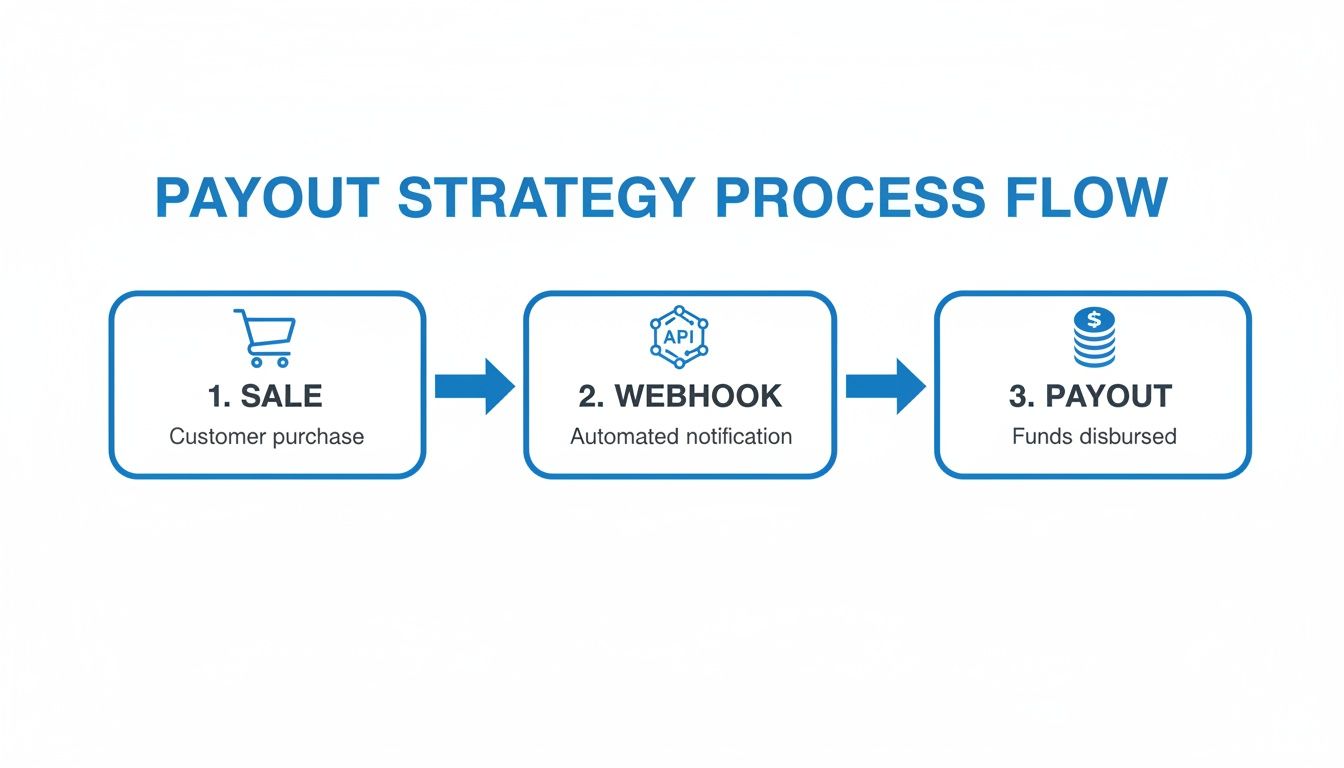
This three-step process is the engine of a modern partner program, ensuring every commission is tracked instantly and accurately, no manual spreadsheets required.
How Does The Software Handle International Payouts?
Without the right system, paying partners around the world is a logistical nightmare. You're juggling different currencies, a dozen payment methods, and a tangled web of tax compliance rules. Manually wiring money to partners in ten different countries just isn't a long-term solution.
This is where a good commission platform really proves its worth.
The best ones integrate directly with global payment networks like PayPal or Wise. This means you can run mass payouts to partners all over the globe with just a few clicks. The system takes care of the currency conversions and makes sure the money gets there through a method that actually works in your partner's country.
Even better, top-tier software helps automate tax compliance. It can collect the right tax forms—like a W-9 for U.S.-based partners or a W-8BEN for international ones—as part of the onboarding process. That feature alone can save you from a mountain of paperwork and keep you on the right side of international finance laws, which is a huge weight off any founder's shoulders.
What Is The Typical Time To Launch A Native Program?
This is a huge one for founders and developers who guard their time fiercely. The answer comes down to which type of tool you choose: a traditional, external platform or a modern, embeddable one.
With the old-school external platforms, you could be looking at weeks or even months to get going. It’s often a long slog of wrestling with APIs to sync data, trying to brand a third-party portal to look like your own, and then testing the fragile links between the two systems.
But with a native, embeddable tool built specifically for SaaS, that timeline gets crushed.
The setup for a truly embeddable solution is incredibly simple:
- Sign Up: Just create an account with the provider.
- Connect Your Payment Gateway: Link your Stripe or LemonSqueezy account, which is usually a one-click process.
- Embed the Dashboard: Copy a single piece of code and drop it into your app wherever you want the partner portal to live.
And that’s really it. Most SaaS teams can go from signing up to having a fully functional, branded partner dashboard inside their own product in under an hour. This speed means you can get your program live and start seeing results right away, without derailing your entire product roadmap.
Ready to launch a fully native, embeddable affiliate program in minutes? Refgrow gives you the tools to build, track, and scale a powerful partner ecosystem right inside your SaaS product. With no earning caps or transaction fees, you can start growing today. Explore Refgrow and start your journey.