

12 Best Marketing Attribution Software Tools for SaaS in 2026

Understanding which marketing efforts actually drive revenue is a fundamental challenge for any SaaS business. Without clear data, you're essentially guessing where to invest your budget, time, and resources. A prospect might see a social media ad, read a blog post, attend a webinar, and finally click a retargeting ad before converting. Which touchpoint gets the credit? This is the core problem that marketing attribution software is built to solve.
This guide moves beyond generic feature lists to provide a comprehensive, comparative roundup of the top attribution platforms available today. We'll dissect the strengths, weaknesses, and ideal use cases for each tool, from enterprise-grade multi-touch solutions to specialized mobile and in-app trackers. You'll gain a clear understanding of which platform aligns with your specific growth model, whether you're an early-stage startup focused on product-led growth or an established firm managing complex, cross-channel campaigns.
Inside this resource, you will find:
- Detailed analysis of 12 leading attribution tools, complete with screenshots and direct links.
- Practical implementation insights to help you get started and avoid common pitfalls.
- Honest assessments of each platform's limitations and pricing structures.
- Specific guidance on where native referral tracking solutions, like Refgrow, fit into a modern attribution stack for in-app, product-led loops.
Our goal is to equip you with the necessary information to select the right marketing attribution software that provides actionable insights, clarifies your customer journey, and helps you make smarter, data-driven decisions to scale your business effectively.
1. Google Analytics 4 (GA4)
For many SaaS startups, Google Analytics 4 (GA4) is the default starting point for understanding user behavior and campaign performance. Its position as a free, powerful tool makes it the undisputed baseline for web and app analytics. Unlike its predecessor, GA4 is built around an event-based model, which provides a more flexible foundation for modern marketing attribution software needs.
GA4’s primary attribution feature is its data-driven model, which uses machine learning to assign credit to various touchpoints across the customer journey. This moves beyond simplistic last-click analysis, offering a more nuanced view of how channels like organic search, paid ads, and social media contribute to conversions. The deep, native integration with Google Ads is a major advantage, allowing teams to not only analyze performance but also activate audiences directly based on attribution insights.
Key Strengths & Use Cases
- Best For: Early-stage SaaS companies needing a free, robust solution to measure multi-channel campaign effectiveness and understand user acquisition paths.
- Primary Use Case: Comparing different attribution models (e.g., data-driven vs. last-click) to understand the incremental impact of top-of-funnel marketing efforts.
- Implementation Tip: Ensure your conversion events are set up correctly from day one. The quality of your attribution data depends entirely on the accuracy of these events.
GA4 is an essential tool, but it primarily focuses on website and ad-driven touchpoints. For SaaS businesses running in-app referral programs, its attribution capabilities have limitations. Understanding how to track user-to-user recommendations requires specialized tools, which is why many turn to dedicated referral tracking software to complement their analytics stack.
Limitations & Pricing
While the standard version is free, the reporting interface has a steep learning curve, especially understanding how different reports use different attribution models. The enterprise version, GA4 360, removes data sampling and increases limits but comes with a significant, sales-led price tag that is often prohibitive for smaller businesses.
Website: https://analytics.google.com
2. Adobe Marketo Measure (formerly Bizible)
For B2B SaaS companies with long, complex sales cycles, Adobe Marketo Measure (formerly Bizible) offers a powerful solution focused on revenue attribution. It moves beyond standard web analytics to connect marketing activities directly to pipeline and closed-won deals within a CRM. As a true enterprise-grade marketing attribution software, its strength lies in stitching together touchpoints from disparate sources to deliver a unified view of the customer journey.
Marketo Measure is engineered to handle the complexities of account-based marketing, providing insights into which channels, campaigns, and content influence key decision-makers over months or even years. Its multi-touch attribution models (like W-Shaped and Full Path) are purpose-built for B2B, giving credit to initial touches, lead creation, and opportunity creation stages. The deep, native integration with Salesforce and Microsoft Dynamics, alongside the broader Adobe Experience Cloud, makes it a go-to for teams already invested in that ecosystem.
Key Strengths & Use Cases
- Best For: Mature B2B SaaS companies that rely on a CRM like Salesforce and need to prove marketing’s direct impact on revenue and sales pipeline.
- Primary Use Case: Analyzing long-term campaign ROI by connecting ad spend and marketing efforts to specific sales opportunities and their final deal size.
- Implementation Tip: Plan for a cross-functional implementation. Getting the most from Marketo Measure requires close collaboration between marketing operations, sales operations, and your CRM administrators to ensure data integrity.
Marketo Measure excels at attributing high-value, sales-led deals to marketing campaigns. However, its focus is external marketing touchpoints, not product-driven growth loops. For SaaS companies aiming to measure and scale word-of-mouth through in-app channels, specialized referral tracking software is necessary to capture the user-to-user interactions that drive organic acquisition.
Limitations & Pricing
Marketo Measure is a premium solution with pricing to match. The cost is sales-led and can be a significant investment, making it less accessible for smaller businesses. Its complexity means implementation isn't a simple plug-and-play process; it requires dedicated resources and a well-defined strategy to configure correctly and manage ongoing data hygiene.
Website: https://business.adobe.com/products/marketo-measure.html
3. HubSpot Marketing Hub (Attribution Reporting)
For SaaS companies invested in an all-in-one platform, HubSpot’s Marketing Hub offers a compelling attribution solution tightly integrated with its CRM. Instead of juggling disparate tools, HubSpot provides a single source of truth connecting marketing activities directly to sales outcomes. This CRM-native approach is its biggest differentiator, allowing teams to visualize the entire customer journey from the first touchpoint to closed-won revenue within one system.
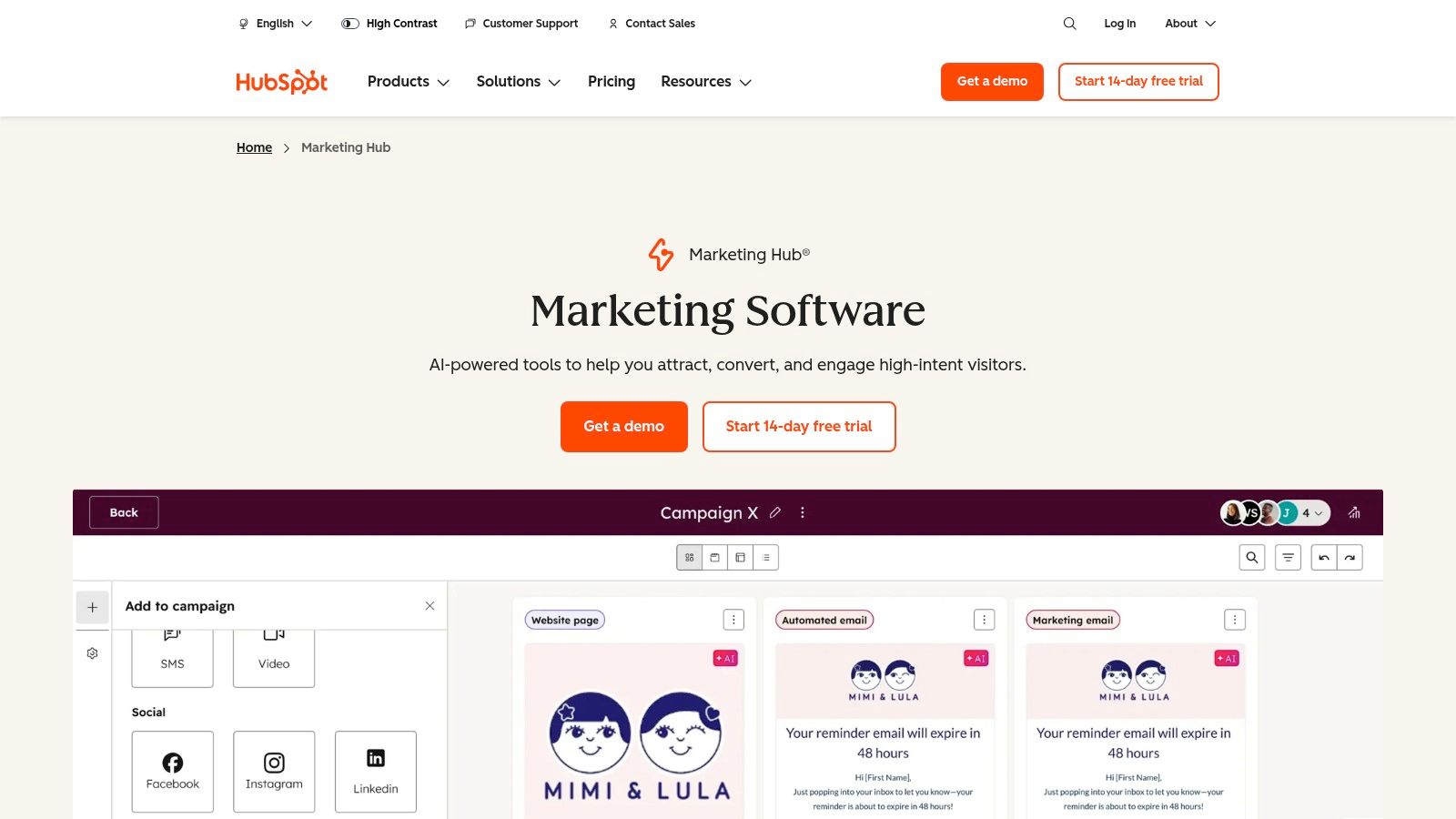
The platform’s multi-touch revenue attribution models, available in the Enterprise tier, assign credit across various interactions, such as blog posts, social media, and paid ads. This is crucial for businesses with long sales cycles, where understanding the influence of each channel is key. The strength of HubSpot lies in its ability to connect these marketing touchpoints to specific deals and contacts in the CRM, providing clear visibility into campaign ROI.
Key Strengths & Use Cases
- Best For: Scaling SaaS businesses that need a unified CRM, marketing, and sales platform with built-in attribution to prove marketing’s impact on revenue.
- Primary Use Case: Creating custom reports that tie specific marketing campaigns (e.g., a new webinar series) directly to the revenue they generated over a six-month period.
- Implementation Tip: Standardize your UTM parameter usage across all campaigns. HubSpot’s attribution reporting relies heavily on these tags to correctly categorize traffic and touchpoints.
HubSpot excels at attributing marketing-to-sales pipeline activities. However, its focus is on traditional channels. It doesn't natively track or attribute product-led growth loops like in-app user referrals, which require a specialized approach to properly measure marketing ROI from word-of-mouth.
Limitations & Pricing
The most powerful attribution features, including multi-touch revenue attribution, are gated behind the expensive Enterprise plan. Businesses on the Starter or Professional tiers have access to more limited, source-based reporting. The platform's all-in-one nature can also lead to vendor lock-in, making it difficult to migrate away if your needs change.
Website: https://www.hubspot.com/products/marketing
4. AppsFlyer
For SaaS companies with a significant mobile presence, AppsFlyer is a dominant player in the mobile measurement partner (MMP) space. It provides sophisticated marketing attribution software designed to navigate the complexities of app installs, in-app events, and user journeys that span mobile and web. Its core strength lies in connecting mobile ad spend to specific user actions, offering clarity in a frequently opaque ecosystem.
AppsFlyer excels at multi-touch attribution across mobile, web, and even connected TV (CTV), providing real-time reporting that is essential for optimizing paid campaigns. With robust support for Apple’s SKAdNetwork (SKAN), it helps marketers adapt to privacy-centric measurement. To leverage such a powerful tool effectively, it’s important that teams also implement proven app marketing strategies to drive initial user acquisition.
Key Strengths & Use Cases
- Best For: Mobile-first SaaS businesses that rely heavily on paid user acquisition and need granular, real-time attribution data from a vast network of ad partners.
- Primary Use Case: Accurately attributing app installs and in-app purchases to specific ad campaigns from partners like Meta, Google, and TikTok, while also measuring web-to-app user flows.
- Implementation Tip: Utilize the extensive partner marketplace to integrate with your existing ad networks and analytics tools from the start. This ensures data flows correctly across your entire marketing stack.
AppsFlyer is the go-to for mobile ad attribution, but it’s not built for organic, user-driven growth channels like in-app referrals or partner programs. While it can track installs from a link, it lacks the infrastructure for managing payouts, creating unique partner links, or tracking commission-based performance, which is where the best affiliate tracking platforms provide critical functionality.
Limitations & Pricing
AppsFlyer offers a "Zero" free plan for small apps, but its primary commercial offering is a pay-as-you-go "Growth" plan. Pricing is based on conversions (e.g., $0.07 per conversion after a welcome package), which can become difficult to forecast and expensive at high volumes. Advanced features and add-ons for fraud protection or deep analytics can also significantly increase the total cost of ownership.
Website: https://www.appsflyer.com
5. Adjust
For SaaS companies with a significant mobile app presence, a Mobile Measurement Partner (MMP) like Adjust is a critical component of the marketing stack. Adjust specializes in providing precise attribution for mobile app installs, web-to-app conversions, and even connected TV (CTV) campaigns, offering a unified view where many standard analytics platforms fall short. Its core value is connecting ad spend on mobile networks directly to user actions within an app, making it a powerful piece of marketing attribution software for app-first businesses.
Adjust stands out with its transparent entry-level pricing, including a free Base plan for up to 1,500 monthly attributions, making it accessible for startups testing their mobile strategy. The platform provides flexible attribution windows and access to both raw and aggregated data, allowing teams to build custom reports and deep-dive into campaign performance. Its deep linking and fraud prevention suite are essential for ensuring a smooth user experience and accurate data integrity from the very first touchpoint.
Key Strengths & Use Cases
- Best For: SaaS businesses that rely heavily on a mobile app and need to attribute installs and in-app events to specific mobile ad campaigns and networks.
- Primary Use Case: Measuring the ROI of paid mobile user acquisition channels by linking ad impressions and clicks directly to app installs, registrations, and subscription events.
- Implementation Tip: Work closely with your development team to implement the Adjust SDK correctly. Accurate in-app event tracking is the foundation for all subsequent attribution analysis.
Adjust excels at attributing paid mobile acquisition but is not designed for organic, in-app growth loops. While it can tell you which ad network drove an install, it can't track word-of-mouth referrals between users. This is a common gap where dedicated referral tracking software becomes necessary to measure and reward user-to-user advocacy within the product itself.
Limitations & Pricing
Adjust's pricing model is usage-based, and while the free tier is generous, costs can escalate as attribution volume grows. Many of its most powerful features, such as incrementality measurement and advanced fraud protection, are sold as add-ons to its Core and Enterprise plans, which can significantly increase the total investment. Teams must carefully monitor their attribution volumes to manage and predict costs effectively.
Website: https://www.adjust.com
6. Branch
Branch excels where many traditional analytics tools falter: unifying user journeys across mobile apps, web, and even connected TV. It combines powerful deep linking technology with its attribution engine, allowing SaaS businesses to create seamless user experiences from ad click to in-app conversion. This integrated approach makes it a standout choice for companies where the mobile app is a core part of the customer lifecycle.
As a piece of marketing attribution software, Branch is built for the privacy-first era. Its Predictive Aggregate Modeling supports modern frameworks like Apple's SKAN and the Android Privacy Sandbox, ensuring marketers can still measure performance effectively. The platform also includes robust fraud defenses and extensive ad network integrations, providing a reliable, enterprise-grade foundation for performance marketing.
Key Strengths & Use Cases
- Best For: Mobile-first SaaS companies that need to attribute app installs and in-app events back to specific web, social, or ad campaigns.
- Primary Use Case: Creating a deep link in an email campaign that not only opens the app directly to a specific feature but also attributes the resulting user engagement back to that email.
- Implementation Tip: Leverage their "Journeys" feature to create smart web-to-app banners. This can significantly increase app adoption and provide clear attribution for those conversions.
Branch is the industry standard for linking and attribution between web and mobile app environments. Its core strength is ensuring a user's context is never lost, even when they cross from a browser to a native application.
Limitations & Pricing
While Branch offers clear self-serve plans like the "Activation" plan starting from $199/month, costs can increase with high user volume and the need for advanced features. Some of the more sophisticated attribution capabilities and enterprise-level support are only available on sales-assisted plans, which might be a hurdle for smaller teams.
Website: https://www.branch.io
7. Singular
Singular is a comprehensive measurement platform and Mobile Measurement Partner (MMP) that unifies attribution, cost aggregation, fraud prevention, and analytics into a single dashboard. It stands out by combining deep mobile app expertise with robust cross-platform capabilities, making it a powerful choice for SaaS companies that rely on both web and mobile applications to acquire and retain customers.
The platform excels at cost aggregation and ROI analytics, offering advanced ETL (Extract, Transform, Load) capabilities to pull spend data from countless sources. This gives marketers a true, unified view of performance that goes beyond just conversion tracking. For iOS-focused businesses, its predictive SKAdNetwork (SKAN) cohort modeling provides critical insights in a privacy-first world, making it a go-to piece of marketing attribution software for modern growth teams.
Key Strengths & Use Cases
- Best For: SaaS companies with a significant mobile app presence needing to consolidate attribution, ad spend, and ROI analytics across all channels.
- Primary Use Case: Analyzing the true ROI of paid campaigns by automatically aggregating cost data from every network and comparing it against attributed conversion value.
- Implementation Tip: Leverage their APIs early on to automate data pipelines. Connecting cost, attribution, and creative reporting to your internal business intelligence tools unlocks the most value.
Singular provides a holistic view of paid acquisition but is not built to track organic, user-driven growth channels like in-app referrals. Its focus is on attributing conversions to marketing campaigns, not on managing the lifecycle of user-to-user invites. This makes it essential to pair Singular with a dedicated tool like Refgrow to capture the full picture of your referral-led growth.
Limitations & Pricing
Singular offers a free tier with a generous allowance for paid conversions, making it accessible for startups. The Growth plan uses a transparent per-conversion pricing model (e.g., $0.05 per conversion), but this can become unpredictable and costly for high-volume B2C SaaS apps. Additionally, some advanced features, like raw data exports, are sold as separate add-ons, which can increase the total cost of ownership.
Website: https://www.singular.net
8. Kochava
Kochava is a powerful mobile-first attribution platform that has carved out a niche in cross-device and Connected TV (CTV) measurement. It provides sophisticated tools for mobile app-focused SaaS companies looking to understand user acquisition beyond traditional web channels. Its unique IdentityLink technology helps stitch together user journeys across mobile, web, and even OTT devices, offering a holistic view of campaign impact.

While many tools in the marketing attribution software space focus primarily on web-based journeys, Kochava excels at untangling the complex paths users take on mobile devices. Its cost aggregation features and fraud prevention are particularly valuable for businesses investing heavily in paid mobile acquisition, ensuring ad spend is both effective and secure. The platform's free tier provides a generous entry point for startups to test its core capabilities.
Key Strengths & Use Cases
- Best For: Mobile-centric SaaS companies and businesses advertising on emerging channels like CTV/OTT that need granular, cross-device attribution.
- Primary Use Case: Accurately measuring the ROI of mobile app install campaigns and understanding how CTV ad views influence in-app conversions.
- Implementation Tip: Take advantage of the high-touch onboarding support offered. Correctly configuring the SDK and event tracking for mobile and CTV is critical for accurate data.
Kochava is built for complex, paid media ecosystems, especially in mobile. However, its core strength is not in organic, user-driven growth channels like word-of-mouth or partner referrals. SaaS teams needing to attribute and scale in-app referral programs often find that dedicated referral tracking software provides the specific features required to manage and reward user-to-user advocacy effectively.
Limitations & Pricing
Kochava offers a permanently free "App Analytics" plan with limits (e.g., 10,000 attributed conversions/month). The paid "Foundation" plans start around $500/month and scale with usage, which requires careful monitoring to manage costs. Some users have noted that UI updates can create a short-term learning curve as they adapt to new layouts and workflows.
Website: https://www.kochava.com
9. Northbeam
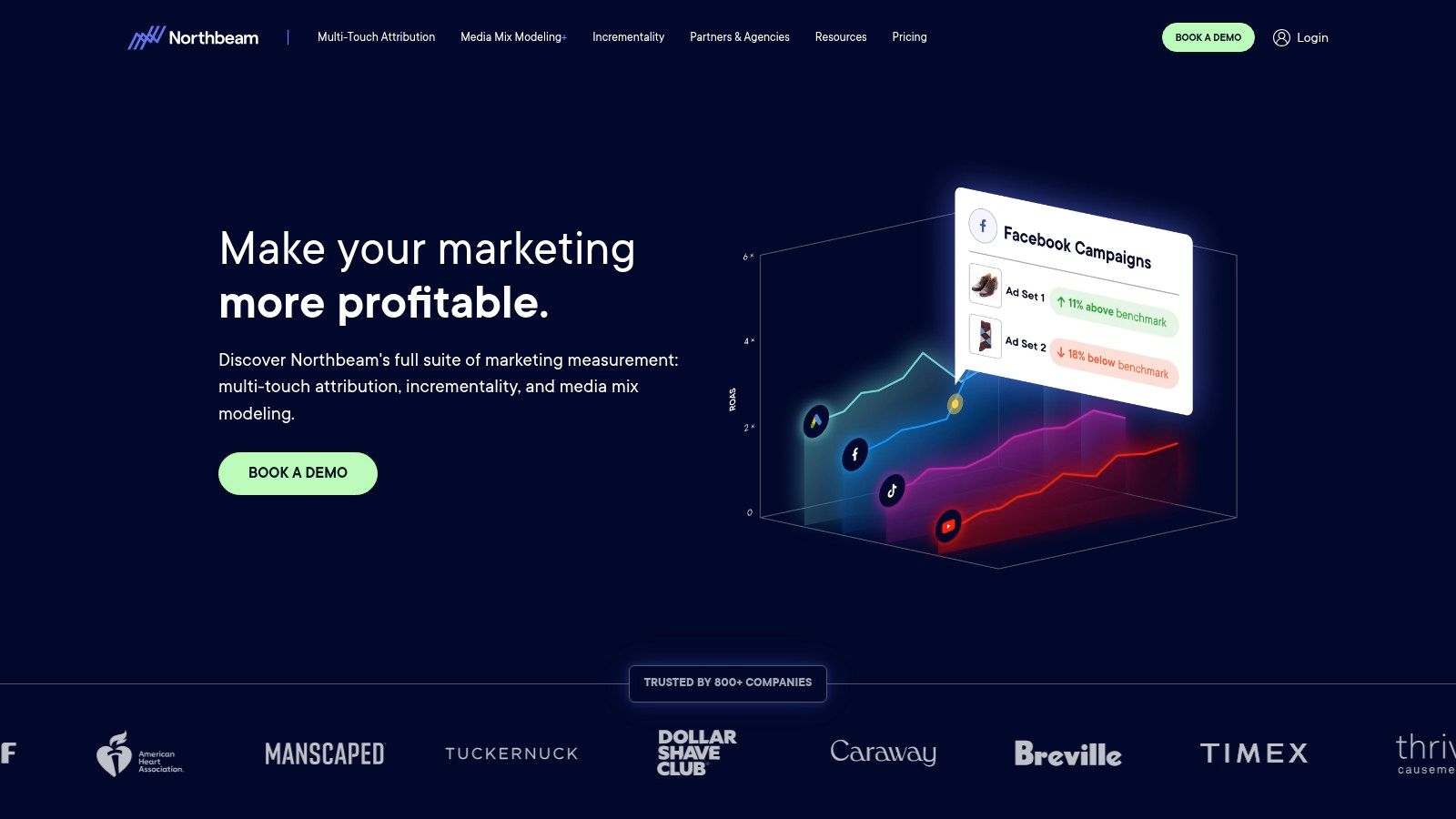
Northbeam is a first-party data platform built from the ground up for the post-privacy, DTC-focused advertising landscape. While many tools in this list serve SaaS, Northbeam's expertise lies in helping high-growth e-commerce and direct-to-consumer brands make sense of their paid media spend, especially on platforms like Facebook, Instagram, and TikTok. It goes beyond standard click tracking, offering modeled view-throughs to capture impression-based influence.
This platform stands out by merging tactical, daily multi-touch attribution (MTA) with strategic marketing mix modeling (MMM) in a single solution. This unique combination allows brands to analyze granular, creative-level performance day-to-day while also understanding broader, top-down channel impact over time. Its focus on first-party data collection makes it a powerful marketing attribution software choice for navigating the challenges of iOS updates and cookie deprecation.
Key Strengths & Use Cases
- Best For: E-commerce and DTC brands with significant paid media budgets that need to optimize ad spend across channels like paid social and search.
- Primary Use Case: Analyzing creative and campaign performance with customizable attribution windows for both clicks and views to get a true picture of paid social's impact.
- Implementation Tip: Leverage Northbeam's "Apex" signal to feed first-party conversion data back into ad platforms, which can improve their machine learning algorithms and ad delivery.
Northbeam excels at attributing value to external paid media, but it isn't designed for internal, product-led growth loops. SaaS businesses focused on user-driven acquisition, such as word-of-mouth or partner programs, find its e-commerce-centric model limiting. Tracking referrals that happen within an application requires a purpose-built system like referral tracking software to connect the dots between users.
Limitations & Pricing
Northbeam is a premium, specialized tool, and its pricing reflects that. Starter plans begin at $999 per month, making it a considerable investment for businesses that do not have a meaningful advertising spend to justify the cost. Its deep feature set is primarily tailored for the complexities of e-commerce, making it a less-than-ideal fit for most B2B or PLG SaaS companies.
Website: https://www.northbeam.io
10. Rockerbox
Rockerbox positions itself as a unified marketing measurement platform, primarily targeting the complex needs of direct-to-consumer (DTC) and ecommerce brands. It moves beyond singular attribution models by combining multi-touch attribution (MTA), marketing mix modeling (MMM), and incrementality testing into a single solution. This approach allows brands to get both granular, user-level insights and a high-level strategic view of their marketing performance.

The platform's strength lies in its data unification capabilities, integrating with over 100 ad, commerce, and data platforms to create a deduplicated, reliable data foundation. By connecting tactical MTA with strategic MMM, Rockerbox helps marketers understand both immediate campaign effectiveness and long-term channel impact. This dual perspective is crucial for scaling businesses that need to optimize budgets across a diverse and growing channel mix.
Key Strengths & Use Cases
- Best For: High-growth ecommerce and DTC brands with complex, multi-channel advertising strategies that need to connect tactical attribution with strategic budget planning.
- Primary Use Case: Using a unified model to decide how to allocate budget between performance channels (like paid search) and brand-building channels (like podcast ads or TV).
- Implementation Tip: Success with Rockerbox depends on the quality of your data feeds. Prioritize clean, consistent data from all your ad and commerce platforms before and during implementation.
Rockerbox is a powerful marketing attribution software for ad-heavy businesses, but it's not designed for the nuances of product-led growth. For SaaS companies where the most valuable conversions are driven by user-to-user invites and in-app referrals, its scope is limited. This is where tools like Refgrow provide a critical, specialized layer for tracking and attributing word-of-mouth growth that happens within the product itself.
Limitations & Pricing
Rockerbox is a premium, enterprise-focused solution, and its pricing is not publicly available, requiring a sales consultation. The platform's effectiveness is highly dependent on the quality and completeness of the data it receives, meaning a significant internal data-wrangling effort may be required to get the most value out of the tool.
Website: https://www.rockerbox.com
11. Dreamdata
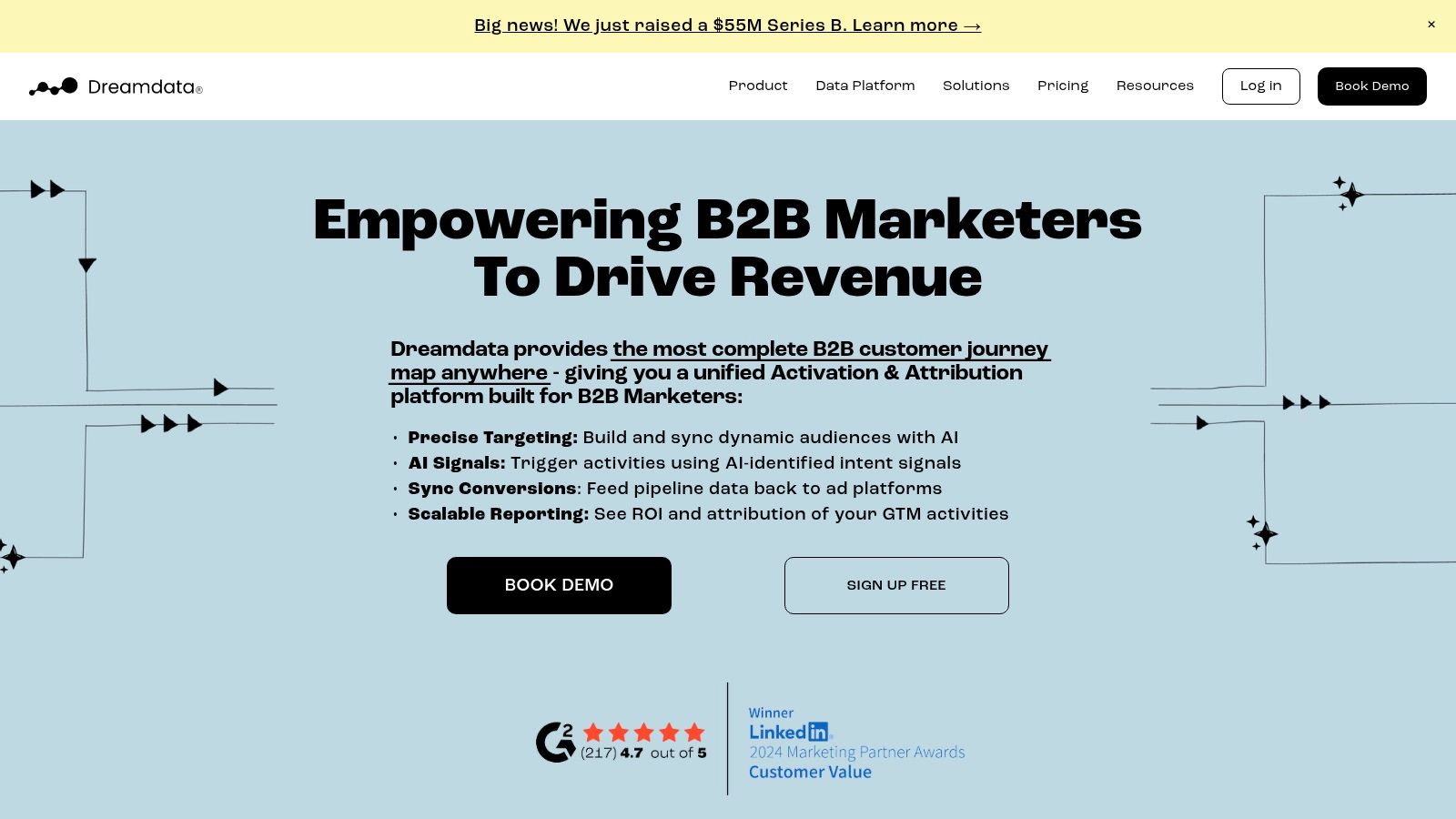
For B2B SaaS companies navigating long and complex sales cycles, Dreamdata offers a purpose-built revenue attribution platform. It moves beyond standard lead-level metrics to provide account-level analytics, connecting marketing activities directly to pipeline and revenue. By deeply integrating with CRMs like HubSpot and Salesforce, it provides a unified view that aligns marketing efforts with sales outcomes, making it powerful marketing attribution software for teams focused on account-based marketing (ABM).
Dreamdata excels at stitching together the B2B customer journey, from the first anonymous website visit to a closed-won deal in the CRM. It analyzes touchpoints from various sources, including ad platforms and organic channels, to reveal which campaigns influence key accounts and drive revenue. This approach helps marketers prove their impact on the bottom line, not just on generating leads.
Key Strengths & Use Cases
- Best For: B2B SaaS businesses with established CRM processes that need to connect marketing spend directly to multi-stakeholder sales cycles and revenue.
- Primary Use Case: Analyzing account-level journeys to understand which channels and campaigns are most effective at sourcing and influencing high-value deals.
- Implementation Tip: Ensure your CRM data is clean and your deal stages are well-defined. Dreamdata's value is maximized when it can pull accurate revenue and pipeline information from a well-maintained system.
Dreamdata provides a powerful account-level view, but its core focus is on marketing-to-sales attribution. For product-led SaaS companies where user-to-user growth is critical, its model doesn't capture the nuances of in-app referrals. This is where dedicated referral tracking software becomes essential for measuring and scaling virality within the product itself.
Limitations & Pricing
While Dreamdata offers an expanded free plan that is quite generous for getting started, its paid tiers are designed for the mid-market and come with quote-based pricing. The platform's true power is unlocked when a company has achieved a certain level of data maturity and has consistent CRM processes, which may present a challenge for very early-stage startups.
Website: https://dreamdata.io
12. G2 — Attribution Software Category
While not a tool itself, G2’s marketing attribution software category is an indispensable resource for research and vendor shortlisting. Instead of offering a single solution, it provides a comprehensive marketplace of options, powered by validated user reviews. This allows teams to compare platforms based on real-world experiences, filtering by company size, industry, and required features.
G2 acts as a critical discovery engine, helping teams move beyond well-known names to find niche or emerging tools that might be a better fit for their specific needs. Its live grid format allows for direct, side-by-side comparisons of vendor profiles, review scores, and feature sets. This social proof-driven approach provides a valuable layer of validation during the evaluation process, helping you understand how a platform performs in practice, not just in marketing materials.
Key Strengths & Use Cases
- Best For: SaaS marketing teams in the evaluation phase, looking to create a shortlist of potential attribution vendors and validate them with user feedback.
- Primary Use Case: Filtering the attribution software landscape by specific criteria (e.g., mobile attribution, multi-touch) and reading detailed reviews to understand implementation challenges and support quality.
- Implementation Tip: Pay close attention to reviews from companies of a similar size and industry to your own. A tool that works for a large enterprise may not be a good fit for a startup.
G2 is an excellent starting point for broad market research, but its categories often blend different types of attribution. For instance, it mixes B2B ad-focused platforms with tools for partner and affiliate programs. To accurately track and reward user-to-user referrals inside your SaaS product, a specialized solution like Refgrow is necessary to manage those unique, product-led loops.
Limitations & Pricing
The platform is free for buyers, but its business model relies on vendor sponsorships. This means sponsored listings and promoted profiles appear at the top of category pages, which requires careful discernment. Additionally, some vendor-provided information can become outdated, so it's always wise to verify details directly on the software provider's website.
Website: https://www.g2.com/categories/attribution
Top 12 Marketing Attribution Tools Comparison
| Product | Core focus | Key features ✨ | UX / Quality ★ | Price / Value 💰 | Target audience 👥 | Unique strength 🏆 |
|---|---|---|---|---|---|---|
| Google Analytics 4 (GA4) | Free web & app analytics baseline | Data-driven attribution, Ads & BigQuery integration ✨ | ★★★★ — powerful but steeper learning curve | 💰 Free; GA4 360 = expensive enterprise | 👥 Startups → Enterprises needing unified analytics | 🏆 Deep Google Ads ecosystem & scale |
| Adobe Marketo Measure | B2B revenue & opportunity attribution | Multi-touch revenue, CRM ingest, ROI dashboards ✨ | ★★★ — enterprise-grade, implementation heavy | 💰 Sales-led enterprise pricing | 👥 B2B orgs using Adobe/Marketo & CRMs | 🏆 Revenue-level attribution for long cycles |
| HubSpot Marketing Hub | CRM-native marketing + attribution | Multi-touch attribution (Enterprise), automation ✨ | ★★★★ — integrated UX; clear upgrade path | 💰 Enterprise features gated; onboarding fees | 👥 Startups → Scaleups on HubSpot CRM | 🏆 All-in-one CRM + marketing attribution |
| AppsFlyer | Mobile-first MMP & cross-platform attribution | SKAN support, fraud prevention, partner marketplace ✨ | ★★★★ — granular, scales well | 💰 Variable/per-conversion; forecasting complexity | 👥 Mobile apps & performance marketers | 🏆 SKAN tooling & wide ad-network coverage |
| Adjust | MMP with transparent entry | Raw data access, fraud suite, growth add-ons ✨ | ★★★★ — privacy-forward; solid global support | 💰 Free base; add-ons can raise costs | 👥 Mobile/global teams & privacy-conscious apps | 🏆 Transparent free entry + privacy posture |
| Branch | Deep linking + cross-channel attribution | Best-in-class deep links, SKAN, QR/link activation ✨ | ★★★★ — clear packaging; strong dev UX | 💰 Plans from ~$199–$499+/mo; scales with volume | 👥 Apps & cross-channel growth teams | 🏆 Deep linking tightly coupled with attribution |
| Singular | Attribution + cost aggregation & ETL | ROI analytics, cost ETL, fraud & SKAN tools ✨ | ★★★★ — strong analytics, unit economics focus | 💰 Growth: ~$0.05/conversion; free tier options | 👥 Performance teams needing cost aggregation | 🏆 Transparent per-conversion pricing + ETL |
| Kochava | Cross-device & CTV attribution | Free App Analytics tier, IdentityLink, cost agg ✨ | ★★★★ — CTV/OTT strength; UI evolution noted | 💰 Free up to limits; paid from ≈$500/mo | 👥 CTV/OTT advertisers & cross-device teams | 🏆 Strong CTV/OTT & cross-device measurement |
| Northbeam | First-party data + MTA for DTC | MTA + MMM, Apex signal, creative analytics ✨ | ★★★★ — strategic + tactical combo | 💰 Starter ≈ $999/mo; higher for scale | 👥 DTC/ecommerce brands with paid media | 🏆 MTA + MMM in one vendor for paid social |
| Rockerbox | Unified DTC measurement (MTA+MMM) | MTA, MMM, incrementality, 100+ integrations ✨ | ★★★★ — robust methodology; data dependent | 💰 Sales-led pricing | 👥 Multi-channel ecommerce measurement teams | 🏆 Integrates MTA, MMM & incrementality seamlessly |
| Dreamdata | B2B account-level revenue attribution | Account journeys, CRM-native activation ✨ | ★★★★ — SaaS-focused; CRM-dependent | 💰 Free plan + quote-based paid tiers | 👥 SaaS & long B2B sales cycles | 🏆 Account-level revenue attribution & activation |
| G2 — Attribution Category | Vendor discovery & social proof | Category grids, filters, user reviews ✨ | ★★★★ — fast shortlisting; community insights | 💰 Free to browse; sponsored listings exist | 👥 Buyers shortlisting attribution vendors | 🏆 Crowdsourced reviews & comparative rankings |
The Missing Piece: Attributing Product-Led Growth with Native Referrals
Navigating the landscape of marketing attribution software can feel like piecing together a complex puzzle. We've explored a dozen powerful platforms, from the foundational analytics of Google Analytics 4 to the enterprise-grade B2B insights of Marketo Measure and the mobile-first precision of tools like AppsFlyer and Branch. Each tool offers a unique lens through which to view your customer journey, illuminating the touchpoints that convert prospects into paying customers.
The core takeaway is clear: there is no single "best" marketing attribution software for every business. The right solution hinges entirely on your specific context, including your business model, customer journey complexity, technical resources, and budget. An e-commerce brand will find immense value in Northbeam's focus on paid media, while a B2B SaaS with a long sales cycle will lean on Dreamdata's revenue-centric models. The key is to map your needs to the tool's strengths.
Your Roadmap to Choosing the Right Attribution Tool
As you move from evaluation to implementation, the decision-making process can be distilled into a few critical steps. Selecting the right platform requires a strategic approach that goes beyond a simple feature comparison.
First, define your "attribution question." Are you trying to optimize ad spend on social media? Do you need to understand which content assets influence enterprise deals? Or are you focused on how users invite other users within your product? Your primary goal will immediately narrow the field.
Next, conduct a technical audit. Assess your existing martech stack and the technical expertise available on your team. A tool like HubSpot offers seamless integration if you're already in its ecosystem, but a more advanced platform like Rockerbox may require dedicated developer time to implement its tracking scripts and API connections correctly. Don't underestimate the resources needed for a successful rollout.
Finally, start with a focused goal. Avoid the temptation to track everything at once. A common pitfall is "analysis paralysis," where an overwhelming amount of data leads to inaction.
- For early-stage startups: Begin by connecting top-of-funnel marketing channels to first-touch sign-ups.
- For PLG-focused companies: Prioritize tracking in-app user actions that lead to upgrades or referrals.
- For sales-led organizations: Concentrate on mapping marketing touchpoints to qualified leads and closed-won deals in your CRM.
The Overlooked Engine: In-App Referrals
While the tools we've covered excel at tracking external marketing channels, they often have a blind spot. They struggle to accurately attribute growth that happens inside your product, driven by your most engaged users. This is the domain of product-led growth, where one happy customer invites another, creating a powerful, cost-effective acquisition loop.
Traditional marketing attribution software is built to track UTM parameters, ad clicks, and website visits. It isn’t designed to manage unique referral codes, track in-app invites, and automate reward payouts directly within your application's native environment. This is a critical gap for any SaaS business that relies on word-of-mouth and user advocacy as a primary growth lever. Bolting on an external tool can create a disjointed user experience and fail to capture the true value of your most loyal customers.
True product-led attribution requires a different approach, one that is built into the core user experience. By empowering users to become advocates directly within your platform, you create a frictionless growth engine that traditional marketing attribution tools simply cannot measure effectively. This is the final, crucial piece of the attribution puzzle.
If your growth strategy relies on users inviting users, you need attribution that lives inside your product, not just on your marketing site. Refgrow provides a developer-first API to build, launch, and manage a native referral program in minutes, giving you the missing piece of your attribution puzzle. See how it works at Refgrow.