

How to Measure Marketing ROI: Master how to measure marketing roi in 4 steps

When you get down to it, measuring marketing ROI is all about proving your efforts bring in more money than they cost. You’ve probably seen the basic formula: (Net Profit - Marketing Cost) / Marketing Cost. But for a SaaS business, that’s just scratching the surface. The real magic happens when you start comparing Customer Lifetime Value (CLV) to your Customer Acquisition Cost (CAC).
This shift in focus takes you from thinking about one-off sales to understanding long-term, sustainable profitability.
Why Measuring Marketing ROI Matters
Knowing how to measure your marketing ROI is what separates strategic investment from just spending money. If you don't have a clear picture of what’s working, you're flying blind, throwing your budget at campaigns and just hoping for the best.
This is especially true in SaaS, where a customer's true value isn't realized in a single transaction. It builds over months, sometimes years. When you can clearly track and report on your ROI, you can walk into any leadership meeting and provide the financial justification for your budget. Suddenly, marketing isn’t a cost center; it’s a proven engine for revenue.
Moving Beyond Simple Calculations
While that classic ROI formula has its place, a truly modern approach demands a much closer look. We're not just interested in the final sale anymore. We need to understand the entire customer journey, which means tracking multiple touchpoints and giving credit where it's due.
Whether you're running traditional campaigns or complex digital marketing initiatives, the core principles of measuring ROI are what empower you to make smarter decisions.
For any SaaS company, this means zeroing in on a few key metrics that signal the long-term health of the business:
- Customer Lifetime Value (CLV): This is the total revenue you can reasonably expect to earn from a single customer over their entire time with you.
- Customer Acquisition Cost (CAC): This is your total sales and marketing spend divided by the number of new customers you brought in.
- CLV to CAC Ratio: This is the real moneyball metric. It directly measures the profitability and efficiency of your marketing. A healthy ratio is typically seen as 3:1 or higher—proof that your business model is built to last.
Focusing on the CLV to CAC ratio forces you to align your marketing with what actually drives growth. It's no longer just about getting a quick conversion; it's about acquiring customers who will stick around and become truly valuable.
Getting these metrics right helps you pinpoint which channels are delivering the most valuable customers, not just the cheapest leads. For a more detailed breakdown, our guide on measuring marketing campaign effectiveness goes even deeper into the topic.
Before you can plug anything into a formula, you need the right data. The table below breaks down the essential metrics you'll need to start your analysis.
Essential Metrics for Calculating SaaS Marketing ROI
Here’s a quick rundown of the core data points you’ll need to pull together to get an accurate picture of your marketing return on investment.
| Metric | What It Measures | Why It Matters for ROI |
|---|---|---|
| Total Marketing Investment | All costs tied to a campaign or time period, including ad spend, tool subscriptions, and team salaries. | This is the "Investment" in your ROI calculation. If this number isn't accurate, your entire analysis will be off. |
| Total Revenue Attributed | The total sales or revenue generated directly from your marketing efforts. | This is the "Return" half of the equation. It relies heavily on proper tracking and attribution to be meaningful. |
| Customer Lifetime Value (CLV) | The projected total revenue a single customer will generate throughout their relationship with your business. | CLV gives you a long-term view of a customer's worth, which is absolutely essential for subscription models. |
| Customer Acquisition Cost (CAC) | The average expense to acquire a single new customer, including all marketing and sales costs. | CAC shows how efficient your acquisition engine is and directly impacts your overall profitability. |
With these numbers in hand, you're well on your way to moving past guesswork and into a world of data-backed marketing decisions.
Laying the Groundwork for ROI You Can Actually Trust
Before you can even think about plugging numbers into a formula, you need data. And not just any data—you need reliable, clean data. Getting this right is easily the most important part of measuring marketing ROI. It's all about building a system that captures every critical step a customer takes, giving you a single source of truth you can bet your budget on.
For any modern SaaS company, this usually comes down to getting a few core tools to play nicely together. We're talking about your analytics platform (like Google Analytics), your CRM (think HubSpot or Salesforce), and your payment processor (Stripe is a popular one). The magic happens when these systems are connected, breaking down the data silos that so often keep valuable insights locked away.
Getting Your Key Tools to Talk to Each Other
One of the biggest headaches I see is trying to connect a specific sale back to the marketing campaign or referral that drove it. If you're running an affiliate program, for instance, you have to know exactly which partner sent you that new paying customer. This is where a solid integration is worth its weight in gold.
This is precisely the problem tools like Refgrow were built to solve. By integrating directly with payment gateways like Stripe, you can use webhooks to automatically tie a new subscription back to the affiliate who sent them your way. Suddenly, you have a clear, undeniable line connecting a marketing activity (the affiliate’s promotion) to the revenue it created. This direct link is the foundation of any accurate ROI tracking for your referral marketing.
Trying to do this manually by matching sales to affiliates is a recipe for disaster. It's not just a massive time sink; it’s incredibly prone to expensive mistakes. A seamless integration means every single conversion gets attributed correctly, automatically.
Ultimately, the entire process boils down to a simple, three-stage flow: gather your data, run the numbers, and then compare your return against what you spent.
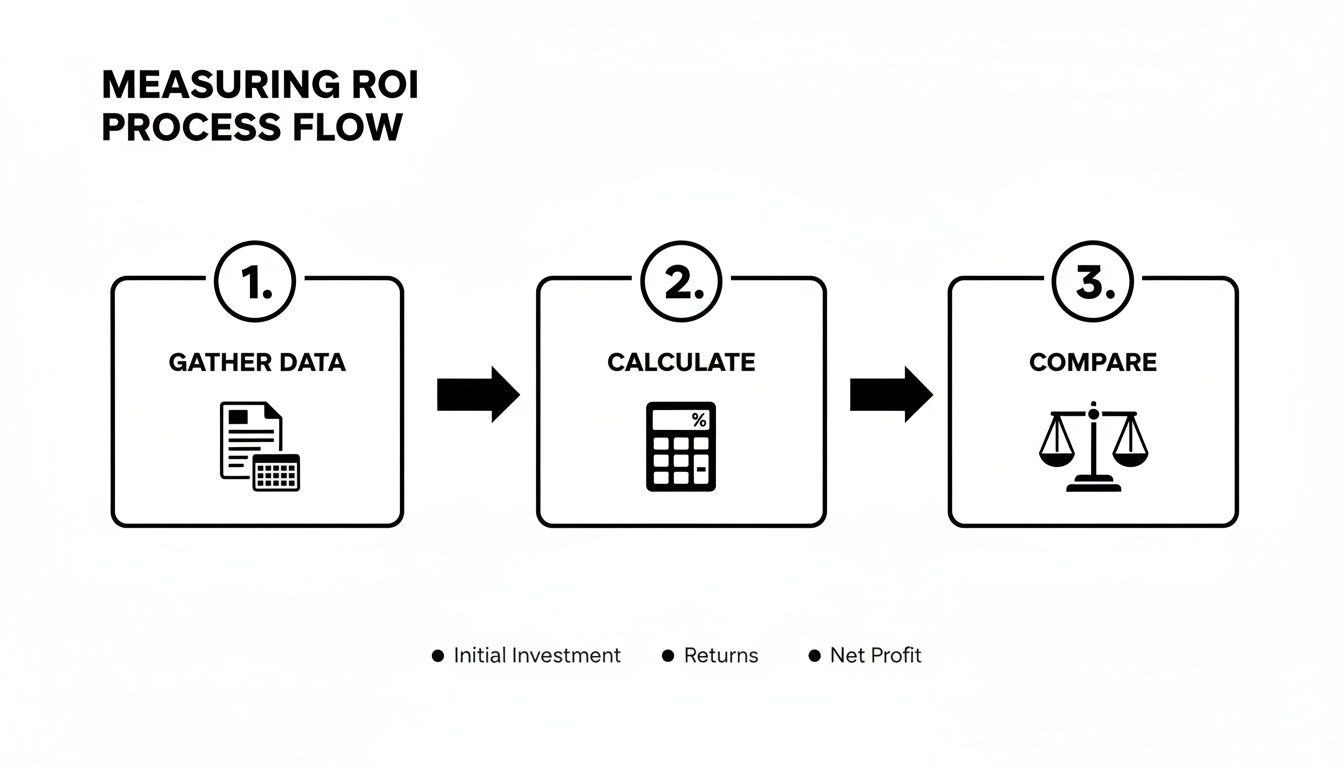
As you can see, solid data collection is always square one. Without it, you’re just guessing.
Making UTM Parameters Your Best Friend
Beyond your internal tech stack, you need a way to track where your traffic is coming from out in the wild. That's the job of Urchin Tracking Module (UTM) parameters. They're just simple tags you add to the end of a URL, but they give your analytics platform the full story of how someone landed on your site.
Consistent UTM use across every single one of your marketing channels isn't just a good idea—it's non-negotiable for accurate ROI. A well-organized UTM strategy is how you trace a paying customer all the way back to their origin point with total confidence.
Here’s what that looks like in the real world:
- Paid Social Ads: Tag every ad with the platform (
utm_source=linkedin), the campaign (utm_campaign=q3-feature-launch), and even the specific creative (utm_content=video-ad-1). Now you can see which ad actually drove valuable signups, not just clicks. - Email Newsletters: Every link in your newsletter needs a tag. Something like
utm_source=newsletter,utm_medium=email, andutm_campaign=weekly-digest-oct22tells you exactly how much punch your email marketing is packing. - Affiliate Links: Always give your partners pre-tagged links. A simple structure like
utm_source=affiliate-partner-nameandutm_medium=referralkeeps everything clean.
By making this a standard process, you can slice and dice your analytics and CRM data to see which channels aren't just bringing in traffic, but which ones are bringing in the right traffic—the kind that pays. This level of detail is what allows you to calculate the ROI of individual campaigns and decide where to put your money next. This data is also a crucial piece of the puzzle when you calculate your customer acquisition cost, giving you a much clearer picture of your marketing's overall efficiency.
The Core Formulas for Calculating Marketing ROI

Alright, with your data tracking humming along, it’s time to actually put those numbers to work. The basic marketing ROI formula is beautifully simple, and it’s the foundation for everything else we'll discuss.
The classic formula you’ve probably seen is: (Return – Investment) / Investment × 100
This spits out a percentage that tells you how much you earned for every dollar spent. So, if you drop $5,000 on a campaign and it brings in $20,000 in revenue, your ROI is a solid 300%. That math is easy enough, but for a subscription business, the idea of "Return" is much, much bigger.
Moving from Revenue to Lifetime Value
For any SaaS company, a customer's first payment is just the opening chapter. If you only measure the initial sale, you're drastically undervaluing your marketing. The real win is acquiring customers who stick around and become part of your long-term growth story.
This is where two of the most important metrics in the game come into play: Customer Lifetime Value (CLV) and Customer Acquisition Cost (CAC). Getting a firm grip on these is the secret to measuring marketing ROI accurately in a subscription model.
The real magic isn't just knowing these two numbers; it's understanding how they relate to each other. This is where the CLV to CAC ratio comes in, and honestly, it’s probably the single most important metric for a SaaS business.
A healthy CLV to CAC ratio, typically 3:1 or higher, is the clearest signal that your business model is actually sustainable. It’s proof that you’re not just buying customers, but acquiring profitable ones who will fuel your growth for years.
This simple ratio completely shifts your perspective. You stop obsessing over just lowering acquisition costs and start focusing on maximizing the long-term value from every single dollar you invest. To go deeper, you can explore our in-depth guide on how to calculate SaaS customer lifetime value.
Calculating Your CLV to CAC Ratio
To get this ratio, you obviously need to figure out your CLV and CAC first. Let’s walk through a quick, practical example.
Imagine your SaaS product has an Average Revenue Per Account (ARPA) of $50/month. On average, your customers stick around for 24 months.
- First, get your CLV: Just multiply your ARPA by the average customer lifetime. That's $50 x 24 months = $1,200.
Now, let's say last quarter you spent $30,000 on all your marketing and sales efforts, and that brought in 100 new customers.
- Next, calculate CAC: Divide your total spend by the new customers acquired. That’s $30,000 / 100 customers = $300.
With both numbers in hand, the final step is a breeze.
- Find the CLV to CAC Ratio: Simply divide CLV by CAC. For this example, that's $1,200 / $300 = 4. This gives you a 4:1 ratio, which is fantastic. It means for every dollar you spend to get a customer, you can expect to get four dollars back over their lifetime with you.
Defining Your Total Marketing Investment
One of the most common mistakes I see teams make is undercounting their investment. To get a true picture, you have to account for every single cost that goes into your marketing. If you miss something, you'll artificially inflate your ROI and end up making bad decisions based on faulty data.
Your total marketing investment isn't just your ad spend. It’s the whole picture:
- Direct Ad Spend: The obvious one. All the money you're giving to Google Ads, LinkedIn, Facebook, and other ad platforms.
- Tool Subscriptions: Don't forget your martech stack! This includes your CRM, email platform, analytics tools, and especially your affiliate software like Refgrow.
- Content Creation Costs: Any fees for writers, designers, or video producers, whether they're in-house or freelance.
- Team Salaries: A portion of your marketing team’s salaries should absolutely be allocated to the campaigns they’re running.
- Agency or Freelancer Fees: Any outside help you’re paying for is part of the cost.
Tallying all these expenses gives you a far more realistic view of what it actually takes to run your marketing engine.
What About Brand Building and EMV?
Okay, but not every marketing activity has a direct line to revenue. What about that viral social media post or getting featured in a major industry publication? These things build priceless brand awareness and trust, but they're notoriously hard to stick a number on.
This is where a concept called Earned Media Value (EMV) can be helpful. EMV is a proxy metric that tries to estimate the value of third-party mentions, like social shares, press coverage, or influencer posts. It answers the question, "What would we have paid to get this same reach and engagement through ads?"
While it’s not a hard revenue metric, EMV is a useful tool for comparing the impact of your brand-building efforts and showing their value to people who want to see a number for everything.
Choosing the Right Attribution Model for Your Business
Once you've got your data pipeline sorted, the real head-scratcher begins: how do you give credit where credit is due? This is the world of marketing attribution, and frankly, it's where a lot of teams get turned around. The model you pick can completely change how you see your channel performance, which has a massive knock-on effect on how you measure ROI.
The goal isn't to chase some mythical "perfect" model—it doesn't exist. The real aim is to find a model that actually reflects how your customers buy. In B2B, sales cycles can be a long, winding road, often stretching 6-12 months and packed with dozens of touchpoints. A simplistic model in that environment isn't just unhelpful; it's actively misleading.
Single-Touch vs Multi-Touch Attribution
The most basic approaches fall under the single-touch attribution umbrella. They're popular because they are dead simple to set up, but that simplicity is also their biggest flaw.
- Last-Click Attribution: This one gives 100% of the credit to the final interaction a person had before they converted. It’s okay for seeing what closes the deal, but it’s completely blind to everything that warmed them up in the first place.
- First-Click Attribution: The flip side of the coin, this model gives all the glory to the very first touchpoint. It’s fantastic for figuring out which channels bring new people into your orbit but ignores all the important nurturing that follows.
Relying only on these models is a recipe for bad decisions. You might end up slashing the budget for a blog that brings in your best customers, all because it wasn't the "last click."
A classic trap is defaulting to the last-click model just because it's the standard in tools like Google Analytics. For any company with a considered purchase, this model will almost always over-value bottom-of-funnel channels (like branded search ads) and shortchange top-of-funnel efforts (like content or social media).
This is exactly why most businesses with a real sales cycle need to embrace multi-touch attribution. These models spread the credit across multiple interactions, giving you a much more honest picture of what’s really working.
Exploring Popular Multi-Touch Models
Multi-touch attribution operates on a simple, powerful idea: a conversion is the result of a team effort, not a solo act. Each model just has a different opinion on how to distribute the credit.
Let's walk through a common scenario. A new user signs up for your product after a month-long journey. It started with a blog post, followed by a LinkedIn retargeting ad. A week later, they attended a webinar, and they finally converted by clicking a link in your newsletter.
Here’s how a few different multi-touch models would slice it:
- Linear Model: This is the most democratic model. It splits credit equally across every touchpoint. In our example, the blog, LinkedIn ad, webinar, and email would each walk away with 25% of the credit. It’s a solid, fair-minded starting point, but it assumes every interaction had the same impact.
- Time-Decay Model: This model is all about momentum. It gives more weight to the touchpoints that happened closer to the conversion. The newsletter click would get the most credit, then the webinar, the ad, and finally the blog post. This is a great fit for longer B2B sales cycles, as it puts a premium on the final nudges that got the deal done.
- Position-Based (U-Shaped) Model: This model champions the beginning and the end of the journey. It typically gives 40% of the credit to the first touch and 40% to the last one, then divides the remaining 20% among all the interactions in the middle. It’s perfect if you believe the moment of discovery and the moment of decision are the most important.
Marketing Attribution Model Comparison
Picking a model isn't a permanent decision, but it's a critical one. The right model brings clarity to your marketing efforts, helping you see which channels are true growth drivers. This table breaks down the most common models to help you find the best starting point for your business.
| Attribution Model | How It Works | Best For | Potential Pitfall |
|---|---|---|---|
| Last-Click | Gives 100% credit to the final touchpoint before conversion. | Short sales cycles and direct-response campaigns where the last action is key. | Ignores all upper and mid-funnel marketing efforts that build awareness. |
| Linear | Distributes credit equally across all touchpoints in the journey. | Businesses that want to value every interaction and have a consistent customer journey. | Can undervalue key moments of influence by treating all touchpoints the same. |
| Time-Decay | Assigns increasing credit to touchpoints as they get closer to the conversion. | Long sales cycles, especially in B2B or PLG, where recent interactions are critical. | Can undervalue the initial awareness-building channels that start the journey. |
| Position-Based | Gives the most credit to the first and last touchpoints (e.g., 40% each), with the rest distributed in the middle. | Companies that highly value both lead generation and conversion-closing activities. | May not give enough credit to important mid-funnel nurturing activities like webinars. |
Ultimately, the best model for you depends entirely on your sales cycle and business goals. Don't be afraid to experiment. Start with the one that feels most logical, and as you gather more data, you can refine your approach to get an even clearer view of your marketing performance.
Putting Your ROI Data into Action

Calculating your marketing ROI is a great first step, but the numbers themselves don't change anything. The real magic happens when you use that data to make smarter, more profitable decisions. Think of your ROI report as a roadmap, clearly pointing out where your budget is fueling real growth and where it's simply being burned.
This isn't a one-and-done analysis. The goal is to create a constant feedback loop: you analyze performance, spot the winners, shift your resources accordingly, and then measure the results of those changes. This cycle is what drives efficient, scalable growth.
Identify Your Winners and Losers
The first thing to do is line up all your channels side-by-side. Compare the ROI from your paid ads, content marketing, email campaigns, and your affiliate program. The differences can be jarring, but they immediately show you which channels are pulling their weight.
For instance, you might find your paid social ads are great for getting sign-ups, but the CLV to CAC ratio is a measly 1.5:1. Meanwhile, your affiliate program—tracked seamlessly with Refgrow—is bringing in customers with a much healthier 4:1 ratio. This is an incredibly valuable insight. It tells you that every customer you acquire through an affiliate is ultimately worth far more to your business.
Your goal isn't just to find channels with a positive ROI, but to find the ones with the best ROI. A channel that breaks even is still consuming resources that could be generating a 3x or 4x return elsewhere.
Once you’ve found the weak links, don't hesitate to make a change. It's almost always better to cut a channel that’s barely treading water and reinvest that cash into a proven performer.
Double Down on What Works
When a channel is clearly winning, that’s your cue to go all in. If your affiliate program is crushing it, it's time to fuel that fire. This means more than just throwing a bigger budget at it; it calls for a strategic investment.
Here are a few ways to scale your best channels:
- Recruit More Affiliates: Go on the offensive to find new partners who fit your brand and speak to your ideal customers.
- Equip Your Partners: Give your affiliates better marketing assets, dedicated landing pages, and exclusive offers to make their promotions a no-brainer for their audience.
- Optimize Commissions: Play with tiered commission structures or performance bonuses to give your top partners an extra reason to promote you.
This same thinking applies to any channel that’s delivering. If your SEO efforts are bringing in high-value leads, invest in more in-depth content, sharper keyword research, or a focused backlinking campaign.
Use Data to Run Smarter Tests
Your ROI analysis is the perfect starting point for a structured testing program. Instead of throwing ideas at the wall to see what sticks, you can build hypotheses based on what your data is already telling you. This immediately stacks the odds of success in your favor.
Let's say your email marketing has a fantastic ROI. The next move is to optimize it. You can A/B test different subject lines, calls-to-action, or segment your list differently to see if you can squeeze even more performance out of it. After reviewing your ROI data, applying proven conversion rate optimization techniques is a surefire way to lift your overall returns.
Looking at industry benchmarks shows why this focus is so important. For example, email marketing often boasts an average ROI of $42 for every $1 spent, while solid B2B SEO can generate an incredible 748% ROI. At the same time, 74% of brands now track direct sales from influencer marketing, showing a clear shift toward hard numbers.
For a SaaS tool like ours with an embedded affiliate platform like Refgrow, these benchmarks create a clear playbook. If your referral program is hitting a 4:1 LTV:CAC ratio, you know it's performing right alongside the best digital channels out there.
Let's Get Real About ROI Measurement Challenges
Let's be honest: perfect ROI measurement is a fantasy. In the real world of B2B marketing, sales cycles drag on for months, data is never as clean as you want it to be, and some of the most crucial touchpoints happen far away from a tracking pixel. It's easy to get bogged down by these challenges and end up with "analysis paralysis" instead of clear, actionable insights.
The secret isn't to chase some mythical, flawless system from the get-go. It's about starting with what you can measure reliably right now. Build that solid foundation first, and then you can layer on more sophisticated tracking as your team and your data mature.
The ROI Confidence Gap is Real
For years, the biggest roadblock hasn't been a lack of tools, but a lack of confidence in the numbers they produce. This isn't just a hunch; it's a well-documented problem. A 2023 Nielsen marketing report found that only 54% of marketers actually feel confident in their ROI measurements. That's a huge issue when you consider that 83% of leaders call it a top priority.
When your leadership team doesn't trust the data, they default to making budget decisions based on gut feelings. That's a battle you don't want to fight. For SaaS companies, this is where tools like Refgrow can be a game-changer, directly connecting affiliate link performance to actual revenue and closing that confidence gap.
The best way to build trust is with transparency. Be upfront about how you're measuring things and what the limitations are. Explaining why you chose a specific attribution model and openly acknowledging what it might miss is far more effective than presenting a suspiciously perfect number that nobody really buys into.
What About the Hard-to-Measure Stuff?
We all know that some of our most impactful work is the hardest to pin a dollar amount on. How do you measure the ROI of building a great brand, running a killer industry event, or fostering a passionate community? These things are essential for long-term growth, but they don't show up in a simple last-click report.
You have to get creative and practical. Here’s how I’ve learned to tackle it:
Bridging Offline to Online: If you're at a trade show, don't just collect business cards. Give attendees a unique URL for a special offer or a QR code that leads to a dedicated landing page. This creates a digital breadcrumb trail you can actually track.
Tracking Brand Momentum: You can't directly measure brand love, but you can track the symptoms. During a big brand campaign, keep an eye on proxy metrics like a jump in branded search queries, a surge in direct website traffic, or an increase in your Earned Media Value (EMV). These are strong indicators that your efforts are paying off.
Taming Messy Data: Don't let imperfect data hold you hostage. Start with the basics, like creating and enforcing a strict UTM parameter policy across your team. Even with a few gaps in your data, you can still spot major trends and make smarter decisions than you could flying blind.
The goal is not to measure every single thing perfectly. It's to measure the most important things well enough to steer the ship in the right direction. When it comes to learning how to measure marketing ROI, always choose progress over perfection.
Unpacking Common Questions About Marketing ROI
Once you start digging into the numbers, questions are bound to pop up. Let's tackle some of the most common ones I hear from SaaS founders when they first get serious about measuring their marketing ROI.
What’s a Good Marketing ROI Anyway?
There’s no single magic number here—what's "good" can vary wildly depending on your industry, business stage, and even your profit margins. That said, a common benchmark that gets tossed around is a 5:1 ratio. This means for every dollar you spend on marketing, you bring in five dollars in revenue. It's a solid target to aim for.
However, in the SaaS world, the Customer Lifetime Value (CLV) to Customer Acquisition Cost (CAC) ratio often tells a more complete story. A 3:1 ratio is widely considered the baseline for a healthy, sustainable business. If you're hitting 5:1 or higher, you've built a seriously efficient and profitable customer acquisition machine.
How Long Until I Actually See a Return?
This is the big one, and the answer is: it depends on the channel. You have to play the long game with some marketing efforts, while others offer more immediate feedback.
Paid advertising, for instance, can start showing a return within days or weeks. But channels like content marketing and SEO are true investments. They build momentum over time.
Don't be surprised if it takes a solid 6-12 months for a content marketing strategy to generate a meaningful, positive ROI. The real power here is in the compounding effect—as your content ranks higher and builds authority, its value grows exponentially.
What if My Tracking Isn't Perfect?
It never will be, and that's perfectly fine. Chasing perfection is a surefire way to get stuck. The real goal is to make steady progress.
Don't paralyze your team by trying to track every single offline chat or unattributed brand mention. Instead, focus on what you can measure cleanly right now. Your core digital channels are the best place to start.
As you get into the rhythm of things and improve your data hygiene—like using UTMs consistently—you can start layering in more complex tracking. The key is to be upfront with your team and stakeholders about your methodology and its limitations. Transparency builds trust.
Tired of guessing which affiliates are actually driving revenue? Refgrow gives you the direct attribution you need to see exactly what’s working. You can launch a native, in-app affiliate program in just a few minutes and finally start tracking real results. Get started with Refgrow today.