

Is Affiliate Marketing Worth It for SaaS Businesses?

For SaaS founders and growth marketers, the big question is always the same: is affiliate marketing really worth the effort?
The short answer is a hard yes, but with a crucial asterisk: *if you do it right.
Affiliate marketing isn't some magic wand you wave for instant growth. Think of it as a performance-based channel that thrives when you have solid product-market fit, a clear value prop, and a genuine commitment to building partnerships.
When those pieces are in place, it’s one of the most cost-effective ways to bring in new, high-quality customers.
The Honest Verdict on Affiliate Marketing
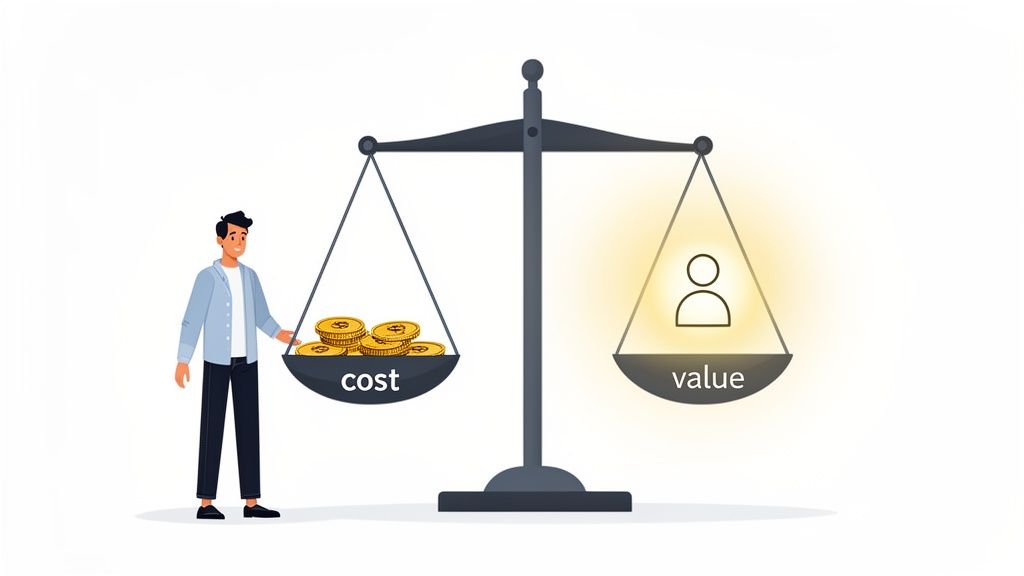
So, is it worth it? To answer that, stop thinking about it like traditional advertising and start seeing it for what it is: building a distributed, commission-only sales team.
Instead of shelling out cash upfront for clicks or impressions—and just hoping for a sale—you only pay when you get a concrete result. A new paying customer. This model alone dramatically de-risks your marketing spend.
This pay-for-performance structure is exactly why the industry is booming. Affiliate marketing has exploded into a global industry valued at $27.8 billion, and experts predict it will jump to an incredible $48 billion by 2027. That kind of growth doesn't happen unless something is working exceptionally well.
For any SaaS or digital business, this channel is a natural fit. A great affiliate program can act as a turbocharger for your existing growth loops, turning your biggest fans into your most effective marketers.
Quick Assessment Is Affiliate Marketing Right for Your SaaS?
Not sure if your business is ready? This table can help you quickly gauge if you're in a strong position to launch a successful affiliate program.
| Business Characteristic | Ideal for Affiliate Marketing | Potential Challenges |
|---|---|---|
| Product & Market Fit | Strong user love; low churn. Solves a clear, painful problem for a specific niche. | High churn rates. Product is still finding its core audience or value proposition. |
| Pricing & LTV | Clear pricing with a high Lifetime Value (LTV). You have a handle on your numbers. | Low-price, single-purchase products. Unclear LTV makes commission planning tricky. |
| Brand & Reputation | Positive brand sentiment and existing word-of-mouth growth. | New brand with little to no market recognition. Affiliates may hesitate to partner. |
| Onboarding & Support | Smooth, self-serve onboarding. Customers can get to their "aha!" moment quickly. | Clunky user experience or a high-touch sales process that requires lots of hand-holding. |
| Existing Audience | You have an audience (even a small one) that you can recruit as your first affiliates. | Starting from absolute zero. No initial pool of potential partners to tap into. |
If you found yourself nodding along with the "Ideal" column, you're likely in a fantastic spot. If you lean more toward the "Challenges" side, it's a sign to focus on strengthening those core business areas first.
Why It Works So Well for SaaS
Unlike a one-off e-commerce purchase, the SaaS model is all about recurring revenue and long-term customer relationships. Affiliate marketing plugs directly into that.
You aren't just paying a commission for a single transaction. You're acquiring a customer who, ideally, will pay you month after month, year after year. That makes the one-time commission you pay an affiliate an incredibly smart investment.
But it only works if a few key things are true:
- Your Product Is Genuinely Great: Good affiliates value their audience's trust. They won't risk their reputation on a buggy or unhelpful product.
- Your Value Is Easy to Explain: Partners need a clear, compelling story to tell. "We help you do X so you can achieve Y" is what they need to hear.
- Your Unit Economics Are Solid: You have to know your LTV and customer acquisition cost (CAC) inside and out. Without that, you can't design a commission structure that's both enticing for partners and profitable for you.
Beyond the Sale The Hidden Value
The real magic of affiliate marketing goes far beyond the direct revenue. A well-managed program builds a powerful moat around your business.
Think about it: you're creating a network of third-party content—reviews, tutorials, comparison articles—that all point back to your product. This generates powerful social proof, boosts your brand's authority, and strengthens your SEO with high-quality backlinks.
But the chain of value doesn't stop at the referral. A new user who has a fantastic onboarding experience is far more likely to stick around, making sure your commission payment delivers a massive ROI. This is why paying close attention to SaaS onboarding best practices is absolutely essential.
When a smooth referral flows into a seamless onboarding process, you don’t just get a transaction. You get a loyal customer for the long haul.
How to Calculate the True ROI of an Affiliate Program
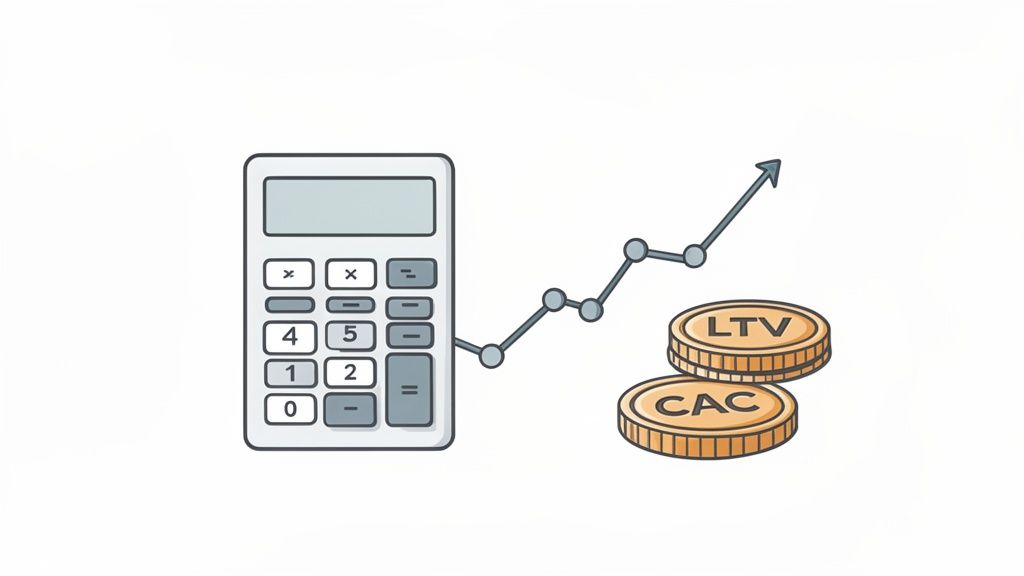
If you really want to know if affiliate marketing is worth it, you have to look past the sales dashboard. The real story isn't just about the revenue coming in; it's about how that revenue stacks up against your other marketing channels and what it does for your core business metrics.
This is where affiliate marketing really starts to shine. It offers a predictable, performance-based cost model that’s hard to beat.
Unlike running paid ads—where you’re burning cash on clicks and impressions with your fingers crossed—affiliate marketing works on a simple promise: you only pay when you get a paying customer. This completely changes the game for calculating your acquisition costs.
Your North Star: The LTV to CAC Ratio
For any SaaS or subscription business, the most important metric is the ratio of Customer Lifetime Value (LTV) to Customer Acquisition Cost (CAC). A healthy, growing company is usually aiming for an LTV that's at least three times its CAC. An affiliate program can give both sides of that crucial equation a serious boost.
Your CAC is simply what it costs you to land a new customer. With paid ads, that number can swing wildly based on bidding wars, ad fatigue, or random algorithm updates. To get a handle on this, you need a solid grasp of your SaaS Customer Acquisition Cost.
An affiliate program makes this math refreshingly simple. Your CAC is just the commission you pay. If you pay an affiliate a $100 commission for bringing in a new customer, your CAC for that specific customer is exactly $100. That kind of predictability is a dream for forecasting and budgeting.
A Practical SaaS Example
Let's break it down with a real-world scenario. Imagine your SaaS product has a $50/month subscription, and you offer affiliates a 30% recurring commission for the first 12 months.
Here’s how the numbers play out:
- Your Revenue: Over the first year, a single customer pays you $600 ($50 x 12).
- Affiliate Commission (Your CAC): You pay the affiliate 30% of that, which comes out to $180 ($600 x 0.30).
- Your Net Revenue (Year 1): You pocket $420 from that customer ($600 - $180).
Now, let's say your average customer sticks around for 36 months. Their total LTV is $1,800 ($50 x 36). You paid just $180 to acquire a customer who will eventually generate $1,800 for your business.
The ROI Calculation: Your LTV to CAC ratio is an incredible 10:1 ($1800 LTV / $180 CAC). This blows the standard 3:1 benchmark out of the water and perfectly illustrates the financial horsepower of a well-designed affiliate program.
This is a true win-win. You acquire a valuable, long-term customer at a fixed, predictable cost. Your affiliate partner is motivated to send you high-quality traffic because their earnings are directly tied to the success of the customers they refer. Recurring commissions are fantastic for this—they align everyone's incentives and turn partners into genuine evangelists.
For a deeper look at these calculations, check out our complete guide on how to measure marketing ROI.
The Unseen Value: The Second-Order Benefits
The financial return is compelling, but the true value of affiliate marketing goes much deeper than the numbers on a spreadsheet. These "second-order" benefits build a moat around your business that paid ads just can't replicate.
- Boosted Brand Trust: Let's be honest, a recommendation from a creator someone actually follows and trusts is infinitely more powerful than a pop-up ad. It's an authentic endorsement that builds instant credibility.
- Improved SEO Performance: Every time an affiliate writes a review, publishes a tutorial, or creates a comparison post, they're building high-quality content about your product. The backlinks from their sites are SEO gold, lifting your domain authority and organic rankings over time.
- An Evergreen Content Ecosystem: A paid ad campaign vanishes the moment you stop feeding it money. The content your affiliates create? It lives on the internet forever. A single YouTube review or blog post can continue to drive traffic and sign-ups for years, delivering value long after it was first published.
You might not see these benefits on a P&L statement, but they are absolutely critical components of your program’s true ROI. They create a stronger brand, more resilient organic traffic, and a community of advocates who are invested in seeing you succeed.
The Four Pillars of a Successful Affiliate Program
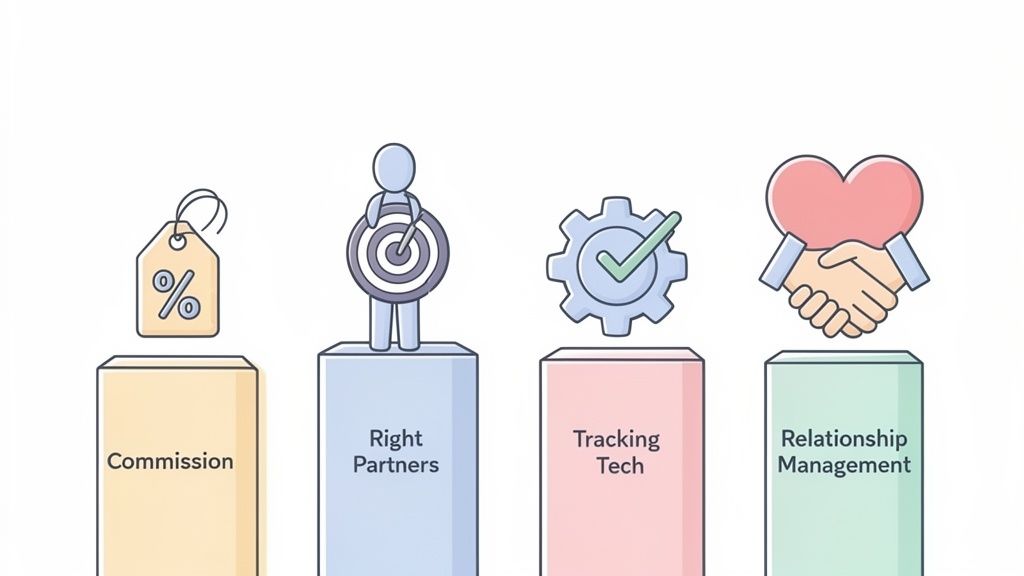
Anyone can launch an affiliate program, but getting it to become a reliable growth engine takes more than just flipping a switch. The real difference between a program that takes off and one that fizzles out comes down to four foundational pillars. Nail these, and you're not just landing new customers; you're building a genuine competitive advantage.
Think of it like building a house. You wouldn't dream of putting up walls without a solid foundation. These four elements are the concrete and steel that ensure your program can handle serious growth for years to come.
Pillar 1: Your Compelling Offer
At its core, any good partnership is a two-way street. For affiliates, this starts and ends with the commission structure. It has to be competitive enough to catch their eye and rewarding enough to keep them promoting your product month after month.
For SaaS businesses, a recurring commission is pretty much the gold standard. A common offer is somewhere in the 20-40% range on a subscription fee for the customer's first year, or sometimes even for life. This model aligns everyone's goals perfectly—affiliates are motivated to send you high-quality customers who stick around, which is exactly what you want. A one-time payout can work, but recurring rewards build partnerships that last.
Your offer isn't just a number; it's a message. It tells potential partners how much you value their work and shows you’re serious about building a program where everybody wins.
Pillar 2: The Right Partners
You could offer the most generous commission on the planet, but it's worthless if you’re working with the wrong people. Recruiting the right affiliates isn't about finding those with the biggest followings; it’s about finding those with the right following.
The best partners are creators, experts, and influencers whose audience looks a lot like your ideal customer.
- Content Creators: Think bloggers, YouTubers, and podcasters who are already creating content in your niche.
- Industry Experts: These are the consultants or coaches who use and recommend tools to their own clients.
- Existing Power Users: Your most passionate customers are often your best advocates. They’re authentic.
Resist the urge to approve every application that comes in. A small group of highly aligned, motivated affiliates will always outperform a huge, disengaged army. Quality over quantity is the name of the game here. A single trusted voice in a niche community can drive more valuable traffic than a dozen generic coupon sites ever could.
Pillar 3: Seamless Technology
An affiliate program runs on trust, and the foundation of that trust is technology. If partners can't rely on your tracking or have to chase you down for payments, they’ll just move on to a competitor. Your tech stack has to be accurate, transparent, and completely frictionless.
This is where the affiliate's own user experience becomes so important. Clunky, third-party dashboards create a jarring experience and add a layer of hassle. Modern platforms solve this by offering native, embeddable dashboards that live right inside your own application.
By integrating the affiliate experience into your product, you get rid of the friction, keep your brand front-and-center, and give partners a smooth, professional environment. When it’s easy for them to grab links, track their performance, and see what they've earned, they're far more likely to stay engaged. To see what's out there, you can explore some of the best affiliate tracking solutions built for SaaS.
Pillar 4: Active Relationship Management
Finally, we have the most overlooked pillar of all: active management. Your affiliates aren't just another marketing channel; they are your partners. You need to treat them that way.
This means going beyond the occasional automated email blast and actually building genuine relationships.
- Onboarding: Give new affiliates a "starter kit" with brand assets, key talking points, and a few content ideas to get them going.
- Communication: Keep in touch regularly. Share product updates, highlight success stories from other affiliates, and pass along performance tips.
- Support: Be quick to answer their questions and actually listen to their feedback.
When you invest in your affiliates' success, they invest right back into yours. This collaborative approach turns a simple transactional arrangement into a powerful, long-term growth partnership, making the answer to "is affiliate marketing worth it?" a definite yes.
Common Pitfalls That Will Derail Your Program
Launching an affiliate program is exciting, but the path to success is littered with common, avoidable mistakes. Most programs don't fail because the core idea was bad; they fizzle out because of foundational errors made right at the start.
Knowing these pitfalls is like getting a map of all the hidden traps. You can just sidestep them. Ignoring these issues won’t just slow you down—it can actively damage your brand and burn bridges with partners who could have been your biggest champions.
Let's walk through the mistakes that sink most programs and, more importantly, how you can build a resilient program from day one by seeing them coming.
Misaligned Commission Structures
Want to kill an affiliate's motivation? Offer them a terrible commission structure. This is especially true for SaaS and subscription businesses.
Offering a tiny, one-time payout for a customer who might pay you every single month for years just doesn't add up. Affiliates can do the math. If their hard work to land you a long-term customer isn't rewarded fairly, they’ll just find a competitor who gets it right.
This is a dealbreaker in recurring revenue models.
- The Mistake: Paying a single, flat fee (like $50) for a new user on your $99/month plan. The affiliate watches you earn nearly $1,200 in the first year while they get pocket change. The incentive is completely broken.
- The Fix: Tie your commissions to the actual customer value. A recurring commission of 20-40% for the first year—or even for the lifetime of the customer—aligns everyone's goals. It shows partners you see them as long-term allies, not just disposable lead sources.
Neglecting Affiliate Onboarding and Support
Imagine hiring a new salesperson, but you don't give them any training, marketing materials, or even a way to contact you. It sounds absurd, but that's exactly how many companies treat their affiliates. You can't just expect partners to sell your product effectively if you don't give them the tools to succeed.
A "set it and forget it" mindset is the death knell for an affiliate program. Affiliates are partners, not just links on a dashboard. Active engagement is non-negotiable for sustained growth.
A simple "Affiliate Starter Kit" can make all the difference. Pack it with brand assets, key messaging points, product tutorials, and examples of content that you know performs well. Keep in touch with a monthly newsletter sharing updates and tips. It keeps your program top-of-mind and proves you're invested in their success.
Inadequate or Unreliable Tracking
Trust is the currency of affiliate marketing. Nothing shatters it faster than faulty tracking.
If an affiliate sends you a paying customer and doesn't get credit for it, you've probably lost that partner forever. And trust me, word travels fast in creator communities. A reputation for shoddy tracking is nearly impossible to shake. This usually happens when you're using an outdated platform or basic cookie-based tracking that breaks easily.
Common Tracking Failures:
- Cookie Expiration: Setting a cookie window that's too short (like 24 hours) cheats affiliates out of sales that take a few days to close.
- Cross-Device Issues: Someone clicks a link on their laptop but signs up later on their phone. Poof. The tracking chain is broken.
- Attribution Disputes: Your system gives the credit to another channel, like a Google Ad, even though the affiliate did all the heavy lifting.
The only way to solve this is to invest in modern, reliable tech. Look for a platform with multi-touch attribution, longer cookie windows (at least 30-90 days is standard), and transparent reporting that both you and your partners can count on.
Ignoring Affiliate Fraud and Brand Misalignment
Finally, not vetting your affiliates is an open invitation for trouble. Opening the floodgates to anyone who applies usually leads to two huge problems: fraud and brand damage.
Fraudulent affiliates use bots, stolen credit cards, or other shady tactics to generate fake sales. This costs you real money in chargebacks and a lot of headaches.
Just as damaging is brand misalignment. Do you really want your thoughtfully crafted SaaS tool promoted on sketchy coupon sites or by creators whose values are the complete opposite of yours? This dilutes your brand and attracts the wrong kind of customers.
A clear vetting process where you manually review applicants is non-negotiable. It ensures you’re partnering with high-quality creators who will represent your brand the way it deserves to be.
Your Step-By-Step Guide to Launching Your First Program
Alright, let's turn all this theory into a real, revenue-generating machine. This is where the rubber meets the road. If you've decided affiliate marketing is a good bet for your business, here's your blueprint to get started without the usual headaches.
Launching a program doesn't have to be some monumental undertaking. It's really just about taking clear, deliberate steps to build a solid foundation. This guide is built for SaaS founders and indie developers who want to get moving quickly and see results.
Step 1: Define Clear Goals and KPIs
Before you write a single email or look at any software, you have to know what success actually looks like. "Getting more sales" isn't a goal; it's a wish. Your goals are the North Star for your program, guiding every decision from how much you pay partners to who you invite to join.
Start by defining specific, measurable Key Performance Indicators (KPIs) that tie directly into your main business objectives.
- New Customer Count: How many new paying subscribers do you want to bring in through affiliates each month or quarter? Be realistic.
- Target Customer Acquisition Cost (CAC): What's the absolute maximum you can pay for a new customer and still have healthy margins?
- Affiliate-Driven Revenue: Set a concrete target for the total monthly recurring revenue (MRR) you want this channel to generate.
- Active Affiliate Count: Aim to recruit and keep a certain number of partners who are consistently driving clicks or, even better, sales.
These numbers give you a tangible way to measure performance. Without them, you're just flying blind and won't be able to prove the program's value.
Step 2: Structure Your Commission Plan
Think of your commission structure as the engine of your affiliate program. It has to be attractive enough to get high-quality partners on board, but it also has to be sustainable for your business. For SaaS companies, recurring revenue models open up some fantastic options.
Key Insight: A recurring commission is the gold standard for SaaS affiliate programs. It perfectly aligns your goals with your partners' by rewarding them for bringing in loyal, long-term customers—not just one-off sign-ups.
To get you started, here is a breakdown of the most common commission models we see in SaaS and digital products.
Affiliate Commission Models for SaaS
A comparison of common commission structures to help you choose the best fit for your business model and growth goals.
| Commission Model | How It Works | Best For | Pros | Cons |
|---|---|---|---|---|
| Recurring Percentage | Affiliates earn a percentage (e.g., 20-40%) of every subscription payment for a set period, like the first year or the customer's lifetime. | Subscription-based SaaS with high LTV. | Highly motivating for affiliates; encourages promotion of "sticky" products. | Can be complex to track; higher long-term payout. |
| One-Time Flat Fee | Pay a fixed amount (e.g., $100) for each new paying customer. | Products with a clear, upfront value and lower LTV, or those with one-time purchase options. | Simple to calculate and manage; predictable CAC. | Less incentive for affiliates to find high-quality, long-term customers. |
| Hybrid Model | Combines a smaller upfront payment with a lower recurring commission (e.g., $50 upfront + 10% recurring). | Businesses wanting to offer an immediate reward while still encouraging long-term partnership value. | Offers the best of both worlds: immediate affiliate gratification and long-term incentive. | Can be the most complex model to set up and explain. |
Choosing the right model really depends on your product’s price point and customer lifetime value (LTV). If you want to go deeper on this, our guide on how to start an affiliate program covers more strategies for setting the perfect commission rates.
Step 3: Create an Affiliate Starter Kit
You can't just send someone a link and expect them to work magic. To get your affiliates promoting effectively, you need to give them the right tools for the job. A well-prepared "Affiliate Starter Kit" removes the guesswork and empowers your partners to start creating content right away.
Your kit should include:
- Brand Guidelines: Your logo, colors, and simple rules on how to talk about your brand.
- Product Messaging: Key value propositions, who your target customer is, and the "pain points" your product solves.
- Marketing Assets: Pre-made banners, social media images, and email templates that partners can easily use.
- Content Ideas: A list of potential blog posts, video topics, or comparison reviews to get their creative juices flowing.
This simple step shows affiliates you're truly invested in their success, which builds loyalty and makes them want to promote your product over someone else's. As you can see below, a lack of support is a huge reason why partners drop off.
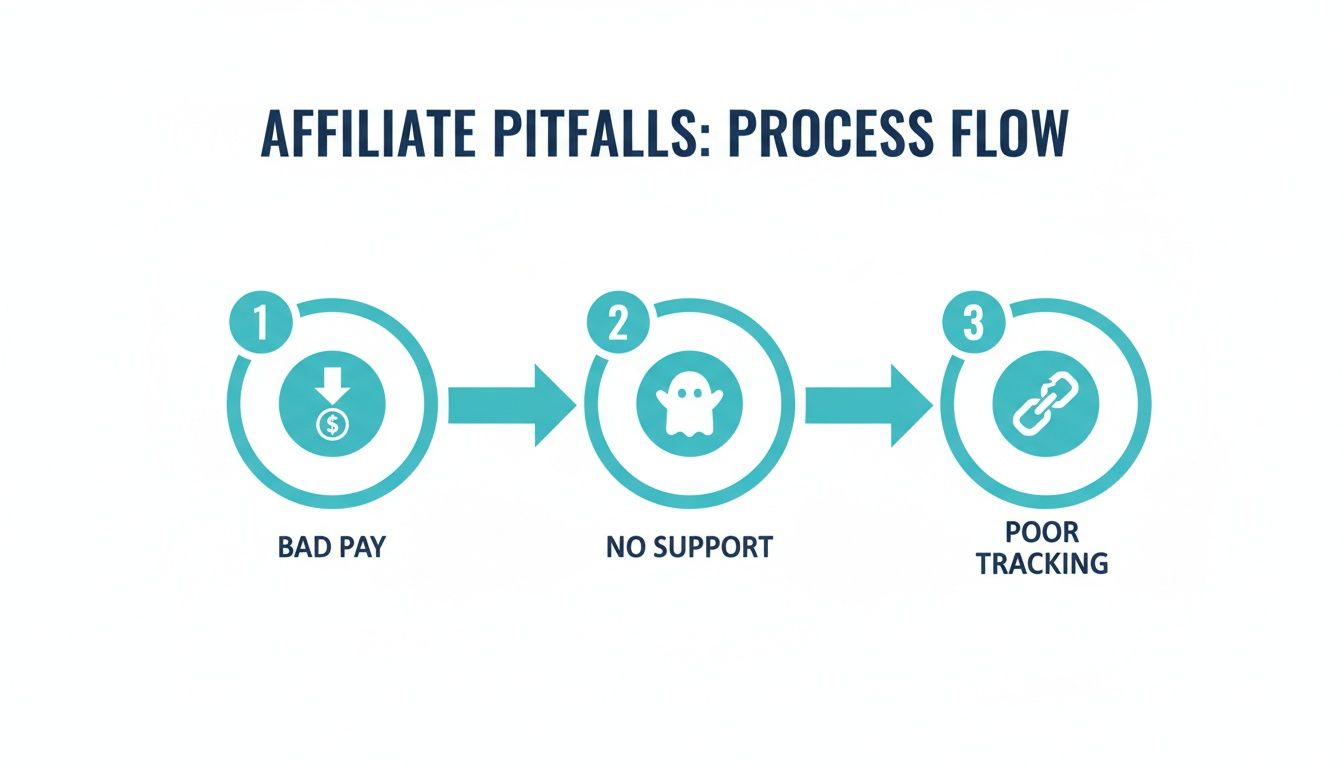
By providing a great starter kit and solid tracking, you sidestep these common problems and build a program people are actually excited to join.
Step 4: Recruit Your First Ten Affiliates
Forget about chasing big-name influencers right out of the gate. Your most powerful first affiliates are already in your orbit: your most passionate customers.
These people already know, use, and love your product. Their endorsement is as authentic as it gets.
Start by sending a personal email to your power users, inviting them to be founding members of your new program. Frame it as an exclusive opportunity to partner up. Once you have a handful of these customer-affiliates, then you can expand your search to niche bloggers and content creators who serve your ideal audience.
Answering Your Top Questions About Affiliate Marketing
Even after you've wrapped your head around the strategy, a few big questions usually pop up. Honestly, deciding if affiliate marketing is really worth it often boils down to getting clear on these final details. Let's dig into the most common questions I hear from founders before they take the plunge.
Getting these practical things right from the get-go is what separates a program that fizzles out from a growth channel that becomes a real asset.
How Much Should I Pay My Affiliates?
This is always the first question, and for good reason. The answer directly affects your ability to attract partners who can actually move the needle. For any SaaS or subscription business, recurring commissions are the gold standard. It's the single most powerful motivator you have.
You should be looking at a recurring commission somewhere between 20% and 40% of the subscription price. You could offer this for a limited time, like the customer's first year, or—and this is a huge draw for top-tier affiliates—for the entire lifetime of the customer. A lifetime commission shows you're serious and signals a true partnership.
What number is right for you? It all comes down to your unit economics. If you have a high Customer Lifetime Value (LTV), you can afford to be more generous, which in turn attracts the best people. A smart way to start is by looking at your Customer Acquisition Cost (CAC) from other channels, like paid ads. Your affiliate commission should be more profitable than your paid channels, but still competitive enough to be compelling.
How Do I Find My First Affiliates?
When you're just starting out, forget about firing off cold emails to massive influencers. Your most powerful, authentic, and effective first affiliates are probably already using your product. I'm talking about your power users.
These are the people who already know your product inside and out. They trust it. They love it. Their recommendation is genuine, and that's something an audience can feel.
- Start With Your Customers: Put together a simple email campaign inviting your most active users to become founding partners. Frame it as an exclusive opportunity.
- Look for Niche Content Creators: Next, start searching for bloggers, YouTubers, and newsletter writers who operate in your specific niche. The key is to find people who are already reviewing or recommending tools just like yours.
- Check Out Platform Marketplaces: If you're using an affiliate platform, many have a built-in marketplace where you can list your program. This gives you instant visibility to professional promoters who are actively searching for new products to partner with.
What Is the Difference Between an Affiliate and a Referral Program?
This is a common point of confusion. While they both involve people spreading the word, they serve very different strategic purposes. Think of them as two completely different tools in your growth toolkit.
A referral program is all about your existing customers. It’s designed to spark word-of-mouth growth by rewarding users for bringing in their friends and colleagues. The rewards are usually non-cash, like credits toward their next bill or a free upgrade.
An affiliate program, on the other hand, is a formal partnership with professional marketers or content creators. You're recruiting them to promote your product to their audience—an audience you likely haven't reached yet—in exchange for a cash commission. Affiliates are for acquiring new audiences; referrals are for leveraging your current one.
The Bottom Line: Affiliates are a sales and marketing channel you actively build. Referrals are a product feature you offer to customers to encourage organic sharing.
How Long Until I See Real Results?
This is where you need to manage your expectations. Affiliate marketing is a marathon, not a sprint. While setting up a program can be fairly quick, seeing a real impact takes time.
Think of it as planting a tree. You have to recruit the right partners, give them the space and time to create great content, and then wait for that content to find its audience.
You might see your first few sales roll in within 30 to 60 days, but building a predictable, scalable revenue stream from affiliates often takes 6 to 12 months. During this time, your partner base grows, and their "evergreen" content—like in-depth blog posts and YouTube tutorials—starts to rank in search and drive consistent traffic. Patience is everything. If you stick with it and support your partners, the momentum will build.
Ready to launch a high-performance affiliate program without the technical headaches? Refgrow offers a fully embeddable platform designed for modern SaaS. You can launch a native, branded affiliate dashboard right inside your app with just one line of code. Get started and turn your best customers into your top promoters.