

SaaS Growth With Lead Generation Affiliate Marketing
Lead generation affiliate marketing is a smart twist on a classic strategy. Instead of paying partners only when a final sale happens, you reward them for delivering qualified leads—think free trial sign-ups, demo requests, or other key actions that signal high intent.
For a SaaS company, this approach is a game-changer. It helps you fill your sales pipeline with a steady stream of promising prospects, rewarding your partners for the exact steps that lead to a purchase.
Why Affiliate Marketing Is Your Next Growth Channel
It's time to look past the old-school, sales-only affiliate model. The real magic for SaaS happens when you shift from a Cost Per Acquisition (CPA) model to a Cost Per Lead (CPL) one. You're no longer just paying for a closed deal; you're rewarding partners for bringing you high-intent prospects. This turns affiliate marketing into a reliable, predictable engine for growth, especially for product-led companies focused on consistent user acquisition.
Imagine your partners acting as a trusted extension of your own marketing team. By building an affiliate program that feels native to your product, you give advocates the tools they need to send you truly qualified traffic. This isn't about chasing one-off sales; it's about building a sustainable pipeline.
The CPL Advantage for SaaS Growth
A Cost Per Lead (CPL) strategy lets you grow your pipeline predictably, but without the massive upfront cash burn of paid ads. Forget bidding for clicks. With CPL, you pay a fixed amount for a specific, valuable action that you get to define.
This could be when:
- A user signs up for a free trial with a verified email.
- A prospect books a demo with your sales team.
- A user completes a critical onboarding step inside your product.
This visual perfectly illustrates how partners can drive targeted traffic through your funnel, generating the qualified leads and trials that fuel real business growth.
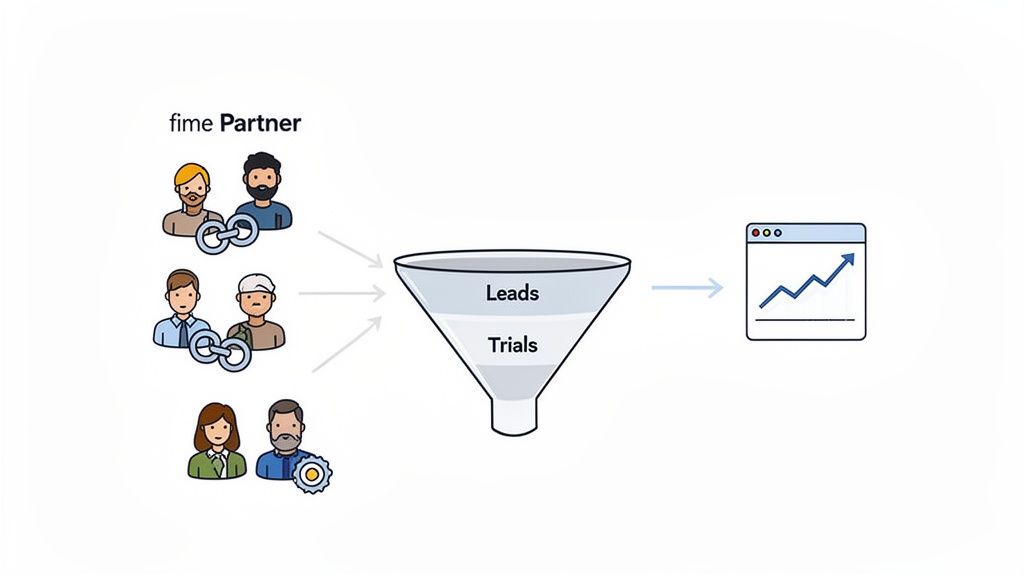
The key here is control. You decide exactly what a "valuable lead" looks like, and you only pay when that criteria is met. This ensures you're getting a much higher return on your marketing spend.
Tapping Into a Proven and Growing Channel
Affiliate marketing isn’t some fringe tactic; it's a massive, thriving industry packed with opportunity for SaaS founders. The global affiliate marketing space is on track to blow past $17 billion by 2026. More telling for us, B2B affiliate programs are expected to see a 17% jump in participation in 2025, with the SaaS sector leading the charge. This isn't just a trend; it's clear market validation for the channel.
Here’s something I’ve seen firsthand: leads from affiliate partners often have a much higher long-term value. In fact, some studies show these leads can deliver an 18% higher lifetime value (LTV) compared to leads from paid ads. That makes this channel not just cost-effective, but genuinely more profitable over time.
To see how this fits into the bigger picture, it’s worth exploring dedicated B2B lead generation services to understand the landscape of growth channels.
This model lets you tap into the pre-built, trusted audiences of your partners, bringing you warm leads who are already interested in what you have to offer. If you want to dig deeper, you can learn about the many other benefits of affiliate marketing in our complete guide. It’s a scalable and incredibly efficient way to expand your reach and accelerate your growth.
Designing Your Lead Generation Affiliate Program
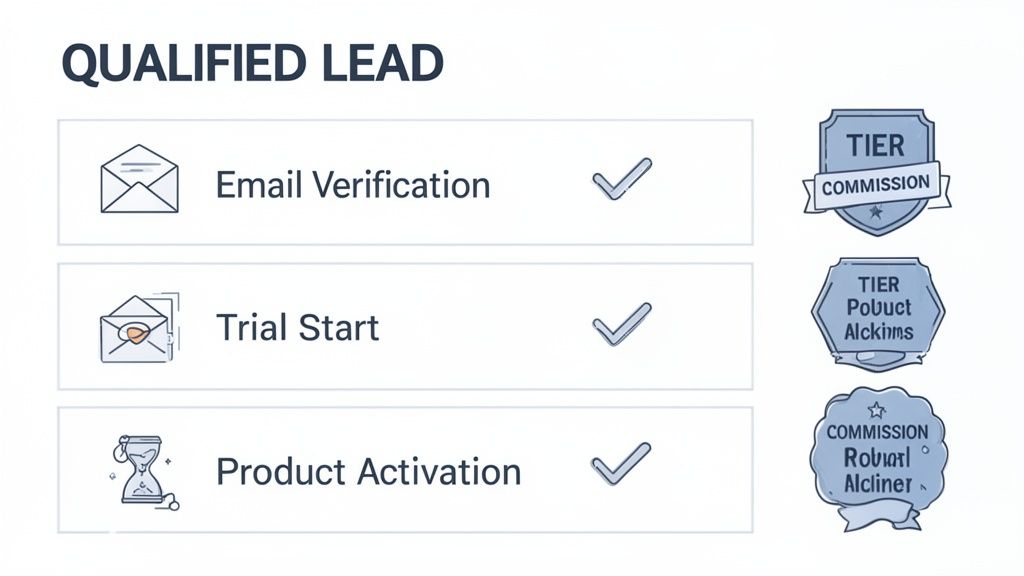
Putting together a solid lead generation affiliate marketing program isn't something you can just wing. The whole thing really comes down to one crucial question: what does a "qualified lead" actually mean to your business? If you don't nail this down from the start, you'll end up paying for a flood of low-quality traffic that never goes anywhere.
Is a qualified lead just an email address tossed into a form? Or does it require more commitment, like a user who not only starts a free trial but also finishes a key setup step? How you answer this will shape everything, from how you pay affiliates to the kind of partners you attract in the first place.
First Things First: Define Your Qualified Lead
Before you even think about commission rates, you have to be crystal clear on the exact action that triggers a payout. This definition is your quality filter, ensuring you only pay for prospects who are genuinely kicking the tires. It’s the difference between collecting vanity metrics and actually building a pipeline.
For SaaS companies, common qualification triggers include:
- Verified Email Signup: The user signs up and actually clicks the confirmation link, proving it's a real email.
- Free Trial Activation: They don’t just sign up; they start a trial, signaling a much stronger interest.
- Demo Request: A prospect fills out a form to talk to your sales team—a huge buying signal.
- Key Product Action: The user does something meaningful inside your product, like creating their first project or inviting a colleague.
Picking the right trigger is all about aligning affiliate incentives with your business goals. For instance, if you want users to experience your product's "aha!" moment, tying commissions to a key product action makes way more sense than just rewarding a simple email signup.
Crafting a Commission Structure That Clicks
Once your lead definition is locked in, you can build a commission structure that’s both a great deal for affiliates and profitable for you. Keep it simple. Partners need to understand exactly how they make money without needing a calculator and a spreadsheet.
A well-designed plan pushes affiliates to send high-quality traffic, not just a high volume of clicks. Let's dig into a few models that work especially well for lead generation.
I’ve found that a tiered structure often works best. It rewards your top performers for their loyalty and encourages mid-tier affiliates to level up. For instance, offering $25 per lead for the first 50 leads and bumping it to $35 per lead after that can significantly boost motivation and results.
To figure out what makes sense for your SaaS, it helps to see the options side-by-side.
Comparing Lead-Based Commission Models
This table breaks down the most common commission structures for lead generation affiliate programs. The goal is to find the model that best fits your goals, sales cycle, and the kind of partners you want to work with.
| Commission Model | How It Works | Best For | Potential Pitfall |
|---|---|---|---|
| Flat-Rate CPL | You pay a fixed amount for every qualified lead. For example, $30 per demo request. | SaaS with a clear LTV and a predictable sales cycle. It's simple and easy for affiliates to understand. | May attract affiliates focused on quantity over quality if the lead definition isn't strict enough. |
| Tiered CPL | The payout per lead increases as affiliates hit volume milestones within a specific timeframe. | Motivating high-performing partners and encouraging a consistent flow of leads from everyone. | Can be more complex to manage and track without the right affiliate software. |
| Hybrid CPL + Rev-Share | A smaller flat fee for the lead, plus a percentage of the revenue if they eventually become a customer. | Aligning incentives for both lead quality and long-term customer value. Great for high-ticket SaaS. | The two-part payout can sometimes be confusing for affiliates if not communicated clearly. |
Choosing a model like the Flat-Rate CPL offers simplicity, which is a huge plus when you're starting out. But as your program matures, a Tiered or Hybrid model can be a powerful tool to drive both quality and scale.
Laying Down the Rules: Establish Clear Program Terms
Think of your program's terms and conditions as your playbook. This document protects your brand, helps prevent fraud, and makes sure everyone is on the same page. It shouldn't read like a legal textbook; it needs to be a straightforward guide that helps your partners succeed while playing by the rules.
Make sure your terms clearly spell out:
- Lead Qualification Rules: State your definition of a qualified lead again, right here.
- Promotion Guidelines: Be specific about what’s allowed and what’s not (e.g., no bidding on your brand keywords in PPC ads).
- Payment Schedule: Explain when and how you pay commissions (e.g., Net-30 via PayPal or another platform like Wise).
- Cookie Duration: Let them know how long the tracking cookie lasts after a click. A 30 to 90-day window is pretty standard in the industry.
By designing a program with a sharp lead definition, an appealing commission plan, and transparent terms, you’re building a foundation for a powerful and sustainable growth channel. This initial strategic work is what ensures your lead generation affiliate marketing efforts bring truly valuable prospects into your pipeline.
Weaving Your Affiliate Program Directly Into Your Product
Let's be honest: the secret to a great affiliate program isn't just about paying out commissions. It’s about the experience you create for your partners. If you're asking affiliates to navigate a clunky, third-party portal just to track their progress, you're creating friction right from the start. The best programs don’t feel like a tacked-on afterthought; they feel like a natural extension of your product.
This is where a native, embedded affiliate dashboard completely changes the game. When you bring the entire affiliate experience directly into your application, you're not just providing a tool—you're building trust and boosting engagement. Your partners can see their stats, grab their referral links, and track earnings without ever leaving your ecosystem.
Ditch the Clunky External Portal
So many affiliate programs still rely on sending partners to an external platform. You know the type—a different login, a generic interface, and zero connection to your brand. This approach instantly creates a disconnect. It feels less like a true partnership and more like a transactional, arm's-length deal.
A native experience, on the other hand, keeps everything under your roof and your brand. It reinforces the idea that your affiliates are valued members of your community. For any SaaS business that prides itself on user experience, offering a seamless, integrated affiliate dashboard is a no-brainer.
Think about the message this sends. When an affiliate can log into their account on your platform and see a dedicated "Partner" or "Referrals" tab right in the main navigation, it’s powerful. It says, "This program is a core part of our business, and we've invested in making it great for you." That small detail has a massive impact on partner loyalty.
The best part? Modern tools make this incredibly simple. With many platforms, you can drop a fully branded affiliate experience right into your app with just a single line of code. If you want to see how this works under the hood, you can explore how an embeddable widget works and see just how fast you can get it up and running.
The Power of Native Integration and Automation
A truly seamless experience is about more than just a pretty interface. It’s about what happens behind the scenes—the technical nuts and bolts of tracking and attribution. This is where automation becomes your best friend, ensuring commissions are handled accurately and instantly. Nothing builds affiliate trust faster than getting paid on time, every time.
Webhooks are the key to unlocking this automation. A webhook is just a simple notification that one app sends to another when something happens. For a SaaS affiliate program, this is incredibly powerful.
Let’s walk through a real-world scenario:
- One of your affiliates sends a new user to your website, and they sign up for a free trial.
- Your payment processor, like Stripe or LemonSqueezy, registers that new trial.
- The payment processor automatically fires off a webhook notification to your affiliate platform.
- Your platform instantly catches the event, attributes the lead to the correct affiliate, and credits their account with the commission you promised.
This whole dance happens in seconds, with zero manual work on your end. It's efficient, it scales, and it's completely transparent for your affiliates. When they see a commission pop up in their dashboard almost immediately after generating a lead, it’s a huge motivator.
Crafting a Frictionless Technical Foundation
To make this seamless system a reality, you need to connect the dots between user actions and affiliate payouts. The goal is a rock-solid tracking loop that accurately captures every single qualified lead your partners send your way.
Here are the essential components you'll need to create that frictionless integration:
- An Embeddable Dashboard: First and foremost, pick a solution that lets you embed the affiliate dashboard directly within your app’s UI. This is non-negotiable for a consistent brand experience.
- Webhook Integration: Your affiliate platform must be able to receive webhooks from your payment processor. This is what automates commission triggers for events like trial starts or first payments.
- Reliable Attribution: Make sure your system uses a robust tracking method, usually with a generous cookie window (60-90 days is a good starting point). This ensures affiliates get credit even if the conversion takes a while.
- Clear Reporting: The affiliate dashboard has to provide clean, real-time data on clicks, leads, conversion rates, and earnings. Transparency is the bedrock of any strong partner relationship.
By focusing on a native, integrated approach, you build an affiliate program that feels professional, trustworthy, and deeply connected to your product. This frictionless experience doesn't just attract higher-quality partners—it motivates them to promote you more actively, turning your affiliate program into a powerful and sustainable engine for lead generation.
Finding and Onboarding the Right Affiliates
Even the most perfectly designed affiliate program will fall flat without the right partners. Your success really comes down to finding affiliates who not only have an audience but also get your brand and genuinely connect with your ideal customer. This isn't about casting a wide net; it's about building a small, powerful team of true advocates.
Forget chasing anyone with a big follower count. The real goal is to recruit partners who can deliver a steady stream of high-quality SaaS leads. That means focusing on people and brands who have already built trust with the exact audience you're trying to reach. These authentic, long-term relationships are what separate a so-so program from a legitimate growth engine.
Identifying Your Ideal Affiliate Partners
Your best affiliates are often hiding in plain sight. They’re the ones already talking about the problems your SaaS solves. The trick is knowing where to look and what to look for, moving past vanity metrics to focus on real relevance and engagement.
I always recommend starting your search in these key areas:
- Industry Bloggers and Content Creators: These folks are masters of storytelling. Look for blogs, YouTube channels, and newsletters that consistently create top-notch content for your target audience.
- Your Own Power Users: Seriously, who knows your product better than your most dedicated customers? An in-app referral program can turn your biggest fans into your most effective promoters. Their social proof is priceless.
- Review and Comparison Sites: Websites that specialize in reviewing software in your niche are a goldmine. Their audience is already in a buying mindset, actively searching for a solution just like yours.
- Complementary SaaS Companies: Team up with non-competing companies that serve the same customer. A joint webinar or a co-branded guide can be a fantastic way to get in front of a new, highly relevant audience.
The Art of the Outreach
Once you have a list of potential partners, your outreach needs to be personal and show immediate value. Generic, templated emails are a one-way ticket to the trash folder. You have to show them you’ve done your homework and understand why a partnership is a true win-win.
A common mistake I see is focusing the outreach email entirely on what you want. Instead, frame it around their audience. For example, "I saw your recent post on improving team productivity, and I think your readers would get a lot of value from our tool's new collaboration feature." This shows you respect their work and are offering something valuable, not just asking for a favor.
SEO-driven content is a huge piece of the affiliate puzzle. In fact, 60% of affiliate managers agree it's the top source of traffic. By building strong relationships with creator-affiliates who are wizards at content and SEO, you can slash your cost-per-lead by 30-40% compared to traditional ad channels. It's a powerful reason to prioritize partners with strong organic reach.
The flowchart below shows the automated tracking process that makes these partnerships so seamless and scalable.
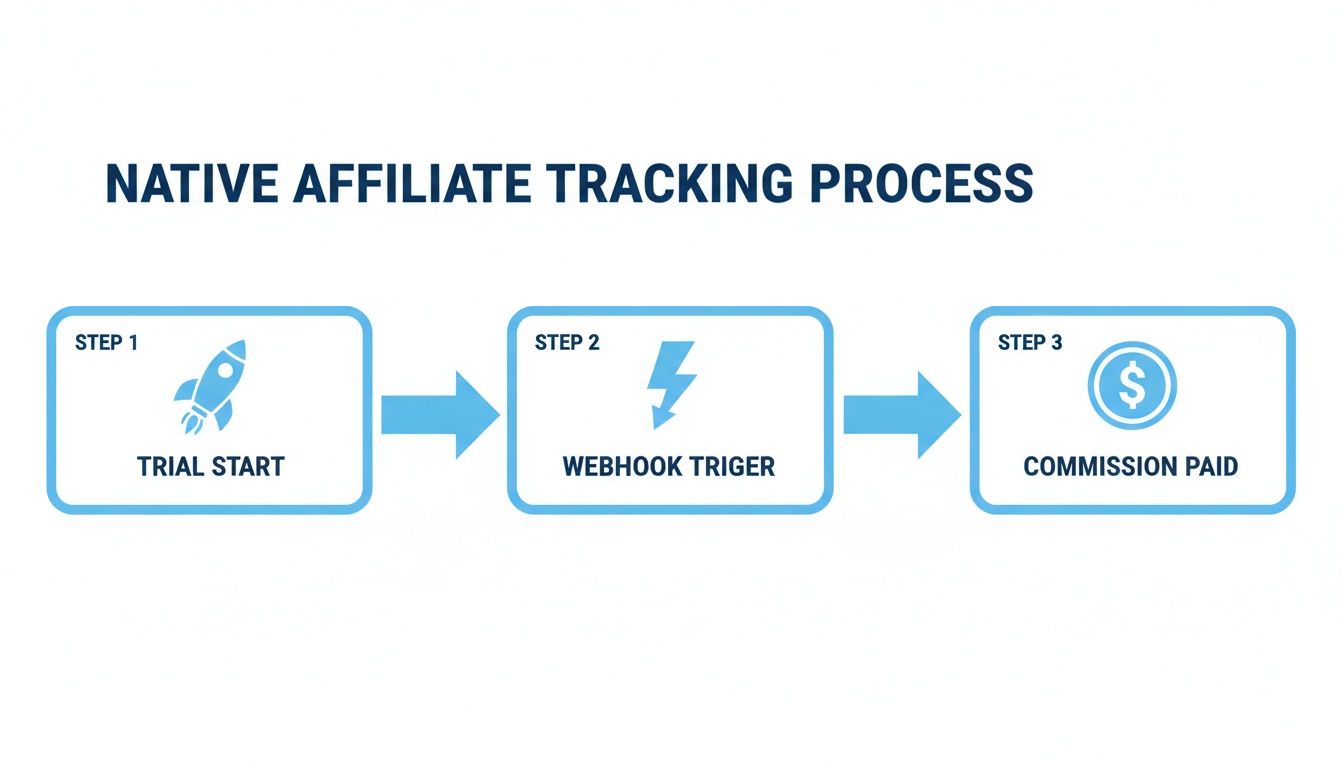
This automated flow—from a trial start to a webhook trigger and instant commission—is what builds the trust needed for a lasting partnership. For more direct strategies, check out this guide on how to find affiliates who are a perfect fit for your SaaS.
Creating a World-Class Onboarding Experience
Recruiting is only half the job. A smooth, supportive onboarding process is what turns a new affiliate into a productive, long-term partner. The goal is to remove any friction and give them the confidence to start promoting your product effectively from day one. Don't just send them a link and wish them luck; give them a full toolkit for success.
Your affiliate resource kit should be a one-stop shop with everything they need:
- A Clear Brand Guide: Provide logos, color palettes, and simple guidelines on your brand’s voice.
- Approved Messaging and Swipe Copy: Give them pre-written email templates, social media posts, and ad copy they can easily adapt. This ensures consistency and saves them a ton of time.
- High-Quality Visual Assets: Offer a library of product screenshots, GIFs, and short demo videos they can drop right into their content.
- Deep Links to Key Pages: Don’t just send them to your homepage. Provide direct links to specific feature pages, case studies, or your pricing page to help them drive targeted traffic that converts.
When you invest in finding the right people and then set them up for success, you're not just building an affiliate program. You're building a community of advocates who are genuinely invested in helping you grow.
Getting Better Over Time with Data and Feedback
Getting your affiliate program off the ground is a great first step, but it’s just that—a first step. The real, long-term growth from lead generation affiliate marketing comes from obsessively optimizing what you’ve built. You have to treat your program like you treat your product: constantly measure what’s happening, listen to feedback, and make iterative improvements.
This means you can’t just glance at top-level numbers like clicks and sign-ups. To really get a handle on the health and ROI of your program, you need to dig much deeper. You need to get into the data and build a solid feedback loop with both your partners and the leads they send your way. This is how you turn a decent program into a predictable growth engine for your business.
Tracking the Metrics That Actually Matter
Vanity metrics can fool you. A flood of new leads looks great on a chart, but it means nothing if none of them ever become paying customers. To get a true picture of your program’s impact, you need to focus on KPIs that tie affiliate activity directly to your bottom line.
Start by getting a grip on these essential data points:
- Lead-to-Customer Conversion Rate: This is the most important metric for judging lead quality. What percentage of leads from Affiliate A actually become paying customers, and how does that compare to Affiliate B?
- Cost Per Qualified Lead (CPQL): This tells you exactly how much you're spending to acquire a prospect who actually fits your ideal customer profile.
- Affiliate-Specific ROI: It's simple math: calculate the total revenue generated from an affiliate's leads and stack it up against the total commissions you've paid them.
- Time to Conversion: How long does it take for a lead from a specific partner to pull out their credit card? A shorter sales cycle is often a strong signal of a higher-quality lead.
This kind of data lets you spot your top performers with incredible accuracy. It’s not always the partner driving the most traffic; it's the one sending the most valuable, high-converting leads. Once you know who your all-stars are, you can double down on those relationships with extra support, co-branded materials, or even a bump to a higher commission tier.
I’ve seen this play out so many times. A program might have one partner sending 500 trial sign-ups a month and another sending just 50. But if the second affiliate's leads convert at 10x the rate, they are infinitely more valuable. The data helps you cut through the noise and reward what truly matters: performance.
Using Real Feedback to Get Better
Numbers tell you what is happening, but talking to people tells you why. You have to create ways for open communication to happen, because that’s how you’ll refine your program and help your partners win. Don't just live in your dashboard; actively go looking for insights.
Checking In with Your Affiliates
Your affiliates are out there on the front lines. They have a direct line to your potential customers and hear exactly what their audience is saying about your product. Make a habit of setting up regular, informal check-ins to ask them direct questions.
- "What are the most common questions or pushbacks you get from your audience?"
- "Is there anything we could build—a guide, a video, a calculator—that would make it easier for you to promote us?"
- "Is our main message landing, or is there a feature you think we should be talking about more?"
This kind of feedback is pure gold. It can help you tweak your marketing copy, create more effective sales assets, and sometimes even give your product team a great idea. An affiliate might mention their audience is confused about a certain feature, which is your cue to create a quick tutorial video they can share. Simple.
Surveying the Leads They Send You
Don't forget about the other side of this partnership. The leads your affiliates bring in are an incredible source of information. A simple, one-question survey sent to new trial sign-ups can tell you so much.
For example, just ask: "Where did you first hear about us?" If you start seeing a pattern of people mentioning a specific blog post or a YouTube review, you know that piece of content is hitting the mark. You can then work with that affiliate to create more content just like it or turn that successful topic into a bigger, joint campaign. It’s this feedback loop that ensures your program keeps getting better and better.
Answering Your Top Questions About Lead Gen Affiliate Programs
Switching from paying for sales to paying for leads is a big mental shift, especially for SaaS teams used to traditional growth models. It’s smart to have questions. This is where we clear up the common sticking points and give you the confidence to build a program that actually drives growth.
Let's get into the nitty-gritty of what’s probably on your mind.
What’s a Good CPL Rate for a SaaS Affiliate Program?
This is the big one, isn't it? The honest answer is: there's no magic number. A good Cost Per Lead (CPL) is entirely specific to your business—it has to be rooted in your own metrics, not some industry benchmark.
The best way to figure this out is to work backward from what a customer is worth to you. You'll need two numbers:
- Customer Lifetime Value (LTV): What’s the total revenue you expect from an average customer?
- Lead-to-Customer Conversion Rate: Out of all the qualified leads you get, what percentage actually become paying customers?
Once you have those, the math is pretty straightforward.
(LTV x Lead-to-Customer Conversion Rate) x Your Desired Profit Margin = Your Target CPL
Let's say your LTV is $2,000 and 10% of qualified leads turn into customers. That means every single qualified lead is potentially worth $200 to you. If you’re aiming for a 3:1 return on your marketing spend, you could set your CPL somewhere in the $50-$60 range and be in a great position.
My advice? Always start on the conservative side. You can easily bump up the commission for your best partners later on as you get a better handle on the lead quality they send.
How Do I Prevent Affiliate Fraud in a Lead Generation Model?
Fraud is a real concern with any CPL program, but it's absolutely manageable if you're proactive. The best defense is a good offense—designing your program from the ground up to discourage low-quality or bogus submissions.
Your first and most important line of defense is how you define a "qualified lead." Never, ever pay for just an email address. You need to tie the commission to an action that shows real intent.
Here are a few practical ways to keep your program clean:
- Pay on Activation Milestones: Don't reward a simple signup. Pay the commission when a new user completes a key onboarding step, connects their calendar, or invites a teammate.
- Use Double Opt-In: This is the bare minimum. Requiring email verification immediately filters out a huge number of bots and throwaway addresses.
- Set a Validation Period: Don't approve commissions instantly. A short holding period, say 7-14 days, gives your team time to review lead quality and spot any red flags before money changes hands.
- Keep an Eye on Traffic Sources: Pay attention to where your affiliates are sending traffic from. A sudden, massive spike from a strange-looking source is a classic sign something is off.
Most modern affiliate platforms, like Tapfiliate or PartnerStack, also have built-in fraud detection that can automatically flag things like suspicious IP addresses, adding another solid layer of security.
Can I Run a Lead Generation Program Alongside a Revenue Share Program?
Not only can you, but you probably should. A hybrid model—offering a CPL payment upfront and a revenue share on the backend—can be a game-changer. It appeals to a much wider variety of affiliates and perfectly aligns incentives for both quantity and quality.
This is how it usually works:
- Upfront CPL Payout: An affiliate earns a fixed, flat-rate commission for driving a qualified lead. Think $25 for a verified free trial. This gives them predictable, immediate cash flow.
- Long-Term Revenue Share: If that same lead converts to a paying customer, the affiliate also earns a recurring cut of the subscription revenue (maybe 20%) for the first 12 months.
This two-part structure is beautiful because it solves two problems at once. The CPL gets partners motivated to send a steady stream of traffic, while the revenue share ensures they’re sending people who are actually likely to convert and stick around. It’s the best of both worlds.
What Are the Most Important Assets to Provide My Affiliates?
Simple: the easier you make it for affiliates to promote your product, the more they will. A well-organized affiliate resource center isn't a "nice-to-have"—it's essential. You want to hand them a complete toolkit so they can get started with minimal friction.
Think of it as their self-serve success kit. Here’s a quick checklist of what you need to have ready from day one:
- A Clear Brand Style Guide: Your logos, colors, and a few simple notes on your brand's voice.
- Customizable Swipe Copy: Ready-to-go email templates, social media posts, and ad copy they can grab and adapt. This saves them hours.
- A Visuals Library: High-quality product screenshots, short GIFs of key features, and embeddable demo videos are gold for content creators.
- Audience Pain Points & Keywords: Give them a cheat sheet of the exact problems your product solves and the search terms your ideal customers are using.
- Deep Links to Key Pages: Don’t just send everyone to your homepage. Provide direct links to feature pages, pricing tables, and specific case studies so they can build more effective, targeted campaigns.
When you equip your partners for success, it shows you're invested in the relationship. That's how you build the trust and loyalty that turns a good affiliate program into a great one.
Ready to launch a native, seamless affiliate program right inside your SaaS? With Refgrow, you can set up a fully branded dashboard with just one line of code, automate commissions with webhook integrations, and tap into a network of active affiliates instantly. Start building your growth engine today at https://refgrow.com.