

8 Unforgettable Examples of Viral Advertising You Can Replicate in 2026
Viral advertising isn't magic; it's a meticulously engineered growth loop. At its core, it's about creating an experience so valuable or intriguing that users become your primary marketing channel. The goal is to achieve a viral coefficient (k-factor) greater than one, where each user brings in more than one new user, leading to exponential, self-sustaining growth. This happens when the incentive to share, the ease of sharing, and the value received by the new user align perfectly.
Unlike traditional paid ads that stop when the budget runs out, a true viral loop can become a permanent growth asset. Understanding the architecture behind these systems is critical for any team looking to build a scalable acquisition model without a massive ad spend. These loops are built on specific psychological triggers and mechanical incentives that encourage sharing as a natural part of the product experience.
In this deep-dive, we'll dissect 8 legendary examples of viral advertising, from Dropbox's two-sided referral program to Slack’s ecosystem strategy. We will break down the specific mechanics, key performance indicators, and strategic decisions that fueled their explosive success. More importantly, we'll extract actionable blueprints and replicable takeaways that SaaS teams can implement today. You will learn how to build your own growth engines, often with embeddable tools that make creating native, high-performance referral programs simpler than ever.
1. Dropbox's Referral Program - The Gold Standard
Dropbox didn't just create a file-sharing service; they engineered one of the most iconic examples of viral advertising by embedding growth directly into their product. Launched in 2010, their two-sided referral program became the gold standard for product-led growth, offering free storage space to both the person referring and the new user who signed up. This wasn't a separate marketing campaign but an integral part of the user experience.
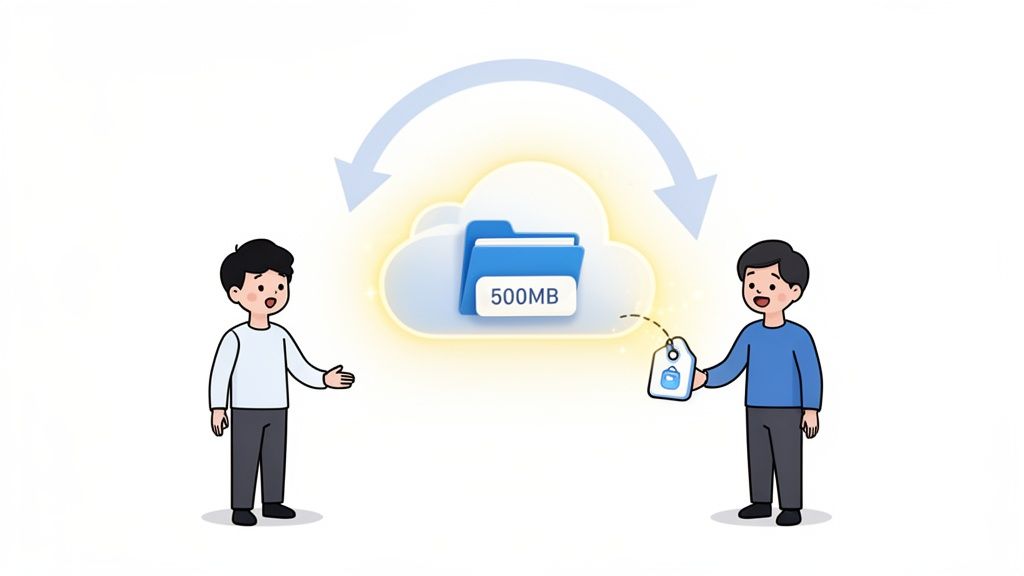
The mechanics were simple yet brilliant. A user received 500MB of bonus storage for each friend who installed Dropbox, and the friend also started with an extra 500MB. This created a powerful, self-perpetuating growth loop that scaled exponentially.
Strategic Breakdown
Dropbox’s success was built on a deep understanding of user motivation and product value. They abandoned traditional ad spend, which proved ineffective and expensive for their product, and instead focused on a system that rewarded users with more of what they already loved: storage space.
Key Insight: The incentive was not a gimmick; it was an extension of the core product. More storage directly improved the user's experience with Dropbox, making the reward highly relevant and desirable.
The program's genius lay in its seamless integration. Users were prompted to refer friends during onboarding and when they approached their storage limits, turning potential friction points into growth opportunities. This strategy led to a staggering 60% permanent increase in signups and was a primary driver in their growth from 100,000 to 4 million users in just 15 months. At its peak, the program was responsible for 35% of all new signups.
Actionable Takeaways for SaaS Teams
- Align Incentive with Core Value: Don't offer unrelated rewards like gift cards. Provide more features, usage credits, or an upgraded plan tier. The reward should make your product stickier.
- Make it a Win-Win: Structure the referral so both the referrer and the new user benefit. This dual-sided incentive dramatically increases participation by removing any social awkwardness.
- Embed, Don't Outsource: Build referral mechanics directly into your product's user flow. SaaS teams can learn how to create a referral program that feels native and intuitive, prompting action at key moments like after a user achieves a success milestone.
- Gamify the Experience: Track referral progress visibly. Celebrating milestones (e.g., "You've earned 2GB of free space!") encourages continued participation and reinforces positive behavior.
2. Slack's 'Powered by Slack' Ecosystem Strategy
Slack didn't just build a messaging app; it cultivated a powerful ecosystem that became one of the most effective examples of viral advertising in the B2B SaaS world. Instead of relying solely on traditional user-to-user referrals, Slack's growth was supercharged by its network of third-party app integrations. This strategy turned partners and even competitors into a high-powered distribution channel.
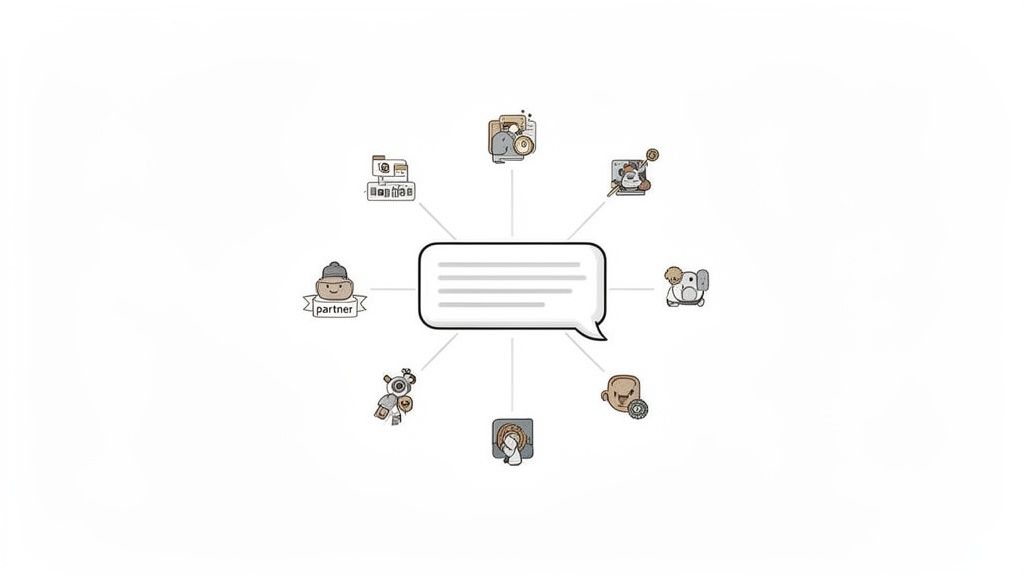
The core mechanic was a value exchange. Developers built integrations to get their tools in front of Slack's massive user base, and in doing so, they actively promoted Slack to their own customers to showcase the integration's value. This created a viral loop where the growth of partner apps directly fueled Slack's adoption, especially within enterprise accounts.
Strategic Breakdown
Slack's genius was in recognizing that its platform became more valuable with every tool it connected to. By building an API-first product and launching the Slack App Directory, which now features over 2,000 integrations, it created a two-sided marketplace effect. Tools like Zapier and Hubspot didn't just integrate with Slack; they became powerful advocates, driving adoption through their established customer relationships.
Key Insight: The product's value wasn't just in its own features but in its ability to be the central hub for other tools. Each new integration was another reason for a team to adopt and stay with Slack.
This ecosystem-led growth was deeply embedded in the product. The easy discoverability of apps within Slack's interface meant users could seamlessly add new functionalities, making Slack stickier and more indispensable. For developers, a "Works with Slack" badge became a mark of credibility, incentivizing them to co-market the platform and accelerate its viral spread across the enterprise landscape.
Actionable Takeaways for SaaS Teams
- Build an API-First Architecture: Design your product to be extensible from day one. A robust API is the foundation for a thriving partner ecosystem and is crucial for creating viral loops through integrations.
- Create a Partner Program with Clear Incentives: Don't just hope for integrations. Offer formal partnership tiers with benefits like revenue sharing, co-marketing opportunities, and dedicated support to motivate developers.
- Enable Easy Discoverability: A well-organized app directory or marketplace within your product is essential. If users can't easily find and install integrations, the viral loop breaks.
- Align Partner Success with Your Own: Structure incentives so that as partners grow their user base through your platform, your product's adoption grows in tandem. This turns partners into a genuine extension of your sales and marketing team.
3. PayPal's Early Referral Incentives ($10 Sign-up Bonus)
Long before "growth hacking" became a buzzword, PayPal pioneered one of the most aggressive and effective examples of viral advertising by literally paying people to use their service. In its early days, the company offered a simple, powerful incentive: sign up and get $10, refer a friend who signs up, and get another $10. This direct monetary reward created an unstoppable engine for user acquisition.
This strategy was incredibly costly but addressed their core challenge: a payment network is useless without a critical mass of users. By injecting cash directly into their burgeoning network, PayPal kickstarted the necessary network effects, turning early adopters into evangelists and fueling explosive daily growth of 7% to 10%.
Strategic Breakdown
PayPal’s approach was a masterclass in overcoming the "cold start" problem. The team, including Peter Thiel and Max Levchin, understood that the value of their network was proportional to the number of users in it. The cash incentive was not just a reward; it was a calculated investment to build that network faster than any competitor could.
Key Insight: For network-effect businesses, the initial cost of acquiring a user can be justified if that user brings in more users, exponentially increasing the platform's value for everyone.
The company treated user acquisition as a core product feature, not just a marketing expense. This strategy was unsustainable long-term and led to acquisition costs of around $20 per user, but it achieved its primary goal. It established PayPal as the dominant online payment system, particularly on eBay, securing a market position that would have been impossible with traditional advertising.
Actionable Takeaways for SaaS Teams
- Use Monetary Incentives for a Cold Start: For products that rely on network effects (like marketplaces or social platforms), a direct cash incentive can be a powerful, albeit expensive, way to build initial momentum.
- Track Your Viral Coefficient (k-factor): PayPal's growth was measurable. You must track how many new users each existing user brings in. If your k-factor is above 1, you have exponential organic growth.
- Balance Incentives with Unit Economics: A high-cost strategy is a short-term play. Have a clear plan to reduce the incentive as the product gains inherent value and network effects take hold.
- Implement Robust Fraud Detection: Offering cash will attract opportunists. From day one, build systems to detect and prevent users from gaming the referral system with fake accounts.
4. Airbnb's 'Belong Anywhere' Referral & Content Marketing Fusion
Airbnb mastered one of the most powerful examples of viral advertising by fusing a transactional referral program with aspirational, user-driven storytelling. While their two-sided referral program (offering travel credits to both referrer and new user) was effective, the true viral engine was their ability to turn customers into advocates and content creators. This transformed the act of sharing from a simple transaction into a form of social currency.
The "Belong Anywhere" and "Live There" campaigns were not just slogans; they were invitations for users to share their authentic travel experiences. By encouraging and showcasing user-generated content (UGC) like photos, reviews, and neighborhood guides, Airbnb created a massive, self-sustaining content ecosystem. Sharing a referral link became synonymous with sharing a unique discovery or a personal story.
Strategic Breakdown
Airbnb’s strategy transcended simple rewards by tapping into a deeper human desire for connection and authentic experiences. They understood that their users weren't just booking a room; they were seeking a unique way to travel and connect with a local culture. The referral program became a mechanism to share this new way of life with others.
Key Insight: Virality was achieved by aligning financial incentives (travel credits) with emotional incentives (sharing unique discoveries and stories). The referral program wasn't just about saving money; it was about evangelizing a better way to travel.
This fusion of content and referral mechanics created a powerful flywheel. High-quality UGC made listings more attractive, leading to more bookings. Positive experiences prompted users to leave reviews and share referral links, which drove new user acquisition. This cycle was a key driver in growing from 10,000 to over 1 million listings, with their famous "Live There" campaign generating billions of impressions largely fueled by user content.
Actionable Takeaways for SaaS Teams
- Fuse Transaction with Emotion: Don't just reward the transaction; reward the story behind it. Encourage users to share why they love your product, not just a link to it.
- Empower Users as Storytellers: Build features that make it easy for users to create and share content related to your product. This could be case studies, templates, or project showcases.
- Showcase, Don't Just Ask: Feature authentic user stories, reviews, and content prominently in your marketing. This provides social proof and inspires others to share their own experiences.
- Integrate Referrals with Content: Allow users to embed their referral links within the content they create. When someone shares a template or a success story, make sure their referral code is attached, turning valuable content into an acquisition channel.
5. Uber's Aggressive Two-Sided Referral Mechanics
Uber didn't just disrupt transportation; they weaponized referrals to conquer the world, city by city. Their approach stands as one of the most powerful examples of viral advertising because it engineered growth on both sides of a two-sided marketplace. By creating separate, yet interconnected, referral loops for riders and drivers, Uber fueled explosive expansion and built the network density required for their service to function.
The model was aggressive and brilliant. Riders earned free ride credits for referring new passengers, making their next trip cheaper. Simultaneously, drivers earned substantial cash bonuses for bringing new drivers onto the platform, directly increasing their income. This dual-engine approach solved the classic "chicken and egg" problem for marketplaces at an unprecedented scale.
Strategic Breakdown
Uber’s strategy was built on surgically targeted incentives that matched the motivations of each user segment. Riders wanted affordability and convenience, so ride credits were a perfect fit. Drivers wanted to maximize earnings, making cash bonuses the most compelling reward possible. This created two distinct, self-fueling viral loops that worked in tandem.
Key Insight: In a two-sided marketplace, the supply and demand sides have different motivations. Tailoring the referral incentive to each side (credits for users, cash for providers) maximizes participation and accelerates network effects.
This model was the engine of Uber’s global expansion into hundreds of cities. When entering a new market, the company would launch with aggressive referral bonuses, often ranging from $10 to over $50 per sign-up, to rapidly build both a rider base and a driver fleet. The referral program wasn't just a marketing tactic; it was their core market-entry strategy, allowing them to establish a dominant position before competitors could react.
Actionable Takeaways for SaaS Teams
- Design for Your Marketplace: If your platform connects two distinct user groups (e.g., buyers and sellers, creators and fans), create separate referral programs. The incentive for one side should not be a one-size-fits-all solution for the other.
- Use Dynamic Incentives: Don't set a single, static reward. Adjust incentive values based on market conditions, customer lifetime value (LTV), or strategic goals like entering a new vertical.
- Track Viral Loops Separately: Measure the viral coefficient and key performance indicators for each side of your marketplace independently. This helps you identify which loop needs more fuel and allows you to optimize your spend effectively. For deeper insights, you can learn more about viral marketing strategies and how to measure them.
- Align Rewards to Motivations: Go beyond generic rewards. For a B2B SaaS marketplace, offer usage credits to the "customer" side and a revenue share or cash bonus to the "supplier" or "partner" side.
6. Robinhood's Gamified Referral with Stock Rewards
Robinhood disrupted the often-stuffy world of finance by gamifying the investment experience, and its referral program was a core part of this strategy. Instead of cash or credits, they offered a chance to win a free share of stock, tapping into the lottery effect and the core desire of their user base: to own a piece of popular companies. This program is a masterclass in using psychological triggers to create powerful examples of viral advertising.
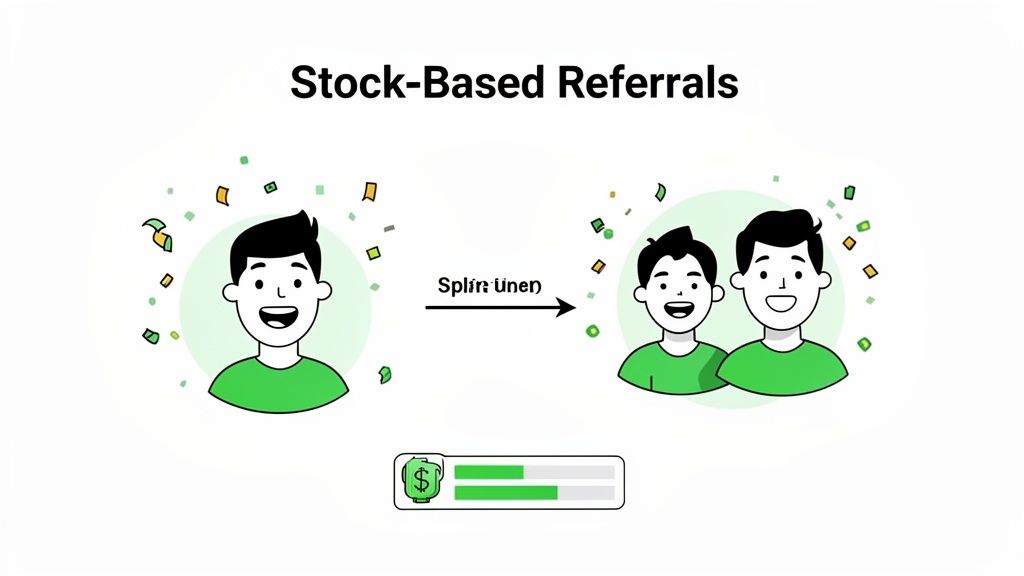
The mechanics were compelling: both the referrer and the new user received a free stock upon signup. The stock was chosen randomly from a list, with a small chance of it being a high-value share like Apple or Microsoft. This element of chance and mystery made the incentive far more exciting than a fixed dollar amount, encouraging repeat sharing.
Strategic Breakdown
Robinhood’s program succeeded by perfectly aligning the incentive with the user’s primary motivation for using the app: investing. Getting a free stock wasn't just a reward; it was a direct onboarding experience into the product's core value proposition. This native reward system drove massive acquisition, helping the platform grow to over 13 million users with referrals accounting for over 30% of new signups.
Key Insight: Variable rewards are psychologically more powerful than fixed rewards. The unknown potential of receiving a high-value stock created a sense of excitement and social currency that a predictable $5 bonus could never achieve.
The program was also deeply integrated and gamified. Users could track their referral progress within the app, creating a sense of achievement. The "scratch-off" animation to reveal the free stock added a layer of delight and surprise, making the experience memorable and shareable. This transformed a simple referral into an engaging mini-game.
Actionable Takeaways for SaaS Teams
- Introduce Variable Rewards: Instead of a fixed incentive, test a system where users can win different tiers of rewards. This could be a random amount of usage credits, a chance at a lifetime plan, or access to a premium feature for a variable duration.
- Gamify the Reveal: Make receiving the reward an experience. Use animations, progress bars, or a "reveal" mechanic to build anticipation and make the moment more impactful.
- Create Aspiration with Tiers: Structure rewards so that top referrers unlock exclusive benefits. This could be early access to new features, a permanent plan upgrade, or a "VIP" badge, creating a competitive social dynamic.
- Keep Incentives Product-Native: The best rewards deepen a user's engagement with your product. Offering more of your service ensures that referred users are motivated by the product's value, leading to higher long-term retention.
7. Notion's Community-First Affiliate & Creator Program
Notion flipped the traditional affiliate model on its head, building one of the most powerful examples of viral advertising by empowering its most passionate users. Instead of simply paying for clicks, they cultivated a thriving ecosystem of creators, educators, and consultants who became authentic brand evangelists. The program's success came from focusing on value beyond monetary rewards.
This community-led approach turned superfans into business partners. By providing creators with exclusive templates, early access to new features, and co-marketing opportunities, Notion built a self-sustaining content engine. This strategy was pivotal in growing their user base past 10 million, with YouTube creators alone generating millions of organic impressions and the Notion Template Gallery becoming a primary user acquisition channel.
Strategic Breakdown
Notion's growth wasn't just product-led; it was community-powered. They recognized that their most engaged users weren't just customers but potential partners who could demonstrate the product's value far more effectively than any ad campaign. The evolution into the Notion Certified Consultant program formalized this, adding a layer of credibility and turning advocacy into a viable career path for its members.
Key Insight: The program succeeded by aligning incentives with creators' intrinsic motivations: building a personal brand, gaining authority, and accessing exclusive resources. The reward was status and opportunity, not just cash.
This symbiotic relationship fueled a viral loop. Creators produced high-quality tutorials and templates to grow their own audiences, which in turn drove new, highly-qualified users to Notion. The company provided the platform and tools, and the community provided the scale and authenticity, creating a powerful and cost-effective growth engine.
Actionable Takeaways for SaaS Teams
- Empower, Don't Just Pay: Identify your power users and provide them with exclusive benefits like early feature access, co-marketing, and official certification. This builds loyalty and generates authentic promotion.
- Build a Creator Flywheel: Enable creators to build businesses on your platform. A template gallery or expert marketplace can become a primary acquisition channel driven entirely by your community.
- Formalize Your Community: Create structured programs like a "Certified Consultant" or "Ambassador" tier. This adds credibility for the creator and establishes a clear path for engaged users to become high-value partners.
- Foster Partner Collaboration: Create dedicated spaces, like a private Slack or forum, where your top partners can connect and support each other. This strengthens the ecosystem and reduces your support load. Learn more about effective partnership marketing strategies to build a similar program.
8. GitHub's Open-Source Sponsorship & Developer Advocacy Model
GitHub redefined growth by treating its community not as customers, but as collaborators. Instead of a traditional marketing funnel, they built one of the most powerful examples of viral advertising by fostering a community-led ecosystem. Their growth engine wasn't a referral link; it was technical credibility, public contributions, and peer-to-peer advocacy built directly into the platform.
The model flips the script: instead of paying for clicks, GitHub empowered developers to build public reputations. Features like contribution graphs, stars, forks, and follower counts became social currency. This created a viral loop where developers drove platform adoption organically by sharing their work, contributing to open-source projects, and showcasing their skills to potential employers.
Strategic Breakdown
GitHub’s success stems from understanding that for developers, reputation is the ultimate incentive. They built a platform where using the product was synonymous with building a professional identity. The launch of GitHub Sponsors in 2019 amplified this by allowing the community to financially support open-source maintainers, closing the loop between contribution and reward.
Key Insight: The viral mechanic is intrinsic motivation, not extrinsic rewards. GitHub's growth is fueled by developers' desire for recognition, collaboration, and career advancement, all of which are facilitated by active platform participation.
This community-centric approach was the primary driver that scaled GitHub from a small startup to a platform with over 100 million developers. The platform's value increases with every new user and every new repository, creating an unstoppable network effect. Developers aren't just users; they are the platform's most effective advocates and content creators.
Actionable Takeaways for SaaS Teams
- Build Reputation Systems: Integrate public profiles that showcase user achievements, contributions, or expertise. Make this profile shareable and a source of pride for the user.
- Enable Peer-to-Peer Recognition: Create features that allow users to endorse, upvote, or reward each other. This fosters a positive community and turns top contributors into natural brand ambassadors.
- Create Status Tiers: Go beyond simple rewards by implementing tiers based on contribution quality or community engagement. This gamifies participation and provides a clear path for users to become super-users.
- Empower, Don't Just Incentivize: Focus on providing tools and platforms that help your users achieve their own goals. When your product's success is aligned with your users' personal and professional success, organic advocacy becomes inevitable.
8 Viral Referral & Advocacy Campaigns Compared
| Example | Implementation Complexity 🔄 | Resource Requirements ⚡ | Expected Outcomes 📊 | Ideal Use Cases 💡 | Key Advantage ⭐ |
|---|---|---|---|---|---|
| Dropbox's Referral Program - The Gold Standard | Medium — native product integration & tracking | Moderate initial dev; low ongoing marketing spend | High sustained virality (35% of new signups at peak) ⭐⭐⭐ | Consumer SaaS where product value scales with usage | Dual-sided native incentives → self-sustaining growth |
| Slack's "Powered by Slack" Ecosystem Strategy | High — partner programs, revenue-share, partner tooling | Moderate–high (partner management, co-marketing) ⚡ | Strong enterprise adoption and network effects 📊⭐⭐⭐ | API-first platforms seeking distribution via integrations | Turns partners into de facto ambassadors via integrations |
| PayPal's Early Referral Incentives ($10) | Low implementation complexity (monetary payouts) 🔄 | Very high capital burn; fraud prevention costs ⚡⚡ | Explosive short-term growth; poor long-term unit economics 📊⭐⭐ | Rapid market capture where network effects are critical | Fast user acquisition with very high viral coefficient |
| Airbnb's "Belong Anywhere" Referral & Content Fusion | High — UGC systems + native referrals | Moderate (community, content ops, moderation) ⚡ | Authentic advocacy and long-term brand loyalty 📊⭐⭐ | Marketplaces and consumer platforms reliant on trust | Merges referrals with storytelling for natural sharing |
| Uber's Aggressive Two-Sided Referral Mechanics | High — separate rider & driver flows, market tuning 🔄 | Very high incentives and ops costs ⚡⚡ | Rapid geographic expansion; costly scalability 📊⭐⭐ | Multi-sided marketplaces needing supply-demand liquidity | Solves chicken‑and‑egg via two-sided incentives |
| Robinhood's Gamified Referral with Stock Rewards | Medium — gamification + fintech compliance | Moderate (fintech infra, regulatory controls) ⚡ | High engagement and quality user acquisition 📊⭐⭐⭐ | Fintech products where native rewards align with value | Product-native rewards + gamification → strong retention |
| Notion's Community-First Affiliate & Creator Program | Medium — creator programs, certification, co-marketing | Low–moderate (creator support, partnerships) ⚡ | Steady, high-quality growth driven by creators 📊⭐⭐ | Tools for creators, educators, and community-led adoption | Sustainable creator advocacy and rich content ecosystem |
| GitHub's Open-Source Sponsorship & Developer Advocacy | Medium — reputation systems & sponsorship features | Low (leverages platform activity; dev relations) ⚡ | Long-term organic growth from developer advocacy 📊⭐⭐ | Developer tools, OSS platforms, API-first products | Reputation-aligned incentives that tap intrinsic motivation |
Your Blueprint for Building a Viral Growth Engine
As we've journeyed through these iconic examples of viral advertising, a powerful, unifying principle has emerged. From Dropbox's seamless referral system to GitHub's developer-centric advocacy, true virality is not a marketing tactic bolted onto a product; it is an intrinsic part of the product experience itself. It is a meticulously designed growth engine, not a lucky accident.
These campaigns succeeded because they went beyond just asking for a share. They identified the core value their users received and then built a sharing mechanism that amplified that same value. The most effective strategies don't just reward the referrer; they deliver immediate, tangible benefits to the new user, creating a frictionless and compelling reason to join.
Distilling the Viral Formula
To transform these case studies into your own success story, it's crucial to isolate the core mechanics. We can distill the strategies of PayPal, Uber, and Notion down to three foundational pillars that any SaaS team can build upon:
- Integrated Incentives: The reward for sharing must feel like a natural extension of your product. Dropbox offered more storage, Robinhood offered a piece of the market, and Slack offered a more connected ecosystem. The incentive should enhance the user's experience, not just provide a generic monetary reward.
- Frictionless Sharing: The act of inviting someone must be incredibly simple, often requiring just a single click. Airbnb integrated sharing into the travel planning process, while Uber made it easy to share a ride code directly from the app. Any barrier, no matter how small, will drastically reduce participation.
- Mutual Value Creation: The most potent viral loops are dual-sided. They create a win-win scenario where both the existing user and the new user benefit. PayPal's original "$10 for you, $10 for them" model remains a masterclass in this principle, establishing immediate trust and value for everyone involved.
From Theory to Action: Crafting Your Growth Loop
Understanding these pillars is the first step; implementing them is what separates high-growth companies from the rest. Your goal is to move beyond abstract concepts and build a tangible, repeatable process. Start by asking critical questions about your own product:
- Identify the "Aha!" Moment: At what point do your users truly grasp the value of your platform? Your viral hook should be anchored to this moment of delight.
- Align Incentives with Value: What reward would make your power users even more successful within your app? More credits, advanced features, or early access can be far more motivating than a simple cash discount.
- Embed, Don't Append: How can you build the referral or sharing mechanism directly into the user workflow where it makes the most sense? Avoid sending users to external landing pages that break the product experience.
Building this functionality from scratch can be a significant engineering investment. However, the lesson from these examples of viral advertising is that user-led growth is the most sustainable and capital-efficient path to scale. For content-driven amplification, understanding how to ignite your startup's growth with short-form video can provide a modern playbook for creating the kind of shareable assets that fuel these loops.
The ultimate takeaway is this: your existing users are your most authentic and powerful marketing channel. By empowering them with the right tools and incentives, you're not just acquiring new customers; you're building a community of advocates who are genuinely invested in your success. This is the foundation of a durable, product-led growth engine that can propel your SaaS business to the next level.
Ready to stop admiring other companies' viral loops and start building your own? Refgrow provides the API-first infrastructure to embed a fully native, customizable referral and affiliate program directly into your SaaS product in minutes. Turn your users into your most powerful growth engine with Refgrow.