

Email Marketing for Affiliate Marketing A Guide for SaaS Growth
When it comes to your SaaS affiliate program, email marketing isn't just another channel—it's the most direct and reliable way to recruit, activate, and motivate your partners. It’s how you manage the entire affiliate lifecycle, from that first cold outreach to celebrating their 100th sale, giving you complete control over your program's growth.
Why Email Is Your Affiliate Program's Growth Engine
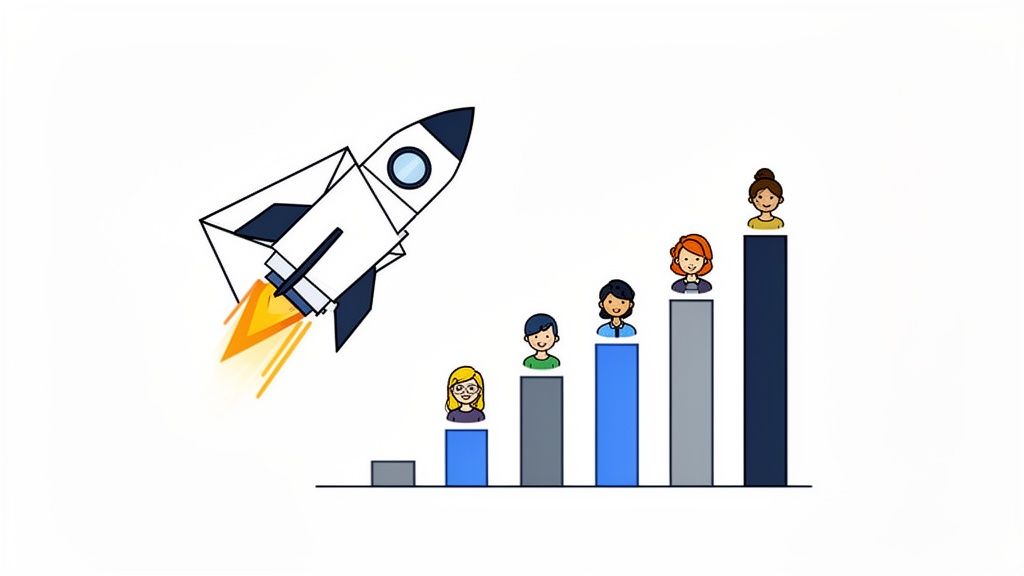
Sure, social media and paid ads can get you some traction, but email remains the undisputed champion for building a high-performing SaaS affiliate program. Why? Because it’s the only channel you truly own.
This gives you a direct, unfiltered line of communication to your most valuable partners. Unlike a tweet or a Facebook post, an email lands right in their inbox, allowing you to have a personalized, one-to-one conversation that builds a genuine relationship. You're not fighting against unpredictable algorithms or rising ad costs; you're in the driver's seat.
The Power of a Direct Connection
Think of your affiliate program as a tight-knit community. Email is your central hub—it's where you gather everyone, share important updates, and hand them the tools they need to win. This direct line is crucial for a few key reasons:
- Targeted Recruitment: Send hyper-personalized outreach to hand-picked partners without the noise of public platforms.
- Seamless Onboarding: Use automated sequences to welcome new affiliates, instantly deliver their unique tracking links, and walk them through your product's key selling points.
- Consistent Activation: Keep your partners engaged and promoting with timely emails full of campaign ideas, fresh marketing assets, and inspiring success stories.
- Motivation and Retention: Regular commission updates, exclusive bonus offers, and shout-outs for top performers build loyalty and keep your best partners from going dormant.
This level of control creates a predictable, repeatable system for scaling your program. You can methodically test everything—from subject lines to CTAs—to find what works, turning your affiliate channel into a reliable revenue engine.
Building a Scalable System
The affiliate world is booming. In the US alone, spending is on track to hit $11.99 billion by 2025 and an estimated $13.20 billion in 2026. What’s powering that growth? A significant chunk comes from email, with 22.8% of affiliate marketers citing it as their primary traffic source. You can dig into more of these affiliate trends to see the full picture.
For a SaaS business, this is about more than just sending a monthly newsletter. It’s about creating smart, automated workflows that react to affiliate behavior. A partner signs up? An onboarding sequence kicks in. An affiliate scores their first 10 sales? An automated email goes out congratulating them and maybe even unlocks a commission bonus.
This is how you move from manual, one-off check-ins to a scalable, hands-off growth machine. The rest of this guide will give you the exact frameworks to build it.
Building Your Affiliate Email Foundation
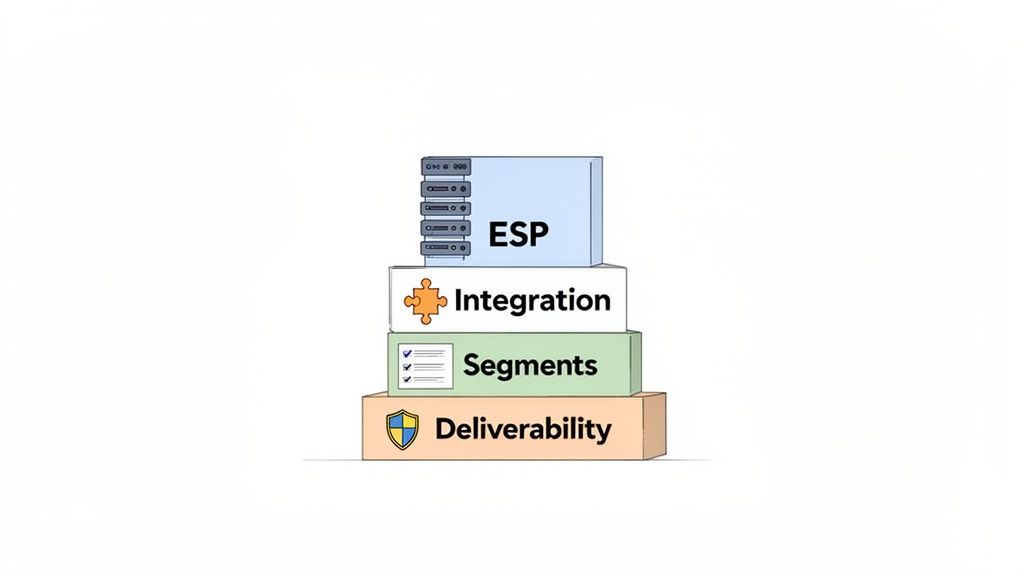
Before you even think about writing a recruitment email, you need to get your house in order. Jumping the gun here is a classic mistake. It's like building a house on sand—it might look fine for a week, but it’s guaranteed to crumble when you try to scale.
Getting this foundation right from the start means your email marketing for affiliate marketing will be automated, effective, and built for the long haul.
The first big decision is your Email Service Provider (ESP). Honestly, the best tool is often the one you’re already using. If you run customer marketing on Mailchimp, ConvertKit, or HubSpot, stick with it. This keeps your data in one place and saves you the headache of managing yet another platform.
The one thing you absolutely cannot compromise on, though, is integration capability. Your ESP must be able to talk to your affiliate platform. The magic keyword here is "webhooks." Webhooks allow your affiliate software to ping your ESP in real-time when something happens—like a new partner signing up or an affiliate making their first sale. This is the linchpin for all your automation.
Choosing Your Email Platform for Affiliate Marketing
Picking the right ESP really comes down to what you need for automation, integration, and segmentation. Some tools are built for simplicity, while others offer deep, complex workflows. To help you decide, I've compared a few popular choices based on the features that matter most for a SaaS affiliate program.
| Platform | Best For | Key Automation Features | Integration Strength (e.g., Webhooks) | Pricing Model |
|---|---|---|---|---|
| ConvertKit | Creators & SaaS | Visual automation builder, tag-based segmentation, conditional content. | Excellent | Subscriber-based |
| HubSpot | Scaling Teams | Advanced workflows, CRM integration, full marketing suite. | Excellent | Contact tiers |
| Mailchimp | Startups & Simplicity | User-friendly interface, pre-built journeys, basic automation. | Good | Contact tiers |
| ActiveCampaign | Advanced Automation | Deep segmentation, lead scoring, conditional logic. | Excellent | Contact-based |
There are other tools to consider as well, like Substack, which might fit a more content-focused approach to affiliate communication. The key is to evaluate each one against your specific program goals, not just what's popular.
Master Your Email Deliverability
Sending an email is easy. Getting it delivered to the primary inbox? That's the real game. If your messages land in spam, your entire strategy is dead on arrival. This is all about email deliverability.
To protect your sender reputation, you have to authenticate your domain properly. This means getting your hands dirty with a few DNS records. Don't skip this.
- SPF (Sender Policy Framework): This record is like a bouncer's guest list. It tells receiving email servers which IP addresses are authorized to send email from your domain.
- DKIM (DomainKeys Identified Mail): This adds a digital, tamper-proof seal to your emails. It cryptographically verifies that the message content hasn't been altered on its way to the recipient.
- DMARC (Domain-based Message Authentication, Reporting & Conformance): DMARC is the enforcer. It tells servers what to do if an email fails the SPF or DKIM checks—quarantine it or reject it outright.
Key Takeaway: Setting up SPF, DKIM, and DMARC isn't a "nice-to-have." It's the single most critical technical step for ensuring your recruitment and activation emails actually get seen.
Segment Your Affiliates from Day One
My last piece of foundational advice: map out your segments before you have a single affiliate. Blasting the same message to everyone is a rookie move that leads to abysmal engagement. By creating distinct groups from the get-go, you can send hyper-relevant emails that resonate with partners at every stage of their journey.
Here are the essential segments to start with:
- Potential Recruits: The list of prospects you're actively trying to bring on board.
- New Affiliates (First 30 Days): This group needs your full onboarding and activation sequence.
- Active Affiliates: Partners who are sending you traffic and sales. Keep them motivated.
- Top Performers (Top 10%): These are your VIPs. They get special treatment, exclusive offers, and a direct line to you.
- Inactive Affiliates: Anyone who hasn't generated a click in 60-90 days. They need a re-engagement campaign.
With a connected ESP, solid deliverability, and a clear segmentation plan, you're finally ready to build the campaigns that will grow your program. If you're looking for a little inspiration, we've put together some great ideas in our guide on referral email templates.
Finding the Right Affiliates (It’s Not a Numbers Game)
Now that the technical groundwork is laid, it's time for the fun part: actually finding people to promote your product. But let's get one thing straight. Successful email marketing for affiliate marketing isn't about blasting a huge list and hoping something sticks. It's about precision.
Your real goal is to recruit high-value partners who already have the trust of your ideal customers. Forget about just finding anyone with a website. Generic, mass-blasted emails are a surefire way to get ignored and tarnish your brand's reputation before you even start.
The whole process kicks off with research, not with drafting an email.
Building Your Hit List
Before you even think about hitting "send," you have to know who you're talking to. The best partners aren't necessarily the ones with the biggest following; they're the ones with the right following.
So, who are you looking for? Your ideal affiliate profile probably includes people like:
- Niche Bloggers: Hunt for writers who are deep in the weeds of your industry. I’m talking about the ones who publish super-detailed reviews, tutorials, and comparison posts. If someone consistently writes "how-to" guides about the exact problem your SaaS solves, they're gold.
- Complementary SaaS Companies: Think about other tools your customers use. Find non-competing software companies that serve the same audience. A partnership here is a win-win—they get a new revenue stream, and you get highly qualified leads.
- Your Own Power Users: Seriously, don't sleep on your existing customer base. Your most passionate users are often your best evangelists. Their recommendation is genuine because it comes from real, hands-on experience.
Once you’ve identified a potential partner, the real work starts. I always block out 10-15 minutes to research each and every prospect. What's their name? What was their last article about? What unique angle do they bring to their content? This is the detail that will make your email stand out from the dozens of lazy, templated pitches they delete every single day.
Crafting a Recruitment Sequence That Actually Works
Let me be blunt: a single cold email will almost never get the job done. High-value partners are busy people, and their inboxes are a warzone. A well-thought-out, multi-touch sequence shows you're serious and that you respect their time.
Here’s a simple but incredibly effective three-part sequence that I've seen work time and time again. It’s all about personalization and leading with value.
Email 1: The Personalized Cold Outreach
The entire point of this first email is to start a conversation. That's it. Don't immediately launch into your affiliate program details or overwhelm them with commission rates. You need to lead with a genuine, specific compliment.
For instance, if you're reaching out to that blogger you found:
Subject: Your recent post on agile project management
Body:
Hi [Prospect Name],
Just read your detailed breakdown of agile frameworks for remote teams. I particularly liked your point about using asynchronous communication to reduce meeting fatigue—something we think about a lot.
Your content is incredibly valuable for SaaS founders, which is the exact audience we serve at [Your Company].
I’m reaching out because we have an affiliate program that I think could be a natural fit for your readers. Would you be open to a brief chat about it next week?
See what happened there? It's tailored. It shows you actually read their work. It's a compliment disguised as an outreach email, and it works.
Email 2: The Social Proof Follow-Up
If you don't hear back in 3-5 business days, it's time for a gentle nudge. This email is all about building credibility. You want to show them that other respected people in their industry are already working with you.
Subject: Re: Your recent post on agile project management
Body:
Hi [Prospect Name],
Just following up on my previous email. I know you're busy!
To give you a bit more context, we're already working with partners like [Similar Blogger/Company 1] and [Similar Blogger/Company 2], who have seen great success introducing our tool to their audience. We provide all the creative assets and support to make promotion seamless.
Let me know if you have any questions.
This simple addition of social proof lowers the perceived risk of partnering with someone new. It sends a quiet signal that they'd be in good company.
Email 3: The Final, Value-Packed Nudge
Your last email in this sequence is a final, no-pressure offer that's packed with value. You’re not trying to strong-arm them into a partnership; you're just giving them one last, compelling reason to hit reply.
One of my favorite tactics here is to offer them an extended trial or even a free lifetime account. This removes every single barrier and shows you have complete confidence in your product.
Subject: A free [Your Product] account for you
Body:
Hi [Prospect Name],
One last follow-up. I'm so confident that your audience would love [Your Product] that I'd like to offer you a free lifetime account, no strings attached.
This way, you can explore the platform for yourself and see if it's something you'd feel comfortable recommending.
If you’re interested, just reply to this email, and I'll get you set up.
This last touch is often what converts the prospects who were on the fence. It completely flips the script from "what can you do for me?" to "here's what I can do for you," setting the stage for a great relationship from day one.
Turning Signups Into Revenue: Your Automated Onboarding and Activation Playbook
So, you’ve convinced a great partner to join your affiliate program. That’s a huge win, but let’s be honest—it’s just the first step. A signup is just a name on a list until they start driving traffic and sales. The real magic happens during activation, and that's where a killer automated email sequence comes in.
This isn't about just sending information; it's about transforming an interested affiliate into a confident, motivated partner who knows exactly how to succeed with your product. Your job is to clear the path, remove any friction, and guide them straight to that first commission check.
The recruitment process itself—building a solid list and doing personalized outreach—lays the groundwork. Once they say "yes," your automated onboarding flow needs to take the baton and run with it.
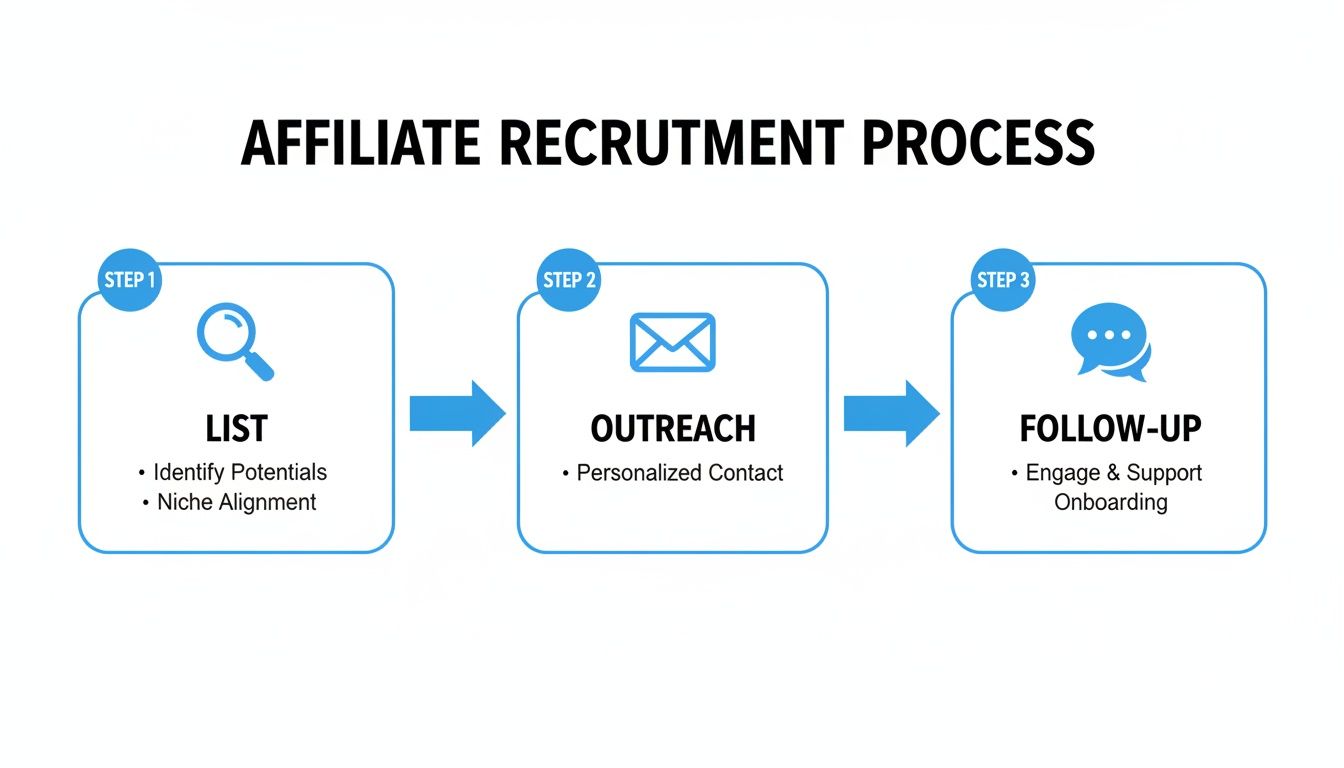
This initial legwork is what gets quality partners in the door. Now, let’s get them moving.
The 5-Part Activation Sequence That Actually Works
Think of this sequence as your new affiliate's personal welcome tour. Each email has a specific job, building on the last to create momentum and arm them with everything they need. This is a strategic drip, not a firehose of information.
Here’s a proven 5-part flow that kicks off the second an affiliate joins your program:
1. The Instant "Welcome & Here's Your Link" Email (Sent Immediately)
This needs to hit their inbox instantly. No delays. Its two jobs are critical: confirm their spot in the program and, most importantly, give them their unique affiliate link. Make that link the hero of the email. Put it in a button, bold it, and make it impossible to miss.
2. The Product Deep Dive (Sent Day 2)
Your partners can't sell what they don't truly understand. This email goes beyond a simple feature list. It’s your chance to tell the story of your SaaS—what problems does it solve? Who is the ideal customer? Give them the key selling points and "aha!" moments that will resonate with their audience.
3. The "Quick Win" Nudge (Sent Day 4)
Momentum is everything in the early days. The goal here is to get them to take one small, easy action. Don't just say, "Go promote us!" Give them a concrete task. For example, provide a pre-written social post they can share or a specific banner they can drop into their blog's sidebar. Make it frictionless.
4. The Resource Library (Sent Day 7)
Now it's time to stock their toolkit. This email is their one-stop shop for all your marketing assets. Give them direct links to a well-organized folder (think Google Drive or Dropbox) with logos, product screenshots, high-quality banners, and maybe even a few case studies. The easier you make it, the more likely they are to use them.
5. The Personal Check-In (Sent Day 14)
Even though this email is automated, it should feel personal. A simple, "Hey, just checking in. How's it going so far? Any questions I can help with?" goes a long way. It opens the door for a real conversation and shows you see them as a partner, not just a number.
An automated onboarding sequence does more than just deliver information; it sets the tone for your entire partnership. It demonstrates that your program is professional, supportive, and designed to help them succeed from day one.
Go Deeper with Behavior-Based Triggers
The 5-part sequence is your foundation. But if you really want to level up, you need to react to what your affiliates are actually doing. By using webhooks to connect your affiliate platform to your email marketing tool, you can create a dynamic system that responds to their actions in real-time.
Think about setting up these kinds of advanced triggers:
- First Click Generated: The moment they drive their first click, send an encouraging email. "Awesome job! Your first visitor just clicked through. That's the first step to a commission. Here are a couple of tips to turn those clicks into sales."
- First Sale Made: This is a celebration! Trigger an immediate "Congratulations!" email. Reinforce that their efforts are paying off and build excitement for what’s next.
- Approaching a Payout Threshold: If an affiliate is just a sale or two away from their first payout, a little motivation can work wonders. "You're so close to your first payout! Just a couple more sales and you'll be there."
This kind of responsive automation makes your partners feel seen and supported. It’s a powerful way to build loyalty and keep them engaged long after the initial onboarding wraps up. For a deeper dive on setting up these kinds of workflows, check out our guide to fully automate affiliate marketing.
The combination of email and affiliate marketing is a serious growth engine for SaaS. With the affiliate industry projected to hit nearly $20 billion globally by 2026, its power is undeniable. Within that world, email is a titan—22.8% of affiliates name it as a top traffic source, and it consistently drives higher earnings. Giving your partners the ability to email their referral links directly from their dashboard is a recipe for scalable growth.
Keeping Your Affiliates Engaged and Motivated
Think of your affiliate program as a living, breathing community, not just a static dashboard. Once the initial buzz of getting someone signed up fades, the real work starts. You’ve got to keep your partners excited and actively promoting your SaaS. Success here isn’t about a one-off trick; it's about building a long-term engagement strategy fueled by smart email marketing.
A quiet affiliate is an unproductive affiliate. It's that simple. Your job is to keep the conversation going, providing a steady stream of value, recognition, and motivation that makes them feel like a genuine partner in your growth. This ongoing communication is what separates a program that thrives from one that just… fizzles out.
Segmenting for Smarter Engagement
Blasting the same generic newsletter to every single affiliate is a surefire way to get ignored. Just like you segmented new partners during onboarding, you need to keep doing it to make sure your messages actually land. Honestly, your long-term success with email marketing for affiliate marketing depends entirely on sending the right message to the right group.
Here are the segments I always keep an eye on:
- Top Performers (Your VIPs): This is the top 5-10% of your crew, the ones driving most of your results. Treat them like gold. They get exclusive access, early news, and a direct line to you.
- Rising Stars: These are the affiliates showing real promise. Maybe they’ve landed a few sales or their traffic is climbing steadily. They need a bit of encouragement and some advanced tips to help them break through to the next level.
- Consistent Mid-Tier: This is the reliable core of your program. They promote pretty regularly but could probably use a creative spark or a new campaign idea to juice their performance.
- Inactive Affiliates: These are the partners who haven't sent a click or a sale your way in the last 90 days. This group needs a dedicated re-engagement sequence to coax them back into the game.
The Monthly Affiliate Newsletter
Your monthly newsletter is the heartbeat of your affiliate community. It’s your most consistent touchpoint for sharing what’s new, celebrating wins, and handing out fresh resources. This shouldn’t feel like a corporate memo; it needs to be a genuinely helpful update that your partners actually look forward to opening.
Every newsletter should be a mix of these key ingredients:
- Leaderboard Shout-outs: Publicly praise your top 3-5 performers for the month. This taps into that natural human desire for recognition and sparks some friendly competition.
- Success Stories: Feature a quick case study or a quote from a successful affiliate explaining a specific tactic that worked for them. Peer-to-peer advice is incredibly persuasive.
- Product Updates: Briefly touch on new features or improvements. But more importantly, tell them how to frame these updates for their audience. Give them the angle.
- New Marketing Assets: Let them know about any new banners, email swipes, or video content you've cooked up for them.
- Upcoming Promotions: Give them a heads-up about any upcoming sales or special offers so they can get their content calendars ready in advance.
Pro Tip: Keep it scannable. No one has time for a wall of text. Use clear headings, bullet points, and bold text. Always wrap up with a single, clear call-to-action, like "Grab the new creative assets here" or "Read this month's top promotion strategy."
Running Exclusive Promotions and Contests
Sometimes, all it takes is a little extra incentive to get things moving again. Running periodic, email-driven promotions can create a huge surge in activity and sales. These campaigns build urgency and give affiliates a compelling reason to push your product right now.
Here are a few promotional ideas that have always worked well for me:
- Commission Bonuses: Announce a limited-time bump in commission. Something like, "For the next 7 days, earn 40% commission instead of 30% on all new sign-ups!"
- Sales Contests: Gamify the experience. Offer cash prizes or cool tech (like an iPad) for the top 3 affiliates who generate the most sales in a given month.
- Tiered Rewards: This is a great way to motivate everyone, not just the usual top performers. Set up bonuses for hitting specific milestones, like "$50 bonus for your first 5 sales" or "$200 for hitting 25 sales."
Re-Engaging Your Inactive Affiliates
It’s just a fact of life: some partners will go quiet. Don’t just let them fade away. A simple, automated re-engagement sequence can often be enough to bring them back. This flow typically kicks in after 90 days of total inactivity.
- Email 1 (The Gentle Nudge): Start with a simple check-in. "Hey [Name], we've missed you! Is there anything we can do to help you get started again?"
- Email 2 (Offer Help): Share a genuinely useful resource, like a link to your best-performing blog post or a guide to promoting your SaaS. Frame it as helpful, not needy.
- Email 3 (The Last Call): Be direct but friendly. "We're cleaning up our affiliate list. If you're no longer interested, no worries! But if you want to stay, here’s an idea for a quick win..."
When you start treating your affiliate program as a community that needs consistent nurturing, you’ll transform it from a simple transactional setup into a powerful, loyal, and incredibly effective growth channel.
Measuring What Matters in Your Email Strategy
If you're not tracking data, you're just guessing. To build an affiliate program that actually drives revenue, you have to move past vanity metrics and measure what’s really working. This is all about connecting your email efforts directly to affiliate performance, giving you a crystal-clear picture of your return on investment.
Tracking the right key performance indicators (KPIs) lets you stop guessing and start making smart, data-backed decisions. I always tell founders to focus on two different, but deeply connected, types of metrics.
Core Email Campaign Metrics
First things first: you need to know if people are even seeing and opening your emails. These are the fundamental metrics that tell you about the health of your deliverability and whether your message is landing. If these numbers are in the red, nothing else you do will matter.
- Open Rate: What percentage of people actually opened the email? A weak open rate is almost always a sign of a boring subject line or a poor sender reputation.
- Click-Through Rate (CTR): Of those who opened, who clicked a link? This tells you, point-blank, how compelling your email copy and call-to-action really are.
- Unsubscribe Rate: You'll always have some people opt out, but keeping this number low (ideally below 0.5%) is a strong signal that you have a healthy, engaged list.
I see this all the time: a high open rate but a terrible CTR. That’s a classic sign of a mismatch. Your subject line wrote a check that your email content couldn't cash. It immediately tells you that your message body is the problem, not your subject line.
Affiliate Program Outcome Metrics
This is where the rubber meets the road. These KPIs are about tying your email campaigns directly to the bottom line of your affiliate program. We're moving beyond clicks and opens to measure actual business impact.
- Affiliate Activation Rate: What percentage of affiliates who sign up actually generate their first click or sale within 30 days? Honestly, this is the single most important metric for judging how well your onboarding sequence is working.
- Sales Per Affiliate: Tracking this helps you instantly spot your top performers and identify those who might need a little more help. It's a goldmine for smarter segmentation.
- Attributed Sign-ups: How many new affiliates can you trace directly back to a specific recruitment email? You need this number to calculate the true ROI of your outreach.
A Practical A/B Testing Roadmap
You have to be constantly iterating. A/B testing is how you systematically refine your emails based on what your audience actually does, not what you think they'll do. The key is to avoid testing everything at once—focus on one variable at a time for clean, reliable results.
I always recommend starting with your recruitment and activation emails, since they have the biggest downstream impact on your program's success. For a much deeper dive into the numbers, check out our complete guide on essential affiliate marketing metrics.
Here are a few high-impact tests you can run right away:
- Subject Line Personalization: Pit a generic subject line like "Affiliate Program Invitation" against something highly personalized, like "[Prospect's Name], love your work on [Their Blog Name]."
- Call-to-Action (CTA) Wording: In an onboarding email, test a basic "Get Your Affiliate Link" against a more benefit-focused CTA like "Start Earning Your First Commission."
- Email Timing and Cadence: Does sending that "Quick Win" activation email on Day 4 get more traction than sending it on Day 7? Test it and find out what drives faster action from new partners.
Diving Into the Details: Your Top Questions Answered
When you get down to the nitty-gritty of building an email engine for your affiliate program, a lot of questions pop up. I get it. Here are some of the most common ones I hear from SaaS founders, along with some straight-to-the-point answers based on what actually works.
How Many Emails Do I Really Need in an Affiliate Onboarding Sequence?
The sweet spot is usually 4-6 emails spread out over the first couple of weeks. This gives you enough runway to get your new partners all the essential info they need without completely flooding their inbox.
Think of it as a guided journey. You want to take them from the initial excitement of joining to actually taking action. The whole point is to automate a solid, supportive experience that sets every single partner up for success right from day one.
A killer onboarding flow isn't just a data dump. It should include a warm welcome, some core product education, easy access to their marketing assets, a simple "quick win" idea to get them started, and a personal check-in to see if they need help.
What's the Best Way to Actually Find Affiliates to Email?
Forget the shotgun approach. The single most effective strategy is to focus on quality, not quantity. You want to find creators and businesses who already have your ideal customer’s ear. A small, highly targeted list will outperform a massive, generic one every single time.
I’d start by looking for these types of partners:
- Niche Bloggers: Go find the writers who are already publishing deep-dive software reviews and tutorials in your space. They’re trusted authorities.
- Complementary SaaS Companies: Think about the other tools your customers are already using. Partnering with a non-competing SaaS is a classic win-win.
- Your Own Customers: This is the most overlooked goldmine. Your biggest fans and power users can become your most passionate and authentic advocates.
Can I Just Use My Existing Email Platform for This?
Absolutely. In fact, you probably should. Sticking with your current email marketing platform—whether it's ConvertKit, Mailchimp, or HubSpot—keeps your data in one place and your tech stack lean. Who wants the headache of managing yet another tool?
The only non-negotiable is making sure it integrates smoothly with your affiliate software. The magic ingredient here is webhooks. That connection is what lets you build powerful automations, triggering specific emails based on what your affiliates are actually doing—like when they sign up or, even better, when they make their first sale. It turns a static email list into a responsive, intelligent system.
Ready to build a powerful, native affiliate program directly inside your SaaS? Refgrow gives you the tools to launch, customize, and scale your program in minutes. Get started with Refgrow today.