

Mastering The SaaS Customer Acquisition Funnel
Think of the customer acquisition funnel as the roadmap a person follows, from the moment they first hear about your brand to the day they become a loyal, paying customer. It's how you methodically turn complete strangers into your biggest fans.
Your Guide To The Customer Acquisition Funnel
Building a customer acquisition funnel isn't all that different from building a great product. You don't just throw features at a wall and see what sticks. Instead, you follow a logical path—from identifying a problem to launching a solution that people can't stop talking about. Each stage of the funnel acts as a blueprint for sustainable growth.
This guide will skip the generic definitions and get straight to what works for modern SaaS companies. We’ll walk through the five key stages of the customer journey, helping you turn your marketing budget from a line-item expense into a predictable revenue machine. Getting this right has never been more important, especially with acquisition costs climbing everywhere.
Why The Funnel Matters More Than Ever
A solid funnel isn't just a "nice-to-have" marketing tool; it's a survival strategy. Customer acquisition costs (CAC) have shot up recently. For e-commerce businesses, the average CAC is now around $70—a whopping 40% increase in just two years. B2B companies haven't been spared either, seeing a 15% rise since 2020. This trend makes an efficient funnel absolutely essential for maintaining healthy unit economics and staying in business.
A customer acquisition funnel directly tackles rising costs by forcing you to be efficient. Instead of just throwing money at ads, you’re strategically guiding users from one step to the next, optimizing each interaction to cut out friction and boost value.
This structured process gives you a framework to spot problems, put your resources where they’ll have the most impact, and turn your product into its own growth channel. It brings clarity and helps you answer the big questions:
- Where are we losing potential customers? Pinpointing the leaks helps you patch up the weakest spots in your user journey.
- Which marketing channels are actually paying off? Data tells you where to double down and where to pull back.
- How do we get happy users to spread the word? A great funnel doesn't stop at the first purchase; it builds powerful growth loops.
For a more hands-on walkthrough of setting up your flow, check out this guide on how to build a marketing funnel. By really understanding and refining each stage—from awareness to activation, retention, and referral—you create a resilient system that consistently brings in and keeps the right kind of customers.
What Are The 5 Stages of a SaaS Customer Acquisition Funnel?
Forget the dusty, old-school marketing funnel. For a SaaS business, the customer journey is less like a straight line and more like an evolving relationship. We need a model that reflects how people actually discover, test-drive, and eventually fall in love with a product.
This is where the modern SaaS customer acquisition funnel comes in. It breaks the journey down into five distinct stages, guiding someone from a total stranger to your biggest fan. Think of it as a roadmap for building trust and proving your product's value, one step at a time.
This process isn't that different from building a great product. You start by identifying a real-world need, create a solution, and then guide users to that magic "aha!" moment where everything just clicks.
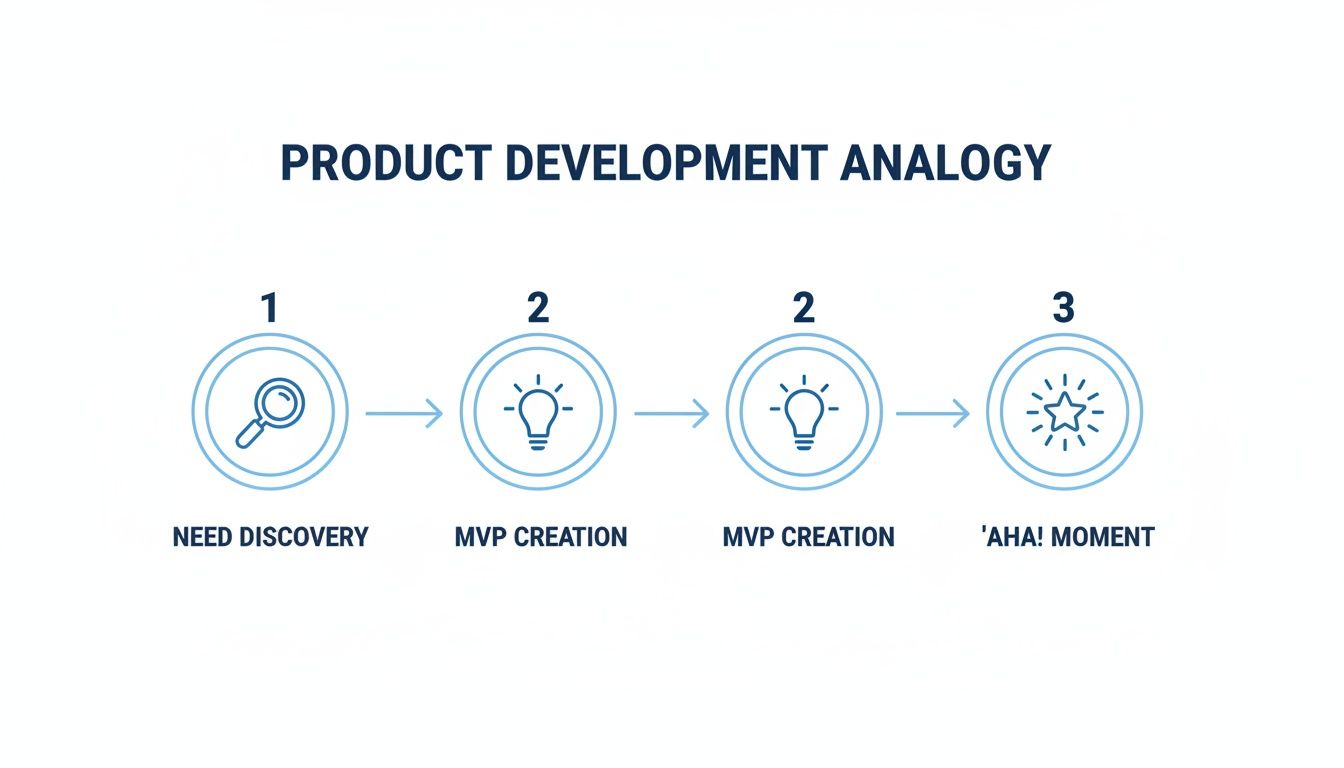
The journey to acquiring a loyal customer mirrors the innovation path—from spotting a market gap to delivering an MVP that provides that crucial moment of insight.
To bring this to life, let's break down each of the five stages, what your goal should be, and the common tactics SaaS teams use to win at each step.
The 5 SaaS Customer Acquisition Funnel Stages
| Stage | Primary Goal | Example Channels & Tactics |
|---|---|---|
| 1. Awareness | Get Discovered. Your brand needs to show up where potential customers are looking for answers to their problems. | SEO-driven blog posts, social media, podcast appearances, guest articles, webinars. |
| 2. Acquisition | Capture Interest. Convert a passive visitor into an active lead by getting them to take a first, low-commitment step. | Free trial sign-ups, freemium plan registrations, demo requests, lead magnet downloads. |
| 3. Activation | Prove Value. Guide new users to their "aha!" moment, where they experience the core benefit of your product firsthand. | In-app onboarding tours, welcome email sequences, setup checklists, tutorial videos. |
| 4. Retention | Build Loyalty. Deliver consistent value to keep customers happy, paying, and engaged for the long term. | Proactive customer support, feature announcements, user communities, loyalty perks. |
| 5. Referral | Inspire Advocacy. Turn your happiest customers into a powerful marketing channel that drives new growth. | In-app referral programs, affiliate partnerships, customer testimonials and case studies. |
Now, let’s dig a little deeper into what’s happening—and what you should be doing—at each of these critical milestones.
Stage 1: Awareness
Right at the top of the funnel, your future customers don’t even know you exist. They just know they have a problem or a nagging question, and they've started looking for answers.
Your mission here is simple: get discovered. You need to be the helpful voice they find during their search. This isn't the time for a sales pitch; it's about providing genuine value and establishing yourself as a credible expert.
- What they're thinking: "How do I solve X?" or "I need to learn more about Y."
- What you should do: Intercept their search with helpful, educational content.
- Where to do it: SEO-optimized blog posts, social media discussions, guest spots on industry blogs, and appearances on relevant podcasts.
Stage 2: Acquisition
Okay, they know who you are. Now what? The acquisition stage is where a passive browser takes the first real step and becomes an active lead. They’ve moved beyond just reading your content and are ready to engage more directly.
This is your chance to offer something compelling in exchange for their contact info or a deeper commitment. For most SaaS companies, this means getting them to sign up for a free trial or a freemium plan.
Acquisition is the first handshake. It’s the moment an anonymous visitor becomes a named user in your system. Success here depends on offering a frictionless, low-risk way for them to experience your product's promise.
Stage 3: Activation
A sign-up is a win, but it’s a temporary one. A user who signs up and ghosts you is a massive missed opportunity. Activation is the make-or-break stage where you guide new users to experience the core value of your product—their personal "aha!" moment.
This is the point where they don't just see your features; they feel the benefit. For a project management tool, that "aha!" could be creating and assigning their first task. For an analytics platform, it might be seeing their first truly insightful report.
Mastering this stage requires a killer onboarding experience. If you’re serious about this, exploring a comprehensive growth strategy framework can help you map out the exact steps to guide every new user toward that moment of value.
Stage 4: Retention
An activated user is fantastic, but a paying, long-term customer is what actually builds a business. Retention is all about turning that initial positive experience into lasting loyalty. You're no longer just selling a product; you're building a relationship.
Happy customers are the bedrock of a healthy SaaS company. They provide predictable revenue, are less likely to churn, and are your best candidates for future upgrades. Key retention efforts often include:
- Proactive Customer Support: Solving issues before they become reasons to leave.
- Ongoing Education: Sharing new features and best practices to make your product indispensable.
- Community Building: Creating a space for users to connect with you and each other.
Stage 5: Referral
Here we are at the final and most powerful stage: referral. This is where you transform your most satisfied customers into your most effective marketing engine. A recommendation from a trusted peer is marketing gold—it carries more weight than any ad you could ever run.
Referrals create a beautiful, self-sustaining growth loop. One happy customer brings in another, who becomes happy and brings in a third, and so on. This is the secret to hyper-efficient growth, as it absolutely crushes your Customer Acquisition Cost (CAC).
To make it happen, you have to make sharing your product ridiculously easy. A native, in-app referral program is one of the best ways to encourage and reward this behavior, effectively turning your funnel into a flywheel.
Measuring The Health Of Your Funnel
A customer acquisition funnel is just a pretty drawing without numbers to back it up. You can't rely on guesswork to build a growth strategy. To figure out what’s actually working—and more importantly, what's broken—you need to measure how users move through each stage. The numbers tell the real story, revealing exactly where people get stuck and where they sail through.
Think of your funnel as a series of pipes. Your metrics are the pressure gauges. A low reading on one gauge is an instant red flag—it tells you there's a leak or a blockage that needs your immediate attention before the whole system grinds to a halt.
Key Metrics For Each Funnel Stage
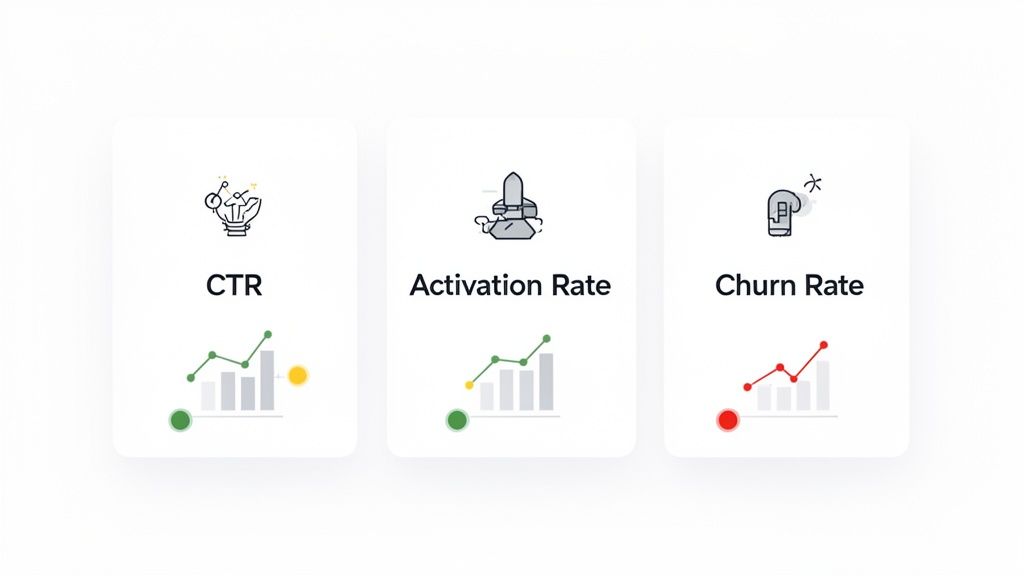
To get a clear picture, you need to track at least one key performance indicator (KPI) for every stage. These are the vital signs of your acquisition engine.
Awareness Stage Metric: Click-Through Rate (CTR)
CTR shows you the percentage of people who see your ad or link and actually click on it. It’s your first signal of effective messaging. Are you compelling enough to earn that initial tap? A low CTR is a clear sign your content isn't hitting the mark or your targeting is way off.Acquisition Stage Metric: Lead Conversion Rate
This is the percentage of visitors who take the next step, like signing up for a trial or downloading an ebook. It tells you how well your landing pages convert anonymous traffic into real, known leads. It's the handshake moment, and a low rate here points to friction in your sign-up process.Activation Stage Metric: Activation Rate
For SaaS companies, this might be the single most important metric. It tracks how many new sign-ups complete a key action that signals they’ve found value—that "aha!" moment. This could be creating their first project or inviting a teammate. A poor activation rate is a massive warning sign that your onboarding is failing.Retention Stage Metrics: Churn Rate & LTV
Churn Rate is the percentage of customers who cancel their subscriptions over a set period. It’s the ultimate test of your product's long-term value. Meanwhile, Customer Lifetime Value (LTV) projects the total revenue you can expect from a customer, showing you just how valuable your loyal users are.
For a SaaS business to survive, its Customer Lifetime Value (LTV) has to be much higher than its Customer Acquisition Cost (CAC). The gold standard is an LTV:CAC ratio of 3:1 or better. If it costs you more to get a customer than they'll ever pay you, your business is on a fast track to failure.
Spotting Leaks In Your Funnel
Knowing the metrics is one thing, but understanding what they mean is everything. Use this table as a quick diagnostic tool to see if your funnel is healthy or springing leaks.
| Funnel Metric | A Healthy Funnel Looks Like... | An Unhealthy Funnel Looks Like... |
|---|---|---|
| CTR (Awareness) | High CTR (2-5%+ for search ads) indicates your message is resonating. | Low CTR means your ad copy or targeting is missing the mark. |
| Lead Conversion Rate | A solid rate (3-5% on average) shows your offer is compelling and frictionless. | A low rate suggests a disconnect between your ad and landing page, or a clunky sign-up form. |
| Activation Rate | High rates (25-40%+) mean your onboarding successfully guides users to value. | Low rates point to a confusing product or a broken onboarding flow that loses people early. |
| Churn Rate (Retention) | Low and stable churn (<5% monthly) shows customers see ongoing value in your product. | High or rising churn signals product gaps, poor support, or simply unmet expectations. |
At the end of the day, these numbers are more than just data points on a dashboard; they are direct feedback from your users. Low conversion rates are people saying, "This is too complicated." High churn is them saying, "This isn't worth the money."
Listening to these signals is the first step toward building an efficient and scalable customer acquisition funnel. To get the full financial picture, it helps to calculate customer acquisition cost and understand your unit economics.
Actionable Strategies To Optimize Your Funnel
Alright, so you understand the stages and metrics of your customer acquisition funnel. That’s the easy part. Now it’s time to roll up your sleeves and get to work. An optimized funnel doesn’t just happen—it’s built through a series of deliberate, continuous tweaks at every single point in the customer journey.
For SaaS and particularly for Product-Led Growth (PLG) teams, this means moving past high-level marketing theory. You need targeted tactics that create a smooth, frictionless path—one that not only converts visitors but turns them into advocates who drive your growth.
Tuning Your Awareness Engine
At the very top of your funnel, optimization is all about precision, not just raw volume. Casting a wide, generic net is a surefire way to burn through your budget. The real goal is to reach the right people in the right places with a message that hits home.
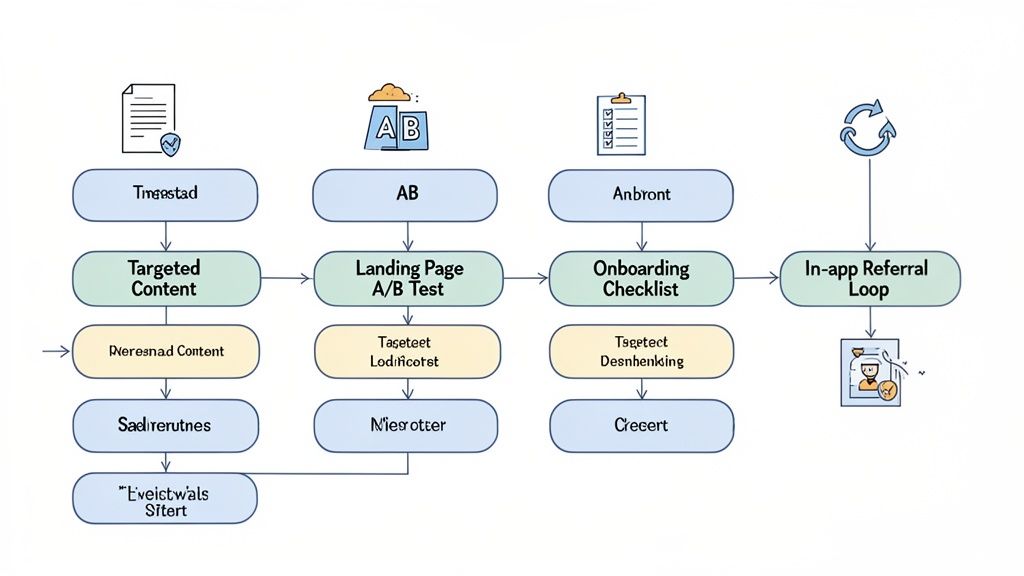
Targeted Content Marketing: Stop blogging about your features. Instead, create in-depth guides, practical tutorials, and honest comparison articles that solve the exact problems your ideal customers are Googling. You want to answer their questions before they even know they have them.
Niche Community Engagement: Your future power users are already hanging out in Slack channels, niche subreddits, and specialized forums. Become a real member of those communities, not a spammer. Offer genuine advice, build credibility, and let interested users find their way back to you naturally.
Streamlining The Acquisition Path
The moment a potential customer lands on your site, every click counts. Friction is your biggest enemy in the acquisition stage. Your job is to make the leap from anonymous visitor to signed-up user feel completely effortless.
This is where so many funnels spring major leaks. While the average conversion rate sits at a dismal 2.35%, the upside is massive. Think about this: companies that use personalized calls-to-action see performance jump by a staggering 202%. It’s proof that small, smart changes deliver huge results.
To nail this, focus on two critical areas:
Aggressive Landing Page A/B Testing: Your landing page is not a "set it and forget it" project. You should be constantly testing everything—headlines, button colors, social proof placement, and form fields. Even a tiny lift in your landing page conversion rate will echo through the entire funnel.
Friction-Free Sign-Up Flows: How many steps does it take to sign up for your product? Can users register with a single click via Google or GitHub? Be ruthless. Eliminate every single unnecessary field from your sign-up form. Each extra box is another excuse for a user to leave.
Engineering The Activation Moment
Getting a sign-up means nothing if that user never experiences the magic of your product. Activation is all about guiding new users to their "aha!" moment as quickly as humanly possible. A confused user is a user who churns.
An effective onboarding sequence isn't a feature tour; it's a guided journey to a specific, valuable outcome. It should be designed to help the user achieve their first small win within minutes of signing up.
Here’s how you can make that happen:
Use Interactive Onboarding Checklists: Don't just tell users what to do—show them. An in-app checklist makes the setup process feel like a game and gives users a clear path to success. As they check off items like "Create Your First Project" or "Invite a Teammate," they’re getting invested and moving closer to that key activation point.
Deploy Personalized In-App Messaging: Use behavior to trigger the right message at the right time. If a user is hovering over a confusing feature, a helpful tooltip can pop up. If they complete a key step, a quick "Great job!" message reinforces their progress and keeps them going.
Building Retention and Referral Loops
The bottom of the funnel is where real, sustainable growth ignites. Keeping a customer is far cheaper than finding a new one, and turning happy customers into evangelists creates a powerful, self-sustaining growth flywheel.
This is the perfect place to introduce a native referral program. By embedding an affiliate or referral dashboard right inside your app, you make it incredibly easy for your most satisfied users to share your product. It gets rid of the hassle of external links and portals by meeting users where they already are.
This approach weaves advocacy directly into the user experience, making it a natural next step for your biggest fans. For a deeper look, our complete customer acquisition strategy template covers these growth loops in detail.
It's not just about rewarding shares; it’s about building an ecosystem. A well-executed native program turns your user base into a motivated, organic sales force, completing the funnel by feeding a steady stream of high-quality leads right back into the top.
Common Funnel Pitfalls And How To Avoid Them
Building a solid customer acquisition funnel isn't a one-and-done job; it's a process of constant tweaking and refinement. Even the most thoughtfully designed funnels can spring leaks, usually from a few common but totally avoidable mistakes.
Spotting these issues early is the difference between building a resilient growth engine and constantly patching up a leaky bucket. Many teams get sidetracked by impressive-looking numbers that don't actually mean anything for the business, creating a false sense of security while real opportunities slip through the cracks.
Focusing On Vanity Metrics Over Actionable Data
It’s easy to get excited about a huge spike in website traffic or a sudden surge in social media followers. These numbers are simple to track and look fantastic on a slide deck. The problem? They’re classic vanity metrics—they make you feel good but tell you nothing about your funnel's actual health or its ability to drive revenue.
Thousands of new visitors are worthless if none of them sign up for a trial. A sky-high click-through rate on an ad is meaningless if the bounce rate on the landing page is just as high. The real danger here is that these surface-level stats can easily mask serious underlying problems.
The Solution: Prioritize Conversion Metrics
You need to shift your focus from the flashy numbers to the KPIs that truly measure how users move from one stage to the next.
- Instead of just looking at Total Traffic, track your Visitor-to-Lead Conversion Rate.
- Instead of celebrating raw Trial Sign-ups, measure your Activation Rate—how many of those sign-ups are actually using the product?
- Instead of obsessing over your Follower Count, analyze your Referral Rate from existing customers.
These are the metrics that paint an honest picture, allowing you to make decisions that actually move the needle on revenue.
Disconnecting Marketing Promises From Product Reality
One of the most damaging mistakes you can make is creating a disconnect between what your marketing promises and what your product actually delivers. Your ads might scream about a one-click, effortless solution, but when new users sign up, they’re hit with a complex interface and a steep learning curve.
That gap creates instant disappointment. It shatters trust before a user even has a chance to experience your product's real value. This is a one-way ticket to terrible activation rates and high churn, as users feel like they've been misled and bail. Your marketing team wrote a check that your product couldn't cash.
A seamless customer acquisition funnel is built on a foundation of trust. That trust begins the moment a user sees your first ad and must be maintained through every single interaction, from landing page to their first 'aha!' moment inside the product.
To head this off, you have to recognize the signs of a broken funnel and learn how to fix them. Make sure your marketing and product teams are in constant communication, aligning every message with the genuine user experience. It's always better to under-promise and over-deliver.
Neglecting The Bottom Of The Funnel
In the mad dash for new leads, it’s all too common to pour every last dollar and minute into top-of-funnel activities like content marketing and paid ads. Teams get obsessed with awareness and acquisition, completely forgetting about the people who have already signed up and started paying. This is a massive, costly mistake.
When you ignore retention and referrals, you're just pouring water into that leaky bucket. You spend a fortune acquiring new customers, only to watch them walk out the door a few months later. You also miss out on the most powerful growth driver there is: your happy, loyal customers.
The Solution: Invest in Retention and Advocacy
Your funnel doesn't stop once a credit card is entered. Real, sustainable growth comes from turning customers into fans who stick around for the long haul and tell their friends.
- Optimize Onboarding: The first few days are absolutely critical. You need a world-class onboarding experience that guides users to success and reassures them they made the right choice.
- Engage Proactively: Don't just sit back and wait for users to run into a problem. Use email and in-app messages to share best practices, announce new features, and actively ask for feedback.
- Build a Referral Engine: Make it ridiculously easy for your happiest customers to become your most effective marketers. By implementing a native referral or affiliate program right inside your app, you can build a powerful, self-sustaining growth loop.
Got Questions About the Funnel? We've Got Answers
Even with a solid plan, putting the customer acquisition funnel into practice always brings up a few questions. Let's tackle some of the most common ones we hear from SaaS founders and marketers to clear up any confusion and help you fine-tune your strategy.
What's the Difference Between a Marketing and Sales Funnel Anyway?
In the old days, things were pretty siloed. The marketing funnel was all about casting a wide net—building awareness and pulling in leads (the Awareness and Acquisition stages). Once a lead was captured, marketing would toss it over the wall to the sales funnel, where a sales team would work their magic to turn that lead into a paying customer (handling Activation and Retention).
But for modern SaaS companies, especially those with a Product-Led Growth (PLG) mindset, that wall has completely crumbled. The two funnels have essentially merged into one.
Today, the product itself is the main engine driving a user's entire journey. This means marketing, product, and sales all have to work in lockstep within a single, unified customer acquisition funnel. It's a collaborative effort to guide someone from their very first interaction all the way to becoming a superfan.
How Can a Small Team Actually Track Its Funnel Without Going Broke?
You don’t need a massive, hundred-dollar-a-month analytics platform to get started. When you're a small team, your biggest advantage is focus. The key is to track what matters without drowning in a sea of data.
Don't try to track everything at once. Pick one key metric for each of the five funnel stages and monitor it religiously. This approach keeps things simple and makes your data immediately useful.
Here’s a lean, mean, and cheap starter stack to get you going:
- Google Analytics: Perfect for the top of the funnel. Use it to watch your website traffic (Awareness) and set up simple conversion goals like free trial sign-ups (Acquisition).
- A Free CRM: A tool like HubSpot's free plan is a lifesaver for organizing and segmenting new leads without spending a dime.
- Payment Processor Analytics: Your payment system is a goldmine of data. Services like Stripe give you a clear view of trial-to-paid conversion rates and churn (Activation and Retention).
When Is the Right Time to Add a Referral Program?
A referral program can be a game-changer, but timing is everything. If you launch one too soon, before you have a core group of genuinely happy customers, it's going to fall flat. Think of a referral program as an amplifier—it can only magnify the good (or bad) that's already there.
The sweet spot for launching a referral program is when you have a solid footing in the Retention stage. You need to see clear signs that users not only "get" the value of your product but are consistently benefiting from it.
Before you even think about building a program, ask yourself these three questions:
- Do we have undeniable product-market fit? Are people sticking around and paying you month after month without a lot of hand-holding?
- Are users already referring us organically? Keep an eye out for unsolicited shout-outs on social media or glowing comments in support tickets. These are your green lights.
- Is our churn rate low and stable? If customers are leaving in droves, a referral program won't fix the underlying problem. It'll just bring more people into a leaky bucket.
Once you can confidently say "yes" to these, you've got the perfect foundation. A native referral program at this stage doesn't just ask for referrals; it empowers your best customers to become your most authentic and powerful growth channel.
Ready to turn your best customers into your most powerful growth engine? Refgrow lets you launch a fully native affiliate and referral program directly inside your SaaS product with just one line of code. Stop sending users to clunky external portals and start building a seamless advocacy loop today. Find out more at https://refgrow.com.