

Your Guide to Building a B2B Affiliate Network That Scales

A B2B affiliate network is less of a marketing channel and more of a strategic ecosystem. It's about connecting your SaaS company with industry experts, specialized agencies, and even other tech businesses that can promote your product in exchange for a commission. Unlike the mass-market affiliate programs you see in the consumer world, this model is built on high-trust relationships and designed to navigate the longer sales cycles typical in B2B.
The goal here isn't a quick click and a cheap sale; it’s about driving substantial, recurring revenue through credible recommendations.
What Is a B2B Affiliate Network
Let's say you've built an incredible project management tool specifically for construction firms. You could spend a fortune on broad digital ads, hoping a few of the right people see them. Or, you could partner with a small group of highly respected construction industry consultants.
These consultants are already the trusted advisors to your ideal customers. When they recommend your software, it carries a weight and authority that no advertisement ever could. That’s the heart of a B2B affiliate network. It’s not about blasting coupon codes to the masses; it’s about building a specialized, commission-based sales force of expert ambassadors.
A Shift from Volume to Value
The whole game changes when you move from B2C to B2B affiliate marketing. B2C programs often live and die by sheer volume—thousands of affiliates driving millions of clicks for products with a quick, simple checkout.
A B2B affiliate network flips that script entirely. The focus is squarely on value over volume.
You don’t need an army of 10,000 affiliates. What you really need are 50-100 highly relevant, deeply integrated partners who genuinely understand your product and your customers' biggest challenges. These aren't just influencers; they are often:
- Industry Consultants: Experts who already advise businesses in your target market.
- Marketing or Sales Agencies: Firms using your tool to get results for their own clients.
- Complementary SaaS Companies: Businesses whose products integrate with yours, making a cross-promotion a natural fit.
This focused approach changes everything. The sales cycle is longer, the average deal size is much bigger, and the commission structure has to reward that effort. It's far more common to see recurring commissions tied to monthly subscription revenue instead of just a one-time payout.
Key Takeaway: A B2B affiliate network thrives on the quality of its partners, not the quantity. The goal is to build deep, mutually beneficial relationships that bring in high-value, long-term customers.
B2B vs B2C Affiliate Marketing at a Glance
To put it simply, the strategies are worlds apart. One is a high-volume play, while the other is a high-touch, high-value partnership. This table breaks down the fundamental differences.
| Characteristic | B2B Affiliate Network | B2C Affiliate Program |
|---|---|---|
| Partner Profile | Industry experts, agencies, consultants, tech partners | Bloggers, influencers, coupon sites, content creators |
| Primary Goal | Generate high-value, long-term leads and customers | Drive high volume of individual sales |
| Sales Cycle | Long (weeks or months), multiple touchpoints | Short (minutes or hours), often impulsive |
| Commission Model | Recurring revenue share, high flat fees | Low, one-time percentage of sale |
| Relationship Focus | Deep, integrated partnerships | Transactional, low-touch |
| Scale Strategy | Quality over quantity; selective recruitment | Quantity over quality; open to most applicants |
In short, while both use the "affiliate" label, their DNA is completely different. B2B is about cultivating a powerful, exclusive network, while B2C is about casting the widest net possible.
Why This Model Is a Game-Changer for SaaS
The SaaS business model, with its obsession with Monthly Recurring Revenue (MRR) and Customer Lifetime Value (LTV), is almost perfectly designed to benefit from a B2B affiliate network. It creates a sustainable, performance-based growth loop. Think about it: you only pay for actual results—a new paying customer—which makes it an incredibly capital-efficient way to scale your business.
This is a huge reason why the global affiliate marketing industry is exploding, with projections suggesting it will hit an estimated US $37.3 billion by 2025. SaaS companies are a major force behind this growth as they pivot away from the unpredictable costs of paid ads toward partnership-driven customer acquisition. You can read the full research about affiliate marketing growth and its impact to see the trend lines.
Modern embeddable platforms like Refgrow are making this shift even easier. They allow SaaS businesses to build and manage a sophisticated affiliate program right inside their own product. This native integration is a huge win for partners. They don't have to log into a clunky, third-party dashboard anymore. Instead, they can track referrals, grab marketing materials, and see their payouts from a portal that feels like a natural part of the software they already know and trust.
This seamless experience doesn't just improve partner engagement—it dramatically cuts down the time it takes to launch and scale a powerful new revenue channel.
Understanding Your B2B Affiliate Ecosystem
A successful B2B affiliate network isn't just a series of one-off transactions. It’s a living, breathing ecosystem where everyone involved gives and gets real value. If you want to build a program that actually lasts, you have to understand who the key players are and what makes them tick. Think of it as a symbiotic relationship built on shared goals and, most importantly, mutual trust.
At its heart, this ecosystem is held up by three main stakeholders, each playing a critical part.
The Three Pillars of a B2B Partnership
The entire structure depends on a healthy, ongoing exchange between the company with the product, the partner who promotes it, and the customer who ultimately benefits.
The SaaS Company: That's you. You've poured your effort into building a great product, and now you need a cost-effective, scalable way to get in front of the right audience. Your main goal is to land high-quality, long-term customers without the guesswork and soaring costs of traditional ads.
The Affiliate Partner: Forget the typical B2C influencers. In the B2B space, your affiliates are trusted authorities in their industry. They’re often marketing agencies, niche consultants, or even other tech companies whose products complement yours. Their reputation is everything.
The End Customer: This is the business with a problem to solve. They're usually drowning in options and desperately looking for a solid recommendation from an expert they already know and respect.
This diagram really clarifies the core ideas that make this environment so unique.
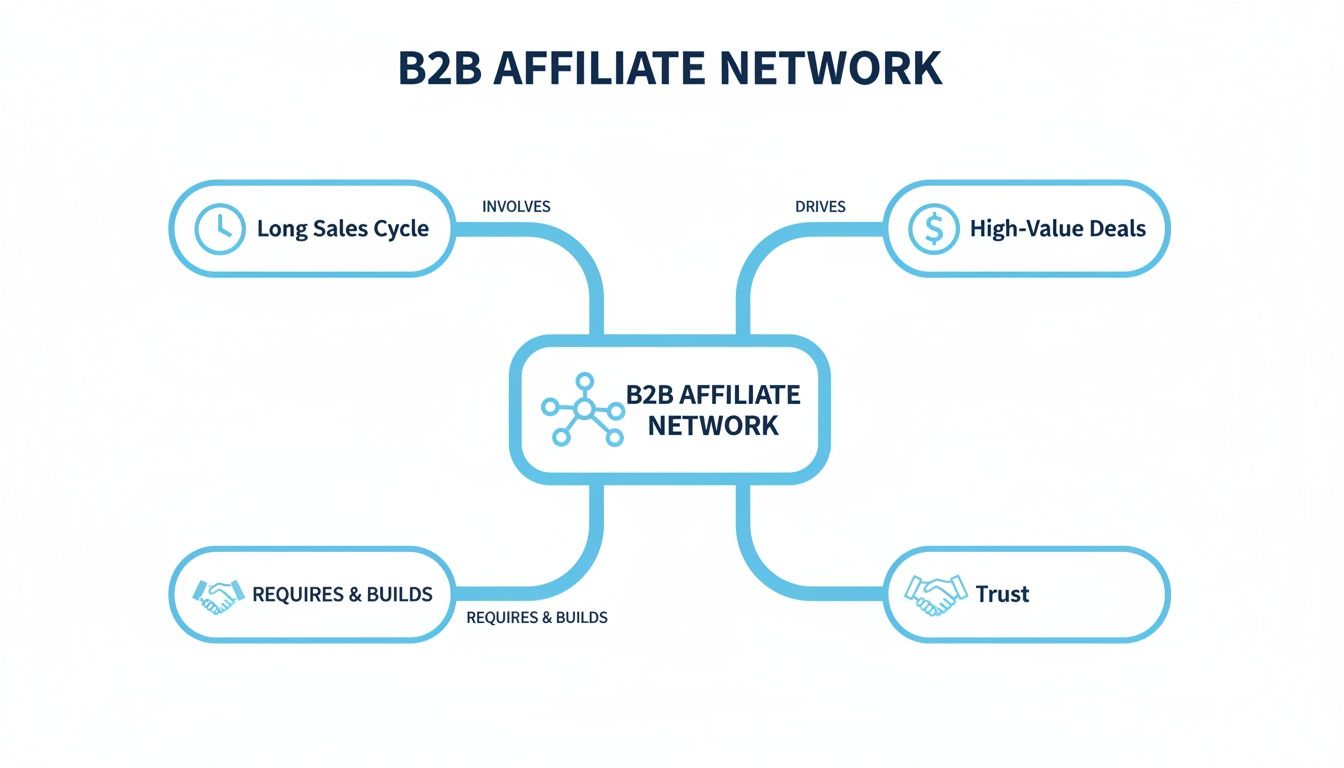
As you can see, a B2B affiliate network is fundamentally shaped by the mix of high-value deals, longer sales cycles, and the non-negotiable need for trust.
Incentives Beyond the Commission Check
While money obviously matters, the real drivers behind a B2B affiliate partnership go much deeper than a simple payout. The partnerships that stick around are built on a foundation of value that goes way beyond that initial referral fee.
Key Insight: In the B2B world, the best affiliates are motivated by recurring revenue and the chance to boost their own credibility by recommending top-notch tools. The commission is the reward, not the sole reason for partnering.
Let's break down what each person really gets out of the deal:
- For the SaaS Company: You get a growth channel that’s based purely on performance. Instead of paying for clicks or impressions that lead nowhere, you only pay when you get an actual paying customer. This creates an incredibly efficient way to acquire customers that scales right alongside your revenue.
- For the Affiliate Partner: The biggest draw is recurring revenue. Earning a percentage of a SaaS subscription month after month, year after year, creates a stable and predictable income stream. Even more importantly, recommending a product that works wonders for their clients reinforces their status as a trusted expert. It's a credibility boost.
- For the End Customer: The main benefit here is confidence. They get a vetted, expert recommendation that cuts through all the market noise. This saves them a ton of time, lowers the risk of picking the wrong tool, and gives them the peace of mind to adopt new technology.
Let’s put this into a real-world context. Imagine a digital marketing agency uses your analytics software to get amazing results for its clients. By joining your affiliate program, the agency can earn a 30% recurring commission on every single client it signs up. This creates a win-win-win. The agency builds a new revenue stream, its clients get a powerful tool backed by an expert they trust, and your SaaS business gains loyal, high-value customers.
If you want to dig deeper into how these relationships work, take a look at our guide on referral marketing strategies for B2B companies. This intense focus on long-term, high-trust partnerships is what truly separates a thriving B2B affiliate network from a simple, transactional program.
Choosing the Right Affiliate Platform for Your SaaS
Picking the right technology is the absolute foundation of a successful affiliate program. Think of it like this: your affiliate platform is the central nervous system of your entire partner ecosystem. If it’s slow, clunky, or missing key features, the whole system breaks down, no matter how great your partners are.
This choice is even more critical for a SaaS business. We’re not dealing with simple, one-off sales here. Our world revolves around recurring revenue, long and winding sales cycles, and high-value customer relationships. These dynamics demand a specialized toolkit that most generic, B2C-focused platforms just don't have. Get this decision right, and you'll empower your partners to become a true engine for growth.
Nail Your Tracking and Commission Structure
First thing's first: the platform has to speak the language of SaaS. Tracking a one-time payout is child's play; that’s not how we operate. Your affiliate platform must be built from the ground up to handle recurring commissions tied directly to your subscription revenue.
This means the system needs to be smart enough to link a customer to an affiliate not just at the initial sign-up, but for every single monthly or annual payment that follows. This is the only way to attract and motivate high-quality partners who are invested in bringing you long-term customers, not just chasing a quick buck.
Beyond that, the tracking itself needs to be tough enough for the B2B buyer's journey. Look for these must-haves:
- Long Cookie Lifespans: B2B purchase decisions aren't made on a whim—they can take weeks, sometimes months. A platform with a flimsy 30-day cookie window is practically useless. You need customizable cookie durations of 90 days or more to make sure partners actually get credit for the leads they nurture.
- Flexible Commission Rules: Can you set up different commission tiers for different partner levels? What about offering a higher percentage for the first year and a smaller one for renewals? This kind of flexibility is crucial for designing incentives that truly align with your business goals.
The Power of a Native Partner Experience
Here’s where we separate the good platforms from the great ones: the partner experience. For years, the industry standard was a clunky, third-party dashboard. This forced your affiliates to leave your website, log into another system, and navigate an interface that looked nothing like your brand. It’s a jarring, disjointed experience that kills partner engagement.
The modern, far superior approach is an embeddable, native affiliate portal.
An embeddable solution lets you build the entire affiliate dashboard directly inside your own product. This means no separate logins and no confusing third-party branding for your partners. It's a seamless, integrated experience that feels like a natural part of your app.
This screenshot from Refgrow shows just how clean a native dashboard can look when it's built right into a product's interface.
When partners can grab links, check their clicks, and track earnings without ever leaving your platform, they’re far more likely to stay engaged and actively promote you. It just makes their job easier, which means better results for you.
Essential Features for a Scalable B2B Affiliate Network
Your program is going to grow, and your platform needs to be ready to grow with it. A basic tool might be fine when you have ten affiliates, but it will crumble under the weight of a hundred or more. To avoid hitting a wall, make sure your platform is built for scale.
When evaluating platforms, it's helpful to have a checklist of the core features that truly matter for a SaaS affiliate program.
Critical Platform Features for SaaS Affiliate Programs
| Feature Category | What to Look For | Why It Matters |
|---|---|---|
| Tracking & Attribution | Recurring commissions, customizable cookie windows (90+ days), cross-device tracking, coupon code tracking. | Accurately rewards partners for the long-term value they bring, accommodating the complex B2B sales cycle. |
| Partner Experience | Native/embeddable portal, custom branding (logos, colors), intuitive dashboard for assets and links. | Creates a seamless, on-brand experience that boosts partner engagement and makes them more effective promoters. |
| Payout Management | Automated mass payouts, integrations with Stripe or Wise, self-service tax form collection (W-9/W-8). | Drastically reduces administrative overhead, ensuring partners are paid accurately and on time with minimal effort. |
| API & Integrations | Robust REST API, webhooks, pre-built integrations with CRM (e.g., Salesforce, HubSpot) and billing systems. | Allows for deep integration with your existing tech stack, automating workflows and keeping all your data in sync. |
| Recruitment & Discovery | A built-in partner marketplace or network to find and recruit new, relevant affiliates. | Solves the "cold start" problem by giving you a pool of vetted partners ready to promote SaaS products. |
A powerful API, for instance, is completely non-negotiable. It’s what allows your developers to build custom integrations, push affiliate data into your CRM, and automate all sorts of workflows. This is how you build a sophisticated b2b affiliate network that works in harmony with the rest of your business. If you want to dive deeper into this, our guide on the best affiliate tracking software for SaaS is a great resource.
Ultimately, you need a platform with features designed for long-term success:
- Frictionless Payout Management: Paying partners shouldn't be a chore. Look for platforms that handle the heavy lifting with features like automated mass payouts. This will save you countless hours of mind-numbing admin work every single month.
- Built-in Partner Discovery: So, how are you going to find your first 50 affiliates? The best platforms give you a head start with a partner marketplace that connects you with vetted affiliates who are already looking for great SaaS products to promote.
- Customizable Branding: Your affiliate portal is an extension of your brand. You absolutely need the ability to customize logos, colors, and the overall layout to maintain a professional and consistent experience for your partners.
Launching Your B2B Affiliate Program
Alright, let's move from theory to action. This is the exciting part—actually building and launching your B2B affiliate network. It can feel like a massive project, but with the right game plan and tools, it's more straightforward than you might think. The goal here is to set clear targets, create incentives that attract the right kind of partners, and use technology to make the whole process smooth.
The first few steps you take will really set the stage for everything that follows. A well-planned launch isn’t just about getting off the ground; it’s about building the momentum you need for real, sustainable growth.
Define Your Goals and Commission Structure
Before you even think about code or recruiting, you have to define what a "win" actually looks like. Vague goals like "get more customers" are useless. You need to be specific and, more importantly, measurable.
Are you trying to source 15% of new monthly recurring revenue (MRR) from affiliates in the first year? Or maybe your goal is to sign up 50 top-tier partners within six months? These kinds of clear targets will shape every decision you make, especially your commission structure.
For SaaS companies, a recurring commission is the undisputed champion. It’s the most powerful hook you can offer because it means your partners’ success is tied directly to your own.
- Percentage of MRR: A common and highly effective model is offering 20-30% of the MRR for the first year, or even for the lifetime of the customer. This motivates partners to find high-quality leads who will stick around, not just quick sign-ups.
- Tiered Commissions: You can also create VIP tiers for your top performers. For instance, a partner bringing in over $5,000 in new MRR each month could unlock a higher commission rate. It’s a fantastic way to keep your best advocates motivated.
Finding the right structure means hitting that sweet spot where your program is generous enough to attract amazing partners but still sustainable for your business.
Implement a Seamless Partner Experience
Your partners are busy people. A clunky, confusing onboarding process is the quickest way to make them lose interest. This is where an embeddable, native affiliate dashboard completely changes the game. Instead of shipping your partners off to some third-party website, you bring the entire program right inside your own product.
With modern platforms, this can be done incredibly fast. A "one-line-of-code" setup can get a fully functional, branded affiliate portal live inside your app in minutes, not months. This takes a huge load off your engineering team, letting them stay focused on your core product.
By embedding the partner portal, you create a frictionless experience. Affiliates can grab their unique tracking links, access marketing materials, and monitor their performance without ever leaving your ecosystem, making them far more likely to stay engaged.
Once the dashboard is up and running, customization is everything. You need to make sure the portal reflects your brand’s look and feel. That means uploading your logo, matching the color scheme, and tailoring the welcome messages. A professional, on-brand portal shows partners you’re serious about the relationship.
Streamline Payouts and Onboard Your First Partners
The last technical piece of the puzzle is payments. When launching your B2B affiliate program, setting up reliable payment systems for commission payouts is a critical step, requiring robust payments expertise. Integrating with a processor like Stripe makes payouts automated and streamlined, which builds trust and ensures your partners get paid on time, every time.
With the tech foundation solid, it’s time to find your first wave of affiliates. Don't go for quantity here—focus on quality. Your best first partners are probably already in your orbit.
- Your Best Customers: Start with your happiest, most successful customers. They already get the value of your product and can talk about it with genuine passion.
- Industry Consultants and Agencies: Think about the experts who already serve your target audience. A personalized invitation explaining how you can both benefit is way more effective than a generic email blast.
- Complementary Tech Partners: Look for other SaaS companies who aren't direct competitors but share a similar customer base. A co-marketing and affiliate partnership is a natural win-win.
Onboarding these initial partners properly is vital. Give them a starter kit with brand guidelines, pre-written email copy, social media templates, and product one-pagers. The easier you make it for them to promote you, the faster you’ll see results from your new b2b affiliate network.
Measuring the Metrics That Actually Matter
You can't fix what you can't measure. In a B2B affiliate network, it's incredibly easy to get lost in a sea of data. But focusing on the wrong numbers—like raw clicks or sign-ups—is like judging a car's performance by how shiny the paint is. It tells you nothing about the engine. To build a truly profitable program, you have to separate these vanity metrics from the key performance indicators (KPIs) that actually drive your business forward.
This means shifting your focus from top-of-funnel activity to bottom-line impact. A great affiliate program isn't just about generating a flood of leads; it's about acquiring high-quality, long-term customers who boost your recurring revenue. The only way to see which partners are truly moving the needle is by setting up a clear dashboard that tracks the right things.
Core KPIs for a B2B SaaS Affiliate Program
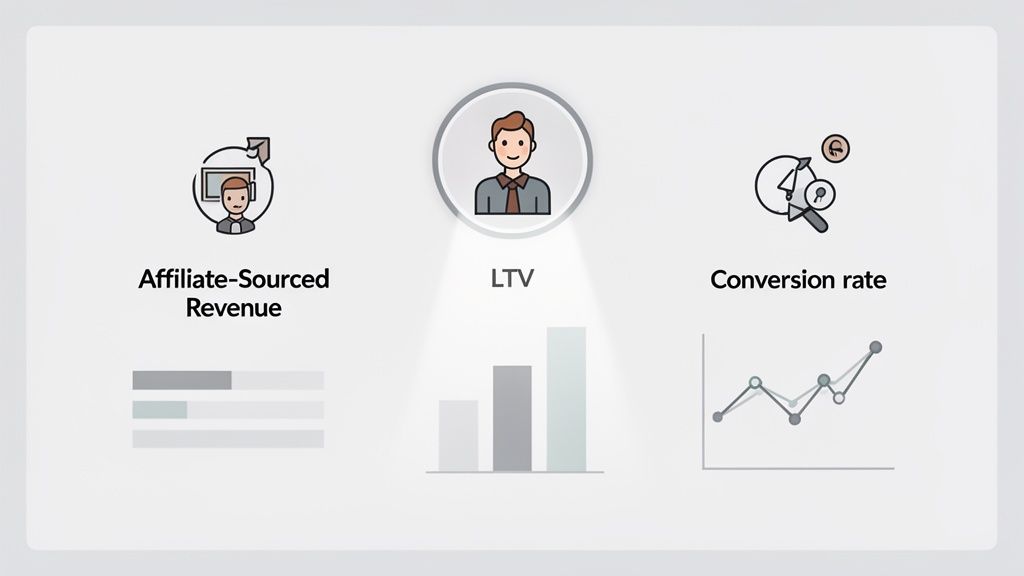
To get a real-time health check on your program, you only need to concentrate on a handful of metrics that directly connect to revenue and customer quality. These are the numbers that tell the true story of your network's performance.
Here are the essentials:
Affiliate-Sourced Revenue: This is your north star. It’s the total monthly or annual recurring revenue (MRR/ARR) coming directly from your partners. It cuts through the noise and answers the single most important question: how much money is this channel actually making?
Referral-to-Paid Conversion Rate: This KPI shows you the percentage of referred leads (say, from a free trial) that actually become paying customers. If this rate is low, it’s a huge red flag that a partner might be sending you low-quality, unqualified traffic.
Customer Lifetime Value (LTV) per Partner: This one is a bit more advanced but absolutely critical. It calculates the total revenue a customer brings in over their entire lifecycle, broken down by the affiliate who sent them. A high LTV from a specific partner means they’re sending you your ideal customers—the ones who stay and grow.
Average Revenue Per Account (ARPA): Tracking the ARPA of customers from affiliates helps you see if your partners are attracting clients who sign up for higher-tier plans or expand their usage down the line.
Focusing on these numbers helps you see beyond the sheer volume of referrals and understand the quality and long-term value of the customers your partners are delivering. For a deeper look, check out our complete guide on the most important affiliate marketing metrics for SaaS.
From Data to Actionable Insights
Collecting data is only half the battle. The real magic happens when you use that data to make smarter decisions. Your dashboard shouldn't just be a report you glance at once a month—it should be a strategic tool that guides your program's growth.
When you spot a partner who consistently drives customers with a high LTV, that's your cue to double down on that relationship. This data empowers you to move beyond a generic, one-size-fits-all commission structure and build a truly dynamic, performance-based program.
Key Takeaway: The whole point of tracking metrics isn’t just to report on what happened last quarter. It’s about actively shaping the future of your affiliate program by using data to find top performers, diagnose weak spots, and make your entire strategy better.
How to Leverage Your Performance Data
Once you have a clear picture of your KPIs, you can start taking concrete steps to optimize and scale your B2B affiliate network.
Here’s how you can turn those insights into real-world results:
Create VIP Tiers for Top Performers: Look at your data and identify the top 5-10% of affiliates bringing in the best revenue and LTV. Treat them like gold. Offer them a higher commission rate, give them early access to new features, or set up co-marketing campaigns. This not only strengthens your best relationships but also gives other partners a clear incentive to level up.
Improve Your Marketing Assets: If you notice a low referral-to-paid conversion rate across the board, the problem might not be your partners—it could be your materials. Use this as a signal to A/B test your landing pages, refresh your email templates, or create new case studies that really nail your product's value proposition.
Refine Your Ideal Affiliate Profile: Take a close look at your most successful partners. What do they have in common? Are they industry consultants, marketing agencies, or tech integration partners? Use these common threads to build a profile of your perfect affiliate, so you can focus your recruitment efforts on finding more just like them.
Avoiding Common Pitfalls in Affiliate Management
Kicking off a B2B affiliate network can feel like a massive win for scalable growth. But the road to success is paved with potential traps, and even the best-laid plans can go sideways if you’re not careful. The most resilient programs are built by those who see the challenges coming before they hit.
Most of these issues boil down to a few core problems: mismatched expectations, a lack of real support, or simply not vetting partners properly from the get-go. The good news? You can get ahead of all of them. By learning from where others have stumbled, you can build an affiliate channel that’s a reliable growth engine, not a constant headache.
Poor Partner Vetting and Brand Misalignment
Want to know the fastest way to tank your program's credibility? Onboard the wrong partners. It’s a classic mistake. In the rush to get more affiliates, some companies will approve almost anyone who applies. Before you know it, your brand is being promoted next to questionable content or by affiliates using spammy, aggressive tactics. This doesn't just send you bad leads; it can seriously tarnish your reputation.
Remember, your partners are a direct extension of your brand. A consultant who doesn't actually get your product or an agency whose values clash with yours creates a confusing and negative experience for the very customers you're trying to attract.
The solution is to create an Ideal Affiliate Profile (IAP). Get specific. Document exactly what your perfect partner looks like. Are they consultants in a specific niche? Tech partners who integrate with your platform? Agencies with a proven client list? Use this IAP as a non-negotiable filter for every application you review.
Key Insight: Treat affiliate recruitment like you're hiring a key employee. A solid vetting process is your first and best defense against brand damage and wasted effort.
Unfair Commissions and Lack of Support
Nothing will kill an affiliate's motivation faster than a commission structure that feels cheap or the feeling that they’ve been left on an island after signing up. A huge pitfall is offering a tiny, one-time payout for a product that has a long sales cycle and a high customer lifetime value. That model completely ignores the immense effort B2B partners invest in nurturing a lead from "curious" to "customer."
Just as bad is leaving your partners to figure everything out on their own. Without clear communication, ready-to-use marketing materials, and consistent updates, even your most excited affiliate will eventually lose steam. They need to feel like they're actually in a partnership, not just another number on your dashboard.
To fix this, make sure your commission structure isn't just competitive—it should be recurring to reflect the ongoing value partners bring. Then, build them a dedicated resource hub with everything they need to win:
- Marketing Kits: Give them logos, banners, pre-written email templates, and powerful case studies.
- Regular Updates: Host a quarterly webinar or send a monthly newsletter to share product news and promotional ideas.
- Direct Support: Assign a dedicated contact for your top partners so they have a direct line for questions and strategy sessions.
When you invest in your partners' success, you're investing in your own. A supported partner is a productive one, and that's the foundation of any great b2b affiliate network.
Got Questions? We've Got Answers
Diving into B2B affiliate networks for the first time usually sparks a few common questions. Let's tackle some of the big ones head-on.
What’s the Real Cost to Get a B2B Affiliate Program Off the Ground?
The cost to launch an affiliate program has changed a lot. In the past, you were looking at hefty setup fees and pricey monthly retainers just to get access to a traditional network. Thankfully, that's not the only way anymore.
Modern embeddable platforms have really opened things up, making it much more affordable to start. Your main expenses will typically be the platform's subscription fee and, of course, the commissions you pay your partners when they deliver results.
Where Do I Even Start Looking for B2B Affiliates?
Look no further than your own backyard. Your happiest customers are often your most powerful and genuine advocates, so start there.
From there, branch out to industry bloggers, consultants, and agencies who already have the ear of your ideal customer. Many modern platforms also have their own partner marketplaces, which can be a great way to find affiliates actively looking for new SaaS products to promote.
Pro-Tip: Don't obsess over quantity at the beginning. Your first ten high-quality partners who genuinely get your product's value are worth more than the next hundred. Quality over quantity is the name of the game.
What’s a Fair Commission Rate for SaaS Affiliates?
For SaaS, recurring commissions are king—it's what top partners expect and what makes your program attractive. A competitive rate usually falls in the 20-30% range of the subscription fee.
You can offer this for a limited time, like the first 12 months, or for the entire lifetime of the customer. The right number for you really boils down to your Customer Lifetime Value (LTV) and what you currently spend to acquire a new customer.
Ready to launch your own native affiliate program in minutes? Refgrow provides the embeddable tools to build, manage, and scale your partner network directly inside your SaaS. Explore Refgrow today.