

What is merchant of record? A Global SaaS Guide
Ever heard of a Merchant of Record, or MoR? If you're running a SaaS company with global ambitions, you'll want to get familiar with this term.
Think of an MoR as a specialized partner that legally sells your product for you. They step in and handle all the messy, complicated parts of a transaction—things like payment processing, tax compliance, and fraud management. This frees you up to do what you do best: build and market an amazing product.
Demystifying The Merchant of Record Model
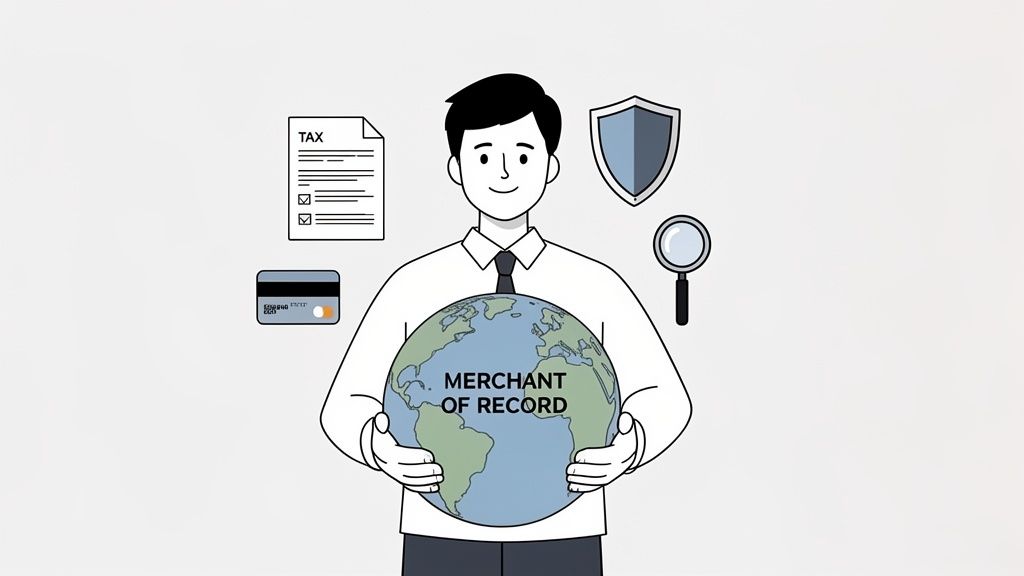
Let's get practical. Imagine your SaaS business is based in the U.S., but you've got customers signing up from Germany, Australia, and Brazil. Each of those countries has its own tax laws, payment preferences, and consumer protection rules. Instead of you needing to become a legal and financial expert in every single region, an MoR takes on that entire headache.
When a customer in Berlin clicks "buy," they aren't technically buying from your company. They're buying from the MoR.
The MoR processes their payment in Euros, calculates and files the correct German VAT, and makes sure the whole transaction follows local laws. Once everything is settled, they pay you your share of the revenue. It’s a game-changer.
In essence, the MoR becomes the seller on paper for every single transaction. This setup shields your business from the direct legal and financial maze of global sales, swapping out dozens of potential problems for one straightforward partnership.
For any SaaS founder dreaming of international scale, this model is a powerful shortcut. It smashes the biggest barriers to entering new markets without having to hire an army of accountants and lawyers.
What Does An MoR Actually Do?
An MoR is so much more than just a payment processor. It’s a full-stack financial operations partner. The real magic is in the sheer volume of critical (but tedious) tasks it takes off your plate—the kind of work that has to get done but doesn't move the needle on your product.
To give you a clearer picture, here’s a quick summary of the core responsibilities an MoR takes over.
Core Responsibilities Handled by a Merchant of Record
| Responsibility Area | What the MoR Handles | What This Means for Your SaaS Business |
|---|---|---|
| Payment Processing | Manages all bank accounts, gateway relationships, and currency conversions globally. | You can accept payments from anywhere in the world without setting up local business entities. |
| Tax & VAT Management | Calculates, collects, and remits sales taxes, VAT, and GST in every customer's jurisdiction. | No more navigating thousands of complex, ever-changing tax codes. The liability is theirs. |
| Compliance & Liability | Assumes responsibility for PCI-DSS, GDPR, and other local consumer protection laws. | The heavy burden of staying compliant with global payment and data regulations is lifted. |
| Refunds & Chargebacks | Manages customer disputes, processes refunds, and absorbs the financial risk of chargebacks. | You're protected from revenue loss and the administrative drain of fighting payment disputes. |
Let's break these down a bit further.
Global Payment Processing: The MoR has already done the hard work of setting up merchant accounts and payment gateways around the world. This is what lets you easily accept different currencies, which is non-negotiable for international growth. If you want to dive deeper, understanding multi-currency payment processing is a great place to start.
Tax and VAT Management: This is a huge one. Tax rules are notoriously complex and differ wildly from country to country, state to state. The MoR is responsible for getting it right every time, so you don’t have to worry about a surprise bill from a foreign tax agency.
Compliance and Liability: Staying compliant with standards like PCI-DSS (for handling credit card data) and privacy laws like GDPR is a full-time job. An MoR assumes this risk. The sheer scope of global compliance requirements for business shows just how much weight this takes off your shoulders.
Fraud and Risk Mitigation: The MoR uses sophisticated systems to screen for fraud and takes the financial hit when chargebacks happen. This protects your revenue and reputation.
By packaging all this together, an MoR lets you operate like a global company from day one, but with the lean overhead of a startup.
The Four Pillars of an MoR Service
A Merchant of Record service isn't just one thing—it's a complete financial and legal framework built on four critical pillars. Think of them as the support columns that take the massive operational weight of selling globally right off your shoulders. When you understand how they work together, you see why an MoR is so much more than a simple payment gateway.
Each pillar handles a specific, high-stakes area of international sales. Getting any one of them wrong can lead to steep fines, angry customers, and a dead end for your growth.
Let’s break down exactly what each of these pillars does for you.
Pillar 1: Global Payment Processing
The first pillar, global payment processing, is the engine that actually drives your international sales. An MoR provides all the machinery needed to take money from customers anywhere in the world, in their own currency, using the payment methods they trust.
This isn’t just about accepting Visa or Mastercard. In Germany, customers expect to use Sofort; in the Netherlands, iDEAL is the standard. An MoR has already done the hard work of integrating these local payment methods, so you don't have to navigate the technical and contractual maze of setting them up one by one.
On top of that, an MoR handles all the messy details of currency conversion and manages relationships with countless acquiring banks. This means your payments get processed through local networks, which dramatically increases your success rate and reduces the chance of a foreign bank flagging and declining a legitimate purchase.
Pillar 2: Worldwide Tax and VAT Management
The second pillar is arguably the most complex and valuable: worldwide tax and VAT management. This is where an MoR essentially becomes your dedicated global tax firm.
Every country—and often every state or province—has its own unique rules for sales tax, Value-Added Tax (VAT), or Goods and Services Tax (GST). For example, selling a digital product to someone in the European Union means you have to collect and pay VAT according to their country's specific rate. In the U.S., you could be tracking sales tax nexus in dozens of different states.
An MoR takes on the full liability for calculating, collecting, filing, and remitting these taxes on your behalf. They stay on top of ever-changing tax laws, so you don't have to. The risk of non-compliance, which can lead to hefty fines and legal trouble, is completely transferred to them.
Pillar 3: Compliance and Liability Shield
The third pillar is the compliance and liability shield that an MoR wraps around your business. When you sell online, you're handling sensitive customer data and must follow strict financial regulations. The MoR steps in and becomes the legally responsible party for these obligations.
This includes maintaining PCI DSS compliance, the gold standard for securing credit card information. It also means staying on top of regional data privacy laws, like GDPR in Europe or CCPA in California. The penalties for slipping up here can be severe.
Because the MoR is the "seller of record," their name is the one on the official transaction. This means they are legally on the hook for the sale, protecting your company from the direct fallout of any regulatory missteps.
Pillar 4: Customer Billing Logistics
Finally, the fourth pillar is customer billing logistics. This covers everything that happens after the initial sale, which is absolutely vital for any business running on a subscription model. If you're looking to dive deeper into this, check out our guide on how to set up recurring payments.
This pillar covers the nitty-gritty of the customer payment lifecycle:
- Refunds: Processing customer refunds correctly according to local consumer protection laws.
- Chargebacks: Fighting payment disputes and absorbing the financial hit from chargebacks, which protects your bottom line.
- Invoicing: Creating and sending compliant invoices that meet the legal standards of each customer's home country.
- Subscription Management: Automating recurring billing, managing dunning (the process of recovering failed payments), and handling subscription changes.
When you put these four pillars together, you get a powerful operational advantage. It's no surprise that companies using an MoR feel more prepared to scale. In fact, research shows that two-thirds of businesses with an MoR are "highly confident" in their ability to expand globally—a massive 32 percentage point lead over companies that go it alone. You can see more insights from that research here. By handing off this operational headache, you can get back to focusing on what really matters: your product and your customers.
Comparing MoR With Other Payment Models
Choosing how to handle payments is one of those foundational decisions that can either supercharge your growth or bog you down in operational quicksand. A Merchant of Record (MoR) is a fantastic, all-in-one solution, but it’s not the only game in town. It’s worth looking at how it stacks up against the other common models: going it alone with a payment gateway (the DIY route) and using a Payment Facilitator (PayFac).
Each path represents a different balance between control, cost, and liability. Getting this right means picking the strategy that actually fits your business goals, your team’s size, and how much risk you're willing to take on.
The diagram below really nails down the core functions an MoR takes off your plate. Think of these as the four big headaches you'd otherwise have to manage yourself.
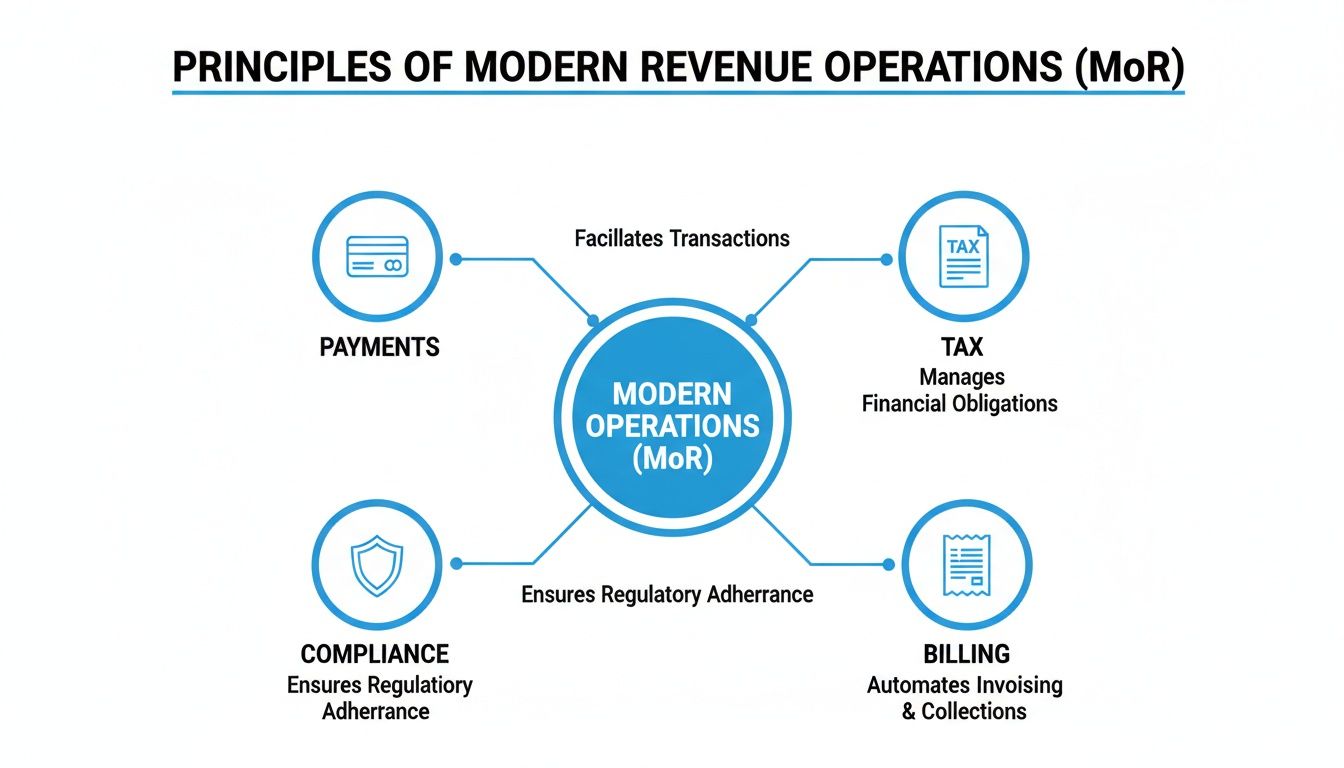
As you can see, an MoR bundles payments, tax, compliance, and billing into a single neat package. It’s designed to handle the gnarliest parts of selling online so you don't have to.
H3: The DIY Approach With a Payment Gateway
The most straightforward option is the DIY approach. You grab a payment gateway like Stripe or PayPal and integrate it directly. This gives you total control over the entire customer experience and your financial setup. You are the merchant, full stop.
But with great control comes great responsibility. When you're the merchant, you own everything:
- Tax Compliance: You’re on the hook for calculating, collecting, and remitting sales tax, VAT, and GST in every single city, state, and country you sell to.
- Global Regulations: It's up to you to stay PCI DSS compliant and navigate the minefield of data privacy laws like GDPR.
- Disputes and Fraud: Every chargeback, refund, and fraudulent transaction comes directly out of your pocket.
This path demands serious in-house muscle—legal, finance, and engineering teams are a must to keep up with the operational load. It can work for businesses selling in just one country or for massive enterprises with entire departments dedicated to global compliance.
H3: The Payment Facilitator (PayFac) Model
A Payment Facilitator, or PayFac, is the middle ground. A PayFac is a service that simplifies accepting payments by letting you operate as a "sub-merchant" under their master account. This gets you up and running much faster than getting a direct merchant account from a bank.
But here’s the crucial part: a PayFac only solves the payment processing piece of the puzzle. They handle the technical side of moving money from A to B, but you are still the merchant of record. That means all the tax collection, compliance headaches, and fraud liability still land squarely on your shoulders. A PayFac makes it easier to take the money, but it won't help you figure out EU VAT or the complexities of U.S. sales tax.
H3: MoR vs Payment Gateway (DIY) vs Payment Facilitator (PayFac)
So, what's the real difference? It all comes down to who shoulders the liability. An MoR is the only model where a third party legally steps in and takes on the financial and regulatory risks of your sales. This distinction becomes incredibly important the second you start thinking about selling internationally.
The market's explosive growth tells the story.
The Merchant of Record software market jumped from USD 11.61 billion to USD 13.20 billion in just one year—a 13.7% surge. And it’s not slowing down, with projections showing the market will hit USD 35.43 billion as more companies look for a simpler way to go global. You can see more data on this market trend at researchandmarkets.com.
Let's lay it all out side-by-side to make the differences crystal clear.
| Responsibility | Merchant of Record | Payment Gateway | Payment Facilitator |
|---|---|---|---|
| Payment Processing | Handled by MoR | Your Responsibility | Handled by PayFac |
| Sales Tax & VAT | Handled by MoR | Your Responsibility | Your Responsibility |
| Compliance (PCI, GDPR) | Handled by MoR | Your Responsibility | Your Responsibility |
| Chargeback Liability | Handled by MoR | Your Responsibility | Your Responsibility |
| Legal Seller | The MoR | You | You |
| Best For | Global scaling, lean teams | Single-market businesses | Simplified payment onboarding |
Ultimately, your choice boils down to a simple question: what do you want to focus on? If you want to pour all your energy into building and marketing an amazing product without getting tangled in red tape, the MoR model is a powerful accelerator. It swaps the unpredictable costs of global compliance for a straightforward, bundled fee. If you want to dig deeper into how that fee works, our guide on what a transaction fee is is a great place to start.
On the other hand, if you crave absolute control and have the experts on hand to navigate international finance and law, the DIY path gives you that freedom. A PayFac offers a practical middle ground for businesses that need to get going quickly but aren't yet dealing with the full weight of global tax laws.
How a Merchant of Record Can Simplify Your Affiliate Program
Affiliate programs are a fantastic way to grow, but they come with a hidden cost: a mountain of financial admin. Manually crunching commission numbers, processing payouts, and keeping up with tax rules for an army of partners can quickly become a full-time job. This is where a Merchant of Record really shines, evolving from just a payment processor into the backbone of your growth strategy.
Think of an MoR as the perfect financial hub for your affiliate and referral programs. Its most important job is giving you a clean, reliable revenue number to work from. When a customer pays, the MoR takes care of everything—processing the payment, calculating the right sales tax or VAT for their location, and officially closing the sale.
What does this mean for you? The revenue figure that gets sent to your affiliate management software is already net of taxes and fees. No more wrestling with spreadsheets trying to figure out the commissionable amount for each sale. The process is clean, consistent, and accurate every single time.
Putting Your Growth Stack on Autopilot
The real magic happens when you connect your MoR with a dedicated affiliate platform. This combination creates an automated system that completely removes the financial grunt work and administrative headaches. Data just flows from the sale all the way to the partner payout without you lifting a finger.
Here’s a step-by-step look at how this automated workflow plays out:
- The Sale: A customer clicks a partner’s link and makes a purchase. Your MoR handles the entire payment process, including all the tax and compliance stuff.
- Clean Data Handoff: The MoR then sends the final, post-tax transaction details over to your affiliate management platform through an API or webhook.
- Perfect Commission Tracking: Your affiliate software gets this clean data and immediately knows which partner gets credit, calculating their commission down to the last cent.
- Effortless Payouts: When payout day arrives, the system has a perfect log of all commissions owed, making it easy to pay everyone correctly in one go.
This tight integration is the secret to scaling a partner program without having to hire a bigger finance team. It guarantees your affiliates get paid the right amount, on time, which builds trust and keeps them motivated to promote you.
The diagram below shows how transaction data moves from the MoR to an affiliate platform like Refgrow, making tracking and payouts a breeze.
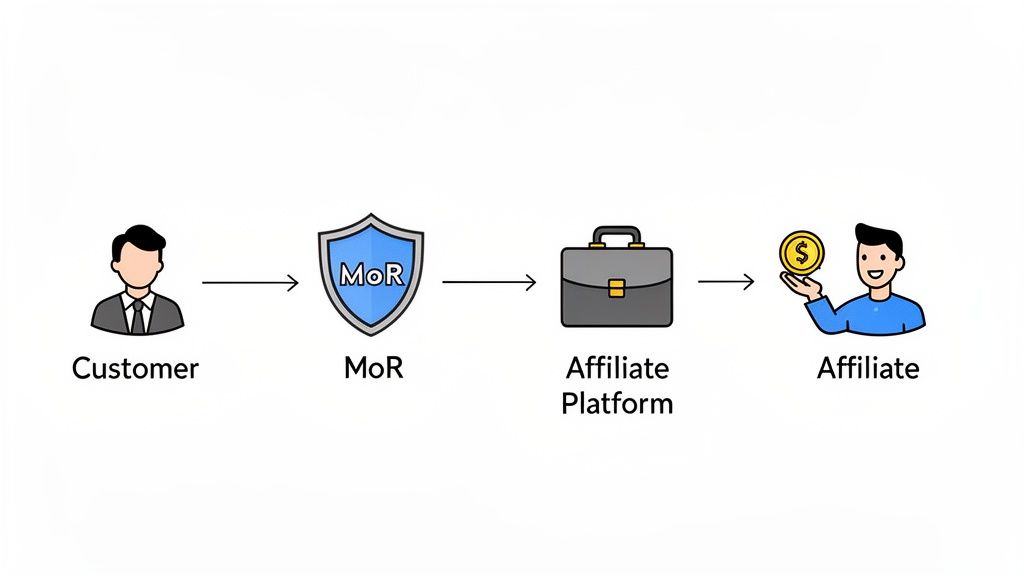
By letting the MoR handle the financial heavy lifting, your affiliate system can do what it does best: track referrals and help you manage your partner relationships.
The Power of a Clean Financial Backend
Without an MoR, all that financial reconciliation work lands squarely on your shoulders. Can you imagine trying to manually subtract the correct taxes from hundreds of global sales before you can even start calculating commissions? It’s not just a time sink; it’s a recipe for errors that can sour relationships with your best partners.
An MoR cleans up the financial mess before the revenue data ever hits your affiliate tool. It turns a chaotic, manual process into a simple, automated workflow, giving your partner program a rock-solid foundation.
This approach gives you a few major wins:
- Accuracy: Commissions are always based on the correct net revenue, which means no more disputes.
- Efficiency: Your team gets back countless hours previously spent on manual data entry and reconciliation.
- Scalability: You can bring on hundreds of new affiliates without worrying if your payment process can keep up.
- Global-Ready: Paying partners in other countries becomes much simpler because the MoR has already dealt with the currency and tax headaches on the initial sale.
In the end, using a Merchant of Record to power your affiliate program is more than just a convenience—it's a strategic decision. It frees you up to build a strong, scalable partner ecosystem that drives real growth, without drowning your team in paperwork.
Deciding whether to use a Merchant of Record isn't just a line item on a budget; it's a fundamental strategic choice. You're essentially trading a bit of direct control over your payment stack for a massive offload of administrative headaches and legal risk. The right answer really hinges on where your business is today and, more importantly, where you want it to go.
So, when does it actually make sense to bring in an MoR? There are a few classic tell-tale signs that signal you're ready. If any of the scenarios below hit a little too close to home, an MoR could be the key to unlocking your next stage of growth.
Clear Triggers for Adopting an MoR
You know it's time to start looking for an MoR when your team is spending more time wrestling with financial admin than innovating on your actual product. The whole point is to hand off that complexity the moment it becomes a bottleneck.
Think of these as the major tipping points:
You're Going Global: This is the big one. The second you decide to sell outside your home country, you’ve just inherited a tangled web of international tax laws and payment regulations. For a SaaS business trying to scale, just figuring out things like navigating international VAT thresholds can become a full-time job for someone on your team.
You Need to Speak the Local Payment Language: Selling in Europe isn't just about showing prices in Euros. Your customers in the Netherlands will be looking for iDEAL, while many in Germany expect to see Sofort. A good MoR has all these local payment methods baked in, which can make a huge difference in your conversion rates.
You Want to Keep Your Team Lean and Focused: If your vision is a nimble, product-driven company, then building out an entire finance and compliance department is the last thing you want to do. An MoR lets you effectively outsource that entire function, keeping your headcount down and your focus where it belongs: on your product.
Evaluating Your Business Needs
The decision isn't just about solving pain points; it's about aligning with your strategy. Geographically, North America currently leads the pack in MoR software usage, with Europe close behind. But the real story is the Asia-Pacific region, which is projected to be the fastest-growing market. This shows a clear global trend: businesses everywhere want to simplify how they sell across borders. You can discover more insights about this market shift at datainsightsmarket.com.
An MoR is an accelerator for businesses that prioritize speed and agility over maintaining in-house control of every financial detail. It's a strategic trade-off that swaps operational burden for a clear path to global scale.
This model is a fantastic fit for early-stage SaaS startups, indie developers, and any product-led team that needs to move fast. By handing off the liability, they can jump into new markets confidently, without the huge upfront investment in legal and financial infrastructure.
When an MoR Might Not Be the Best Fit
That said, a Merchant of Record isn't a silver bullet for every single business. There are definitely times when keeping payment processing and compliance in-house is the smarter move.
An MoR might not be right for you if:
- You're a massive enterprise: Global corporations with their own dedicated finance, legal, and tax departments often have the scale and resources to manage this complexity themselves.
- You operate in a single, simple market: If you only sell in your home country and have zero plans for international expansion, the all-in-one service of an MoR is probably overkill. A simple payment gateway will do the trick.
- Your margins are razor-thin: While an MoR's all-in-one fee is often a net positive, businesses with extremely tight margins might need to pinch every penny and handle things themselves to optimize costs.
Ultimately, choosing an MoR comes down to a simple question: where is your team's time and energy best spent? If the answer is on building, marketing, and supporting your product, then offloading the messy parts of global commerce is one of the smartest moves you can make.
Common Questions About Using a Merchant of Record
Once you start digging into the Merchant of Record model, a few practical questions always pop up. It's a powerful way to handle payments, but it's natural to wonder how it works on the ground. Let's tackle some of the most common questions SaaS founders ask when they're considering an MoR.
My goal here is to cut through the jargon and give you straight answers, so you can see exactly how this fits into your business.
What’s the Real Cost of Using a Merchant of Record?
Most MoRs bundle everything into a single rate, often a percentage plus a fixed fee per transaction—something like 5% + $0.50.
Now, if you compare that directly to the 2.9% + $0.30 you see from a payment processor, it can feel like a steep jump. But that’s not really an apples-to-apples comparison. The MoR's fee isn't just for payment processing; it replaces a whole stack of other costs you'd have to pay for separately.
That single fee typically covers:
- Payment gateway and processing fees
- Currency conversion charges (which can bite you)
- Fraud detection tools and software
- The operational cost and time spent fighting chargebacks
- Services for calculating and remitting sales tax and VAT globally
When you add up all those individual line items, the MoR’s all-in-one price often turns out to be much more predictable and even more cost-effective, especially as you start selling into different countries. It turns a messy list of variable expenses into one clean, simple number.
Does Using an MoR Mean I Lose My Customer Relationship?
Not at all. This is probably the biggest myth out there about the MoR model. You keep total control over your brand, your product, and most importantly, your direct relationship with your customers.
Think of the MoR as the invisible plumbing that handles the money and legal paperwork behind the scenes. Your customers will still be on your website, using your app, and reaching out to your support team. The entire customer experience you’ve worked so hard to build stays exactly the same.
The only place a customer might ever see the MoR’s name is on their credit card statement or a formal invoice. It's a legal necessity for tax purposes, but it doesn't change the fact that they are your customer. That relationship is—and always will be—yours.
Can I Switch to an MoR Model Later On?
Absolutely, and many successful SaaS companies do exactly this. It's a very common growth path. You might start out with a simple Stripe integration when most of your customers are in your home country. It’s straightforward and works perfectly for that stage.
But as you scale internationally, the headaches start piling up. You're suddenly dealing with global tax compliance, multiple currencies, and a rising tide of fraud attempts. That’s the point where the operational burden gets heavy, and migrating to an MoR becomes a smart strategic move.
The transition is a well-oiled process. MoR providers are pros at this, guiding you through updating your checkout and, for subscription businesses, securely migrating customer payment details. It's an upgrade that frees you to chase global growth without having to build out an entire finance and compliance department.
How Does an MoR Simplify Affiliate Payouts?
An MoR makes managing an affiliate program so much cleaner by tidying up the financial data right at the source. It acts as a filter, making sure your affiliate platform gets only the final, accurate numbers it needs to work with.
Here's how it breaks down: the MoR handles the complete customer transaction first. It processes the payment, correctly calculates and pulls out any sales tax or VAT, and then confirms the final net revenue from the sale.
This clean, post-tax number is what gets passed to your affiliate software. Your platform can then calculate commissions on that accurate figure, with no room for error. This prevents miscalculations, ensures your partners are always paid the right amount, and builds a huge amount of trust in your program.
Ready to launch a high-powered affiliate program without the operational headaches? With Refgrow, you can embed a fully native, brand-aligned affiliate dashboard directly into your SaaS in minutes. Explore how Refgrow can accelerate your growth today.