

Multi currency payment processing: Your Guide to Global SaaS Growth
That abandoned cart from an international user? It’s a familiar, frustrating sight for almost every SaaS founder trying to scale. Multi-currency payment processing is the answer. Think of it as a universal translator for money, letting you sell to anyone, anywhere, in the currency they use every day. This isn't just some backend feature; it's one of the most powerful tools you have for unlocking global growth.
Your Blueprint for Global SaaS Growth
So many SaaS companies hit a wall when they try to expand beyond their home country. They do the hard work of attracting users from new regions, but then watch their conversion rates fall off a cliff at the checkout page.
The culprit is usually something surprisingly simple: sticker shock from an unfamiliar currency. A potential customer in France sees a price in USD, starts worrying about conversion rates and hidden bank fees, and suddenly that "buy now" button feels risky. That moment of hesitation is all it takes to lose a sale.
Multi-currency processing is like setting up a local, digital storefront for every single customer. It takes the guesswork and the anxiety out of the equation. Someone in Germany sees their price in Euros, a user in Tokyo sees it in Yen. It might seem like a small tweak, but this single change dramatically improves the user experience and is a critical piece of any solid growth strategy framework.
Why Localization Matters More Than Ever
In today's crowded SaaS market, you can't afford to give customers a reason to leave. A localized payment experience is no longer a "nice-to-have"—it's a must. It sends a clear signal to international buyers that you've built your service with them in mind, which instantly builds the trust you need to make a sale.
The impact goes well beyond just that first transaction.
- Higher Conversion Rates: When you remove the confusion around pricing and currency, you slash checkout abandonment. It’s that simple.
- Deeper Customer Trust: Paying in a familiar currency just feels safer and more professional. This encourages first-time buyers and helps with long-term retention.
- A Sharper Competitive Edge: It lets you go head-to-head with local competitors in foreign markets on a much more even playing field.
For any SaaS looking to expand, seeing how others have done it is invaluable. For instance, looking at Kea's rollout of local payouts in 85 currencies shows just how powerful this approach is in the real world. This guide will walk you through how to implement a similar strategy, helping you turn that global interest into reliable, recurring revenue.
How Multi Currency Payments Actually Work
So, how does this all work behind the scenes? Let's break it down.
Think about the last time you traveled internationally and bought something. The menu or price tag was in the local currency, right? But when you checked your credit card statement later, the charge showed up in your home currency. That's the essence of multi-currency payment processing.
It all boils down to two key ideas.
First, there’s the presentment currency. This is simply the currency your customer sees at checkout. If someone in France is signing up for your service, you want them to see the price in Euros (€), not U.S. Dollars. It feels familiar and removes that awkward mental math, which is a huge step in building trust.
Second is the settlement currency. This is the currency that actually lands in your company’s bank account. Even though your French customer paid in Euros, your payment processor handles the currency exchange and deposits the funds as U.S. Dollars (or whatever your home currency is).
The Journey of a Global Payment
When a customer clicks "Buy Now," your payment gateway and processor kick into gear. They manage all the technical heavy lifting to make the transaction feel instant and local for the customer.
This is more than just a convenience; it's a direct solution to a major growth blocker. Seeing an unfamiliar currency at checkout creates friction and doubt, leading many potential customers to abandon their carts. By presenting local currencies, you remove that barrier.
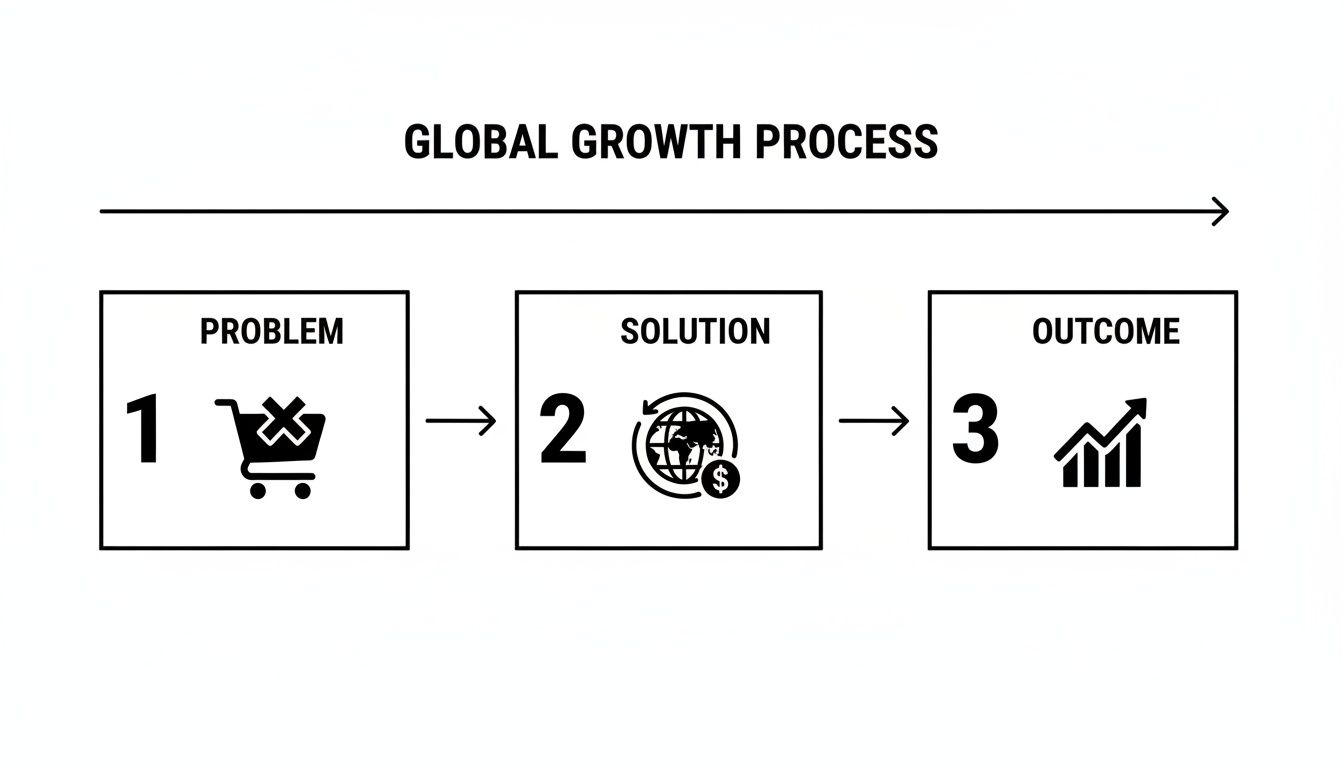
As the diagram shows, localizing the payment experience is a straightforward way to solve a common problem, paving the way for international growth.
Key Transaction Stages
A typical cross-border transaction flies through these three stages in just a few seconds:
- Authorization: The payment gateway grabs the customer's card details (in their local currency) and pings their bank to make sure the funds are available. It’s a quick security check.
- Conversion: Once the payment is authorized, the processor converts the money from the presentment currency (say, British Pounds) to your settlement currency (like U.S. Dollars) using a specific exchange rate.
- Settlement: Finally, the converted funds are transferred and deposited into your business bank account.
This whole dance happens in the blink of an eye. The data is clear: 93% of global consumers confirm that seeing prices in their own currency impacts their decision to buy. It's not a "nice-to-have"—it's a must for any SaaS looking to scale.
A Quick Note on Dynamic Currency Conversion (DCC): You might hear this term thrown around. DCC is when a customer is asked at checkout if they want to pay in their currency or the merchant's currency. It sounds helpful, but it usually comes with less-than-ideal exchange rates for the customer. For a smooth SaaS checkout, sticking to true multi-currency presentment is almost always the better choice.
Getting this right depends heavily on your payment provider. For example, our guide on integrating your SaaS with Stripe shows how modern platforms can make this entire process incredibly simple to manage.
Key Multi-Currency Concepts Explained
Getting a handle on the jargon can feel like half the battle. This table breaks down the essential terms every SaaS founder should know.
| Term | What It Is | Why It Matters for Your SaaS |
|---|---|---|
| Presentment Currency | The currency shown to the customer on your pricing page and at checkout (e.g., Euros for a customer in Germany). | This is all about the customer experience. Showing local currency builds immediate trust and reduces cart abandonment. |
| Settlement Currency | The currency you, the merchant, receive in your bank account after a transaction is processed (e.g., USD for a U.S.-based company). | This simplifies your accounting and financial planning. You operate in your home currency without needing foreign bank accounts. |
| Payment Gateway | The technology that securely captures and transmits customer payment data from your website to the payment processor. | Think of it as the digital credit card terminal. It's the front door for every transaction and is critical for security. |
| Payment Processor | The financial institution that handles the transaction processing, including currency conversion and moving funds between banks. | This is the engine doing the heavy lifting—communicating with banks, managing exchange rates, and getting you paid. |
Understanding these four components gives you a solid foundation for making smart decisions about your global payment strategy.
The Strategic Advantages of Selling Globally
Adopting multi-currency payment processing is much more than a technical backend tweak; it's a foundational move in your global growth strategy. When you let customers pay in a currency they actually use, you knock down one of the biggest walls in their buying journey: price uncertainty.
Think about it from their perspective. A potential user in Berlin is checking out your SaaS. Seeing the price in US dollars forces them to stop, open a new tab to calculate the cost in Euros, and then guess what their bank might tack on in fees. That little bit of friction and doubt is often all it takes for them to close the tab for good. But when they see the price in Euros right away? The decision becomes simple and clear.
This one change can have a massive ripple effect across your most important business metrics.
Boost Conversions and Build Trust
The first thing you'll notice is a real lift in conversion rates. By getting rid of the financial guesswork, you make the checkout process feel safer and more familiar. This isn't just about making things easy; it’s about establishing trust with a global audience from the very first click.
That trust doesn't just stop at the checkout page. It becomes the bedrock of a long-term customer relationship.
- Improved Customer Lifetime Value (CLV): A smooth payment experience is a key part of overall customer satisfaction, which means people are far more likely to stick around.
- Reduced Churn: International customers hate seeing their credit card bills jump around because of shifting exchange rates. Stable, local pricing means fewer surprises and less reason to cancel.
- Enhanced Brand Perception: When you offer local currencies, you're sending a clear signal: you're a serious, global business that respects its international customers.
This isn't some niche market we're talking about. Cross-border payments are a massive, booming sector. Projections show the value of cross-border retail payments rocketing from around $200 trillion to $320 trillion by 2032—that's a 60% jump. You can dig into more of these global payment trends from the European Central Bank.
Offering multi-currency options isn’t just about making more sales today. It's about building a sustainable revenue stream from a global customer base that feels valued and understood, laying the groundwork for predictable, long-term growth.
Leveling the Competitive Playing Field
For startups and growing SaaS companies, multi-currency payment processing is the great equalizer. It lets you go toe-to-toe with bigger, more established players in their own backyards. You might not have a physical office in Tokyo, but you can deliver a checkout experience that feels every bit as native as a local Japanese competitor’s.
Suddenly, your total addressable market isn't just one country—it's the entire world. By catering to local payment habits, you open up revenue streams from regions you might have written off as too hard to crack. Whether you’re eyeing the bustling tech hubs in Southeast Asia or expanding across the European Union, a localized payment strategy is your passport to entry, turning global interest into loyal, paying customers.
Navigating Common Implementation Challenges

Diving into multi-currency payment processing opens up a world of opportunity, but let's be honest—it’s not always a simple plug-and-play affair. While the upside is huge, SaaS founders usually run into a few predictable hurdles along the way.
The good news? With the right tools and a solid game plan, these challenges are far from insurmountable.
The first wall many teams hit is technical integration. Just the thought of re-architecting a payment system can give any engineering lead a headache, especially when you're running a lean team. Thankfully, this isn't the monumental task it used to be. Modern payment service providers (PSPs) now offer powerful, well-documented APIs and SDKs that turn what was once a multi-month project into a few days of focused development.
Another tricky part of the puzzle is dealing with currency exchange rate volatility. Rates are constantly in flux, which introduces a layer of unpredictability for both your business and your customers. Imagine a customer in Japan signing up for a subscription; if the JPY/USD rate shifts significantly by their next billing cycle, it can cause confusion, frustration, and ultimately, churn.
Taming Financial and Legal Complexities
So, how do you handle that currency risk? Many modern payment platforms have built-in tools to lock in exchange rates at the moment of a transaction. This simple feature ensures the price a customer sees is exactly what they pay, and you get the revenue you expected.
For recurring subscriptions, you can often go a step further and set fixed, local prices for each currency. This creates a stable, predictable experience for everyone involved. No more surprise price hikes for your subscribers.
Beyond the numbers, you have to contend with international tax laws, which can feel like a minefield.
The sheer complexity of global tax compliance, especially with regulations like Value Added Tax (VAT) in Europe, is one of the biggest roadblocks for expanding businesses. One wrong move can lead to hefty fines and legal trouble.
This is where your choice of partner really matters. A top-tier payment processor or a Merchant of Record can take this entire burden off your plate. They automatically handle the calculation, collection, and remittance of sales taxes for you, keeping you compliant in every single country you operate in.
They effectively turn a massive legal headache into a quiet, automated piece of your multi currency payment processing machine.
Choosing Your Multi-Currency Payment Partner
Picking the right payment processor is one of the most important decisions you'll make when taking your SaaS global. Don't think of it as just another utility; this partner is the engine that will power your international revenue. Making the wrong choice can lead to lost sales from failed payments, nasty surprise fees, and a mountain of compliance headaches.
The right partner, on the other hand, makes selling around the world feel almost effortless.
Your first step is the most obvious one: do they even support the currencies and countries you're targeting? A provider with broad global coverage means you won't have to scramble for a new solution every time you expand into a new region. This is the foundational check that ensures their capabilities actually match your growth plans.
Once that's settled, it’s time to get into the weeds on pricing. You need absolute transparency here—it’s non-negotiable. Many processors bury their real costs in complicated fee schedules, sneaking in things like foreign exchange markups, cross-border fees, and extra charges for every little thing like refunds or chargebacks. A real partner gives you a clear, predictable pricing model so you can actually forecast your margins without any guesswork.
Evaluating Technical and Operational Fit
Beyond the money and maps, the technical integration and operational features are what really separate the good from the great. Your development team will thank you for choosing a partner with a well-documented, flexible API. This is what allows you to build a smooth, custom checkout experience that feels like a natural part of your product, not some clunky, tacked-on payment form.
For a closer look at what this really involves, our guide on integrating with partners like Paddle offers some real-world perspective on the process.
Security and compliance are just as critical. Your partner absolutely must be fully compliant with global standards like PCI DSS to keep your customers' sensitive data safe. Even better, find a processor that handles the complexities of international sales tax, like VAT or GST. This alone can save you an unbelievable amount of time and legal risk.
The best multi-currency payment processing partner does more than move money. They act as your guide to global commerce, handling the complexities of compliance, currency, and local payment preferences so you can focus on building a great product.
When you're vetting potential partners, it helps to use a checklist to make sure you're comparing apples to apples. This ensures you cover all the critical features your SaaS will need to scale successfully.
Payment Processor Feature Checklist
| Feature | What to Look For | Why It's Critical |
|---|---|---|
| Global Currency & Payment Methods | Extensive list of supported currencies and local payment options (e.g., iDEAL, SEPA). | You can't sell where you can't get paid. Local payment methods drastically increase conversion rates in specific markets. |
| Transparent Pricing | A clear, simple fee structure with no hidden cross-border or FX markup fees. | Predictable costs are essential for managing your margins and profitability as you scale globally. |
| Developer-Friendly API | Well-documented, flexible, and easy-to-integrate API. | A good API saves your development team countless hours and allows for a seamless, branded customer experience. |
| Security & Compliance | Full PCI DSS compliance and proactive fraud detection tools. | Non-negotiable for protecting customer data and your business's reputation. |
| Global Tax & VAT Handling | Automated calculation, collection, and remittance of global sales taxes. | This is a massive operational and legal burden. Offloading it frees up your team to focus on growth. |
| Subscription Management | Robust tools for handling recurring billing, dunning, and subscription logic. | If you're a SaaS, your payment partner must be an expert in the subscription lifecycle. |
| Integrated Financial Tools | Easy integration with accounting, analytics, and other financial software. | Your payment system shouldn't be an island. It needs to connect seamlessly with the rest of your financial stack. |
Ultimately, you need to think about the entire revenue lifecycle. Does the platform truly support your business model, whether that’s subscriptions, one-time sales, or a mix of both? And remember, effective payment processing is only one piece of the puzzle. You’ll also want to look into multi-currency accounting software that can handle the financial reporting on the back end.
Choosing a partner that supports your full financial stack from checkout to bookkeeping is the key to scaling without the headaches.
Optimizing Your Global Checkout Experience
Simply showing prices in different currencies is just the starting point. To build a truly world-class product, you need to make it feel completely native to every user, no matter where they are. This means fine-tuning every single element of your checkout flow to eliminate friction and build subconscious trust.
Think of it this way: your checkout page is the final handshake before a customer commits. If that handshake feels awkward or unfamiliar, they’ll pull back. Seemingly small details, like localizing address formats or date conventions, make a huge difference in creating a smooth, intuitive experience.
Building a Truly Localized Payment Flow
The best multi-currency payment processing strategies are practically invisible to the end user. They just work. Your goal is to remove every ounce of mental effort, making the payment process feel automatic and secure.
This begins with smart automation. Using geolocation to automatically detect a user's country and display the correct currency is a powerful first step that immediately signals you’re ready to do business with them.
A world-class product feels local, everywhere. This requires moving beyond currency conversion to true checkout localization, which means adapting the entire experience—from payment methods to address fields—to match regional expectations.
Next, you have to offer a diverse mix of payment options. Credit cards might be king in North America, but they are far from the only game in town.
- Europe: For recurring SaaS subscriptions in many EU countries, SEPA Direct Debit is essential.
- Netherlands: Over 60% of online transactions are completed using iDEAL. Not offering it means you’re effectively ignoring the majority of the Dutch market.
- Germany: Local shoppers often expect to see options like ELV and Giropay.
Being completely transparent about any exchange rates or fees is also critical. Nothing sours a user experience faster than seeing an unexpected charge show up on their bank statement.
Finally, keep an eye on how technology is evolving. AI integration is fundamentally changing the game. For example, some major financial institutions are now hitting a 99.5% straight-through processing rate by using AI to optimize transactions. You can learn more about these 2025 cross-border payment trends. This is the level of efficiency every SaaS company should be aiming for in their global payment operations.
Frequently Asked Questions
Even with a solid plan, you're bound to have some specific questions when you start setting up a global payment system. Here are some direct, practical answers to the questions I hear most often from SaaS founders about multi-currency payment processing.
How Do I Handle Currency Exchange Rate Fluctuations?
This is a big one. The good news is, you don't have to become a day trader. Most modern payment processors give you tools to manage this risk.
You can usually choose to either show the live exchange rate to the customer right at checkout or lock in rates for a specific time. For subscriptions, many platforms will automatically update renewal prices based on current rates or let you set your own fixed prices for each currency. Honestly, finding a provider that handles this automatically is the easiest path for most SaaS startups.
What Is the Difference Between a Payment Gateway and a Processor?
It’s easy to get these two mixed up. Think of a payment gateway as the secure digital version of a credit card terminal on your website—it grabs the customer's payment details and encrypts them for sending. The payment processor is the one that takes that encrypted data, talks to the banks, and actually moves the money.
Thankfully, most modern payment solutions, like Stripe or Adyen, bundle both functions into one integrated platform. This makes your life so much simpler because you aren't stuck managing two different vendors for one critical job.
Key Takeaway: While they are different technologies, the best partners today combine the gateway and processor. This unified approach cleans up your tech stack and makes managing transactions from start to finish a whole lot smoother.
Can I Offer Multi-Currency Payments Without a Foreign Bank Account?
Yes, absolutely. This is one of the biggest wins of using a modern payment processor or a Merchant of Record. They use their own global banking infrastructure to accept payments in local currencies for you.
They take care of all the currency conversion behind the scenes and then deposit the money right into your main business bank account, in your home currency. This saves you from the massive headache and expense of setting up legal entities and bank accounts in other countries just to get paid.
How Does This Affect My Affiliate Payouts?
This is a fantastic question and one that often gets missed. If you're selling in multiple currencies, your affiliate commissions are also going to be earned in those currencies. Your affiliate management platform has to be able to handle that.
A good system will track each commission in the original currency of the sale. From there, it should either let you pay your affiliates in a single currency (like USD) or, even better, give them the choice to get paid in their own local currency. It all comes down to what your affiliate platform can do.
Ready to scale your SaaS with a world-class affiliate program? Refgrow makes it easy to launch, track, and manage referral partnerships globally. See how our native, embeddable platform can help you grow at https://refgrow.com.