

Build a Thriving Multi Vendor Marketplace Platform From Scratch
Think of a multi-vendor marketplace platform as a digital version of a bustling town square or a massive shopping mall. You're not the one selling the goods; you're the one who built the square. You provide the space, the rules, and the infrastructure that allows dozens, or even thousands, of independent sellers to set up their own stalls and reach customers.
Instead of managing inventory, you facilitate transactions between these vendors and their buyers. Your revenue comes from things like commissions on sales, listing fees, or even monthly subscriptions for the sellers. This hands-off approach to inventory is what allows for incredible product diversity and massive scale without the typical overhead.
What Defines a Multi-Vendor Marketplace Platform?
Familiar names like Amazon, Etsy, or Airbnb are perfect real-world examples. Amazon doesn't manufacture every product it sells, and Airbnb certainly doesn't own every vacation rental listed. What they did was build a powerful, trusted environment where countless sellers could connect with a massive audience of buyers.
A multi-vendor marketplace platform is the engine that runs this entire ecosystem, handling everything from getting a new seller signed up to making sure they get paid correctly.
The real magic here is the network effect. More sellers bring a wider variety of products, which attracts more buyers. More buyers, in turn, make the platform a more attractive place for new sellers to join. It's a self-reinforcing cycle that, when managed well, can create explosive growth.
The Core Business Model
At its heart, this model flips the traditional e-commerce script. The heavy lifting of sourcing products, managing stock, and handling shipping is all on the individual vendors. This frees you, the platform owner, to focus on a different set of critical tasks:
- Recruiting great vendors to ensure your marketplace is filled with high-quality, desirable products.
- Bringing in the crowds by marketing the platform and making it easy for customers to find.
- Ensuring every transaction is smooth and secure for both the buyer and the seller.
- Keeping the peace by managing reviews, ratings, and stepping in when disputes arise.
The image below gives a great visual of how this works. The platform is the central hub, connecting all the different sellers to a wide pool of potential customers.

This setup isn't just a niche concept; it's rapidly becoming the dominant force in e-commerce.
The numbers tell a compelling story. Marketplace sales in the US alone hit a staggering $385 billion in 2023. Projections show that figure climbing by over 10% each year to hit $603 billion by 2027. Globally, it’s even more dramatic: third-party sellers are on track to make up 59% of all e-commerce sales by 2027. If you want to dig deeper into this trend, you can explore the marketplace growth trajectory on Mordor Intelligence. This isn't just a trend; it's a fundamental shift in how people buy and sell online.
Essential Features Every Marketplace Platform Needs
A great multi-vendor marketplace isn't just a website; it's a living, breathing community. You have three different groups to keep happy: your vendors, their customers, and you, the platform operator. To keep everything running without constant headaches, you need a solid set of core features. These are the non-negotiables.
Think of it like building a physical shopping mall. You can't just have an empty building. You need a smooth process for new shops to move in, a system to collect rent, good signage to help shoppers find their way, and a manager's office to handle any problems. Your digital marketplace needs the exact same things, just in software form.
Vendor Onboarding and Dashboards
It all starts with getting vendors onto your platform. This first impression—the vendor onboarding—has to be dead simple. If a potential seller has to jump through a dozen hoops just to sign up, they’ll give up and go somewhere else. A great platform automates the application, letting vendors create their storefront and upload their documents without needing your help.
Once they're in, every vendor needs their own command center: a dedicated vendor dashboard. This is their home base for everything they do on your marketplace.
- Product Catalog Management: This is where they'll spend most of their time. They need an intuitive way to add products, update inventory, and tweak pricing on the fly.
- Order Fulfillment: When a sale comes in, the dashboard should make it obvious. Vendors need to see new orders, mark them as shipped, and communicate with customers, all from one place.
- Performance Analytics: Good data helps your vendors succeed, which in turn helps you succeed. Give them simple reports on their sales, best-selling items, and traffic so they can make smarter decisions.
Commission Management and Payouts
Let's talk about the money. The heart of any marketplace is its automated commission management. This is the mechanism that ensures you get your cut of every sale. You can't be manually calculating percentages and sending invoices; that’s a recipe for disaster.
Imagine a customer buys a $100 product. If you have a 10% commission, the system should instantly and automatically split that payment—sending $90 to the vendor and $10 to you. It has to be reliable and transparent, or you'll quickly lose your vendors' trust.
This system should also be flexible. Maybe you want to offer a lower commission to your top sellers or a different rate for certain product categories. From there, you need automated payouts. Manually sending money to hundreds of vendors every month is simply not an option as you grow. The platform has to connect to payment systems that can handle splitting funds and sending scheduled payouts directly to your vendors' bank accounts.
Building Trust and Resolving Issues
In any marketplace, trust is everything. Customers won't buy if they don't trust the vendors, and vendors won't stick around if they don't trust the platform. Two features are absolutely critical for building that trust.
First, you need a solid review and rating system. This gives buyers the social proof they need to feel confident in their purchase and shines a spotlight on your best vendors.
Second, you need a clear dispute resolution workflow. Problems will happen—a product arrives damaged or isn't what the customer expected. A structured process gives buyers and sellers a place to communicate and sort things out, with you acting as the mediator only when necessary. This protects everyone involved and proves that your marketplace is a safe and credible place to do business.
Understanding Your Marketplace Architecture and Integrations
If your marketplace features are the rooms in a building, then the architecture and integrations are the plumbing and electrical systems hidden in the walls. They're invisible to most people, but they're absolutely essential for anything to work. A solid technical foundation is what allows your multi-vendor marketplace platform to handle growth, complexity, and new challenges without collapsing.
At the very heart of this technical framework are APIs (Application Programming Interfaces). The easiest way to think of APIs is as universal translators that let different software programs talk to each other. Your marketplace has to connect with external services for payments, shipping, and taxes. APIs are what make these connections happen, turning a standalone platform into a powerful, interconnected ecosystem.
This flow chart gives you a simple look at how these core pieces fit together—from getting a new vendor set up to managing their store and building trust through customer reviews.
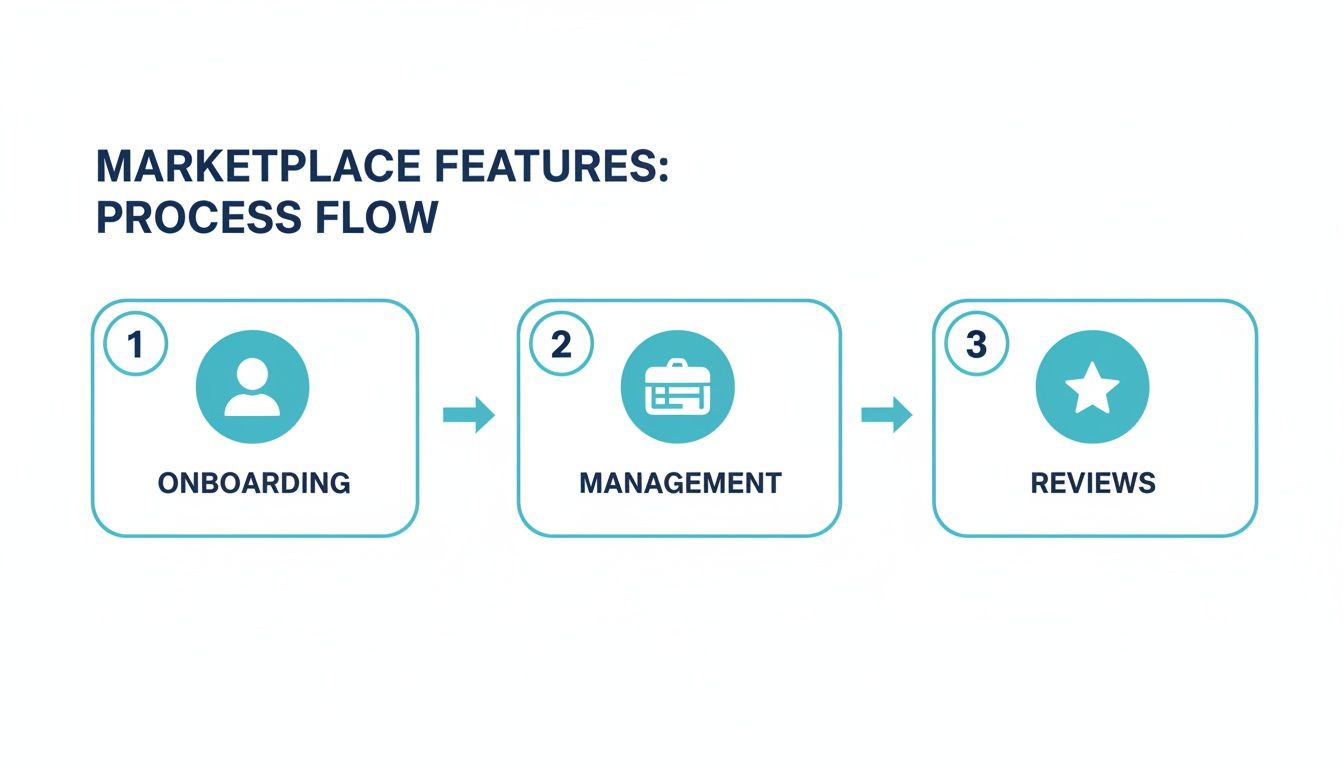
As you can see, a smooth vendor journey is a cycle. Each step logically builds on the last, creating an operation that just works.
Key Integration Points for Your Platform
The single most important integration you'll make is with a payment gateway built for marketplaces, like Stripe Connect. These systems are specifically designed to handle split payments automatically. When a customer buys from three different vendors in one cart, the gateway intelligently divides the money, sends the right amount to each vendor, and routes your commission straight to your account. This eliminates a massive administrative headache.
Handling payments across borders adds another layer of complexity. You can learn more in our guide on multi-currency payment processing.
Another critical piece of the puzzle is webhooks. If an API is like asking another system for an update, a webhook is like that system sending you an automatic notification the second something happens. For instance, when a vendor updates their product stock, a webhook can instantly ping your platform. This real-time communication keeps everything perfectly in sync and prevents frustrating problems like selling out-of-stock items.
A well-built marketplace doesn't just connect systems; it orchestrates them. The goal is to create an automated flow of information where payments, orders, and inventory data move seamlessly between your platform, vendors, and other tools without anyone lifting a finger.
For marketplaces that operate globally or work with vendors in different regions, strong logistics integrations are non-negotiable. Connecting with services that provide reliable global logistics tracking gives everyone the visibility they need. Vendors can manage their shipments, and customers can see where their orders are. This direct link to shipping networks builds a ton of trust and cuts down on support tickets.
Ultimately, these behind-the-scenes technical connections are what turn a basic website into a dynamic and efficient multi-vendor marketplace platform.
Choosing the Right Marketplace Business Model
Picking a business model for your marketplace is like deciding how a restaurant makes its money. Do you charge per dish, offer an all-you-can-eat buffet, or rent out the private dining room for special events? Each choice shapes the customer experience, the kind of chefs you attract, and ultimately, your bottom line.
The most common approach, by far, is the commission model. It’s simple and effective. When a vendor makes a sale, you take a small cut. Think of it as your platform playing the role of a trusted agent, connecting a seller with a buyer and earning a fee for making it happen. The beauty of this model is its perfect alignment: you only win when your vendors win. This makes it a really easy sell for new sellers, as there’s virtually no risk to get started.
Expanding Beyond Commissions
But relying solely on commissions can leave you vulnerable. What happens during a slow sales month? That’s why the smartest platforms don't put all their eggs in one basket. They layer in other revenue streams to build a more stable, predictable financial foundation.
This is where things like subscriptions and listing fees come in.
With a vendor subscription model, sellers pay a recurring fee—say, monthly or annually—to maintain their storefront on your platform. This gives you a steady stream of predictable income, which is a game-changer for budgeting and planning future growth. This model works best when you offer clear, ongoing value beyond just a sales channel, like advanced analytics, marketing tools, or access to a highly coveted audience.
Another option is charging listing fees. Every time a vendor posts a new product, you charge them a small, one-time fee. Platforms like Etsy have used this to great effect. It naturally discourages spammy or low-quality listings because sellers have some skin in the game for every single item they post.
The strongest platforms rarely stick to just one model. A hybrid approach—combining a small commission with a tiered subscription plan, for instance—allows you to cater to different types of vendors, from small artisans to large-scale enterprises.
Value-Added Services and Niche Markets
You can also get creative by offering value-added services. This is where you unbundle premium features and sell them à la carte. Think about offering sellers the chance to pay for a "featured product" spot on the homepage, buy on-platform advertising, or even access logistics and fulfillment services you provide. These create new ways to earn revenue without touching your base commission rate.
This kind of flexibility is absolutely critical in the B2B world. The B2B multi-vendor marketplace space is exploding, projected to hit $36.16 trillion globally by 2026. In 2021 alone, sales grew by an incredible 131%, a trend driven by businesses looking for more efficient ways to buy what they need. You can find more data on this B2B e-commerce boom on Digital Commerce 360. For these platforms, a simple commission might not cut it. They often use custom subscription tiers based on sales volume or charge specialized fees for lead generation, proving just how important it is to tailor your model to your market.
Deciding Whether to Build or Buy Your Platform
Sooner or later, every marketplace founder hits this fork in the road: should you build your platform from scratch or buy a ready-made solution? This isn't just a technical question. It's one of the most important strategic decisions you'll make, dictating your budget, timeline, and what your platform can ultimately do.
There’s no one-size-fits-all answer here. The right choice depends entirely on your specific vision, resources, and how quickly you need to get your marketplace live.
The Case for Buying a SaaS Solution
For most startups and new ventures, buying an existing SaaS solution is the smartest way to start. Think of it like leasing a perfectly located storefront in a new, high-traffic mall. You get to open for business almost immediately, leveraging a foundation that already includes security, payments, and all the essential infrastructure.
This path drastically shortens your time-to-market. Instead of spending a year or more in development, you can be onboarding vendors and attracting your first customers in a matter of weeks. The big trade-off, of course, is that you're working within the landlord's rules—deep customization can be tricky when you don't own the building.
Still, the sheer speed makes this a compelling option. You can validate your entire business idea without a massive upfront investment. The platform handles the heavy lifting on the backend, freeing you up to focus on what truly matters: building a thriving community of buyers and sellers.
This approach lines up perfectly with where e-commerce is heading. Marketplaces are booming because they offer sellers an easy way to manage their own inventory and sales. In fact, experts predict that by 2026, a staggering 67% of all online spending will happen on marketplaces, up from an already impressive 58%. Ready-made solutions from companies like Sharetribe or Marketplacer let you jump right into that growing market.
Many of these SaaS platforms also offer white-labeling, which gives you a degree of customization and branding. If that sounds interesting, you should check out our guide on what white label software is and how it can help.
When to Consider a Custom Build
Building your own platform is like hiring an architect to design and construct your dream flagship store from the ground up. It’s a massive undertaking that demands a lot of time, a talented development team, and a significantly larger budget.
The payoff for all that effort? Total control.
When you build custom, the platform is yours and yours alone. Every single feature, workflow, and user interaction is crafted to fit your unique business model. That’s a powerful competitive advantage that a generic, off-the-shelf solution can never quite match.
This route makes the most sense for well-funded companies with a highly specialized or niche concept that no existing platform can handle out of the box. If your core value proposition is tied to a one-of-a-kind feature, a custom build might be the only way to truly bring that vision to life.
Build vs Buy Decision Matrix
To help you think through this, we’ve put together a simple matrix comparing the two approaches across the factors that matter most.
| Factor | Building Custom | Buying SaaS Solution |
|---|---|---|
| Time-to-Market | Slow (6-18+ months): Requires full development, testing, and deployment cycles. | Fast (Weeks to a few months): Launch quickly by configuring an existing platform. |
| Upfront Cost | Very High: Significant investment in developers, project managers, and infrastructure. | Low: A predictable monthly or annual subscription fee. |
| Total Cost of Ownership | High: Ongoing costs for maintenance, security, updates, and hosting. | Predictable: The subscription fee usually covers all maintenance and hosting. |
| Customization | Unlimited: You have complete control to build any feature or workflow you can imagine. | Limited: You're restricted to the platform's features and available add-ons. |
| Technical Risk | High: You are responsible for every bug, security vulnerability, and scalability issue. | Low: The provider handles all technical complexity, security, and updates. |
| Business Focus | Divided: Significant time and resources are spent on product development, not just business growth. | Focused: You can concentrate almost entirely on marketing, vendor onboarding, and community building. |
| Scalability | Your Responsibility: You must architect and manage the infrastructure to handle growth. | Handled by Provider: Most SaaS platforms are built to scale automatically as you grow. |
Ultimately, this decision comes down to a classic business trade-off. Do you need speed, low upfront risk, and the ability to test your idea right now? Or is your vision so unique that having complete control and flexibility is the most critical ingredient for your long-term success? Answering that question will point you in the right direction.
Igniting Growth With a Native Affiliate Program
Once your multi-vendor marketplace platform is live, the real work begins. The focus pivots from building the car to actually driving it—and picking up speed. A powerful, yet surprisingly overlooked, way to fuel that growth is by building a native affiliate and referral program right into your ecosystem.
This isn't about duct-taping a clunky, third-party tool onto your platform. A native system offers a seamless experience for both your vendors and the promoters they work with, making participation feel effortless instead of like a chore. When you're ready to really scale, solid affiliate marketing strategies can be a game-changer, and a native solution puts that power directly into your vendors' hands.
The Power of a Purpose-Built Solution
This is where purpose-built tools like Refgrow really shine. Imagine adding a fully customizable affiliate dashboard inside your platform with just a single line of code. That's the idea. By integrating directly with payment gateways like Stripe, commissions and payouts are handled automatically, which removes a massive administrative headache for you and your vendors.
The real magic of a native program is how it creates a self-sustaining growth loop. When vendors can easily recruit their own affiliates, they stop being passive sellers and become active partners in marketing the entire marketplace—not just their own little corner of it.
This dynamic shift does more than just drive sales for individual vendors; it boosts the overall traffic and brand awareness of your entire platform. You're essentially turning your vendor base into a motivated, decentralized marketing army that works for you.
Tools like Refgrow also tackle the dreaded "cold start" problem with some clever features. If you're looking for a step-by-step guide to get started, you can learn how to create an affiliate marketing program from the ground up.
The diagram below shows how an integrated system can plug vendors directly into a network of promoters.
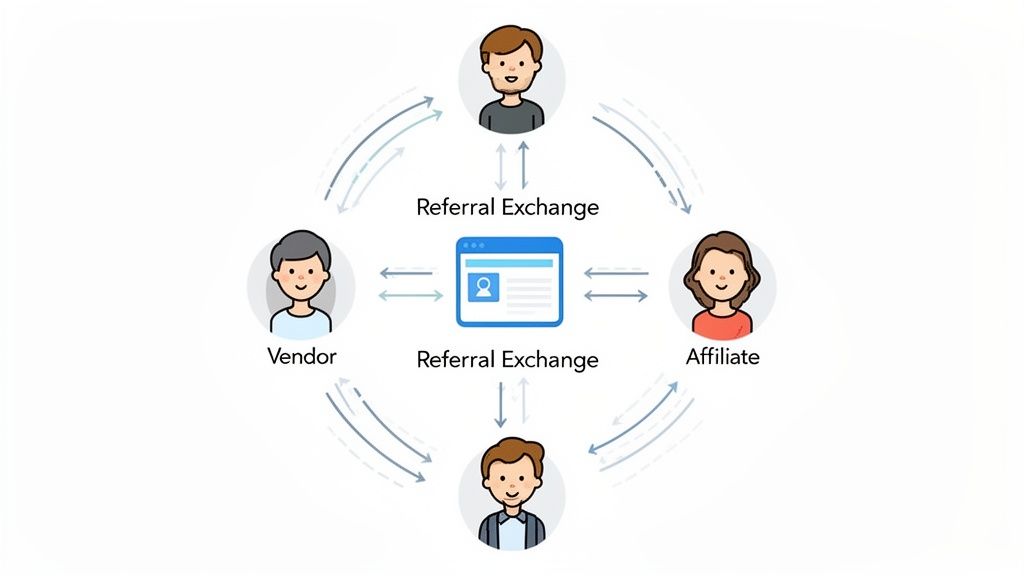
Think of it this way: a feature like a ‘Referral Exchange’ can instantly connect your brand-new vendors with a pre-vetted network of affiliates from day one. This creates immediate momentum, solving a huge business challenge right out of the gate and kickstarting your marketplace's growth engine.
Marketplace Platforms: Your Questions Answered
When you're diving into the world of multi-vendor marketplaces, a lot of questions pop up. Whether you're just sketching out your business plan or already managing a growing platform, you're not alone. Let's tackle some of the most common questions we hear from founders.
How Do Payments and Commissions Actually Work?
This is a big one. The secret sauce is usually a payment gateway with a feature often called "split payments." Think of platforms like Stripe Connect.
When a customer fills their cart with items from three different vendors, the gateway automatically carves up that single payment. It shoots each vendor their cut, deducts your platform's commission, and handles the processing fees, all in one go. This system is crucial for making sure everyone gets paid accurately and without a ton of manual work.
What's the Single Biggest Hurdle When Starting Out?
Without a doubt, it’s cracking the classic “chicken-and-egg” problem. You can't get customers without sellers, but sellers won't sign up if there are no customers to buy their products. It's a real catch-22.
The trick is to stop trying to build both sides at once. The most successful marketplaces focus on one side first. You could hyper-focus on a tiny niche, offer a killer deal to your first 100 vendors (like zero commission), or build a tool that's so useful for sellers that they'd join even without immediate sales. Getting that initial momentum is everything.
Can I Add a Referral or Affiliate Program to My Marketplace?
Yes, and you absolutely should. Modern platforms built with APIs make this much easier than you'd think. You don't need to build something complex from scratch.
Tools like Refgrow are designed for this exact scenario. It can often be added with just a single line of code to create a dashboard that feels completely native to your platform. This lets you launch a powerful referral and affiliate program that empowers your vendors to become your best marketers, all without distracting your developers from their core work.
Ready to ignite growth with a seamless, native affiliate program? Refgrow integrates directly into your platform with a single line of code, turning your vendors into a powerful marketing force. Start your free trial today.