

What Is White Label Software and How Does It Work?
What if you could add a powerful, in-demand feature to your SaaS platform in a matter of weeks, not months, and without your team writing a single line of new code? That's the core idea behind white label software. It’s essentially a ready-made, unbranded product that you can buy, put your own logo on, and sell to your customers as if you built it yourself.
Think of it as a strategic shortcut that lets you expand what you offer and grow your business much faster.
Your Shortcut to Launching a New SaaS Feature

Let's use an analogy. Imagine a world-class bakery that supplies amazing, unbranded cakes to local cafes. Each cafe then adds its own icing, packaging, and unique branding, presenting the cake as their own special creation.
The cafe didn't have to build a kitchen from scratch, hire a team of pastry chefs, or spend months testing recipes. They just took a high-quality product and used it to instantly delight their customers. White label software works the exact same way.
You get a fully developed, market-tested solution that you can seamlessly integrate into your own platform. Slap your branding on it, and it becomes a native part of your product suite. This approach is a game-changer for startups and lean teams, letting them compete with much bigger players without the massive cost of in-house development.
The Strategic Advantage of Speed and Focus
Building any new software feature from the ground up is a huge undertaking. It drains time, money, and the brainpower of your development team. White labeling lets you sidestep that entire painful process, offering a much more capital-efficient way to innovate.
Instead of burning resources to reinvent the wheel, your team can stay focused on what they do best—acquiring customers, nailing your marketing, and improving your core product. This simple shift can be the difference between getting stuck in endless development cycles and actually capturing more of the market.
For instance, adding a feature like embedded analytics for SaaS (https://refgrow.com/blog/embedded-analytics-for-saas) can give your users incredible data insights without you ever having to build a complex reporting engine from the ground up.
White label software empowers companies to expand their service offerings almost overnight. It's not just about saving money; it's about gaining a critical speed-to-market advantage that can define your competitive edge.
To really nail down the concept, let's break it down in a quick table.
White Label Software at a Glance
This table offers a snapshot of what white label software is all about and what it means for a business like yours.
| Characteristic | What It Means for Your SaaS | Example Application |
|---|---|---|
| Ready-to-Use | You get a fully functional product without any development time. | A marketing agency buys a white label social media scheduling tool to offer clients. |
| Unbranded | The software is a blank canvas, ready for your logo, colors, and name. | A CRM company rebrands a reporting dashboard to look like a native feature. |
| Resellable | You purchase the rights to sell the software as your own. | An e-commerce platform integrates a white label shipping calculator and charges for it. |
In short, it’s a plug-and-play solution that looks and feels like it’s always been part of your brand.
A Growing Market for Ready-Made Solutions
The appeal of this model is clear from its rapid growth. The white label software market is on a rocket trajectory, forecasted to accelerate with a CAGR of around 9.8% from 2026 to 2033.
This trend makes perfect sense when you consider that up to 85% of business apps are expected to be SaaS-based by 2025. As more businesses move to the cloud, the demand for quick, reliable solutions will only increase.
Ultimately, choosing a white label solution is a strategic move that allows you to:
- Launch features faster: Go from a great idea to a live product in weeks instead of months or even years.
- Reduce development costs: Skip the high salaries of engineers and the ongoing costs of maintaining new infrastructure.
- Increase customer value: Quickly add the functionalities your users are asking for, which helps with retention.
- Strengthen your brand: Offer a more complete, all-in-one solution under your own trusted brand name.
Get to Market Faster and Smarter
In the software world, speed is everything. It’s not just a nice-to-have; it’s a core competitive advantage. The first to market often grabs the most attention, captures the most users, and sets the standard. This is where white label software flips the script, turning a long development marathon into a quick, decisive sprint.
Think about the traditional route: building a new feature from scratch. You're looking at months of planning, coding, testing, and debugging. A feature like an affiliate marketing module, even a moderately complex one, can easily take six to twelve months to get right. That's a huge drain on your most precious resources—your team's time and your company's cash.
Now, picture the white label approach. Instead of building, you're integrating. You take a ready-made, fully tested solution and plug it into your existing platform. This can often be done in just a few weeks. The difference is night and day. You launch sooner, get real customer feedback faster, and start making money while your competitors are still tangled up in code.
The Financial Case for Speed
That time you save isn't just about bragging rights; it translates directly into significant financial wins. Building a feature in-house isn't a one-time cost. It's an ongoing financial commitment that grows over time.
- Developer Salaries: A small team of good developers costs a lot—tens of thousands of dollars a month. A year-long project can easily run into six figures just for payroll.
- Infrastructure Costs: Every new feature needs servers, databases, and monitoring, which adds to your monthly bills.
- Ongoing Maintenance: Software is never truly "done." It needs constant updates, bug fixes, and security patches. This becomes a perpetual drain on your engineering team, pulling them away from working on your core product.
A white label solution rolls all those unpredictable expenses into one clear, predictable subscription fee. This frees up your cash to invest where it really matters—marketing, sales, and innovating on what makes your business unique. It also lets you quickly offer new solutions under your own name, helping you create a memorable brand identity and get a foothold in the market much faster.
A Tale of Two SaaS Companies
Let's make this real. Imagine two competing SaaS companies, "InnovateCo" and "AgileLaunch." Both want to add an affiliate marketing module to their platforms.
InnovateCo's In-House Journey:
InnovateCo decides to build it themselves. Their team spends the next nine months deep in development, hitting unexpected bugs and integration headaches along the way. While this is happening, their core product stagnates and the marketing team has nothing new to talk about. By the time they finally launch, they've burned through over $150,000 in development costs and lost a ton of momentum.
AgileLaunch's White Label Advantage:
AgileLaunch goes with a white label affiliate platform. They get the entire solution integrated and branded in just three weeks. Their engineering team stays focused on improving the main product, and their sales team has a powerful new feature to sell. They launch their "new" affiliate program a full eight months ahead of InnovateCo, winning over early adopters and cementing their reputation as the more complete platform.
AgileLaunch didn't just save a pile of cash. By choosing the white label path, they seized a critical market advantage. They spent their resources winning customers, not reinventing the wheel. That's the strategic power of this model.
This scenario gets to the heart of it. The white label approach is designed to slash development time and costs, offering a path to market that can be six to twelve times faster. It allows businesses to brand powerful tools—analytics dashboards, SEO platforms, or CRM systems—as their own, boosting customer loyalty in the process. We've also seen a huge boom in white label social media tools, which let agencies manage dozens of client accounts under a single, branded roof.
By moving faster, you're not just beating the competition to the punch. You're building a more focused, resilient, and profitable business.
Exploring the Different Flavors of White Label Solutions
So, you get the basic idea of white label software. But here’s the thing: "white label" isn't a one-size-fits-all solution. Digging a little deeper, you'll find a few different types, each built for a specific business need.
Think of it like choosing a vehicle. You wouldn't pick a two-seater sports car for a family camping trip, right? In the same way, the best white label tool for you hinges entirely on what you're trying to accomplish. The market generally breaks down into three main categories, and figuring out which one you need is the key to a smart investment.
This flowchart really brings the concept to life, showing how white label solutions can be a shortcut to getting your product out there, way faster than building everything yourself.
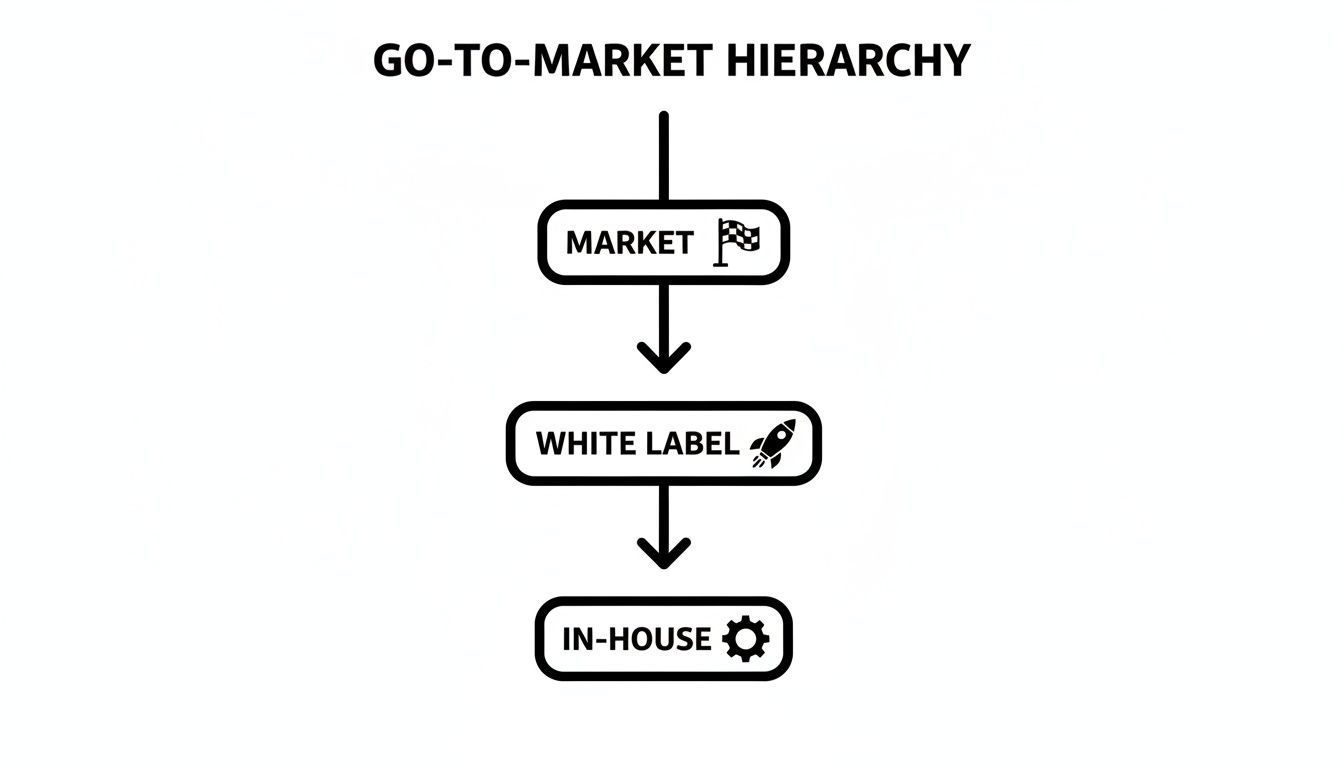
As you can see, the white label "rocket" offers a major head start, letting you bypass the slow, grinding "gear" of in-house development.
Complete, Rebrandable Platforms
First, you have the all-in-one platforms. These are complete, fully-functional software products—think CRMs, marketing automation suites, or social media schedulers—that you can put your own brand on and sell as a new product line. It’s the perfect play for businesses wanting to add a major new service without touching a single line of code.
For example, a marketing agency could license a white label SEO reporting tool, slap their logo on it, and offer clients a sleek, proprietary analytics dashboard. The setup is usually straightforward, focusing on branding and user accounts, and the pricing is often a simple monthly subscription.
The global white label market is on a serious growth trajectory, projected to hit $99.19 billion by 2026 with a 12.3% annual growth rate. This boom is fueled by the massive shift to SaaS—where up to 85% of apps are expected to be SaaS-based by 2025. You can get more market insights on this from AMRA & ELMA.
Specific Features and Embedded Modules
The second category is a bit more surgical. Instead of a whole platform, you're licensing a specific feature or module that you can plug directly into your existing software. This is a go-to strategy for SaaS companies that want to add new capabilities to their core product without the headache of building them from scratch.
It’s like adding a new, fully-equipped media room to your house instead of building a whole separate guesthouse. These modules are designed to integrate so smoothly that your users will never know they weren't built by you.
A few classic examples include:
- Affiliate Dashboards: Quickly adding a referral program to your SaaS.
- Payment Gateways: Integrating a pre-built checkout system into an e-commerce site.
- Event Calendars: Giving a membership platform a way to manage and promote events.
The integration here is a bit more technical—you'll likely be working with APIs and need some developer time to get everything connected. But it’s an incredible way to add value, boost user retention, and open up new revenue streams. To see a real-world application, check out our guide on choosing a white label affiliate program.
Service-Based Software for Agencies
Finally, there’s a whole class of white label software built specifically for agencies and other service-based businesses. These tools are all about helping you manage multiple clients efficiently, all under your own brand.
A digital marketing agency, for instance, could use a white label platform to automatically generate custom-branded performance reports for every client, pulling in data from dozens of ad platforms. The real win here is efficiency and professionalism. The agency saves a ton of time on manual reporting while delivering a polished, branded experience that constantly reinforces its value. For any agency looking to scale, these tools are practically essential.
Choosing the Right White Label Partner
Picking a white label software provider is one of the most important calls you'll make for your business. This isn't just a simple purchase; you're starting a partnership that will shape your product, define your brand's reputation, and ultimately fuel your growth.
Get this right, and a great partner can feel like a superpower, pushing you forward. Get it wrong, and you could be stuck with technical headaches, unhappy customers, and a business that’s dead in the water. You have to look past the slick sales presentations and really dig in to find a partner whose success is tied to your own.
Start with the Technical Foundation
First things first, you need to kick the tires on the technology. A long list of features is useless if the platform itself is buggy, confusing, or can't keep up as you bring on more users. Your developers will be the ones dealing with it day-to-day, so get them involved in this part of the evaluation.
Here’s what to zero in on:
- API Quality and Documentation: A clean, well-documented API is absolutely essential. Your team needs a clear roadmap to connect their systems, so ask to see the developer docs before you sign anything. If they're a mess, walk away.
- Scalability: Can this platform handle your ambition? Ask them how their infrastructure is built and what happens during a sudden surge in traffic. You need a partner who can support you at 100 users just as well as they can at 100,000.
- Performance and Reliability: What are their uptime guarantees? Look for a formal Service Level Agreement (SLA). Remember, their downtime is your downtime, and your customers won't know the difference.
A shaky technical foundation will always result in a poor user experience, and that's a direct reflection on your brand.
Scrutinize Branding and Customization Options
The whole reason you're doing this is to make their software look like your software. The level of customization they offer is the difference between a seamless product and a clunky, tacked-on feature that confuses everyone.
A successful white label integration should be invisible to the end-user. It must blend perfectly with your existing UI and UX, reinforcing your brand identity rather than detracting from it.
You need to understand exactly how deep the customization goes. Is it just a logo and a few color swaps, or can you control the fine details like fonts, CSS, and component layouts? The more control you have, the more you can create an experience that feels truly native to your brand.
Analyze the Business and Support Model
A company's business model tells you everything you need to know about its priorities. Watch out for complex pricing with hidden transaction fees or weird caps that punish you for growing too quickly. The best partners have simple, predictable pricing that encourages your success.
Beyond the contract, look at their support. When something inevitably breaks, you need to know that a smart, responsive team has your back. Ask about their support hours, average response times, and if you get a dedicated person to call. This is a partnership, and good ones run on clear communication and reliable help.
When done right, this kind of strategic outsourcing delivers serious results. Agencies that outsource 40-60% of their work through white label services see 2.3 times faster growth and enjoy 20% higher profit margins. Even better, their client retention rates jump by 42% because they can consistently deliver top-tier services. You can explore more about what these marketing statistics mean for your business.
To help you stay organized during your search, use a structured approach. A simple checklist can keep you focused on what truly matters when comparing potential partners.
White Label Partner Evaluation Checklist
| Evaluation Criteria | What to Look For (Ideal Partner) | Red Flags to Avoid |
|---|---|---|
| Technical Health | Robust, well-documented API. Clear scalability path. High uptime (99.9%+ SLA). | Vague or incomplete API docs. No clear answers on scaling. No formal SLA. |
| Customization | Deep branding control (CSS, fonts, layouts). Flexible API for custom integrations. | Logo-slapping only. Limited styling options. "What you see is what you get." |
| Pricing Model | Transparent, predictable pricing. Tiers that support growth. No penalties for success. | Hidden fees. Complicated usage-based billing. Revenue-sharing models that cap you. |
| Support & Onboarding | Dedicated account manager. Multiple support channels (phone, chat). Fast response times. | Email-only support. Slow or unhelpful responses. Poor onboarding process. |
| Partnership Alignment | Clear product roadmap. They listen to partner feedback. Invested in your success. | Stagnant product. Unwillingness to share future plans. Transactional relationship. |
This framework isn't just about ticking boxes; it's about finding a partner you can trust to build with for the long haul. The time you invest in this vetting process now will pay for itself many times over.
Real-World Examples of White Label Success

It’s one thing to talk about white label software in theory, but where the rubber really meets the road is seeing how it plays out in the real world. Businesses of all stripes are using these pre-built solutions to get ahead faster, round out their service offerings, and give customers more value without the headache and expense of building from scratch.
These success stories aren’t just about cutting costs. They're about being smart, fast, and agile in the market. From nimble startups to established agencies, the pattern is clear: white labeling works.
Igniting Growth for an Early-Stage SaaS
Picture an early-stage SaaS startup with a great product but a stalled growth engine. They knew a referral program could kickstart a viral loop of new signups, but their small development team was already buried in work on core features. Building a solid affiliate system from the ground up? That would have meant a six-month delay and blowing up their entire product roadmap.
Instead, they went with a white label option. By implementing a white label referral software, they were able to launch a fully branded affiliate dashboard that looked and felt completely native to their app. And they did it in just a few days. The effect was immediate. They gave their most enthusiastic users a way to spread the word, and new customers started rolling in almost overnight.
- The Challenge: Not enough developers to build a crucial customer acquisition channel quickly.
- The Solution: Plugged in a ready-to-go affiliate module instead of building one.
- The Result: A 30% jump in new user sign-ups in the first quarter, all driven by the new referral program.
This is a classic example of how white label software provides a practical answer to the question "what is white label software?". It's a strategic shortcut to execute on a great idea without the usual delays and steep costs.
Boosting Retention for a Marketing Agency
A digital marketing agency was dealing with a different kind of headache: client churn. Their campaign results were good, but they had a hard time showing their ongoing value in a way that really stuck. The monthly PDF reports they sent were easy for busy clients to ignore, creating a sense of disconnect.
The agency’s lightbulb moment was deciding to offer a branded social media dashboard. They used a white label platform to give every client a personalized, real-time portal where they could see campaign performance, approve content, and check analytics on their own time. Suddenly, the agency's services felt more professional, transparent, and essential.
By providing a branded, high-touch experience, the agency transformed its client relationships from a simple service transaction into a true partnership. This shift dramatically improved stickiness and long-term loyalty.
The numbers don't lie. The agency saw a stunning 45% increase in client retention within a year of launching the dashboards. Better yet, they created a new premium revenue stream by upselling access to the portal, adding directly to their bottom line. It's a clever move that’s catching on—in fact, 73% of agencies now use white label services to expand what they can offer.
Increasing Engagement for a Membership Community
Finally, think about a growing online community centered on professional development. The founders wanted to offer exclusive virtual events and workshops to keep members engaged, but their platform had no tools for managing events.
They found a white label event system and integrated it right into their community portal. Now, they could create, promote, and run events seamlessly. Members could sign up for workshops, watch recordings, and network with each other, all without ever leaving the site. The user experience was so much smoother, and the community's value proposition became that much stronger. The result? Event attendance tripled, and they saw a major spike in member-to-member interaction.
Common Pitfalls and How to Avoid Them
White label software can be an incredible shortcut to launching new features, but it's certainly not a magic wand. If you rush in and pick the wrong solution or partner, you can easily find yourself facing technical nightmares, angry users, and a hole in your budget.
Success means knowing what traps to look out for and how to steer clear of them from the start.
The most common mistake I see is choosing a solution that just feels "bolted on." This is when the integration is clunky, and the user experience feels completely separate from your main product. Remember, your customers have no idea who built the underlying tech; they just know it doesn't work well, and that reflects directly on your brand.
Another huge problem is a lack of real customization. If all you can do is slap your logo on it and change a few colors, the new feature is going to stick out like a sore thumb. That generic feeling completely defeats the purpose of white labeling, which is all about offering a seamless, branded experience.
Misaligned Partnerships and Hidden Costs
Beyond the software itself, a bad partnership can sink the whole project. Imagine you've partnered with a provider who offers slow, unhelpful technical support. When something inevitably breaks, you're the one on the front lines with your customers. If your white label partner is nowhere to be found, your reputation takes the hit.
You're not just looking for a vendor; you need a partner who feels like an extension of your own team.
Then there are the hidden costs. This is a big one. Some providers will hook you with an attractive low price, only to surprise you later with hefty transaction fees, user caps, or extra charges for features you thought were included.
The goal of a white label partnership should be mutual growth. If a provider's pricing model penalizes you for succeeding, they are not a true partner. Always read the fine print to ensure their business goals align with yours.
How to Mitigate Your Risk
Thankfully, you can avoid most of these headaches with a little due diligence during the selection process. Here are a few practical steps you can take to protect your business and choose with confidence:
- Demand a Deep Dive Demo: Don't just sit through a sales pitch. Get your hands dirty. Ask them to show you the customization options live and have your technical team dig into the API documentation to check for quality.
- Stress-Test Their Support: Before you sign anything, try contacting their support team with a few real-world technical questions. How fast they respond and the quality of their answers will tell you everything you need to know.
- Analyze the Total Cost of Ownership: Don't just look at the monthly fee. Create a simple spreadsheet and map out all potential costs—per-user fees, transaction percentages, API access charges—to get a clear picture of the true financial commitment over time.
By being proactive and asking the tough questions upfront, you can sidestep these common frustrations. A thorough evaluation is the key to finding a white label solution that actually helps you grow instead of holding you back.
Frequently Asked Questions
When you start exploring white label software, a few key questions always seem to pop up. Let's tackle the most common ones to clear up any confusion and give you a better handle on how this strategy actually works.
Is It Legal to Rebrand and Sell Someone Else’s Software?
Absolutely. In fact, that's the whole point of the white label business model. It’s not just legal; it’s the foundation the entire system is built on.
The original software creator builds their product with the specific goal of licensing it out to other companies. Those companies, like yours, can then legally put their own brand on it and sell it as if they made it themselves.
This is all formalized in a licensing agreement. This document is your rulebook—it spells out exactly what you can and can't do, so make sure you understand it completely.
What Is the Difference Between White Label and Private Label?
People often mix these two up, but the difference is pretty simple and boils down to one word: exclusivity.
White Label: This is a "one-to-many" approach. A provider makes one standard product and sells it to anyone and everyone who wants to resell it. Think of it like a bakery selling the same plain cake to ten different coffee shops, and each shop adds its own unique icing and logo.
Private Label: This is usually a "one-to-one" deal. A provider creates a unique software solution for a single client. It's often more customized and exclusive to that one company. This is more like hiring a baker to create a signature cake recipe that only your coffee shop can sell.
The core distinction is simple: white label is for mass resale under different brands, while private label is for a single, exclusive reseller, often with deeper customization.
How Does Customer Support Work?
In almost every white label arrangement, you’re the face of the product. That means you are the first line of defense for customer support. When your users have a question or a problem, they're coming to you.
If they report a bug or a technical issue that's beyond your team's ability to fix, you then escalate it to the white label provider. They handle the heavy lifting on the back end.
This two-tiered system makes it incredibly important to vet the provider’s support team before you commit. A partner who is slow to respond or unhelpful can directly damage your customer relationships and your brand's reputation.
Can I Fully Customize the Look and Feel?
This is a huge "it depends." The degree of customization can vary wildly between providers, so this should be a top question on your list when you're shopping around.
Some basic white label tools might only let you slap your logo on and maybe change a few brand colors. This can work, but it often feels a bit disjointed from the rest of your platform.
On the other hand, more sophisticated providers give you much deeper control through APIs and direct CSS access. This lets your developers weave the software into your existing product so seamlessly that your users will never know it wasn't built in-house. Always get a demo to see exactly what you can and can't change.
Ready to launch a fully branded affiliate program without writing a line of code? Refgrow provides an embeddable, customizable platform that feels native to your SaaS. Start your free trial and launch in minutes.