

10 Top Subscription Business Model Examples to Drive Growth in 2026
The subscription economy isn't just a trend; it's a fundamental shift in how value is delivered and consumed. For founders and product teams, mastering this model is no longer optional. It's the key to predictable revenue, deeper customer relationships, and sustainable growth. However, simply choosing to offer a subscription is not enough. The real challenge lies in selecting and implementing the right strategy from a diverse set of options.
This article moves beyond surface-level descriptions to provide a deep, strategic breakdown of the most effective subscription business model examples in action today. We will dissect everything from SaaS and freemium to usage-based and hybrid models. You will gain actionable insights into their core mechanics, ideal customer profiles, and the key metrics that drive success. For a broader array of successful strategies, explore these 10 Subscription Business Model Examples that can inspire your entrepreneurial journey.
We’ll explore how industry leaders implement these models, what their pricing structures look like, and how they overcome common challenges. More importantly, we’ll show you how to apply these lessons to your own venture, including how integrating referral programs can significantly accelerate customer acquisition and create a powerful, self-sustaining growth engine. This is your playbook for building a resilient, recurring revenue business.
1. SaaS Subscription Model (Software-as-a-Service)
The Software-as-a-Service (SaaS) model is one of the most popular subscription business model examples, where customers pay a recurring fee (monthly or annually) to access cloud-based software. Instead of a one-time purchase and local installation, users access the platform via a web browser or API, making it incredibly scalable and accessible. This model provides predictable revenue for businesses and lower upfront costs for customers.
Analysis & Key Metrics
Pioneered by companies like Salesforce, the SaaS model's success hinges on customer retention over acquisition. Key metrics include Monthly Recurring Revenue (MRR), Customer Lifetime Value (LTV), and critically, Churn Rate (the percentage of subscribers who cancel). Companies like Slack and Notion exemplify product-led growth within SaaS, using a freemium or free trial approach to let the product sell itself. A low churn rate and a high LTV to Customer Acquisition Cost (CAC) ratio (ideally 3:1 or higher) signal a healthy SaaS business.
Strategic Insight: SaaS thrives on value alignment. Tiers should be based on features that correlate with customer growth (e.g., users, contacts, API calls), ensuring that as your customers succeed, your revenue grows with them.
Actionable Takeaways
- Implement a Low-Friction Entry Point: Use a free trial or a freemium tier to reduce adoption barriers. This allows users to experience your product's value firsthand before committing.
- Prioritize Seamless Onboarding: Guide new users to their "aha!" moment as quickly as possible. Strong onboarding reduces initial churn and increases activation rates.
- Build for Stickiness with Integrations: Offer native integrations with essential tools in your customer's workflow. For instance, Refgrow's direct webhooks for Stripe and LemonSqueezy make it an indispensable part of a user's payment stack.
- Monitor and Act on Feedback: Regularly track your Net Promoter Score (NPS) to gauge customer satisfaction and identify areas for improvement before they lead to churn. Exploring different monetization strategies for apps can also reveal new opportunities for value delivery.
2. Freemium Model
The Freemium model is a powerful acquisition-focused subscription business model example that offers a free, feature-limited version of a product alongside premium paid tiers. This strategy lowers the barrier to entry, allowing a wide user base to experience the core value proposition firsthand. The goal is to convert a percentage of the free user base into paying customers by showcasing the benefits of advanced functionality, higher usage limits, or collaborative features.
Analysis & Key Metrics
Popularized by consumer apps like Dropbox and perfected in B2B by Slack and Figma, the Freemium model excels at building a large top-of-funnel user base. The most critical metric is the Free-to-Paid Conversion Rate, which typically hovers between 2-5% for successful products. Other key indicators include Daily/Monthly Active Users (DAU/MAU) to gauge engagement on the free plan and Time-to-Conversion. The model's success depends on the free tier being valuable enough to retain users but limited enough to create natural upgrade triggers.
Strategic Insight: A successful Freemium model isn't about giving away a product; it's a marketing strategy. The free tier must be designed to create "product-qualified leads" who understand the core value and hit a limitation that a paid plan elegantly solves.
Actionable Takeaways
- Define Clear Upgrade Paths: Design your free tier limitations around value metrics like storage (Dropbox), features (Notion), or collaboration (Figma). Make the next step to a paid plan feel like a natural progression, not a frustrating wall.
- Leverage In-App Nudges: Use contextual, non-intrusive in-app messages to highlight premium features at the exact moment a free user might need them.
- Optimize the Free User Experience: A sticky free product creates a larger pool of potential converters. Focus on delivering a fantastic core experience to build brand loyalty and encourage word-of-mouth growth.
- Integrate Referral Incentives: Use a tool like Refgrow to empower free users to earn premium features or credits by referring others. This turns your free user base into a powerful, low-cost acquisition channel.
3. Tiered/Multi-Tier Pricing Model
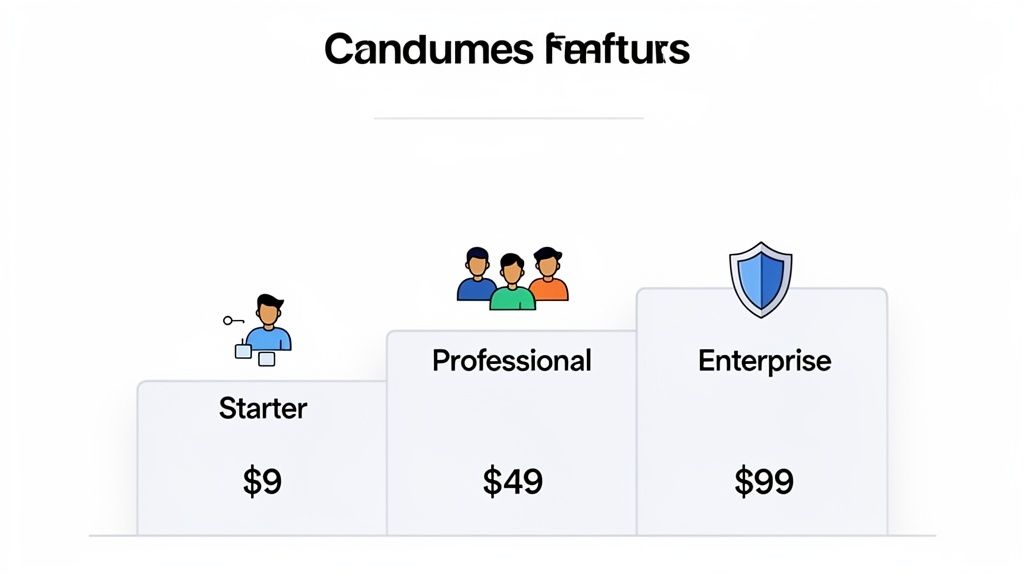
The tiered pricing model is a foundational subscription business model example where a business offers several subscription plans at different price points. Each successive tier provides more features, higher usage limits, or greater capabilities, allowing customers to choose the plan that best fits their specific needs and budget. This approach is highly effective for capturing a wider market segment, from individual users to large enterprises.
Analysis & Key Metrics
Companies like HubSpot and Calendly masterfully use tiered pricing to create a clear upgrade path for customers. The key is to anchor tiers to distinct customer personas or use cases. Metrics to watch include Tier Distribution (the percentage of customers on each plan) and Expansion MRR (revenue growth from existing customers upgrading tiers). A healthy model sees customers moving up tiers as their needs grow, indicating that your pricing aligns with the value they receive. If over 70% of users are on your lowest-priced plan, it may be undervalued or your higher tiers may lack compelling features.
Strategic Insight: Leverage the "Goldilocks Principle" by designing your middle tier to be the most attractive option for the majority of your target customers. This tier should offer the best balance of features and price, making it feel like the default, most logical choice.
Actionable Takeaways
- Align Tiers with Value Metrics: Base your pricing tiers on features that scale with customer growth, such as user seats, contact limits, or API access. Refgrow does this by limiting affiliate numbers on its Starter plan while offering unlimited affiliates and API access on its Professional tier.
- Create a Clear Comparison: Design a transparent pricing page that visually distinguishes the features available in each tier. This reduces friction and helps prospects self-select the right plan.
- Incentivize Annual Commitments: Offer a significant discount (typically 15-25%) for annual pre-payment. This boosts your Customer Lifetime Value (LTV) and improves cash flow.
- Refine Tiers with Data: Regularly analyze which features drive upgrades and monitor tier distribution. For a deeper dive, explore various tiered pricing strategy examples to see how others structure their plans.
4. Usage-Based/Pay-As-You-Go Subscription Model
The usage-based subscription model, also known as pay-as-you-go, directly links a customer's cost to their consumption. Instead of a fixed recurring fee, users pay based on specific metrics like API calls, data storage, or transactions processed. This model is one of the most transparent subscription business model examples, as it ensures customers only pay for the value they actually receive, making it popular for infrastructure and platform services.

Analysis & Key Metrics
Popularized by infrastructure giants like AWS and API-first companies like Twilio and Stripe, this model's success depends on aligning your core unit of value with customer growth. The key metrics shift from MRR to Usage Revenue and Average Revenue Per User (ARPU). Monitoring Cost of Goods Sold (COGS) per unit is critical to ensure profitability. The main challenge is revenue predictability, which can be volatile compared to fixed subscriptions. Companies often mitigate this with a hybrid approach, combining a small base fee with usage-based overages.
Strategic Insight: This model excels by eliminating adoption friction. A small startup can use the same powerful infrastructure as a large enterprise without a massive upfront commitment, allowing your service to scale seamlessly with your customers' success.
Actionable Takeaways
- Offer Real-Time Usage Dashboards: Transparency is paramount. Provide customers with clear, real-time dashboards to track their consumption and predict future costs, preventing surprise bills.
- Implement a Hybrid Model for Predictability: Combine a low base subscription fee for core access with overage charges for usage. This secures a predictable revenue floor while capturing upside from heavy users.
- Establish Clear Overage Policies: Set soft limits and communicate clearly when a user is approaching them. Automated notifications help customers manage their usage and avoid unexpected charges.
- Use Referrals to Drive High-Value Usage: Incentivize affiliates to bring in users who will actively consume your service. For example, a platform like Refgrow could tie affiliate commissions to a percentage of the referred customer's first-year usage revenue, directly rewarding high-consumption referrals.
5. Value-Based/Outcome-Based Pricing Model
The value-based pricing model is a sophisticated approach where subscription fees are tied directly to the tangible outcomes or business value delivered to the customer. Instead of charging for features or usage, this model aligns the provider's revenue with the customer's success, creating a powerful partnership. This is one of the more advanced subscription business model examples and is best suited for products that can directly impact a client's key performance indicators, like revenue or user acquisition.
Analysis & Key Metrics
Pioneered by service industries like consulting and performance marketing, the value-based model is gaining traction in SaaS. The critical metric here is Customer ROI, which must be clearly defined and tracked. Other key metrics include Revenue Share Percentage and Value-Metric Correlation (how closely your pricing metric tracks with the value a customer receives). Companies like HubSpot and some performance agencies use this model to justify premium pricing by guaranteeing or directly linking their fees to results, such as lead generation or sales pipeline growth.
Strategic Insight: This model requires deep customer understanding and confidence in your product's impact. The price is a direct reflection of the ROI you provide, transforming the sales conversation from a cost discussion to a value-driven investment.
Actionable Takeaways
- Define Clear, Measurable Success Metrics: Before implementation, agree with the client on what "success" means. This could be qualified leads generated, revenue increase, or cost savings, and must be tracked transparently.
- Start with a Hybrid Model: Reduce risk for both parties by combining a lower base subscription fee with a performance-based bonus. This proves value while securing predictable revenue.
- Build Robust Tracking and Reporting: Trust is paramount. Implement systems that provide both you and your customer with a clear, undeniable view of the outcomes being achieved.
- Leverage Aligned Affiliate Structures: Integrate tools like Refgrow to create performance-based referral programs. For instance, an enterprise tier could offer partners a revenue share on the customers they refer, mirroring the value-based model in your growth strategy.
6. Marketplace/Commission-Based Subscription Model
The Marketplace model is a unique hybrid among subscription business model examples, where revenue is generated primarily from commissions on transactions between two parties (buyers and sellers). Instead of a flat fee for access, the platform takes a percentage of the value exchanged. This is often supplemented with optional premium subscriptions for sellers to gain enhanced visibility, lower fees, or access to advanced tools.
Analysis & Key Metrics
Pioneered by eBay and scaled by giants like Amazon Marketplace and Uber, this model's success relies on generating a high volume of successful transactions. Key metrics include Gross Merchandise Volume (GMV), Take Rate (the commission percentage), and Seller/Buyer Churn. For instance, Etsy charges a 6.5% transaction fee plus a listing fee, creating a powerful flywheel where more sellers attract more buyers, increasing transaction volume and platform revenue. Success depends on balancing a competitive take rate (typically 15-30%) that doesn't deter sellers while remaining profitable.
Strategic Insight: The core challenge is solving the "chicken and egg" problem: you need buyers to attract sellers, and sellers to attract buyers. Focus on creating immense value for one side of the marketplace first to build critical mass.
Actionable Takeaways
- Offer Tiered Value for Sellers: Create premium subscription tiers that offer tangible benefits, like reduced commission rates, promotional tools, or better placement, to add a predictable revenue stream.
- Build Trust with Transparency: Clearly communicate your fee structure, including any payment processing or listing fees. Implement robust systems for dispute resolution and fraud detection to protect both sides.
- Empower Seller Success: Your platform's growth is tied to your sellers' growth. Provide them with analytics, educational resources, and marketing tools to help them increase their sales volume.
- Leverage Network Effects: Integrate referral programs to incentivize both buyers and sellers to invite new users. For example, a platform like Refgrow’s Referral Exchange uses a commission model to power its affiliate network, creating a self-sustaining growth loop.
7. Enterprise/Custom Pricing Model
The Enterprise/Custom Pricing model is a high-touch subscription business model example designed for large organizations. Instead of fixed public pricing, contracts are negotiated on a case-by-case basis, factoring in elements like user volume, implementation complexity, dedicated support, and custom feature development. This model moves beyond self-serve and focuses on building deep, strategic partnerships with high-value clients.
Analysis & Key Metrics
Pioneered by giants like Salesforce, this model prioritizes Annual Contract Value (ACV) and Customer Lifetime Value (LTV) over sheer user numbers. A single enterprise deal can be worth hundreds of self-serve accounts. Key metrics include Sales Cycle Length, Deal Size, and Implementation Success Rate. Companies like Slack (with its Enterprise Grid) and Stripe (with custom processing rates) excel by offering enhanced security, compliance, and administrative controls that are non-negotiable for large corporations. Success hinges on a specialized sales team skilled in navigating complex procurement processes.
Strategic Insight: The enterprise model is about selling solutions, not just software. It requires a shift from product features to business outcomes, aligning your offering with the client's strategic goals and proving a clear return on investment (ROI).
Actionable Takeaways
- Establish Clear Qualification Criteria: Define what constitutes an "enterprise" lead (e.g., employee count, ARR, industry) to focus your sales team's efforts effectively.
- Build Dedicated Enterprise Teams: Invest in separate sales, onboarding, and customer success teams trained to handle the unique needs and long-term nature of enterprise relationships.
- Develop White-Label Capabilities: Offer a fully re-brandable version of your product. For example, Refgrow's enterprise tier provides a white-labeled affiliate dashboard, allowing clients to present a unified brand experience to their partners.
- Formalize Service Level Agreements (SLAs): Guarantee performance metrics like uptime (e.g., 99.9%) and support response times to build trust and meet corporate requirements.
8. Membership/Community Subscription Model
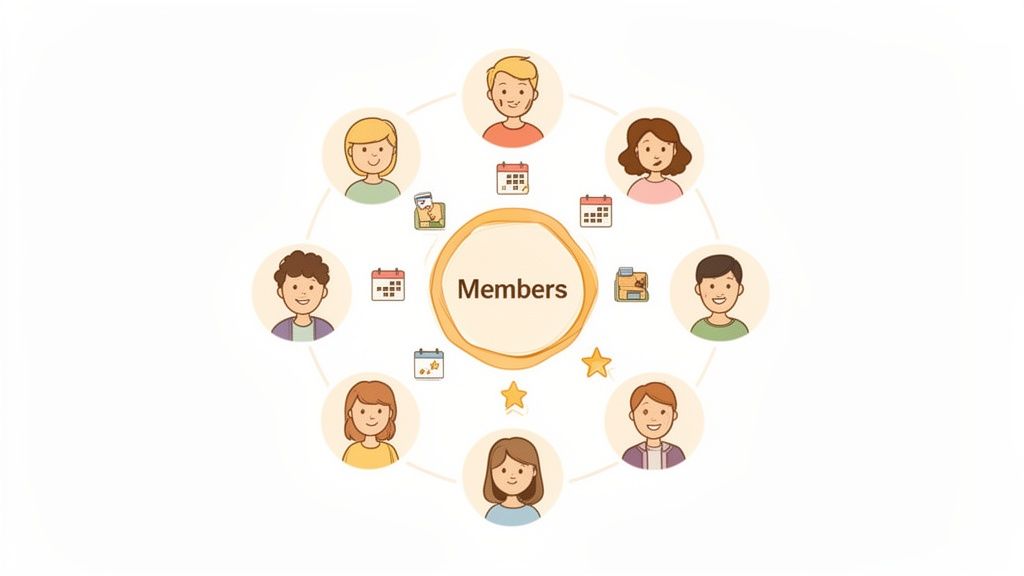
The membership model grants customers exclusive access to a community, premium content, or unique benefits in exchange for a recurring fee. As one of the most powerful subscription business model examples, it focuses on belonging and shared value rather than just a product. It's especially popular in the creator economy, professional networks, and niche interest groups. Platforms like Patreon and Substack have enabled individual creators to build sustainable revenue streams from their dedicated audiences.
Analysis & Key Metrics
Success in the membership model hinges on engagement and perceived value. The most critical metrics are Member Engagement Rate (how active users are), Churn Rate, and Member Lifetime Value (MLV). Unlike transactional models, the value proposition is often intangible, tied to community connection and exclusive access. Circle and Mighty Networks exemplify this by providing the infrastructure for creators to build, manage, and monetize vibrant, private communities. A healthy community model shows low churn and high engagement, indicating members find continuous value.
Strategic Insight: A successful membership model makes members feel like insiders. The value isn't just in the content you provide, but in the connections and status they gain by being part of the group.
Actionable Takeaways
- Create Exclusive, Gated Experiences: Offer content, events, or networking opportunities that are impossible to find elsewhere. This creates a strong incentive to subscribe and remain a member.
- Deliver Immediate Onboarding Value: Ensure new members feel welcomed and understand how to engage from day one. A strong onboarding process dramatically reduces early-stage churn.
- Foster Member-to-Member Interaction: Build features that encourage community-led discussions, like forums or live events. The network effect becomes a powerful retention tool.
- Implement a Referral Program: Reward existing members for bringing in new ones, for instance, by offering a free month of membership. This leverages your most engaged users as a growth engine.
9. Affiliate/Revenue-Share Subscription Model
The affiliate or revenue-share subscription model leverages partnerships to drive growth, rewarding external partners (affiliates) with recurring commissions for each customer they refer. Instead of a large upfront marketing spend, businesses pay a percentage of the subscription revenue for as long as the referred customer remains active. This turns a fixed acquisition cost into a variable one, perfectly aligning incentives between the business and its partners.
Analysis & Key Metrics
Pioneered in e-commerce by Amazon Associates and perfected in SaaS by companies like Shopify and Stripe, this model's health is measured by Partner Lifetime Value (PLV) and Channel Contribution (what percentage of new MRR comes from affiliates). The focus shifts from direct customer acquisition to partner enablement. For Refgrow, this is its core business model, offering tools for businesses to manage their own affiliate programs. A successful program depends on transparent tracking, reliable payouts, and a high-value product that partners are proud to promote.
Strategic Insight: Your partners are your most scalable sales team. Treat them as true business partners, not just lead sources. Providing them with dedicated resources, co-marketing materials, and a clear path to higher earnings will multiply their effectiveness.
Actionable Takeaways
- Establish Clear and Attractive Terms: Define a transparent, competitive commission structure (e.g., 20-30% recurring) and a reasonable cookie-life duration to attract high-quality partners.
- Equip Partners for Success: Provide a dedicated partner portal with marketing assets, tracking links, and performance dashboards. Real-time visibility builds trust and motivates partners.
- Tier Commissions to Incentivize Performance: Create tiers that reward top-performing affiliates with higher commission rates or bonuses, encouraging them to prioritize promoting your product.
- Simplify Partner Onboarding: Make the sign-up and approval process as frictionless as possible. Provide new partners with a welcome kit that explains how to get started and earn their first commission quickly. Delving into different revenue sharing models can help you find the perfect structure for your program.
10. White-Label/Reseller Subscription Model
The white-label or reseller model is one of the more advanced subscription business model examples, empowering agencies, partners, or marketplaces to sell your software under their own brand. Partners typically purchase access at a wholesale rate and then resell it at a retail price, bundling it with their own services. This model essentially outsources sales and marketing to a dedicated partner network, enabling rapid market penetration without direct overhead.
Analysis & Key Metrics
Popularized by platforms like HubSpot and Shopify, this model's success depends on empowering partners to succeed. Key metrics include Partner-Sourced Revenue, Partner Lifetime Value (LTV), and Channel Sales Velocity. Businesses must also track Partner Activation Rate (the percentage of signed partners who actively sell the product). High-performing programs, like Refgrow's enterprise tier, provide a fully re-brandable platform that agencies can embed into their client offerings, creating a seamless experience and a strong, scalable revenue channel for both parties.
Strategic Insight: A successful reseller model is built on mutual benefit. Your platform's growth is directly tied to your partners' ability to profit from it. Provide them with robust tools, dedicated support, and clear financial incentives to make selling your product an easy decision.
Actionable Takeaways
- Develop a Comprehensive Partner Kit: Provide partners with everything they need: API documentation, co-branded marketing materials, sales scripts, and dedicated support channels.
- Implement a Tiered Partner Program: Create levels (e.g., Silver, Gold, Platinum) with increasing benefits like higher margins, dedicated account managers, and marketing development funds (MDF) to incentivize performance.
- Establish Clear Onboarding and Certification: A structured onboarding process ensures partners understand your product's value and can sell it effectively. Certification programs build credibility and expertise.
- Invest in Co-Marketing Efforts: Support your top partners with joint webinars, case studies, and lead-sharing initiatives to drive mutual growth and strengthen the partnership.
Top 10 Subscription Model Comparison
| Model | Implementation complexity 🔄 | Resource requirements 💡 | Expected outcomes 📊⭐ | Ideal use cases ⚡ | Key advantages |
|---|---|---|---|---|---|
| SaaS Subscription Model (Software-as-a-Service) | 🔄 Medium — continuous updates, multi-tenant ops | 💡 Moderate–High — cloud infra, DevOps, support, integrations | 📊 Predictable MRR/ARR; ⭐ High LTV if retention is strong (churn risk) | ⚡ Scalable B2B/B2C apps, API-first platforms (e.g., Refgrow) | ⭐ Predictable revenue, easy rollouts, strong analytics |
| Freemium Model | 🔄 Low–Medium — feature gating and conversion funnels | 💡 Moderate — support & infra for many free users | 📊 High acquisition; ⭐ Revenue depends on free→paid conversion | ⚡ Product-led growth, developer tools, startups | ⭐ Low friction signups, viral growth potential |
| Tiered / Multi-Tier Pricing Model | 🔄 Medium — design & maintain clear tier boundaries | 💡 Moderate — billing, gating, support per tier | 📊 Captures segments; ⭐ Increases ARPU via upsells | ⚡ Businesses with diverse customer segments | ⭐ Maximizes revenue via price discrimination; clear upgrade paths |
| Usage-Based / Pay-As-You-Go | 🔄 High — accurate metering & complex billing logic | 💡 High — tracking, billing system, dashboards | 📊 Aligns cost-to-value; ⭐ High upside but MRR variable | ⚡ APIs, infra, transaction-heavy services (AWS, Stripe) | ⭐ Fair, scalable pricing; lowers entry barrier |
| Value-Based / Outcome-Based Pricing | 🔄 Very High — custom contracts, measurable outcomes | 💡 Very High — analytics, success teams, legal | 📊 Potentially very high revenue; ⭐ Strong vendor–customer alignment; variable MRR | ⚡ Enterprise customers where ROI is measurable | ⭐ Maximizes revenue from high-value customers; aligns incentives |
| Marketplace / Commission-Based | 🔄 Medium–High — transaction flows, disputes, compliance | 💡 High — payments, fraud prevention, two-sided acquisition | 📊 Scales with transactions; ⭐ Network effects drive growth | ⚡ Marketplaces, affiliate exchanges (Refgrow Referral Exchange) | ⭐ Aligns platform success with user activity; low entry friction |
| Enterprise / Custom Pricing | 🔄 Very High — bespoke integrations & procurement cycles | 💡 Very High — enterprise sales, PS, SLAs, support | 📊 Large ARR per deal; ⭐ Strong retention but slow ramp | ⚡ Large organizations needing customization & SLAs | ⭐ High LTV, premium positioning, deep customer lock-in |
| Membership / Community Subscription | 🔄 Medium — content cadence & community moderation | 💡 Moderate — content creators, community managers, events | 📊 Predictable recurring revenue; ⭐ High engagement & retention | ⚡ Creators, professional networks, membership-driven products | ⭐ Loyal community, low marginal cost per member |
| Affiliate / Revenue-Share Model | 🔄 Medium — tracking, payouts, partner management | 💡 Moderate — partner support, fraud controls, payout infra | 📊 Scales via partners; ⭐ Low CAC and recurring partner-driven revenue | ⚡ SaaS with partner channels, reseller networks (Refgrow core) | ⭐ Scalable acquisition via partners; aligns incentives |
| White-Label / Reseller Model | 🔄 High — rebranding, partner portals, billing flexibility | 💡 High — partner onboarding, custom integrations, support | 📊 Rapid channel growth potential; ⭐ Revenue via partner margins | ⚡ Agencies, resellers, platforms wanting branded solutions | ⭐ Fast channel expansion; leverage partner relationships |
Applying These Models to Your Business
We've explored a diverse landscape of ten powerful subscription business model examples, from the straightforward SaaS model of Adobe Creative Cloud to the community-centric approach of FounderPass. The common thread weaving through these successful companies is not just the adoption of a recurring revenue model, but the strategic selection and meticulous execution of one that perfectly aligns with their product, market, and customer value proposition.
The journey from a single transaction to a long-term customer relationship is the core of the subscription economy. This shift demands a deeper understanding of your user's journey, their evolving needs, and the specific value metrics they care about most. As we've seen, what works for a usage-based platform like AWS will not fit a tiered SaaS like HubSpot. The key is to move beyond simply copying a template and instead dissect the principles behind each model.
Key Takeaways and Strategic Synthesis
Your primary task now is to synthesize the insights from these examples and map them to your own business context. Consider the following strategic questions:
- Value Alignment: Does your pricing directly correlate with the value your customers receive? As demonstrated by the value-based model, aligning price with tangible outcomes can significantly boost customer acquisition and retention.
- Scalability and Flexibility: Can your chosen model grow with your customers? The tiered and usage-based models offer clear paths for customers to scale their investment as their needs expand, creating a frictionless upsell motion.
- Acquisition Flywheels: How can you turn your existing customers into your most effective acquisition channel? The freemium model excels at this by lowering the barrier to entry, while integrating referral and affiliate programs supercharges this effect across all models.
Mastering these concepts is no longer optional; it is fundamental to building a resilient, predictable, and scalable business. The subscription model is not a "set it and forget it" strategy. It requires continuous monitoring of key metrics like LTV, CAC, and Churn, along with a commitment to iterating on your pricing and packaging based on customer feedback and market dynamics.
Your Actionable Next Steps
The next phase is about experimentation and implementation. Start by identifying the two or three models from our list that most closely resonate with your product's core function and target audience. Develop a pilot program or a pricing experiment for a small segment of new users.
Crucially, from day one, embed mechanisms for growth. As you've seen, a native referral program is not an afterthought but a core growth lever. By integrating a tool that automates this process, you build a self-sustaining engine that rewards your best customers for spreading the word, effectively lowering your customer acquisition cost and accelerating your path to profitability. The most successful subscription businesses are not just built on great products; they are built on powerful, interconnected growth loops.
Ready to accelerate your subscription growth? Integrate a powerful, native referral and affiliate program in minutes with Refgrow. See how our seamless dashboard can help you build the growth loops discussed in these subscription business model examples and turn your loyal customers into your #1 acquisition channel. Get started with Refgrow today.