

Unpacking The Viral Marketing Definition for SaaS Growth

Viral marketing is a growth strategy where your product is designed to be its own best marketing channel, spreading from user to user like a digital wildfire. This isn't about luck; it's an intentional process of engineering your product so that each new user has a high probability of bringing in more users, creating a self-sustaining growth engine.
What Viral Marketing Actually Means for Your SaaS
Let’s be clear: for a SaaS business, "going viral" has nothing to do with a funny cat video or a trending meme. It’s a deliberate strategy that turns your existing users into your most powerful distribution network.
Think of it less like catching lightning in a bottle and more like building a really effective domino chain. You engineer the first domino—your product experience—to perfectly topple the next one, which is getting a user to invite someone else. The momentum builds from there.
The whole idea is that the very act of using your product becomes an act of sharing it. This creates a powerful network effect, where the product gets more valuable as more people join. Each new signup doesn't just represent one new user; it unlocks a gateway to their entire professional or social network, paving the way for exponential growth.
An Engineered Growth Engine
This fundamentally changes the customer acquisition game. Instead of pouring more money into ads to shout at potential customers, you build the acquisition channels directly into your product.
This could be a straightforward referral program, a collaboration feature that’s useless without a team, or any function where a user needs to invite others to unlock the product's full potential.
Viral marketing transforms your customers from passive consumers into active promoters. They don't just use your product; they become a critical part of its growth story, driving down your acquisition costs and building trust through authentic peer-to-peer recommendations.
To really see how this approach differs from the norm, it helps to put it side-by-side with conventional advertising.
Viral Marketing vs. Traditional Advertising at a Glance
Here’s a quick comparison of the fundamental differences between engineering virality and buying attention through conventional ads.
| Attribute | Viral Marketing | Traditional Advertising |
|---|---|---|
| Primary Channel | Users sharing with their network | Paid media (ads, TV, print) |
| Cost Structure | Low marginal cost per acquisition | High and scalable ad spend |
| Trust Factor | High (recommendations from peers) | Low to moderate (brand messages) |
| Scalability | Exponential and self-sustaining | Linear and budget-dependent |
As you can see, the two models operate on completely different principles. One relies on intrinsic product value and human connection, while the other depends on budget and media placement.
Understanding The Mechanics of Viral Growth
Viral marketing isn't some random stroke of luck; it's a predictable, measurable engine. This engine has two core components that work together to kickstart exponential growth: the viral coefficient and the viral loop. Once you get how these work, "going viral" shifts from a vague hope into an actual strategy you can build.
Think of it like a snowball rolling downhill. It starts small, but with every turn, it picks up more snow and gains momentum, growing bigger and faster all by itself. Viral loops are the turns, and the K-factor measures how much new snow it collects each time.
This chart does a great job of showing how the network-driven spread of viral marketing stacks up against the old-school broadcast model of traditional marketing.
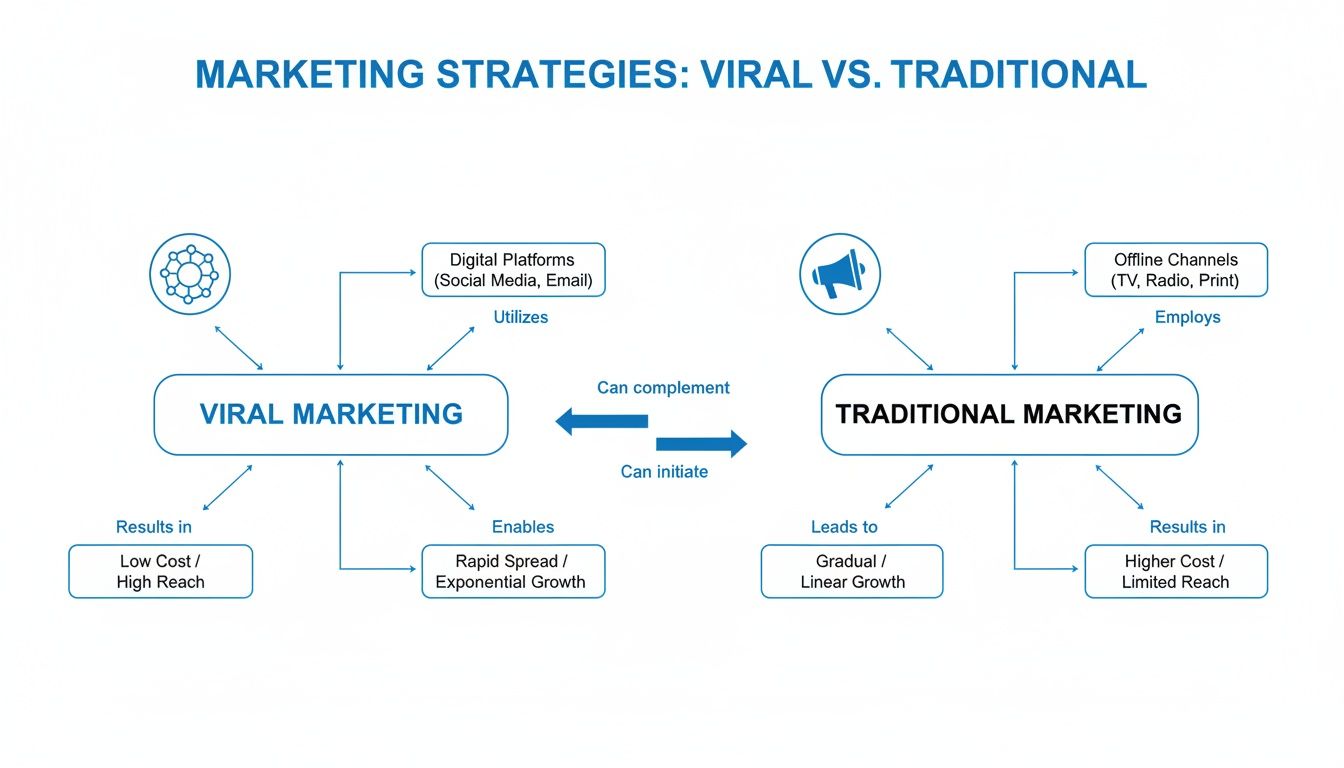
You can see how viral growth is self-perpetuating, relying on users to spread the word to other users. Traditional methods, on the other hand, need a constant push (and budget) to reach people one by one.
Decoding the K-Factor
The success of any viral push is measured by its K-factor, also known as the viral coefficient. It's a simple number that tells you how many new users each existing user brings in, on average.
The formula is straightforward but incredibly telling: K = i * c. In this equation, 'i' represents the number of invitations an average user sends out, and 'c' is the conversion rate of those invites.
Let's say each user invites 4 colleagues to their workspace (i=4) and 30% of those people actually sign up (c=0.3). Your K-factor would be 1.2.
A K-factor greater than 1.0 is the magic number. It means you’ve achieved true, self-sustaining virality. For every 10 customers you get, they'll bring in 12 more, all without you spending another dime on acquisition.
The Power of Viral Loops
If the K-factor is the what, the viral loop is the how. It’s the repeatable, step-by-step journey a user takes from first discovering your product to sharing it with others.
A classic viral loop for a SaaS product looks something like this:
- A new user signs up and has that "aha!" moment with a key feature.
- The product prompts or incentivizes them to share it (e.g., "Invite your team to collaborate on this project").
- Their invitation pulls a new person into the product.
- That new user starts the exact same journey, kicking off the loop all over again.
This is a carefully engineered process, which sets it apart from more organic, unstructured chatter. To see the difference more clearly, check out our guide on word-of-mouth marketing strategies.
Real-World Viral Success Stories from SaaS
It's one thing to talk about viral loops in theory, but seeing how they work in the wild really brings the concept to life. The most legendary examples of viral marketing weren't happy accidents; they were intentional, brilliantly engineered growth machines built right into the product.
Two of the best case studies come from SaaS pioneers: Dropbox and Hotmail. They both figured out how to attach a simple sharing mechanic to a core user action, creating a growth engine that just wouldn't quit. Their stories are a masterclass in how to build virality from the ground up.
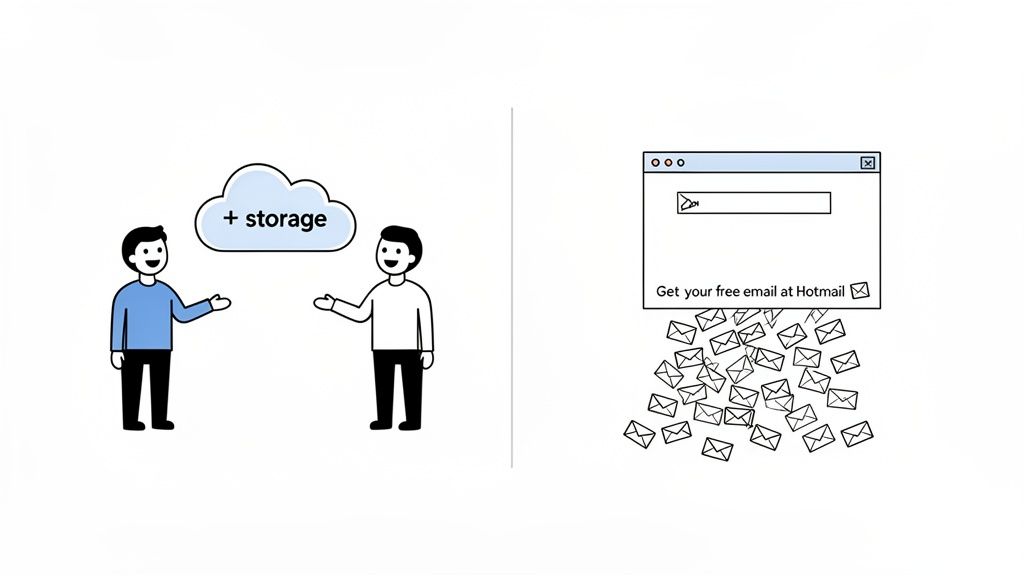
Hotmail: The Original Viral Loop
The term "viral marketing" actually came about in 1997 to describe what Hotmail was doing. The free email service added a simple, clickable signature to the bottom of every single email sent from its platform: "Get your free email at Hotmail."
That tiny line turned every user into a brand ambassador. Each email they sent became a product demo and a call to action, helping Hotmail explode to 12 million users in just a few years with virtually no ad budget. It was an elegant, self-perpetuating loop baked into the product's primary function.
Dropbox: Incentivizing The Core Value
Dropbox took a slightly different, but equally powerful, approach. They built a two-sided referral program that gave users exactly what they wanted most—more free storage. When you referred a friend who signed up, both of you got an extra 500MB of space.
This worked so well because the reward wasn't just some random perk; it was more of the product's core value. More storage makes Dropbox more useful, which gave users a powerful, selfish reason to invite everyone they knew.
This win-win setup fueled Dropbox’s explosive growth. It solved a real user need (more space) while driving customer acquisition at the same time. You can explore these and other brilliant campaigns in our collection of examples of viral advertising.
Measuring The Metrics That Actually Matter
To get a real grip on your viral marketing efforts, you have to look past the surface-level stuff. Likes and social shares are nice, but they don't tell you if you're actually growing. The goal is to build a growth engine that’s both measurable and sustainable.
The true story of your success is hidden in a handful of key performance indicators (KPIs) that act like a health check for your viral loop.
The Two Most Important Numbers
When it comes to viral growth, two metrics are king. The first is your Viral Coefficient (K-factor). This number tells you, on average, how many new users each existing user brings in. If it's greater than one, you've got exponential growth on your hands.
The second is Viral Cycle Time. This measures how long it takes for a user to invite someone else and for that new person to sign up. A shorter cycle is what separates a slow burn from a wildfire—it’s the secret to truly explosive growth.
Essential Viral Marketing KPIs for SaaS
To understand what’s driving your K-factor and cycle time, you need to track a few other key performance indicators. Tracking these KPIs will help you diagnose the health and impact of your viral growth engine.
| Metric | Definition | Why It Matters |
|---|---|---|
| Invitation Rate | The percentage of your active users who send out at least one invitation or share. | A low rate signals a problem. Maybe the incentive isn't strong enough, or the sharing process is too clunky and hard to find. |
| Conversion Rate | The percentage of invitations that successfully convert into new, active users. | This is a direct reflection of how compelling your product is to a brand-new audience. A high rate means your value prop is clear. |
| Customer Acquisition Cost (CAC) | The total cost of sales and marketing to acquire one new customer. | As your viral engine gets more efficient, your CAC should drop significantly because your users are doing the marketing for you. |
Each of these metrics provides a piece of the puzzle. A low invitation rate might mean you need to make sharing more visible in your product, while a poor conversion rate could point to a confusing onboarding flow for new users.
Ultimately, effective viral marketing isn't just about getting eyeballs; it's about driving down your Customer Acquisition Cost (CAC). As your viral engine gets better, you spend less to get each new customer. And as your campaigns take off, it's crucial to measure social media ROI to see the full picture.
True virality is measured by bottom-line conversions and user actions, not just views. Research shows that content driven by emotion and real value can get 3x more shares and have a 40% longer impact, even if the initial spike is brief.
How to Build a Viral Loop Into Your SaaS Product
Building a viral loop isn't about hoping for a lucky break. It's an intentional, engineered process designed to make your product itself the engine for growth. For SaaS teams, this means weaving sharing mechanics directly into the user's journey so it feels like a natural, valuable part of using the tool.
The whole process hinges on a few key moments, as you can see below.
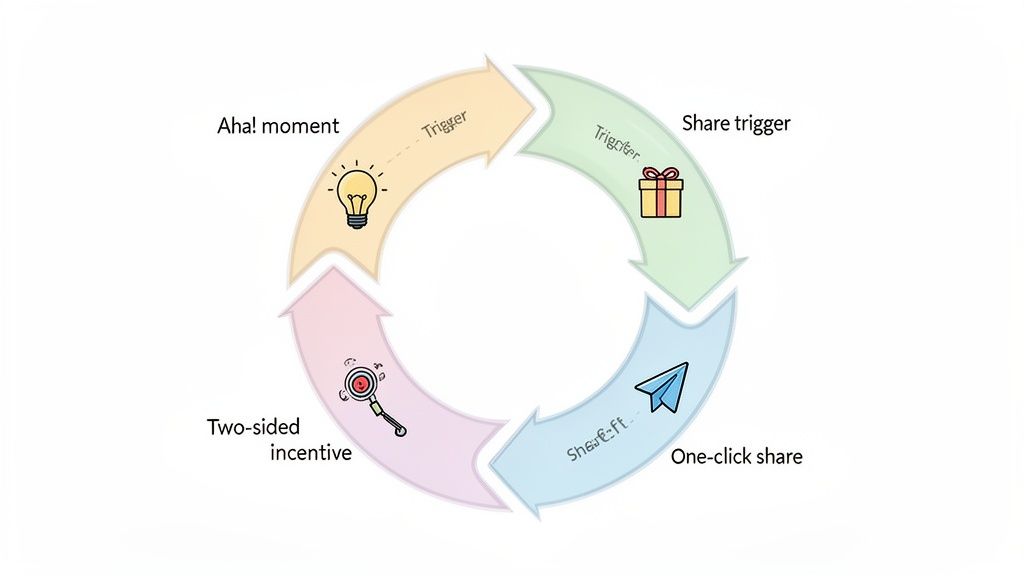
It all kicks off the second a user "gets" your product's value. From that point forward, your job is to make sharing as easy and rewarding as possible.
A Framework for Engineering Virality
An effective viral loop isn't just one feature; it’s a sequence of four key steps. Each one is designed to guide a user from that first moment of value discovery to actively bringing others on board.
- Pinpoint the 'Aha!' Moment: First, you have to know the exact point where a user truly grasps your product’s value. This is the peak of their excitement—and the perfect time to nudge them to share.
- Identify Natural Sharing Triggers: Look for logical places within your product's workflow to prompt a share. Does it make sense after they finish a major task? Or maybe when they use a feature that’s better with a teammate?
- Design a Compelling Incentive: The best rewards are two-sided, giving something to both the person sharing and their friend who signs up. This gives everyone a reason to follow through.
- Engineer a Frictionless Experience: Sharing has to be dead simple. If it takes more than a click or two, people just won't do it. Any little bit of friction will absolutely crush your invitation rate.
Now, building this framework from scratch can be a heavy lift, often tying up valuable engineering resources for months. But you don't always have to start from zero.
For most SaaS teams, especially those in the early stages, an embeddable referral solution is the fastest path to a powerful viral loop. These tools handle all the complex bits, like granular tracking and managing rewards, so you can focus on your product.
With a tool like Refgrow, for example, you can embed a complete affiliate dashboard right into your app with a single line of code. It effectively turns your product into a self-perpetuating growth machine. You can learn more about how to implement these viral marketing strategies in your own product.
Weighing The Benefits And Risks of Going Viral
Going after a viral strategy can feel like trying to bottle lightning. The rewards are huge, but you have to understand both the incredible upside and the potential downside before you jump in. When it works, engineering virality is like hitting the growth jackpot—it can fundamentally change your company's entire future.
The Upside: Explosive Growth and Unshakeable Trust
The most obvious win is a massive, nearly free explosion in growth. When every user you acquire brings in more than one new user, your Customer Acquisition Cost (CAC) basically drops to the floor. Your user base doesn't just grow; it grows exponentially. This isn't just about scoring some cheap signups; it's about building a self-sustaining engine for growth.
But it goes beyond the raw numbers. Viral growth builds brand credibility in a way paid ads can only dream of. Think about it: a recommendation from a friend you trust is infinitely more persuasive than any sponsored post you scroll past. This kind of peer-to-peer endorsement creates real, deep-seated trust and can help you carve out a huge piece of the market in a surprisingly short time.
The Other Side of the Coin: The Risks Involved
Of course, the path to virality is a tricky one. For starters, there are no guarantees. You can pour time and resources into a campaign that just doesn't catch on, and that can feel like a major setback.
More importantly, the very same mechanics that spread positive buzz can turn against you, amplifying negative feedback just as quickly. A nasty bug, a poorly timed email, or a clunky user experience can morph into a PR nightmare overnight if it gets caught in that same viral loop.
A sudden surge in users is both a blessing and a curse. It’s amazing validation for your product, but it can also hammer your servers, crash your app, and stretch your support team to its absolute breaking point if you aren't ready for that kind of scale.
The key to managing these risks is planning. You need to stress-test your infrastructure to make sure it can handle a huge wave of traffic and have a clear communication plan locked and loaded for any scenario. Being prepared is what allows you to ride the wave of success while protecting your brand from the potential fallout.
Common Questions About Viral Marketing
As you start digging into viral growth, a few questions always seem to pop up. Let's clear the air on some of the most common ones so your team can build a strategy that really moves the needle.
Is Viral Marketing Just Another Name For Word-of-Mouth?
Not quite, but they're definitely related. Think of it this way: word-of-mouth is when someone naturally tells a friend about your product because they love it. It's organic and unstructured.
Viral marketing is the deliberate act of building features into your product that encourage and accelerate that sharing. It’s the difference between hoping people talk and giving them an easy, rewarding way to do it. You're not just hoping for a breeze; you're building a sail to catch it.
Do Products Have to Be Free to Go Viral?
Absolutely not. While "free" definitely helps lower the barrier to sharing, plenty of paid SaaS products have achieved incredible viral growth. The secret is offering incentives that feel genuinely valuable and are tied directly to your product.
A few ideas that work well for paid products include:
- Account credits to lower a user's next subscription bill.
- Access to premium features or higher usage limits.
- Cash rewards for advocates who bring in new paying customers.
How Fast Can We Expect to See Results?
This all comes down to your Viral Cycle Time—the time it takes for a user to send an invite and for that new person to sign up.
If your cycle is fast—say, a user invites a teammate who signs up that same afternoon—you could see exponential growth in weeks. If the cycle takes months, your growth will be a slow, steady burn. The goal is always to shorten that loop and make the whole process as seamless as possible.
Ready to build a viral loop without tying up your dev team? Refgrow lets you embed a full-featured referral and affiliate dashboard directly into your app with just one line of code. Start your growth engine in minutes at refgrow.com.