

Your Guide to Building a Referral Tracking Program
At its core, a referral tracking program is simply a system that helps you manage and measure your word-of-mouth marketing. It turns your most enthusiastic customers into a genuine growth channel by giving them unique links or codes to share. When a new customer signs up using that link, the system automatically traces it back to the person who referred them, making sure they get the credit—and the reward—they deserve.
This creates a repeatable, predictable engine for bringing in new customers.
Unlocking Growth Through Referral Tracking

Imagine your happiest customers acting as your best salespeople. That's the real power behind referral marketing. But without a system to manage it, word-of-mouth is just a nice-to-have, an unpredictable trickle of new business. A referral tracking program is what turns that hope into a structured, measurable strategy.
Think of it like a digital breadcrumb trail. When a customer loves your product, the program gives them a special link to share. When their friend clicks that link and becomes a customer, the system automatically follows the trail back, connecting the new signup to the original advocate. This connection, known as attribution, is the engine that drives the whole thing.
The Core Components of a Referral Program
A referral program is more than just handing out links; it's a complete ecosystem built to handle the entire referral journey, from the initial share to the final reward. To see how these pieces fit together in the real world, it helps to look at something like a dedicated referral program, which usually brings these key elements to life.
The foundational pieces almost always include:
- Unique Identifiers: Each person in your program gets their own referral link or code. This is like their digital fingerprint, ensuring every referral they send your way is credited directly to them.
- Automated Attribution: The software instantly knows when a new customer signs up through a referral link. This gets rid of manual tracking, spreadsheets, and the human errors that come with them.
- Reward Management: The system takes care of the entire reward process. It tracks who is eligible and handles the payouts, whether you’re offering cash, account credits, or other perks.
This level of automation is what makes a modern referral program so effective. It does all the heavy lifting, ensuring the program is fair, trustworthy, and ready to grow right alongside your customer base.
Why Digital Tracking Matters More Than Ever
Today, almost every recommendation happens online, and that has completely changed the game. The importance of digital referral platforms skyrocketed by 65% between 2020 and 2025. Why the jump? It’s because automated attribution systems can boost revenue tracking accuracy by an incredible 84%.
This accuracy translates directly to better results, leading to 57% higher conversion rates and 73% better engagement. A well-built referral tracking program isn't just another marketing tactic anymore; it's essential infrastructure for building sustainable, customer-led growth.
Of course, here is the rewritten section with a more natural, human-written tone.
So, Why Bother Tracking Referrals? The Real Payoff
Putting a dedicated referral tracking program in place is about much more than just getting a few extra sign-ups. It's a strategic play to get better customers, and to get them more efficiently. Think of it this way: paid advertising can feel like you're shouting into a crowd, hoping someone listens. A referral program is more like a trusted friend making a personal introduction.
The secret sauce is the built-in trust. When a recommendation comes from someone you know, it cuts through all the marketing fluff. That introduction feels real, and it means new prospects walk through your door already believing you can help them.
This trust has a massive impact. It means you're not just getting more leads; you're getting higher-quality leads who already have a good feeling about your product and a solid idea of what it does.
Attract People Who Are Ready to Convert
The first thing you’ll notice with a referral program is the sheer quality of the leads. These aren't random people who clicked on an ad. They’re folks who were told, "You have to check this out," by someone they respect. That personal stamp of approval does a lot of the heavy lifting for you, shortening the journey from "who are you?" to "take my money."
Not only do these leads convert more easily, but they also tend to sign up faster. They come in with fewer doubts because their friend or colleague has already answered their biggest questions. For B2B companies that get this right, it’s not uncommon to see conversion rates jump by a staggering 71% compared to their other marketing efforts.
And this isn't just a B2B game. The numbers show that a solid referral tracking program pays off everywhere. Projections for 2025 show software and digital products hitting average referral rates of 6.2%, with the best programs pulling in an incredible 8-15%. The tracking part is what makes this work—it’s how you know who to thank, which is a big reason why 95% of US business leaders say referral leads are the best they can get. You can learn more about these referral marketing statistics and what they mean for your revenue.
Lower Your Acquisition Costs, Boost Your Lifetime Value
Let's be honest, one of the toughest parts of running a SaaS business is the Customer Acquisition Cost (CAC). Pouring money into search ads and social media can feel like a bottomless pit, with no real promise of a return. A referral program flips that script and gives you a much more cost-effective way to grow.
You're essentially turning your happy customers into your best marketing team. This creates a growth engine that doesn't depend on a constantly growing ad budget. The costs are tied directly to results—you only give out a reward when a new customer actually signs on. It’s predictable and it scales beautifully.
At the end of the day, the goal isn't just to get customers on the cheap. It's to get customers who stick around and become more valuable over time. And that's exactly what referred customers do.
This loyalty directly translates into a higher Customer Lifetime Value (LTV). Time and time again, the data shows that referred customers are less likely to churn and more likely to upgrade down the road. In fact, customers who come from a referral often deliver a 16% higher LTV.
It’s this one-two punch of a lower CAC and a higher LTV that makes a referral program more than just a "nice-to-have." It’s a core part of building a business that can grow sustainably for the long haul.
What Makes a Great Referral Program Tick?
Let's be honest, not all referral platforms are built the same. A basic setup might give you a few trackable links, but a truly high-performing program is a sophisticated growth engine for your SaaS. It’s built to cut out the friction, put workflows on autopilot, and deliver the deep insights you need to actually scale.
Think of it this way: you can cross a lake in a rowboat, or you can do it in a modern speedboat. Both get you to the other side, but one has a powerful motor, GPS, and real-time performance data. For a SaaS business, choosing the right features is what decides if your referral program just floats along or truly accelerates your growth.
The goal is to find features that make the whole process seamless for everyone involved—your team, your brand advocates, and the new customers they're bringing your way.
Effortless Sharing and Rock-Solid Attribution
The absolute bedrock of any successful program is making it ridiculously easy for people to share and for you to track their efforts accurately. This all starts with giving every single participant a unique identifier.
- Unique Links and Codes: Every advocate needs their own personal, shareable link or a simple code. This is their digital fingerprint, making sure every single click and sign-up is credited to them. No guesswork needed.
- One-Click Sharing: A great platform lets advocates share their link wherever they live online—email, social media, Slack, you name it—with a single click. Pre-written messages are a huge plus, as they remove the "what should I say?" barrier.
If sharing feels like a chore, even your biggest fans won't do it. Getting this first step right is non-negotiable.
It's not always about the cash. One study found that non-cash incentives can be 24% more effective. For SaaS, this is gold—offering product credits or early access to premium features ties the reward directly back to the value you provide.
Real-Time Dashboards: Your Mission Control
You can't improve what you don't measure. A high-performing referral program gives you a central dashboard where you can see the health of your entire program at a glance. It’s your command center for word-of-mouth growth.
This dashboard needs to give you a crystal-clear view of your key performance indicators (KPIs). You should be able to instantly see what’s working and what’s falling flat. Look for the ability to track metrics like how many people are participating, how often they share, click-through rates, and, of course, the all-important conversion rate.
The best systems take it a step further, showing you exactly who your top-performing advocates are and which channels are driving the most sign-ups. That’s how you find your champions and double down on the strategies that actually move the needle.
Automated Rewards That Just Work
Manually managing reward payouts is a nightmare waiting to happen. It’s slow, prone to errors, and one of the fastest ways to kill the trust your advocates have in you. For any SaaS business that wants to scale, automation here is a must-have. A solid system should handle the entire reward lifecycle without anyone on your team lifting a finger.
But it's not just about automation; it's also about flexibility. The best platforms let you choose how to reward people:
- Cash Payouts: Simple and effective. Direct deposits or gift cards are a tangible thank you.
- Account Credits: A brilliant way to get users more deeply invested in your product.
- Tiered Rewards: Incentives that get better as an advocate refers more people. This gamifies the experience and encourages them to keep going.
When advocates get paid correctly and on time, every time, they stay motivated. It’s that simple.
Now, let's pull these core components together. When you're evaluating a referral tracking solution, certain features are non-negotiable for driving sustainable, scalable growth in a SaaS environment.
Essential Features of a Modern Referral Tracking Program
| Feature | Why It's Critical for SaaS | Impact on Growth |
|---|---|---|
| Unique Referral Links & Codes | Ensures every referral is accurately tracked back to the source. Eliminates disputes and builds trust with advocates. | Increases advocate confidence and participation, leading to more reliable referral data and higher conversion volumes. |
| Omnichannel Sharing | Empowers users to share on their preferred platforms (social, email, messaging) with a single click. Reduces friction. | Dramatically increases the reach and share rate of your program, exposing your brand to new, highly-relevant audiences. |
| Real-Time Analytics Dashboard | Provides immediate visibility into KPIs like shares, clicks, and conversions. Enables data-driven optimization. | Allows for quick strategy pivots and identification of top performers, accelerating program ROI and overall growth. |
| Automated Reward Payouts | Removes manual workload, prevents errors, and ensures timely rewards. Builds a reliable and trustworthy program. | Boosts advocate morale and long-term engagement, creating a sustainable cycle of referrals. |
| Flexible Reward Structures | Supports various incentives (cash, credits, tiers) to match user motivation and business goals. | Increases the appeal of the program to a wider range of users, maximizing participation and referral quality. |
| Native In-App Integration | Creates a seamless, branded experience by embedding the program directly within your product. Avoids clunky third-party portals. | Enhances user experience and adoption rates, making the referral program a natural part of the customer journey. |
Ultimately, these features work together to create a program that feels effortless for your users and delivers powerful, measurable results for your business.
Seamless In-App Integrations
For product-led SaaS teams, the user experience is everything. Nothing kills the vibe faster than a clunky, third-party portal that forces users out of your application. It feels disjointed and unprofessional. This is where native, in-app integrations become a game-changer.
Modern solutions, like those from Refgrow, let you embed the entire referral experience directly into your own product’s UI. This creates a cohesive, branded experience that feels like it truly belongs there. With solid API access, your engineering team can build custom workflows, sync referral data with other tools in your stack (like your CRM), and maintain complete control over the program's look and feel.
Key Metrics to Measure Program Success
Launching a referral program without tracking its performance is like driving blind. You might be moving, but you have no idea if you're actually getting anywhere. Real success isn't just about a handful of new sign-ups; it's about understanding the entire journey, from the moment a link is shared to when a new, loyal customer comes on board.
Think of your metrics as the dashboard for your growth engine. Each number tells a piece of the story, showing you where the program is humming along and where it needs a tune-up. By tracking the right data, you can stop guessing and start making smart decisions that fuel real, sustainable growth.
This entire flow—from giving advocates their links to analyzing the results and sending out rewards—is the operational heart of your program.
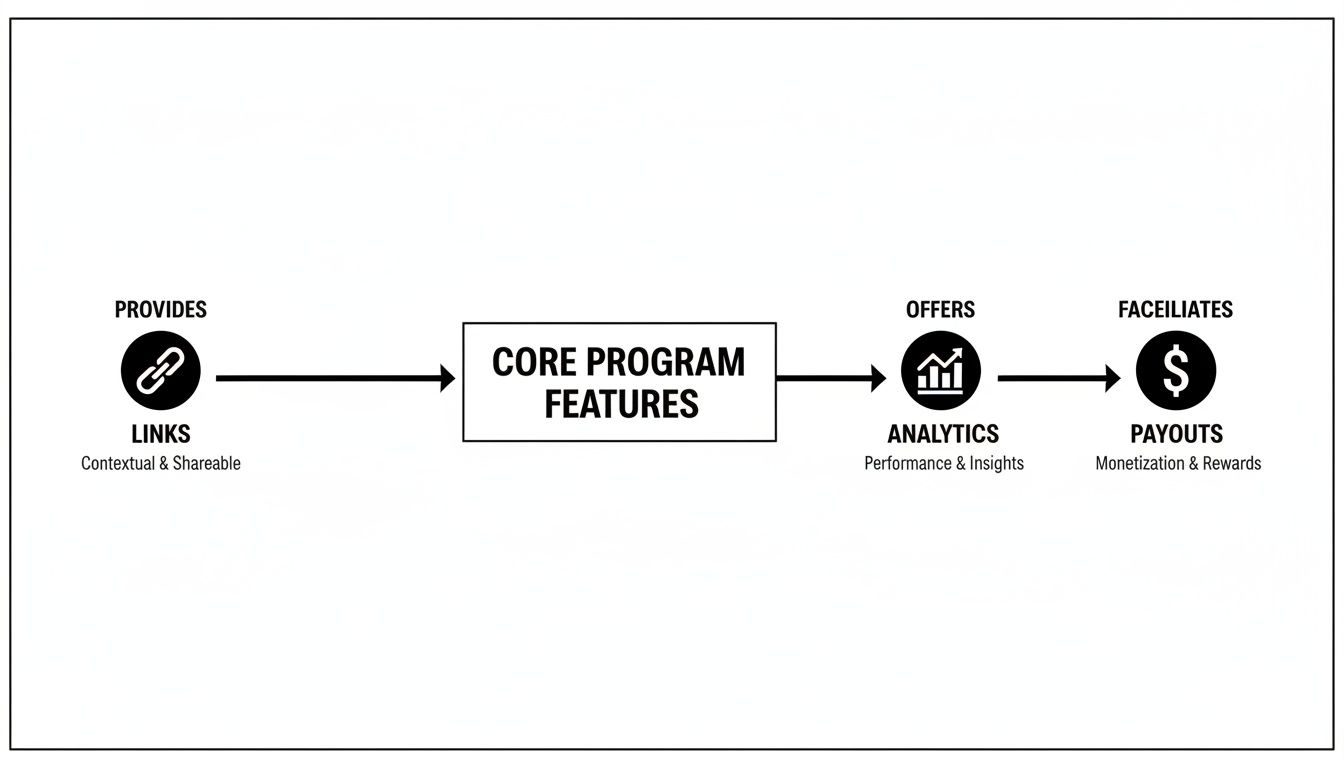
As you can see, a well-oiled referral program is a system, moving methodically from arming your fans with unique links to tracking their impact and automating payouts.
Are People Actually Participating?
First things first: you need to know if you're engaging your current users. Are they even aware of your referral program, and more importantly, do they care enough to join in? This is where the initial momentum comes from.
Participation Rate: This is simply the percentage of your users who have signed up to be an advocate. If this number is low, it’s a big red flag that you might have a promotion problem. People can't join a program they don’t know exists.
Share Rate: Of the people who signed up, what percentage are actually sharing their referral link? This metric gets straight to the point—it tells you how appealing your program is and whether your incentives are hitting the mark.
A low share rate often means one of two things: your rewards aren't compelling, or the sharing process is a pain. Making it dead simple with one-click sharing options can make a world of difference here.
From Clicks to Customers: Is It Working?
Once your advocates start sharing, the focus shifts. Are those shares actually driving new traffic and, ultimately, new customers? These metrics are all about the middle of your funnel, where curiosity turns into action.
Click-Through Rate (CTR): This shows how many people are clicking on the shared referral links. A healthy CTR is a great sign that your advocates are sharing with the right audience and that their recommendations carry some serious weight.
Conversion Rate: This is the big one. It’s the percentage of those clicks that turn into what you want—a new trial, a paid subscription, you name it. A high conversion rate is the ultimate proof that your program is delivering real value.
Tracking these numbers is what separates a world-class referral program from one that’s just taking up space. For a deeper look at these KPIs, our guide on essential referral program metrics is a great resource to help you dial in your own strategy.
Tracking Your Way to Success: Key Referral Metrics
To truly understand your program's health, you need to look at a few core metrics together. The table below breaks down the most important numbers, what they tell you, and why they're so critical for measuring your return on investment.
| Metric | What It Measures | Why It Matters | Industry Benchmark (SaaS) |
|---|---|---|---|
| Participation Rate | % of total users who join the program. | Shows program awareness and initial appeal. | 5-15% |
| Share Rate | % of participants who share their link. | Measures advocate motivation and ease of sharing. | 20-40% |
| Click-Through Rate | % of shared links that get clicked. | Indicates the quality of advocate shares. | 10-20% |
| Conversion Rate | % of clicks that result in a new customer. | The ultimate measure of program effectiveness. | 2-5% |
| Customer LTV | Lifetime value of referred customers. | Gauges the quality of customers acquired. | 16%+ higher than other channels |
| Customer Acquisition Cost | The cost to acquire one new customer. | Measures financial efficiency and profitability. | Should be lower than paid channels |
By keeping an eye on these figures, you can quickly spot what’s working and what isn't, allowing you to fine-tune your program for maximum impact.
What's the Real Business Impact?
Finally, let's connect the dots to your bottom line. It's not just about getting more customers; it's about getting the right customers who stick around and contribute to long-term growth.
The single most important metric here is the Customer Lifetime Value (LTV) of referred users versus customers from other channels. Time and time again, studies show that referred customers have a higher LTV—often by 16% or more. They're typically more loyal, less likely to churn, and get more value out of your product right from the start.
On top of that, you need to track your Customer Acquisition Cost (CAC) for the referral channel. In almost every case, it will be dramatically lower than paid ads because your main cost is the reward you give out after a successful conversion. A low CAC combined with a high LTV? That’s the magic formula for profitable, efficient growth.
Best Practices for a Successful Launch
Getting your referral program off the ground is a big deal, but a successful launch isn't as simple as flipping a switch. You have to lay the groundwork first. A smooth, well-planned rollout can be the difference between a few new signups and a growth engine that runs itself.
The goal here is to make your program impossible to miss, easy to understand, and too good not to share. Your happiest customers are your best advocates, so the first order of business is getting them excited and involved from day one.

Design Rewards That Truly Resonate
First things first: you need an incentive that actually motivates your users. Cash is always an option, but it’s not always the most powerful one. For a SaaS product, a reward that improves a customer's experience with your tool can be much more compelling.
Think about offering rewards like:
- Account Credits: This is a fantastic choice because it directly encourages customers to stick around and use your product more, which is a huge win for retention.
- Feature Upgrades: Giving referrers access to a premium feature or a higher subscription tier is a high-value reward that costs you very little.
- Extended Trials: A free month of service is simple, tangible, and universally appealing.
The real trick is to tie the reward back to the value of your product. This creates a neat little loop: advocating for your product makes the product itself even better for the person doing the advocating.
Make Sharing Absolutely Effortless
Even your most loyal customers won't bother referring people if it's a hassle. If the process is clunky or confusing, you’ve lost them. Your referral interface needs to be clean and intuitive, with obvious calls-to-action that let users share in just a few clicks.
One of the best ways to reduce friction is to provide pre-populated sharing messages. These ready-made templates for email and social media posts take the guesswork out of it. All a user has to do is copy and paste, which dramatically increases the chances they'll actually do it.
We know from over 3.1 million business leaders that 32% believe brand trust is the key to getting referrals. At the same time, 41% say that simply having better tracking would be a game-changer for them. Modern platforms solve this by automating the grunt work, which has been shown to boost accuracy by 84% and drive 57% more conversions. For a deeper dive, you can explore the complete market data.
Promote Your Program Relentlessly
People can't join a program they don't know exists. You have to shout it from the rooftops. Don’t just build it and hope they come—tell your users about the program, and then tell them again.
Your promotion plan should include a few key moves:
- A Launch Announcement Email: Draft a dedicated email to your entire user base. Explain how the program works, what's in it for them, and include a clear link to get started.
- In-App Notifications: Use banners, tooltips, or pop-ups inside your app to catch people’s attention while they’re already engaged.
- A Permanent Home: Make sure there’s a permanent, easy-to-find link to the referral program in the user dashboard, main navigation, or account settings.
By weaving your program into the fabric of the user experience, you ensure it stays top of mind. For more great ideas, take a look at our complete guide on referral program best practices. Consistent promotion is what turns a strong launch into lasting momentum.
Choosing the Right Referral Tracking Solution
Getting your referral strategy right is one thing, but bringing it to life with the right tool is a whole different ballgame. The software you pick is the final, crucial piece of the puzzle, and it has a massive impact on your user experience, brand consistency, and whether your program can actually grow with you.
The market is flooded with options, but for most SaaS teams, the decision boils down to one fundamental choice: do you go with a traditional third-party platform or a modern, embeddable solution?
Traditional platforms usually live outside your app. They force your customers to click away to a separate, externally branded portal just to grab a link or check their status. It works, sure, but it’s a clunky, disjointed experience that creates friction and can weaken the brand you've worked so hard to build.
Modern tools, on the other hand, are designed to live directly inside your product. They provide a seamless, in-app experience that feels like it’s always been there—a natural extension of your platform. For any product-led company, where user experience is everything, this is a non-negotiable.
The Power of Native Integration
When you embed your referral program directly into your product, you unlock some serious advantages that lead to more people participating and better overall results. Having the referral dashboard right there in your native UI makes it instantly accessible and trustworthy.
Here’s what that really means for you:
- Reduced User Friction: Your customers can generate links, track their progress, and see rewards without ever having to leave your app. This convenience alone is a huge driver of engagement.
- Enhanced Brand Consistency: The entire referral experience matches your product’s look and feel. This reinforces your brand identity instead of advertising someone else's.
- Deeper Stack Integration: Native solutions are built to connect deeply with the tools you already use, from your payment processor to your CRM.
This kind of tight integration elevates your referral program from a simple marketing tactic to a core part of your product's growth engine.
Advanced Capabilities for Scaling Growth
As your SaaS business takes off, your referral program has to keep up. A simple link generator just won’t cut it for long. Ambitious growth teams need advanced features to manage complex campaigns, automate payouts, and get real, actionable data.
Your referral tool shouldn't just track clicks; it should empower your entire growth strategy. The right solution provides the flexibility to build custom workflows and the automation to execute them flawlessly, freeing up your team to focus on optimization instead of administration.
When you’re looking at different tools, keep an eye out for features built for scale. Things like API access for custom integrations, mass payout automation to handle rewards for hundreds or thousands of advocates, and granular tracking parameters are essential. These are the features that give you deep insights into what’s actually working. For a more detailed breakdown, exploring the different types of referral tracking software can help you put together a solid checklist.
In the end, choosing the right solution isn't just about ticking off a list of features. It's about investing in the infrastructure that will support your growth for years to come. By prioritizing a seamless, in-app experience and powerful, scalable capabilities, you can build a world-class referral program that becomes a reliable engine for acquiring new customers.
Answering Your Top Referral Program Questions
So, you're considering a referral program. That's a smart move. But even the best ideas come with a few lingering questions. It's completely normal—a referral program has a lot of moving parts, and it pays to get the details sorted out before you commit.
Let's walk through some of the most common questions we hear from SaaS teams. Think of this as your final checklist before launch, making sure everyone is on the same page and ready to go.
Referral vs. Affiliate Programs: What's the Real Difference?
This one comes up all the time. On the surface, they seem similar, but their core relationship is totally different.
A referral program is all about tapping into your existing customer base. It’s built on genuine trust and personal relationships. You're encouraging happy users to tell their friends, colleagues, and connections about your product—people they actually know. It’s an organic, word-of-mouth engine.
An affiliate program, on the other hand, is more of a business partnership. It’s for professional marketers, content creators, or influencers who promote your product to their wider audience. The relationship is transactional and built on performance metrics and reach. The good news? Modern tracking tools are flexible enough to handle both, so you can bring customers and professional partners under one roof.
How Much Should We Actually Pay for a Referral?
Figuring out the right reward amount can feel like a guessing game, but it doesn't have to be. There’s no magic number, but a little back-of-the-napkin math will get you close.
Start by looking at your Customer Lifetime Value (LTV) and your average Customer Acquisition Cost (CAC). Your reward needs to hit that sweet spot: attractive enough to get people to act, but low enough that you’re still profitable. A simple rule of thumb is to keep the reward well below your LTV.
For SaaS companies, we see a few popular models that work really well:
- A simple, one-time cash bonus when a referral converts.
- Recurring commission, like 20% of the new customer's subscription fee for the first year.
- Product-based incentives, such as account credits or a free upgrade to a higher plan.
Don't just default to cash. The best reward often ties back to your product and what your specific users value most.
It's easy to think cash is king, but that’s not always the case. In fact, studies show non-cash rewards can be up to 24% more effective. Why? Because they tie the incentive directly back to your product's value, which helps build even more loyalty.
When Will We Start Seeing Results?
Everyone wants to know how long it takes to see a return. While you might get your first few referrals within days of launching, a referral program is a long game. It builds momentum over time.
Think of it like planting a tree, not flipping a switch. The first 1-3 months are all about getting the word out, learning from the initial data, and tweaking your approach. You should start seeing a more predictable, steady flow of new customers after about 3-6 months as awareness spreads and those network effects start to kick in. The more you promote it, the faster you'll get there.
Can We Just Track This on a Spreadsheet?
Technically, yes. But for any company that's serious about growing, it’s a genuinely bad idea.
Trying to manage referrals manually with spreadsheets is a recipe for disaster. It's an enormous time-sink and incredibly error-prone. You'll inevitably run into disputes over who referred whom, which erodes trust with your biggest advocates. And forget about scaling—it’s just not possible.
Dedicated referral tracking software takes all of that off your plate. It automates everything from generating unique links to tracking conversions and handling payouts. This keeps things accurate, transparent, and frees up your team to focus on growing the business, not updating cells in a spreadsheet.
Ready to turn your happiest customers into your most powerful growth engine? With Refgrow, you can launch a fully native, in-app referral program in minutes. Stop wrestling with spreadsheets and clunky third-party portals. Start building your referral program today.