

10 Actionable Ideas for Referral Programs That Drive SaaS Growth in 2026
In the competitive SaaS landscape, relying on paid ads and content alone is no longer enough. The most successful companies build self-sustaining growth engines, and at the heart of these engines lies a powerful, often underutilized, channel: referral marketing. But generic, 'share this link' programs barely scratch the surface of what's possible. True growth comes from strategic, well-designed referral systems that are deeply integrated into the product experience and cater to the specific motivations of your users, partners, and creators.
This guide moves beyond the obvious. We're not just talking about giving away a $10 gift card. We're diving into ten sophisticated and actionable ideas for referral programs, specifically tailored for the modern SaaS business. From native in-app dashboards that eliminate friction to developer ecosystems that build an army of advocates, you'll discover how to transform referrals from a passive tactic into your most effective acquisition channel.
Each idea is broken down with clear, practical steps and real-world examples to show you what works. You will learn how to implement advanced strategies like:
- Tiered commission structures that incentivize top performers.
- Freemium-to-paid upgrade models that turn free users into a sales force.
- Community-driven programs that leverage user-generated content.
- API and developer ecosystems that create powerful partner-led growth.
We’ll also provide a clear look at how platforms like Refgrow can help you launch these powerful growth loops in minutes, not months. This comprehensive roundup is designed to give you the specific blueprints you need to build a referral program that actually drives meaningful revenue and sustainable user acquisition.
1. The High-Performer's Choice: Tiered Commission Structures
Standard flat-rate referral programs treat every partner the same, which can demotivate your most effective advocates. Tiered commission structures solve this by creating a dynamic, performance-based reward system. This model moves beyond a one-size-fits-all approach, actively encouraging affiliates to drive more sign-ups by increasing their rewards as they hit specific milestones.
Instead of a static 20% commission for every referral, a tiered system creates a path for growth. For example, a referrer might earn 15% for their first 10 referrals, 20% for referrals 11-25, and a highly motivating 30% for any customer they bring in beyond that. This gamified progression transforms casual sharers into dedicated, high-value partners who are invested in your platform's success.
This is one of the most powerful ideas for referral programs because it directly rewards loyalty and impact, making it ideal for SaaS companies focused on sustainable, high-quality growth.
How to Implement It
- Automate Thresholds: Manually tracking tiers is an operational nightmare. Use an embeddable referral platform like Refgrow to configure and automate tier thresholds and commission payouts without writing any custom code. This ensures partners are paid correctly and on time as they level up.
- Visualize Progress: A key to engagement is showing partners how close they are to the next reward tier. Implement a visual progress bar or milestone tracker directly in their affiliate dashboard. This visual feedback loop serves as a constant motivator.
- Introduce Velocity Tiers: To encourage consistent performance rather than sporadic bursts, consider time-based tiers. For instance, offer a bonus commission for affiliates who bring in more than 10 referrals within a single month.
- Mix in Non-Monetary Perks: At higher tiers, reward top partners with exclusive benefits that build a stronger relationship. Offer them early access to new features, dedicated support channels, or co-marketing opportunities like a joint webinar or blog post. This makes them feel like true partners, not just another number.
2. Native In-App Referral Dashboards
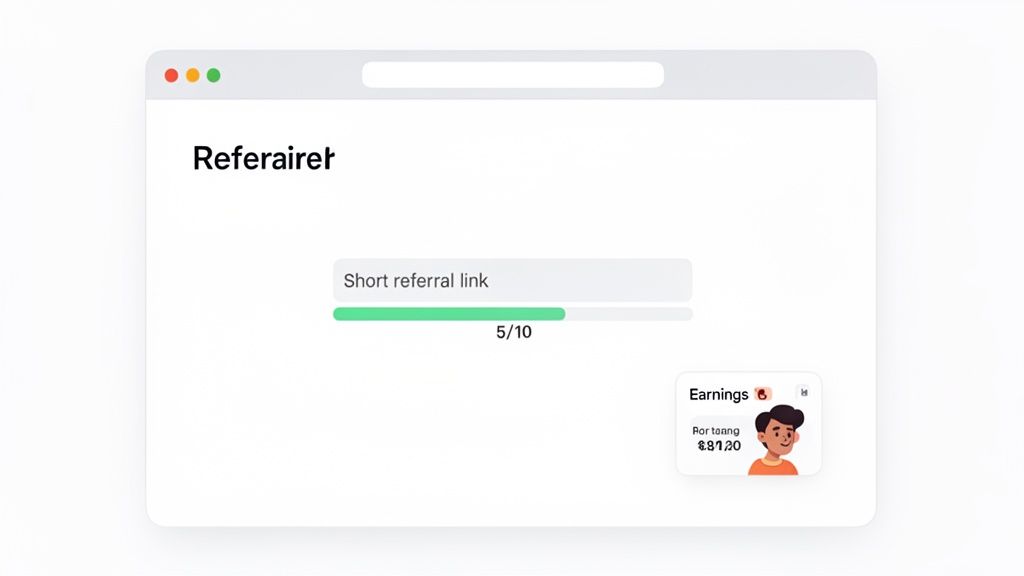
Forcing users to a separate, third-party portal to manage referrals introduces unnecessary friction and leads to program abandonment. Native in-app referral dashboards solve this by embedding the entire referral experience directly within your product. This allows engaged users to generate links, track clicks and conversions, and view earnings without ever leaving your application's ecosystem.
This seamless integration transforms your referral program from a disjointed marketing channel into a core product feature. By meeting users where they already are, you dramatically increase adoption and participation rates. This approach is especially powerful for product-led growth (PLG) companies where user engagement within the app is the primary driver of expansion, as seen in platforms like Figma and Zapier.
This is one of the most effective ideas for referral programs because it leverages existing user habits and high-intent moments, turning your most active customers into your most effective advocates with minimal effort.
How to Implement It
- Embed with a Single Line of Code: Use a tool like Refgrow to embed a fully functional and customizable referral dashboard directly into your app. This eliminates the need for complex API integrations or building a system from scratch, allowing you to launch in hours, not weeks.
- Optimize Dashboard Placement: Don't bury the referral program. Place a link to the dashboard in high-traffic, intuitive areas of your UI, such as the main navigation sidebar, the user account menu, or the settings page. A/B test different placements to find what drives the most engagement.
- Provide Pre-Made Assets: Reduce the cognitive load for referrers by providing copy-paste-ready messages for social media, email, and direct messaging. Include branded, short URLs that are easy to share and track.
- Use Contextual Prompts: Trigger non-intrusive pop-ups or notifications that guide users to their referral dashboard after they complete a positive action, like upgrading their plan or achieving a key milestone. This prompts them to share when they are most satisfied with your product.
3. Affiliate Network Marketplaces (Referral Exchange)
Building a network of high-quality affiliates from scratch is a slow, manual grind. Affiliate network marketplaces, or referral exchanges, solve this by plugging your SaaS directly into a pre-vetted ecosystem of active promoters, content creators, and influencers who are already looking for great products to share with their audiences. This model accelerates partner acquisition exponentially, skipping the painful cold outreach phase.
Instead of hunting for partners one by one, you list your program in a marketplace where established creators can discover and apply to promote you. This instantly exposes your brand to relevant audiences you might never have reached otherwise. Think of it as a talent agency for affiliates, where platforms like ConvertKit and Typeform have successfully leveraged creator networks to drive massive, consistent referral volume from trusted sources.
This is one of the most scalable ideas for referral programs because it turns partner acquisition into an inbound motion, letting you tap into established trust and distribution channels from day one.
How to Implement It
- Define Your Ideal Partner: Before joining a marketplace, clearly articulate your target customer persona. This helps the network match you with affiliates whose audiences align perfectly with your product, ensuring higher conversion rates and better-fit customers.
- Provide a Turnkey Asset Kit: Top creators are busy and have many options. Make it incredibly easy for them to promote you by providing a comprehensive asset kit upfront. Include brand guidelines, pre-written copy for different channels, high-quality visuals, and talking points.
- Be Responsive and Build Relationships: The best affiliates want to work with partners who are engaged. Respond to inquiries and applications quickly. Once they’re on board, treat them like true partners, not just lead sources. Offer support and be open to collaboration.
- Use Marketplace Analytics for Optimization: Leverage the data from the marketplace to understand which types of creators drive the best results. Analyze performance by channel (blog, YouTube, newsletter) to identify your most valuable partner profiles and double down on recruiting similar affiliates.
4. Performance-Based Bonus Incentives
While tiered commissions reward long-term performance, bonus incentives inject short-term urgency and excitement into your program. This supplementary reward system offers one-time bonuses when partners hit specific milestones within a set timeframe, like a $500 bonus for driving 10 paid sign-ups in a single month or a quarterly prize for the top-performing affiliate.
These time-limited challenges create spikes in referral activity by motivating partners to focus their promotional efforts. Instead of a steady trickle of referrals, bonuses encourage concentrated campaigns. For example, a SaaS company could launch a bonus campaign to accelerate sign-ups for a new feature, or a platform like Calendly could run a quarterly "super referrer" competition to re-engage its partner base and drive a surge in new users.
This is one of the most effective ideas for referral programs when you need to hit specific, time-sensitive growth targets, as it aligns affiliate motivation directly with your immediate business objectives.
How to Implement It
- Set Achievable Thresholds: The goal is to motivate, not discourage. Design bonus targets that are challenging but attainable for a meaningful portion of your partners, typically aiming for 20-40% to qualify. This creates a sense of healthy competition and broad participation.
- Communicate and Create Urgency: Announce bonus campaigns with at least two to three weeks of lead time so partners can plan their promotions. Use countdown timers in dashboards and regular email updates to build excitement and reinforce the deadline.
- Visualize the Goal: Just like with tiered structures, a visual progress bar showing affiliates how close they are to hitting the bonus target is a powerful motivator. This tangible feedback keeps the incentive top-of-mind and encourages a final push as the deadline nears.
- Align Bonuses with Business Goals: Tie incentives directly to your company's priorities. Want to drive mobile adoption like Dropbox did? Offer a bonus for mobile app installs. Launching a new enterprise plan? Create a larger bonus specifically for referring enterprise-level customers.
5. Co-Marketing and Content Partnership Programs
Standard referral programs often treat partners as passive link-sharers, limiting their potential impact. A co-marketing partnership program transforms this dynamic, turning affiliates into active collaborators who co-create high-value content. This model moves beyond simple promotion, focusing on joint webinars, detailed case studies, insightful whitepapers, or in-depth comparison guides that provide tangible value to both audiences.
Instead of just sharing a link, a partner might co-host a webinar with your team, sharing their expertise and driving sign-ups from a highly engaged audience. For example, a marketing automation platform like Pardot might collaborate with a top sales consultant on a research report, generating qualified leads for both parties. This approach builds deeper relationships and produces evergreen content assets that fuel your broader marketing funnel.
This is one of the more strategic ideas for referral programs because it aligns your brand with respected industry voices, yielding higher-quality leads and building long-term authority. It's especially effective for B2B SaaS companies targeting professionals who rely on educational content to make purchasing decisions.
How to Implement It
- Develop Co-Marketing Kits: Create clear guidelines, templates, and brand assets to streamline collaboration. Provide partners with pre-made slide decks for webinars, interview question templates for case studies, and co-branded landing page designs to ensure consistency and make participation easy.
- Start with Pilot Partners: Before scaling, identify 1-2 of your most engaged and successful affiliates to test the co-marketing model. Use these pilot campaigns to refine your process, gather feedback, and create powerful success stories to attract other high-value partners.
- Track Co-Marketing ROI: Use dedicated UTM parameters, unique landing pages, and specific referral codes for each co-marketing initiative. This allows you to accurately measure the ROI of each campaign and identify which partners and content formats drive the best results.
- Reward Beyond Referrals: To incentivize these deeper partnerships, consider offering a revenue share on all leads generated from a co-marketing campaign, not just direct sign-ups. You can also feature top partners prominently on your website, in newsletters, or in testimonials, providing them with valuable brand exposure.
6. Community and User-Generated Referral Programs
Instead of relying solely on formal affiliates, this approach leverages your most authentic asset: your existing user community. Community-driven referral programs turn satisfied customers into genuine brand evangelists by making it easy and rewarding for them to invite peers. This grassroots strategy is incredibly effective for product-led growth companies where users already love and advocate for the product organically.
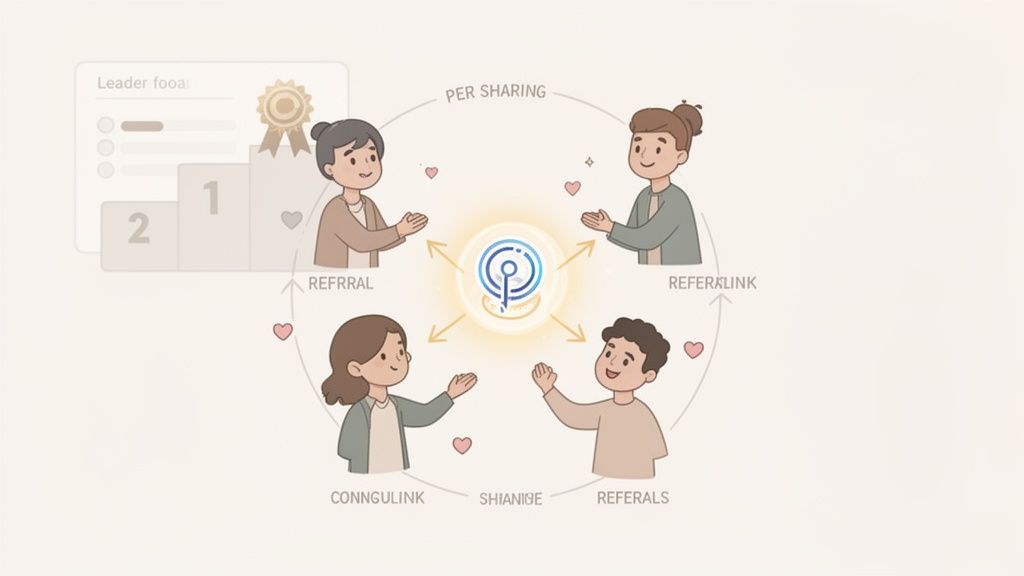
This model thrives on credibility. A recommendation from a trusted colleague using Figma or Slack carries far more weight than a paid advertisement. The goal is to embed frictionless sharing tools directly into the user experience, transforming moments of delight into opportunities for organic growth. Dropbox famously used this to grow its user base from 100,000 to 4 million, proving the immense power of peer-to-peer trust.
This is one of the most powerful ideas for referral programs because it taps into word-of-mouth marketing at scale, generating high-quality leads that arrive with built-in trust and context.
How to Implement It
- Make Sharing Contextual: Don't just place a referral link in the account settings. Prompt users to share at their "moment of delight," such as after they complete a key task, export a project, or receive positive feedback. This captures their enthusiasm at its peak.
- Gamify with Leaderboards: Foster friendly competition by creating public or private leaderboards that showcase your top referrers. This introduces a powerful social dynamic and provides recognition, which is often a stronger motivator than a small monetary reward in community-focused products.
- Provide Shareable Templates: Make sharing effortless by providing pre-written, non-spammy message templates for email, social media, and community forums. Ensure the copy feels authentic and focuses on the product's value, not just the incentive.
- Emphasize Recognition Over Reward: For strong communities, the incentive can be secondary. Feature top referrers in a newsletter, offer them exclusive community badges, or give them a shout-out on social media. Learning how to properly nurture these relationships is key to building brand advocates who contribute for the long term.
7. Channel Partner and Reseller Programs
While consumer-focused referral programs target individual advocates, a channel partner program elevates this strategy for B2B SaaS. This model formalizes relationships with agencies, consultants, system integrators, and resellers who promote your product to their existing client base, often in exchange for recurring commissions. Unlike typical affiliates, these partners sell your software as part of a larger, integrated solution, leveraging established trust and authority.
This approach transforms your referral engine from a one-to-one to a one-to-many model. For example, a single marketing agency partner could integrate your analytics tool for dozens of their clients, creating a scalable and highly efficient customer acquisition channel. Major players like Salesforce and Shopify have built empires on this model, with partners driving a significant portion of new business by embedding the product into their core service offerings.
This is one of the most powerful B2B ideas for referral programs because it unlocks access to high-value customers who rely on trusted advisors for their technology stack decisions. It is ideal for platforms that require implementation, integration, or serve complex enterprise needs.
How to Implement It
- Develop a Partner Tier System: Create a structured program with clear levels like Silver, Gold, and Platinum. Each tier should offer escalating benefits, such as higher commission rates, dedicated support, and access to co-marketing funds. This incentivizes partners to grow with you.
- Build a Comprehensive Partner Portal: Centralize all essential resources in a password-protected portal. Include deal registration forms to prevent channel conflict, detailed pricing sheets, marketing collateral, and training materials. This empowers partners to sell effectively and independently.
- Invest in Training and Certification: Your partners are an extension of your sales team. Develop a formal certification program to ensure they deeply understand your product’s value proposition and can implement it successfully. This protects your brand and ensures client success.
- Assign Dedicated Partner Managers: For your top-performing partners, assign a dedicated manager to foster a strong relationship. These managers can help with strategic planning, provide support for large deals, and conduct quarterly business reviews to align on growth goals.
8. Freemium-to-Paid Upgrade Referral Programs
Most referral programs focus on acquiring new paying customers, but what about activating your largest, most underutilized asset: your free user base? Freemium-to-paid upgrade programs turn this segment into a powerful growth engine. This model incentivizes free users to refer others who eventually convert to paid plans, rewarding the referrer with credits, premium features, or discounts.
Instead of a direct cash payout, which might not resonate with someone not yet paying, the rewards enhance their existing free experience. For example, a free user on a project management tool might earn a month of the "Pro" plan for every three friends they refer who upgrade. This creates a low-friction loop where free users drive paid conversions, get a taste of premium features, and are more likely to upgrade themselves.
This is one of the most effective ideas for referral programs for product-led growth companies because it directly bridges the gap between your free and paid tiers, using your community to drive monetization.
How to Implement It
- Offer Product-Led Rewards: The best incentives are directly tied to your product's value. Reward referrers with things they can't get otherwise, like increased storage (Dropbox's classic model), access to a coveted premium feature, or account credits that can be applied to a future subscription.
- Trigger Prompts at "Aha!" Moments: Don't just place a static referral link in the footer. Prompt users to refer friends immediately after they experience a key moment of value, such as completing a major project, hitting a usage milestone, or exporting their work for the first time.
- Clearly Communicate the Value: Ensure free users understand exactly what they’re working toward. Instead of saying "earn credits," be specific: "Refer 3 friends who upgrade and unlock our 'Advanced Analytics' feature for free." This makes the reward tangible and desirable.
- Implement Tiered Incentives: Consider offering different reward values based on the quality of the referral. A user might earn 5 credits when a friend signs up for a free account but receive 50 credits if that friend converts to a paid plan. This encourages referrers to bring in high-intent users.
9. API and Developer Ecosystem Referral Programs
Standard referral programs focus on customer-to-customer sharing, but for platforms with a strong API, the real growth engine is the developer ecosystem. This specialized model incentivizes developers and third-party services to build integrations, plugins, or apps that extend your platform's functionality. Instead of just referring users, they create value-added tools that attract new customer segments.
This approach transforms your platform into a central hub, where developers earn commissions based on the usage of their integration or from the subscriptions of customers they refer. Think of Shopify's App Store or Slack's app ecosystem; their growth is supercharged by developers who are financially motivated to build high-quality solutions. By rewarding innovation, you outsource R&D and marketing to a global network of talented partners.
This is one of the most scalable ideas for referral programs for SaaS companies with open APIs, as it creates a powerful, self-sustaining flywheel of innovation and user acquisition.
How to Implement It
- Provide a Developer-First Experience: Success hinges on minimizing developer friction. Offer comprehensive API documentation, SDKs, and dedicated sandbox environments for testing. A smooth onboarding process encourages more developers to start building.
- Establish a Clear Revenue Share: Define a transparent and compelling commission structure. A typical model offers a 25-30% recurring revenue share from customers who sign up through a partner's integration. This clarity is crucial for building trust and motivating developers.
- Automate Complex Tracking: Tracking referrals originating from API integrations is complex. Use a platform with a robust REST API, like Refgrow, to automate the tracking of sign-ups and attribute them correctly to the right developer partner without manual work. You can learn more about API-driven affiliate marketing and its technical requirements.
- Feature and Promote Top Integrations: Create a marketplace or app directory and prominently feature the best-performing integrations. This visibility serves as a powerful non-monetary incentive, driving more users to their solution and creating a competitive environment where quality is rewarded.
- Foster a Developer Community: Build a dedicated space for developers, such as a Slack channel or a forum. Use it to provide technical support, announce API updates, and run community events like hackathons to spark creativity and collaboration.
10. Influencer and Content Creator Programs
Traditional affiliate programs cast a wide net, but influencer partnerships offer a targeted, trust-based approach. This strategy involves collaborating with micro and macro influencers, YouTubers, podcasters, and newsletter creators who already command the attention and respect of your ideal customers. Instead of just sharing a link, these creators integrate your product authentically into their content through reviews, tutorials, and sponsored features.
This model leverages the creator's established credibility to drive both brand awareness and high-intent conversions. When a productivity expert like Ali Abdaal showcases how he uses Notion, his audience sees a genuine use case, not just an advertisement. Similarly, Figma’s collaborations with top design influencers provide social proof that resonates far more deeply than a standard marketing message.
This is one of the most effective ideas for referral programs for SaaS companies because it taps into pre-built communities and borrows the trust that creators have painstakingly earned with their audiences.
How to Implement It
- Prioritize Audience Alignment: Forget vanity metrics like follower count. The most critical factor is whether the creator's audience matches your ideal customer profile. Request audience demographics and engagement metrics upfront to ensure a good fit before committing to a partnership.
- Start with Micro-Influencers: Creators with 10,000 to 100,000 followers often deliver a higher return on investment. Their audiences are typically more engaged, and their recommendations feel more authentic and personal than those from mega-influencers.
- Grant Creative Freedom: The best content comes from letting creators be creators. Provide them with key messaging points and product access, but avoid overly restrictive scripts. Authentic promotion will always outperform a forced, robotic ad read.
- Establish Clear Deliverables & Tracking: Negotiate clear terms for the partnership, including the number of posts, video length, and specific mentions. Provide each creator with a unique promo code or referral link to accurately attribute sign-ups and measure the ROI of each campaign.
- Build Long-Term Ambassador Relationships: Instead of one-off campaigns, focus on building lasting relationships with creators who genuinely love your product. This transforms them into true brand ambassadors who will advocate for your SaaS platform organically over time.
Top 10 Referral Program Ideas Comparison
| Referral Model | 🔄 Implementation Complexity | ⚡ Resource Requirements | 📊 Expected Outcomes | 💡 Ideal Use Cases | ⭐ Key Advantages |
|---|---|---|---|---|---|
| Tiered Commission Structure Referral Programs | Moderate 🔄 - backend tier logic & tracking | Medium ⚡ - tracking platform, dashboard, higher payout budget at scale | 📊 Encourages sustained growth and higher-value referrals | 💡 SaaS wanting to reward high-volume affiliates and retain top partners | ⭐ Motivates top performers; scalable; improves affiliate retention |
| Native In-App Referral Dashboards | Low 🔄 - one-line integration but requires design/maintenance | Low–Medium ⚡ - front-end dev, payment & analytics integrations | 📊 Raises engagement (often 30–50% uplift) and reduces abandonment | 💡 Product-led SaaS prioritizing seamless UX and in-product adoption | ⭐ Frictionless experience; better data control; higher conversion |
| Affiliate Network Marketplaces (Referral Exchange) | Very Low 🔄 - instant access on signup | Low ⚡ - commission fees and marketplace margins | 📊 Fast partner acquisition and rapid referral volume | 💡 Brands needing quick scale and access to vetted creators | ⭐ Immediate access to active promoters; faster time-to-market |
| Performance-Based Bonus Incentives | Moderate 🔄 - campaign rules, tracking, payout automation | Low–Medium ⚡ - bonus budget, communications, tracking | 📊 Short-term spikes and concentrated referral activity | 💡 Seasonal campaigns, product launches, reactivation pushes | ⭐ Creates urgency; cost-effective for short-term volume increases |
| Co-Marketing and Content Partnership Programs | High 🔄 - coordination, content production workflows | High ⚡ - creative, technical, and time investments | 📊 Produces high-quality leads and durable content assets | 💡 B2B SaaS targeting enterprise audiences and thought leadership | ⭐ Deeper partnerships; higher lead quality; long-term marketing assets |
| Community and User-Generated Referral Programs | Low 🔄 - simple sharing tools; execution-focused | Low ⚡ - platform features and community management | 📊 High conversion rates, low CPA, viral growth over time | 💡 Product-led companies with strong user satisfaction | ⭐ Highest trust and conversion; low acquisition cost; scalable |
| Channel Partner and Reseller Programs | Very High 🔄 - partner management, deal registration, training | High ⚡ - partner managers, certifications, integration support | 📊 Larger deals and higher LTV but longer sales cycles | 💡 Enterprise SaaS requiring consultative sales and integrations | ⭐ Access to established client pipelines; recurring revenue potential |
| Freemium-to-Paid Upgrade Referral Programs | Moderate 🔄 - billing integration and fraud prevention | Medium ⚡ - billing/dev work, credit budget, monitoring | 📊 Boosts paid conversions and viral coefficient when executed well | 💡 SaaS with large free user base focused on monetization | ⭐ Aligns referrer/referred incentives; variable cost tied to conversions |
| API and Developer Ecosystem Referral Programs | Very High 🔄 - robust API infra, SDKs, and dev relations | High ⚡ - docs, sandbox, support, revenue-sharing arrangements | 📊 Expands functionality and integrations; long-term product stickiness | 💡 Platforms with APIs aiming to grow an app/integration marketplace | ⭐ Drives integrations; creates switching costs; attracts developer innovation |
| Influencer and Content Creator Programs | Moderate 🔄 - outreach, negotiation, campaign coordination | Medium–High ⚡ - sponsorship budgets, content production, management | 📊 Increases brand awareness and targeted conversions; variable ROI | 💡 B2C or niche SaaS seeking audience trust and content assets | ⭐ High-quality content and credibility; potential for viral reach |
From Ideas to Implementation: Your Next Steps
We've explored a comprehensive landscape of ten powerful ideas for referral programs, each designed to serve as a unique growth engine for modern SaaS businesses. From the structured incentives of tiered commissions to the expansive reach of channel partner programs, the central theme is clear: there is no single "best" referral strategy. The most successful programs are deeply integrated into the product's DNA and finely tuned to the motivations of its user base.
Your SaaS product's nature dictates the optimal approach. A product-led growth tool thrives with a seamless, native in-app referral dashboard. In contrast, an enterprise solution gains more from high-touch co-marketing partnerships and structured reseller programs. The key is to match the model to your audience and business goals, transforming abstract ideas for referral programs into a tangible, high-performing growth channel.
Synthesizing Strategy into Action
The transition from a promising idea to a successful, revenue-generating program hinges on one critical factor: execution. A brilliant concept can easily fail if bogged down by a clunky user experience, inaccurate tracking, or burdensome administrative overhead. The goal is to make participation effortless for your advocates and management seamless for your team.
Consider these core principles as you move forward:
- Friction is the Enemy: Every extra step a user has to take to share your product reduces the likelihood they will. Prioritize a one-click sharing experience and a clear, accessible dashboard where they can track their progress.
- Alignment is Key: Ensure your incentives align with both the advocate's motivation and your business's key performance indicators. Whether it's cash payouts, product credits, or exclusive feature unlocks, the reward must feel valuable and directly tied to a meaningful action.
- Technology is the Enabler: Manually tracking referrals with spreadsheets is not a scalable solution. Modern referral platforms are built to handle the complexity, from accurate attribution and fraud detection to automated payouts and performance analytics.
Charting Your Course for Referral-Led Growth
Your immediate task is to evaluate the ten models presented in this article against your current growth strategy, user demographics, and technical resources. Don't try to boil the ocean by launching multiple complex programs at once. Select the one strategy that offers the most direct path to value for both your users and your business.
Once you've chosen a direction, the next phase is meticulous planning and setup. To turn these concepts into concrete actions, a comprehensive Affiliate Marketing Step by Step Guide can provide the necessary framework for execution, covering everything from initial setup to long-term optimization. This foundational knowledge is crucial for building a program that not only launches successfully but also endures.
The true power of referral marketing lies in its ability to build a sustainable, self-perpetuating growth loop. You are not just acquiring customers; you are building a distributed team of advocates who are genuinely invested in your success. They are your most authentic marketing channel, and empowering them is the most direct path to scalable, capital-efficient growth. It's time to stop just thinking about ideas for referral programs and start building your engine.
Ready to turn these ideas into reality without the technical overhead? Refgrow provides the complete toolkit for SaaS to launch, manage, and scale native referral and affiliate programs. Go from concept to a fully integrated, in-app referral dashboard in minutes at Refgrow.