

How to Build a Referral Program for Predictable SaaS Growth
The best referral programs turn your happiest customers into your most effective, most authentic sales team. It's about more than just giving out rewards; it’s about creating a simple, trustworthy system that encourages users to share your product and rewards them reliably when they bring in new business. Get this right, and you'll build a powerful, self-sustaining growth loop for your SaaS.
Why Your SaaS Needs a Referral Program Today
Before we dive into the how, let's nail down the why. A well-built referral program isn't just another box to check on your marketing to-do list; it's a genuine growth engine. It transforms your satisfied users into active promoters, creating a powerful acquisition channel built on the one thing you can't buy: trust.
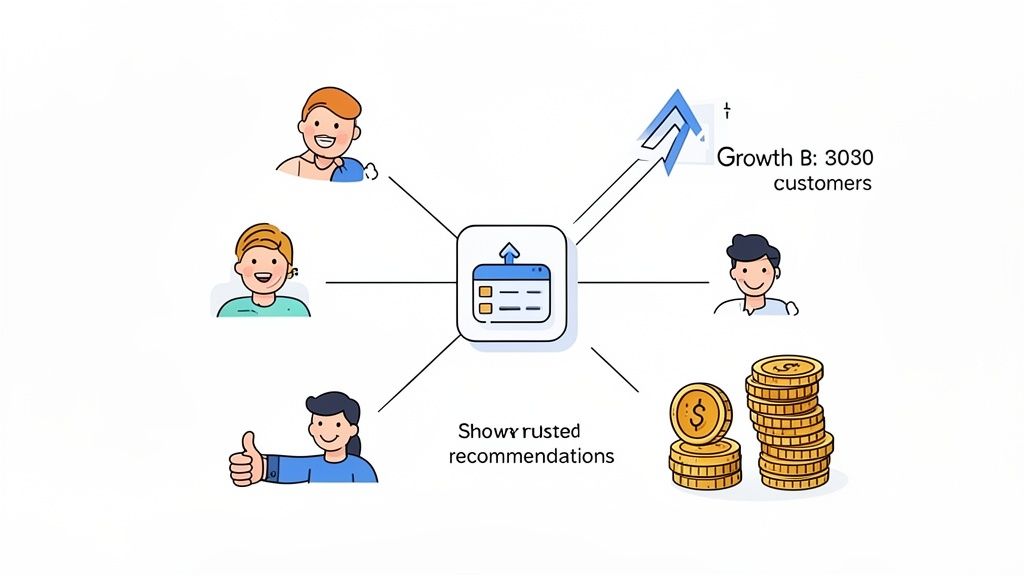
In a SaaS market that's more crowded than ever, a recommendation from a peer cuts through the noise far better than any paid ad ever could. Just think about your own experience—when a colleague you trust recommends a tool, you’re instantly interested. You're far more receptive than if you saw a flashy banner ad for the exact same product. That's the simple, powerful idea at the heart of referral marketing.
The Tangible Business Impact
The data is just as convincing. Recent referral marketing statistics show that these programs can drive 3x higher conversion rates compared to traditional channels and slice customer acquisition costs by a massive 25%.
And it gets better. Referred customers don't just sign up; they stick around and spend more. On average, they have a 16% higher lifetime value. We're not just talking about getting more sign-ups here; this is about acquiring better, more loyal customers who are primed to succeed with your product from day one.
The numbers speak for themselves, but here’s a quick summary of what a great referral program can do for your core metrics.
| Referral Program Impact at a Glance | | :--- | :--- | | Metric | Average Improvement with Referrals | | Customer Acquisition Cost (CAC) | 25% Reduction | | Conversion Rate | 3x Higher | | Customer Lifetime Value (LTV) | 16% Increase | | Churn Rate | 18% Lower |
This table clearly shows why a referral program shifts from a "nice-to-have" feature to a foundational growth strategy. It's not just about marketing; it's about building a more sustainable and profitable business.
This direct impact on key SaaS metrics is precisely why a referral program is a must-have. It directly attacks two of the biggest hurdles every SaaS company faces:
- Lowering Customer Acquisition Cost (CAC): Instead of pouring an ever-increasing budget into ads with diminishing returns, you’re incentivizing your existing, happy customers to do the heavy lifting. It's marketing efficiency at its absolute best.
- Increasing Lifetime Value (LTV): Customers who arrive via a referral already have a positive impression of your brand. They onboard faster, churn less, and are often the first to become advocates themselves, kickstarting a virtuous cycle of growth.
A referral program isn't really about finding new customers. It's about empowering your best customers to find more people just like them—the ones who are most likely to convert, stay, and grow with you.
By tapping into your existing user base, you're building a scalable and cost-effective channel that produces your most valuable cohort of customers. It’s a strategic investment that pays dividends long after you've set it up, building an authentic community of advocates around your brand.
Setting Clear Goals and Choosing the Right Incentives
Let’s be honest: a referral program without a clear goal is just a money pit. It feels productive, but it’s like a ship without a rudder—you're moving, but you have no idea if you're heading toward your destination. Before you even think about rewards, you have to define what success actually looks like for your business right now.
What you're aiming for will shift depending on where you are in your growth journey. An early-stage startup is probably obsessed with getting more users in the door, period. But a more established company might need to focus on turning its massive free user base into paying customers.
Your goal needs to be specific and measurable. "Get more sign-ups" is a wish, not a goal.
Here’s how to frame it with precision:
- For Early-Stage SaaS: "Increase new trial sign-ups by 20% in the next quarter." This is tangible. It’s tied to a timeline and directly impacts top-of-funnel growth.
- For Product-Led Growth (PLG) Companies: "Drive a 15% lift in free-to-paid conversions within six months." Now the focus has shifted from pure acquisition to actual monetization.
- For Enterprise SaaS: "Generate 50 qualified enterprise demo requests from referrals this fiscal year." This is all about lead quality, not just quantity, tailored for a sales-heavy motion.
A well-defined goal is your North Star. It dictates not only how you measure success but also what kind of incentives will actually motivate your users to take the desired action.
Without this clarity, you're just throwing money at a problem. You'll end up with a program that looks busy but has zero impact on your bottom line—a cost center instead of a true growth engine.
Matching Incentives to Your Goals and Audience
Once you have that crystal-clear objective, you can start building the heart of your program: the incentives. The best reward isn't always the biggest cash prize. It’s about offering something that your users genuinely want and that aligns perfectly with the action you need them to take.
For example, a cash bonus can be a huge motivator for a B2C-style SaaS where users are very price-sensitive. But for a highly technical tool used by developers, offering exclusive access to a new beta feature might be far more compelling. It taps into their desire for status, expertise, and a competitive edge.
The trick is to understand what your users truly value. Don't just guess.
Single-Sided vs. Double-Sided Incentives
One of the first forks in the road is deciding whether to reward only the person referring (single-sided) or both the referrer and their friend (double-sided). While single-sided programs can work, a double-sided approach almost always creates a more powerful, viral loop.
- Single-Sided: Only the referrer gets a reward. This can feel a bit transactional, even selfish, to the person being invited.
- Double-Sided: Both the referrer and the new customer get something. This completely changes the dynamic. The referral becomes a genuine gift, making the referrer feel generous and the new customer feel welcomed.
The data backs this up. In B2B tech, a massive 82% of sales leaders say referrals deliver high-quality leads that smoke every other channel. And when they build these programs, 71% opt for double-sided cash bonuses because they’re just that effective at getting everyone on board. You can see more data like this in a detailed Extole report.
Choosing the Right Reward Structure
Beyond the single vs. double-sided debate, the type of reward you offer is critical. Here’s a breakdown of the most common options and when each one shines.
| Reward Type | Best For | Example Scenario |
|---|---|---|
| Cash Payouts | B2C-style SaaS or when the referrer isn't a direct user (like an agency partner). | A project management tool pays a partner agency a $100 cash reward for every new paid team they refer. |
| Account Credits | Subscription-based SaaS where users have recurring bills. | A CRM company gives both the referrer and the new customer a $50 credit toward their next monthly bill. |
| Feature Upgrades | PLG or freemium models with clear upgrade paths. | A design software unlocks premium templates for users who successfully refer three new free users. |
| Gift Cards | Products with broad appeal where users appreciate flexibility. | An email marketing platform offers a $25 Amazon gift card for each new paying subscriber. |
For most SaaS companies, account credits are a brilliant move. They directly fight churn by giving users a tangible reason to stick around. Plus, the cost is absorbed as a reduction in future revenue instead of a direct cash-out expense from your bank account. If you want to go deeper, we have a complete guide on choosing the best referral program incentives for your specific business model.
At the end of the day, your goal and your incentive structure must be perfectly in sync. If you’re trying to drive more trial sign-ups, a small, immediate reward like an account credit or a feature unlock is perfect. But if you’re chasing high-value enterprise deals, a more substantial cash payout after the contract is signed makes a lot more sense. Get these two elements right, and you’re well on your way to building a referral program that actually works.
Nailing Your Commission and Attribution Model
Getting the numbers right is probably the single most critical step in building a referral program that actually lasts. If your commissions are too stingy, you won't attract quality partners. But if they're too generous, you'll sink your own ship. The goal here is to land on a financial model that partners are excited about and that works for your bottom line.
It all boils down to one fundamental choice: do you pay partners a one-time fee or a recurring commission? Your answer will shape the entire program, from the type of partners you attract to how hard they'll work to send you good customers.
One-Time vs. Recurring Commissions
A one-time commission is exactly what it sounds like. A partner sends you a new customer, they sign up, and you pay the partner a flat amount or a percentage of that first payment. Simple. It’s clean, easy to track, and gives your partners that instant gratification of a cash reward.
This model is a fantastic fit for SaaS products with big, annual-only contracts or those with significant setup fees. The large upfront payment from the customer gives you plenty of room to carve out a really motivating reward. For example, if your annual plan costs $1,200, a one-time 25% commission is a $300 payout. That’s a serious incentive that gets people’s attention.
On the flip side, recurring commissions are the gold standard for most subscription businesses. Instead of a single payout, you give the partner a slice of the subscription revenue for a set period of time—maybe the first 12 months, or if you're feeling generous, for the entire lifetime of that customer.
Recurring commissions build real, lasting partnerships. You're aligning their success directly with yours, giving them a reason to find you customers who will stick around for the long haul.
Think about it. For a $50/month SaaS plan, a 20% recurring commission for the first year means your partner earns $10 every single month for 12 months. That's $120 total per referral. This creates a predictable, passive income stream that serious affiliates and content creators absolutely love. It gives them a reason to build high-quality, evergreen content that keeps sending you valuable traffic, not just chase a quick buck.
Setting Up Your Attribution Rules
Once you've landed on a commission structure, you need to sort out attribution. This is simply the rulebook for who gets credit for a sale. If your attribution rules are fuzzy or feel unfair, you'll lose the trust of your partners, and the program is doomed before it even starts.
There are two key pieces to get right:
Attribution Window (or "Cookie Life"): This is how long the cookie lasts. It's the timeframe after someone clicks a referral link where the partner is still eligible for a commission if a sale happens. For SaaS, the sweet spot is typically between 30 and 90 days. A 30-day window can be a bit tight for a considered B2B purchase, while a 90-day window gives a lead plenty of time to poke around, do a trial, and get team buy-in before pulling the trigger.
Attribution Model: This is the rule that decides which partner gets credit if a customer interacts with multiple links. For referral programs, the most common and trusted model is first-touch attribution. This means the very first partner whose link the customer clicked gets 100% of the credit. It’s simple, transparent, and fairly rewards partners for bringing you brand-new leads. Last-touch, while popular in ad platforms, can create a lot of "who-stole-my-commission" drama in affiliate programs and is best avoided.
Here's a quick look at how the two commission models stack up:
| Commission Model | Best For | Key Advantage | Potential Downside |
|---|---|---|---|
| One-Time Payout | SaaS with annual-only plans or high setup costs. | Large, immediate reward that is highly motivating. | Doesn't incentivize partners to find high-LTV customers. |
| Recurring Commission | Monthly/Quarterly subscription SaaS. | Attracts long-term partners and encourages quality referrals. | Payouts are smaller and spread out over time. |
At the end of the day, a system that is fair, clear, and easy to understand is non-negotiable. Building a great referral program starts with this solid financial and technical foundation. Get your commission structure and attribution model right, and you'll create a program that partners trust—and one that will become a powerful, sustainable growth engine for your business.
Choosing Your Technical Path: From Simple Embeds To Full API Control
Alright, you've nailed down your goals, incentives, and commission model. Now for the fun part: actually building the thing. This is where your strategy meets code, and the technical path you choose will define your program's launch speed, flexibility, and long-term potential. It’s the classic startup dilemma: do you want it fast, or do you want full control?
You've basically got three routes to take, each with its own pros and cons. The right one for you really boils down to your team's current engineering bandwidth and what you need to achieve right now.
The Fastest Path: Simple Embeddable Solutions
For most SaaS startups, the main goal is to get a working referral program live yesterday. This is exactly what embeddable platforms are built for. With this approach, you can drop a fully functional, native-looking affiliate dashboard right into your app with a single line of code.
Seriously, it’s often as simple as embedding a YouTube video. Your partners can sign up, grab their unique links, and see their stats without ever leaving your product. It feels professional and seamless, which is huge for building partner trust from the get-go.
This is the perfect route if you want to:
- Launch in minutes, not months. Your engineering team can stay focused on your core product, which is where they should be.
- Avoid reinventing the wheel. You get a battle-tested system for tracking, attribution, and partner management straight out of the box.
- Maintain brand consistency. Good embeddable solutions are highly customizable, so you can make them look and feel just like the rest of your UI.
The Automated Middle-Ground: Webhook Integrations
The next level up involves using webhooks. Think of webhooks as a direct line of communication between your referral platform and your payment processor, like Stripe or LemonSqueezy. Instead of just relying on click-tracking, the system listens for real-time events.
For example, when a new customer successfully subscribes, Stripe can send a customer.subscription.created event to your referral platform. The platform then instantly checks if that customer came from a referral and, if so, automatically credits the right affiliate.
This is a game-changer. It automates the most critical part of the process—attributing commissions based on actual paid conversions. No more manual spreadsheets, no more guesswork. It’s accurate, scalable, and keeps your partners happy.
The Power User's Choice: Full Control With A REST API
For teams that need total customization, building your program with a REST API is the way to go. An API-first approach gives you complete control over the entire experience and logic. You can build a completely bespoke affiliate dashboard from scratch, pipe referral data into your internal BI tools, and create unique reward triggers tied to specific in-app actions, not just subscriptions.
You’d head down this path if you need to:
- Integrate referral data with a complex, proprietary CRM or analytics stack.
- Build a unique two-sided marketplace where both buyers and sellers can be referrers.
- Create custom reward logic, like paying a commission only after a user invites three teammates.
The image below can help you visualize how your technical choice influences one of your biggest decisions: the commission model.
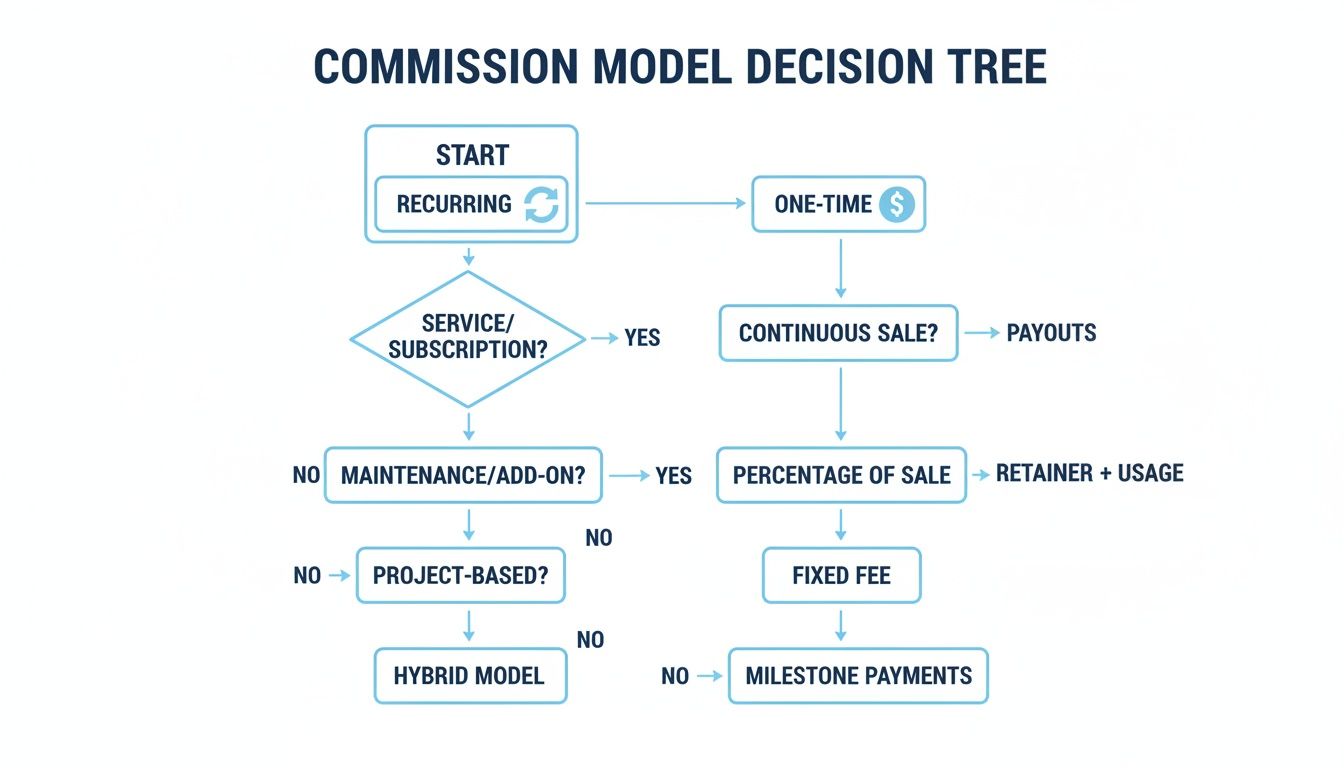
This isn’t a small choice. Recurring commissions are fantastic for aligning partners with long-term customer value, while one-time payouts provide a strong, immediate kick.
Of course, the API route demands serious engineering resources. It's a full-on development project, not a quick setup. But for established companies with very specific needs, the investment can create a program that becomes a true competitive advantage. You can learn more about what's possible with API-driven affiliate marketing in our detailed guide.
To make the decision easier, here’s a quick breakdown of how these three methods stack up against each other.
Referral Program Tech Implementation Comparison
This table compares the three primary technical approaches, helping you pick the right path based on your team's resources and goals.
| Implementation Method | Best For | Effort Level | Key Advantage |
|---|---|---|---|
| Simple Embed | Early-stage startups, non-technical teams, and anyone needing to launch fast. | Low | Speed to market. You can be live in under an hour. |
| Webhook Integration | Teams using a standard payment processor (like Stripe) who want automated, accurate tracking. | Medium | "Set it and forget it" accuracy. Eliminates manual commission tracking. |
| REST API | Established companies with engineering resources and a need for deep, custom integration. | High | Total control and flexibility to build a completely bespoke program. |
Ultimately, the best approach is the one that fits your current reality. Don't let the dream of a perfect, custom-built system stop you from launching a perfectly good one right now.
The best technical solution is the one that gets a high-quality program in front of your users the fastest. You can always evolve your setup later.
The goal is to make your referral program feel like a natural part of your product. After all, with 71% of SaaS firms running formal programs, a clunky, disjointed experience just won’t cut it. Modern platforms are increasingly offering a hybrid approach—a simple embed to get started and a powerful API to grow into. Choosing the right technical foundation today sets you up for a program that's not just effective, but effortlessly scalable tomorrow.
Launching and Promoting Your Program for Maximum Impact
So, you’ve done the hard work. The goals are defined, the incentives are killer, and the tech is all wired up. But here’s the thing: a referral program nobody knows about is just a well-built secret. This is where your planning turns into real-world momentum. It’s not about just flipping a switch; it’s about creating a wave of awareness that gets your best users genuinely excited to participate from day one.
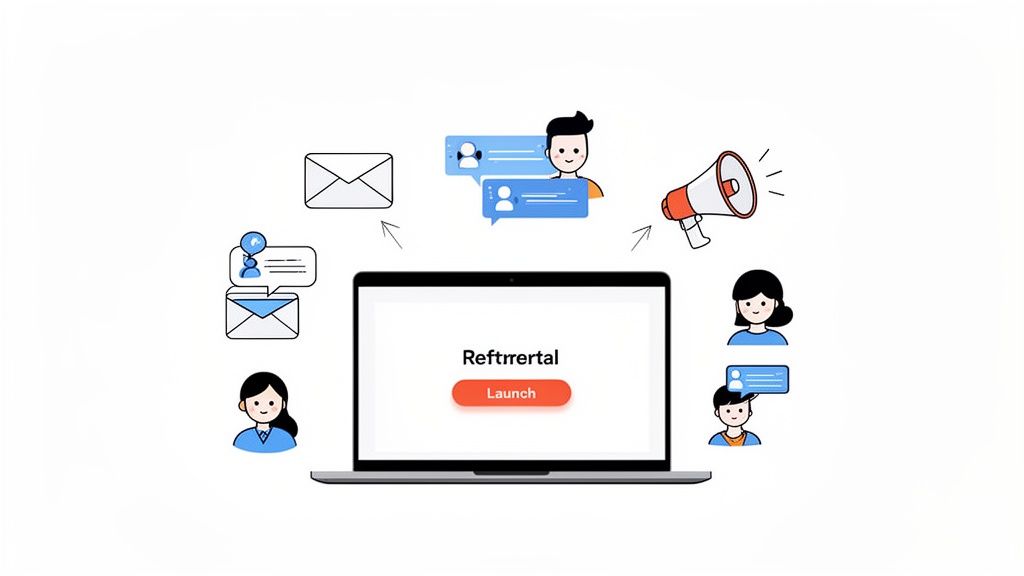
Think of this as your playbook for making a splash, not just a ripple. A great launch is a multi-channel push designed to meet your users exactly where they are, making it almost impossible for them to miss out on this new opportunity.
Crafting a Compelling Landing Page
Your first and most important asset is a dedicated landing page. This is more than just a sign-up form; it’s the central hub for your entire program. It needs to sell the "why" before it even gets to the "how."
A potential referrer hitting this page should immediately find answers to three core questions:
- What's in it for me? Don’t bury the lead. The reward is the hero of the page, so put it front and center.
- How does it work? Keep it simple. A clean, 3-step graphic or a short bulleted list is perfect: Sign up, share your link, get rewarded.
- What are the rules? You need a link to the full terms and conditions, but summarize the most important part right there on the page (e.g., "Get paid for every new paid subscriber").
Make the page visually engaging, dead simple to understand, and laser-focused on a single call-to-action: joining the program.
Announcing Your Program to the World
Once your landing page is live, it’s time to make some noise. A single announcement email simply won't cut it. You need a coordinated promotional blitz across multiple channels to build and maintain excitement.
- Announcement Email: Send a dedicated email to your entire user base. The subject line has to be benefit-driven, something like "Get $50 for Referring a Friend to [Your Product]." Keep the email short and sweet, explain the double-sided benefit, and drive all traffic straight to your new landing page.
- In-App Notifications: Catch users when they're most engaged—while they’re actually using your product. This could be a subtle banner, a modal pop-up for their first visit after launch, or even a permanent link in the navigation menu. The message should be brief and direct: "Love our product? Refer a friend and you both get a month free!"
- Social Media Blitz: Get a series of posts ready for your social channels. Create simple, eye-catching graphics that highlight the reward. You can even encourage followers to tag friends who would benefit from your tool, turning the announcement itself into a referral action.
Your launch isn't just about informing users; it's about activating them. The goal is to create an immediate sense of opportunity and make joining feel like a no-brainer.
This initial promotional burst is what generates that first wave of sign-ups. That early momentum provides the social proof and data you need to start refining your approach.
Ensuring Frictionless Affiliate Onboarding
Getting a user to click "Join" is only half the battle. If the onboarding process that follows is clunky or confusing, you'll lose them right then and there. The sign-up should be incredibly simple—ideally just a one-click action if they’re already logged into your app.
Once they're in, don't just hand them a link and wish them luck. You have to equip your new partners for success from the get-go. This means having a "Partner Kit" waiting for them right in their dashboard.
This kit should include essentials like:
- Pre-written Copy: Email templates, social media posts, and short blurbs they can copy and paste. This removes the creative guesswork and keeps messaging consistent.
- Brand Assets: A folder with your logos, product screenshots, and any promotional graphics you’ve created.
- Unique Tracking Links: Make it painfully obvious where their unique referral link is and how to use it. A simple "copy to clipboard" button is a must.
The easier you make it for them to share, the more likely they are to actually do it.
Leveraging Partner Networks for a Head Start
For many SaaS companies, especially those just getting started, building an army of advocates from scratch is a slow burn. This is where partner networks can be a game-changer. Platforms like Refgrow often have a built-in exchange or marketplace that connects you with established affiliates who are actively looking for new products to promote.
Tapping into a network like this can give your program a massive jumpstart. You get immediate access to professional content creators, influencers, and agencies who already have an audience that trusts their recommendations. It’s like pouring gasoline on a fire, helping you land those crucial first referrals and build momentum far faster than you could on your own.
By combining your internal promotion with the reach of an external network, you maximize your launch's impact from day one.
How to Measure Success and Scale Your Program
Getting your referral program live is a huge win, but it’s really just the starting line. A great referral program isn't a "set it and forget it" tool. It’s a living, breathing part of your growth strategy that needs constant attention to really take off. To turn it from a nice-to-have feature into a predictable growth engine, you have to be obsessive about tracking, measuring, and optimizing.
Without solid metrics, you're just guessing. You won't know what's actually working, who your best partners are, or where to double down with your time and resources. The first step is building a simple dashboard that gives you an at-a-glance view of your program's health.
Defining Your Core Key Performance Indicators
You don't need to track dozens of vanity metrics. Just focus on the vital few that tell the real story of your program's performance. These KPIs will give you a clear picture of both partner engagement and the actual business impact.
Start with these essentials:
- Affiliate Sign-Ups: This is your top-of-funnel health check. A steady flow of new affiliates means your program is attractive and your promotion is working.
- Activation Rate: Of all the people who sign up, what percentage actually start sharing their link? If this number is low, your onboarding might be confusing or the incentive isn't hitting the mark.
- Referral Conversion Rate: This is the big one. How many of the clicks your partners generate actually turn into paying customers? This metric tells you everything about the quality of traffic your partners are sending.
- Revenue Generated: The ultimate bottom line. Tracking the total revenue from referred customers is how you prove the program's direct financial contribution.
One of the main reasons to build a referral program is to lower your customer acquisition costs. That’s why it's so important to get good at calculating your Customer Acquisition Cost (CAC). When you can show that your referral CAC is way lower than your paid channels, you've found a truly efficient growth machine.
Identifying and Empowering Your Top Performers
Here’s a little secret I've seen play out in every single affiliate program I've ever run: the Pareto principle is always in effect. You'll quickly discover that 20% of your partners are driving 80% of your results. Your job is to find these superstars and roll out the red carpet for them.
Don't treat all your partners the same. Your top performers are a massive asset, and investing in those relationships can have an outsized impact on your growth. Once your dashboard helps you spot them, you can build a playbook just for them.
Your top advocates aren't just sending you traffic; they are your most authentic and effective brand ambassadors. Investing in them directly is one of the highest-leverage activities you can do.
Think about creating a tiered system or a special "VIP" program. This could mean offering a higher commission rate, giving them early access to new features, providing dedicated one-on-one support, or even sending them some company swag. A small gesture can go a very long way in making these critical partners feel valued.
Scaling Operations for Long-Term Growth
As your program picks up steam, all the manual tasks that were easy at the start will quickly become a nightmare. Scaling successfully means automating the grunt work so you can stay focused on strategy and relationships. This is where you graduate from a list of tasks to a well-oiled machine.
Here are a few key areas to automate as you grow:
- Automated Payouts: Manually calculating and sending commissions each month is slow, painful, and prone to errors. Use a platform that handles automated or mass payouts to make it painless and reliable.
- Compliance and Fraud Management: As you scale, you'll inevitably run into issues like self-referrals or other shady behavior. You need clear terms of service and a system to flag suspicious activity. Good referral software often has this built right in.
- Iterating on Incentives: Let the data guide your offers. If you see that partners referring enterprise customers are bringing in a much higher LTV, maybe they deserve a special bonus for those bigger deals.
The goal here is continuous improvement. By regularly checking your KPIs and, just as importantly, listening to feedback from your partners, you can make small tweaks that lead to huge wins over time. To go even deeper, check out our guide on the most important referral program metrics to track.
By transforming your referral program into a dynamic system of measurement and iteration, you build a sustainable, predictable source of high-quality customers. The tools from Refgrow are designed to give you this clarity from day one, with native dashboards and automated tracking that make scaling effortless. Start building your growth loop with Refgrow today.