

What Is a Standard Finders Fee Percent for SaaS
If you're trying to pin down a standard finder's fee, you'll often hear numbers thrown around between 5% and 20% of a deal's value. But the truth is, there’s no magic number. The right percentage really depends on the industry you're in, the size of the deal, and how much heavy lifting the finder actually did to get the deal across the finish line.
What's a Typical Finder's Fee Percentage?
Think of a finder's fee as a well-deserved "thank you" for a warm introduction that turns into real business. It’s a reward for making a connection, not for closing the sale. The concept is straightforward: someone brings you a new client, that client signs on the dotted line, and you pay the finder a pre-agreed cut of the revenue.
This isn't some new-fangled idea; it's a practice that's been around for ages in almost every industry. What does change, sometimes dramatically, is what everyone considers a "standard" fee. That's because the deals themselves—their value, complexity, and how long they take to close—are completely different from one field to the next.
How Percentages Change from One Industry to Another
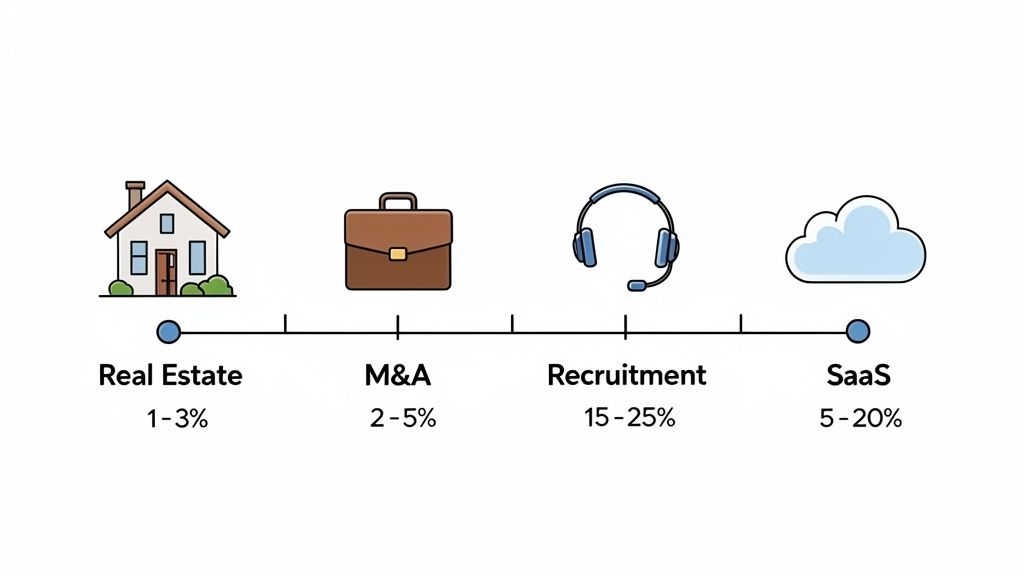
A real estate agent might get a small slice of a very large, one-time property sale. An M&A advisor, on the other hand, might negotiate an even smaller percentage, but on a massive multi-million dollar acquisition. These models are pretty clear-cut because they’re tied to a single, high-value transaction.
But SaaS is a different beast entirely. Here, the value isn't locked into a single purchase; it’s all about the recurring revenue that builds over time. This subscription model completely changes how a finder's fee percent should be structured. A 20% commission in SaaS might be paid out every month for a year, creating a totally different kind of motivation than a one-and-done payment.
To see just how different these models can be, let's look at some common benchmarks.
Typical Finders Fee Percentages Across Industries
Here's a quick comparison of what you can expect to see for finder's fees in a few major business sectors. Notice how the calculation basis and key considerations shift depending on the nature of the transaction.
| Industry | Typical Finders Fee Percent Range | Basis of Calculation | Key Considerations |
|---|---|---|---|
| Real Estate | 1-3% of the Agent's Commission | Total sale price of the property | High-value, one-time transaction. |
| M&A (Mergers & Acquisitions) | 1-5% of the Transaction Value | Total value of the acquisition or merger | Extremely high deal values, requires deep industry connections. |
| Recruitment | 15-30% of the Candidate's First-Year Salary | Candidate's annual salary | High-value placement, fee reflects talent scarcity. |
| SaaS | 10-30% of Recurring Revenue | Monthly or Annual Recurring Revenue (MRR/ARR) | Based on subscription value, often paid out over time. |
This table helps illustrate why a one-size-fits-all approach just doesn't work. The context of the deal is everything when it comes to setting a fair rate.
Why SaaS Is a Different Ballgame
That table really drives home a crucial point. While other industries focus on a single, big payout, the finder's fee in SaaS is all about the long game—it's tied directly to customer lifetime value. This recurring revenue model is what makes SaaS referral programs so incredibly effective.
The goal isn't just to reward a single introduction. It's to incentivize partners to bring in loyal, long-term customers who contribute to sustainable growth month after month.
Getting a handle on these industry benchmarks is your first step toward setting a rate that’s both fair and competitive. When you understand how your SaaS model fits into the bigger picture, you can build a program that attracts the right kind of finders and makes sure their success is tied directly to yours. That context is absolutely essential for creating a growth engine that can truly scale.
Navigating the Legal Landscape of Finder's Fees
Before you offer a single dollar for a referral, you need to understand the rules of the game. Handshake deals just don't cut it anymore. Today, finder's fees operate within a specific legal framework, and ignoring it is a recipe for disaster. The single most important thing to get right is the line between a "finder" and an unlicensed "broker."
A finder is a connector. They make an introduction, open a door, and then step back, leaving the actual deal-making entirely up to you. A broker, on the other hand, gets their hands dirty negotiating the terms. This might seem like a subtle difference, but legally, it's a chasm. Acting as an unlicensed broker can land you and your finder in serious hot water.
The Finder vs. Broker Distinction
Blurring this line can completely invalidate your agreement and expose your business to risks you don't want. In many places, anyone who negotiates a transaction for a fee needs a license. If your "finder" starts hopping on sales calls, talking about pricing, or helping you hash out the details, they've likely crossed that line.
Court cases have repeatedly driven this point home. Judges have forced unregistered finders who acted like brokers to give up their fees. In the M&A world, SEC rules are even stricter, limiting finders to just making introductions. The message is clear: keep your finder’s role confined to the introduction and nothing more.
Your Best Defense: A Written Agreement
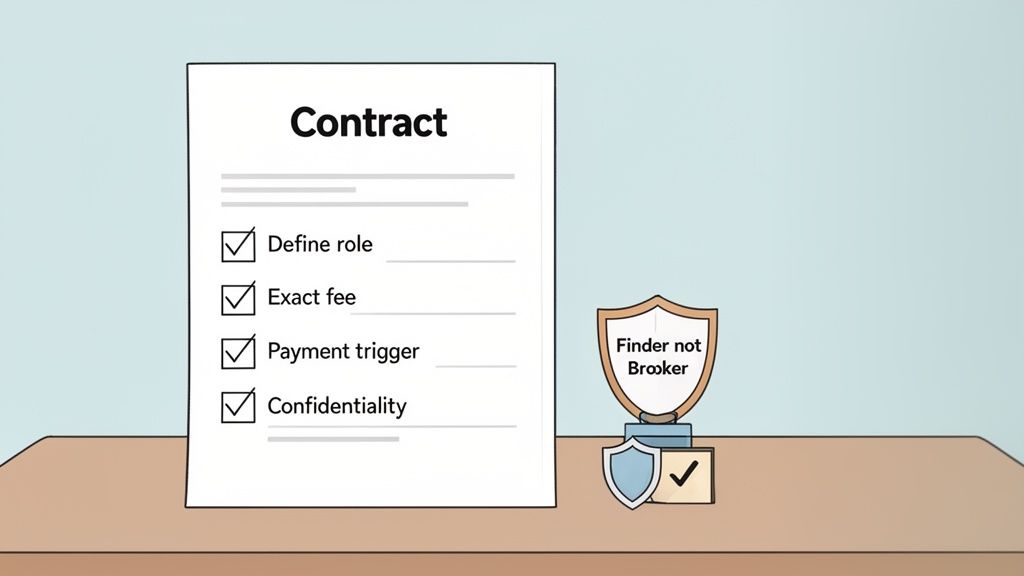
The only real way to protect yourself is with a clear, comprehensive, and legally sound written agreement. A verbal promise is not only risky but often completely unenforceable. Think of your contract as a shield that clearly defines the relationship and protects everyone from headaches down the road.
A well-drafted finder's fee agreement isn't just a formality—it's a foundational tool for risk management. It clearly outlines the scope of the relationship, ensuring your finder remains a finder and doesn't unintentionally become an unlicensed broker.
Every solid finder's fee contract needs to nail down a few key components:
- Clearly Defined Role: The agreement must state, in no uncertain terms, that the finder's only job is to make an introduction. Explicitly forbid any involvement in negotiations, pricing talks, or deal structuring.
- Specific Fee Structure: Spell out the exact finder's fee percent, what it's calculated on (e.g., first month's revenue, total first-year contract value), and the payment schedule.
- Payment Triggers: Define the exact moment the fee is earned. Is it when the contract is signed? When you receive the first payment from the new client? Be specific.
- Confidentiality Clause: You need language to protect any sensitive business information that might be shared during the referral process.
Since these are legal contracts, modern tools for AI contract review can be a huge help in spotting potential issues and ensuring compliance. If you're building out a more structured program, starting with a good affiliate agreement template can also give you a strong foundation. You can find a great example here: https://refgrow.com/affiliate-agreement-template
How to Set a Fair and Motivating Finder's Fee Rate
Ever wonder why one finder's fee is a modest 5% while another is a whopping 25%? It's not just a number pulled out of thin air. Setting the right finder's fee percent is a careful balancing act—you need to make the offer juicy enough to motivate people to send great leads your way, but also keep it sustainable for your own bottom line.
A rate that feels fair and genuinely motivating comes down to understanding the context behind the referral. You have to weigh the value of the deal, the effort involved, and how exclusive the connection is to land on a number that works for everyone.
Key Factors Influencing Your Rate
When you sit down to structure your fee, three main variables should steer the conversation. Each one tells you a piece of the story about what that referral is truly worth to your company.
- Total Deal Value: This is the big one. The size of the contract is almost always the most important factor. A massive deal can justify a huge payout, even if the actual percentage is on the lower end.
- Complexity of the Sale: How much heavy lifting did the finder have to do? A referral for a simple, self-serve plan doesn't require the same level of incentive as a personal introduction to a C-suite executive for a major enterprise sale.
- Exclusivity of the Lead: Was this a unique introduction that the finder spent months cultivating, or was it a name pulled from a public list? A warm, exclusive intro is worth its weight in gold and should be rewarded accordingly.
This idea of a connector adding serious value isn't new. Just look at the real estate world. For Sale By Owner (FSBO) homes, which skip the intermediary, account for only 6% of U.S. sales and sell for a median of $380,000. In contrast, agent-assisted sales hit a median of $435,000. That's proof that a good connector can boost the final deal value by over 14%. You can dig into more stats like this over at NAR's research page.
Putting It Into Practice with SaaS
Let's ground this in a real-world SaaS example. Imagine you get two very different referrals in the same week.
Scenario A: A finder introduces you to a small startup. They sign up for your $99/month basic plan. The sale was quick, and the annual contract value (ACV) is a neat $1,188.
Scenario B: Another finder brokers a warm introduction to a massive enterprise client. After multiple demos and a long sales cycle, they sign a $100,000 annual contract.
For Scenario A, a higher percentage feels right. Offering something like 20-25% recurring for the first year is a great motivator without breaking the bank.
But for Scenario B, a lower percentage makes more sense. A rate of 5-10% would result in a huge one-time payout of $5,000-$10,000. This generously rewards the finder for the high-value connection.
Juggling these factors is the key to a successful program. If you want to dive deeper into the mechanics, check out our guide on how to calculate commission percentage.
How to Calculate Finder's Fees for Your SaaS Business
Alright, let's move from the "what" to the "how." The real magic happens when you understand the math behind your finder's fee program. For a SaaS company, this isn't just about picking a number; it's about modeling different scenarios to see how a specific finder's fee percent actually plays out on your balance sheet.
The goal is to land on simple, repeatable formulas that you can apply consistently. Let's walk through three of the most common models with real numbers to make it crystal clear.
Model 1: The One-Time Payout
This is the most straightforward approach. A finder brings you a customer, you pay them once, and you're done. It's clean, simple, and gives the finder an immediate, chunky reward. This works especially well for annual-only plans where you get a large upfront payment from the customer.
- Scenario: A partner refers a new client who signs up for your $5,000 annual enterprise plan.
- Fee Structure: You've set a 20% one-time finder's fee.
- Formula:
Annual Contract Value (ACV) × Finder's Fee Percent = Payout - Calculation:
$5,000 × 0.20 = $1,000
Boom. The finder gets a $1,000 check. Simple as that.
Model 2: Recurring Commission on Subscriptions
Now we're talking SaaS. The recurring model is the engine of most modern partner programs because it perfectly aligns your finder’s goals with your own: long-term customer success. The finder keeps earning as long as the customer keeps paying.
- Scenario: A finder gets someone to sign up for a $200/month plan.
- Fee Structure: You offer a 25% recurring commission, paid out for the first 12 months of the subscription.
- Formula:
Monthly Recurring Revenue (MRR) × Finder's Fee Percent × Number of Months = Total Payout - Calculation:
$200 × 0.25 × 12 = $600
Here, the finder earns $50 every month for a year, adding up to $600. This model is brilliant because it naturally encourages partners to refer customers who will stick around, not just quick sign-ups that churn a month later.
By tying commissions to ongoing subscriptions, you create a powerful incentive for partners to refer customers who are a great fit for your product, directly improving your retention rates and lifetime value.
Model 3: The Tiered Structure for Your All-Stars
Want to really motivate your top performers? A tiered structure is your answer. It gamifies the referral process by increasing the finder's fee percent as partners hit certain milestones. This gives them a clear incentive to keep sending high-quality leads your way.
Here’s what a simple tier system could look like:
- Tier 1 (1-5 referrals): 20% commission
- Tier 2 (6-10 referrals): 25% commission
- Tier 3 (11+ referrals): 30% commission
This structure doesn't just reward activity; it rewards results. Your best partners feel valued and have a tangible reason to prioritize sending business to you over a competitor.
To help you visualize these different approaches, here's a quick breakdown of how each model applies in a typical SaaS context.
SaaS Finders Fee Calculation Models
| Calculation Model | Example Scenario | Formula | Total Payout |
|---|---|---|---|
| One-Time Payout | A referral signs an annual contract worth $10,000. The finder's fee is 15%. | $10,000 × 0.15 |
$1,500 |
| Recurring Monthly | A referral subscribes to a $150/month plan. The fee is 30% for the first year. | ($150 × 0.30) × 12 |
$540 |
| Tiered Performance | A top partner (Tier 3) refers a $300/month customer. Their tier earns 35% for a year. | ($300 × 0.35) × 12 |
$1,260 |
These models give you a solid foundation. If you want to dive deeper and model out more complex situations with different variables, check out our interactive SaaS commission calculator to experiment with your own numbers.
Building Your SaaS Finders Fee Program
A competitive finders fee percent is just the start. If you really want your program to take off, you need a solid operational plan that turns it from a manual headache into a genuine growth engine. This means getting rid of the spreadsheets and building a smooth, automated workflow for both you and your partners.
It all begins with a simple but legally sound agreement. This document is crucial for protecting everyone involved, clearly laying out roles, commission structures, and when and how people get paid. With the legal stuff sorted, the real work begins: making it incredibly easy for partners to sign up, track their referrals, and cash out.
From Manual Mess to Automated Success
Let's be honest: manually tracking referrals and calculating payouts is a recipe for disaster. It’s slow, prone to errors, and just doesn't scale. As your program grows, this approach will quickly fall apart. The key is to automate the entire process, creating a frictionless experience that builds trust and keeps your partners motivated.
Think about traditional finder's fees in real estate, where a single referral can earn 5% to 35% of the agent's commission. That's a nice one-time payout. But for SaaS, the model is much more powerful. A referred client bringing in $10,000 MRR on a 20% finder's fee means $2,000 in your partner's pocket every single month. That recurring revenue quickly dwarfs most one-off deals.
This is where specialized platforms become non-negotiable. When you're figuring out your program, it's worth learning how to choose an affiliate network because the right software makes all the difference. Tools designed for partner programs allow you to build a referral dashboard right inside your own app, which is a total game-changer.
The Power of Native Integration
Embedding your partner program directly into your product is a brilliant move. Instead of forcing partners to log into some clunky, third-party portal, you keep them engaged right inside your ecosystem. This native experience is powered by deep integrations that handle all the heavy lifting for you.
Here’s what that modern, automated system looks like in action:
- Seamless Onboarding: A new partner signs up and gets their unique tracking link from a dashboard that’s part of your app. No extra logins, no confusing new platforms.
- Automated Tracking: When a referred customer pays, webhooks from processors like Stripe instantly and accurately credit the right partner. No more "who gets credit for this?" debates.
- Real-Time Dashboards: Partners can see their clicks, conversions, and pending commissions update in real-time. This transparency is huge for building trust.
- Effortless Payouts: You can pay all of your partners with a single click using mass payout features, saving your team hours of administrative work.
This diagram breaks down the most common fee models you can build your program around.
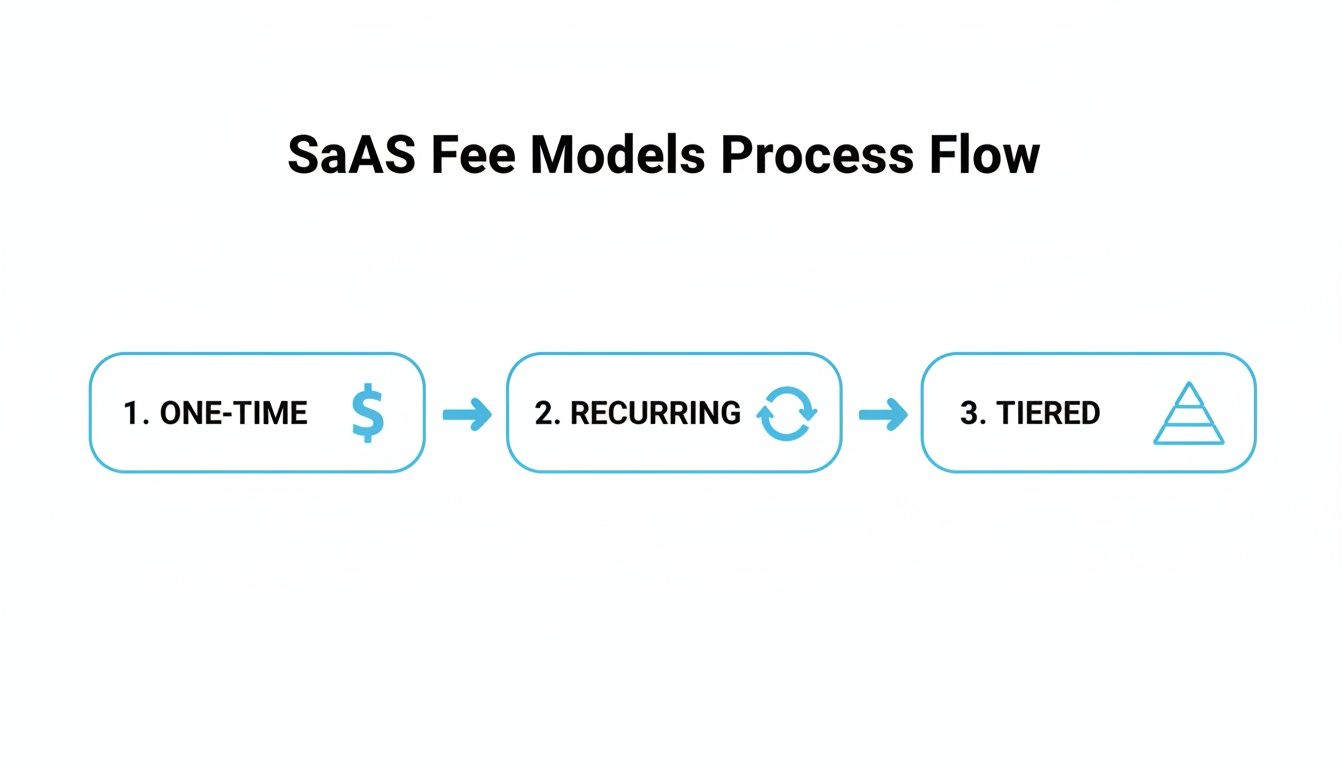
As you can see, SaaS companies have a ton of flexibility, from simple one-time payments for a new customer to recurring or tiered structures that reward partners for bringing in high-value, long-term business.
By automating these steps, you free up your team to do what they do best: recruit fantastic partners and scale the program. This kind of operational excellence is what turns a simple finder's fee incentive into a powerful acquisition channel that practically runs itself.
Common Questions About Finder's Fees
Even with the best-laid plans, questions always come up when you start putting a finder's fee program together. I've seen founders and growth leaders run into the same hurdles time and again, mostly around legal stuff, how to actually pay people, and what to call things. Let’s clear up the most common questions so you can move forward without tripping over these common pitfalls.
Getting these details right from the start is a big deal. A simple misunderstanding about payment terms or legal duties can balloon into a major headache down the road.
Are Finder's Fees Legally Binding?
Yes, but only if you have a clear, written agreement signed by both you and the finder. A handshake deal is just asking for trouble. When a dispute comes up—and they do—a verbal promise is incredibly difficult, if not impossible, to enforce. The contract is what gives the arrangement real teeth.
Think of the agreement as your single source of truth. It needs to spell out the exact finder's fee percent, the specific conditions that trigger a payout (e.g., "when the client pays their first invoice"), and what you expect the finder to do. Without that piece of paper, you’re leaving yourself wide open to arguments and legal challenges. Always, always get it in writing.
How Do You Pay a Finder's Fee for a Subscription?
When you're selling a SaaS subscription, you've got two main ways to structure the payout. The path you choose really depends on what you want to incentivize: the quick win of a new sale or the long-term value of a loyal customer.
- One-Time Payout: This is the straightforward approach. You can pay a single, upfront fee based on a multiple of the Monthly Recurring Revenue (MRR) or a slice of the Annual Contract Value (ACV). A common example is paying 100% of the first month's fee.
- Recurring Commission: The other option is to pay an ongoing percentage—say, 20% of MRR—for a set period, like the first 12 or 24 months of the subscription.
If you go the recurring route, an automated system isn't a luxury; it's a necessity. You need a reliable way to track subscriptions as they change (upgrades, downgrades, cancellations) and make sure payouts are on time, every time. This is critical for keeping your partners happy and maintaining trust.
The subscription model is where SaaS affiliate programs really shine. By offering recurring commissions, you align your partner's incentives directly with your own goal of acquiring loyal, high-value customers who stick around.
What Is the Difference Between a Finder's Fee and an Affiliate Commission?
People in the SaaS world often use these terms interchangeably, but there's a classic distinction between them that's helpful to know.
A finder's fee, in its traditional sense, was for a one-off payment for a very specific, high-value introduction. Picture big-ticket deals in real estate, M&A, or enterprise software, where a personal connection opens a door that would otherwise be closed. The whole point is the quality and exclusivity of that one introduction.
An affiliate commission, on the other hand, usually refers to ongoing payments inside a structured, scalable program. Here, partners (affiliates) use unique tracking links to promote a product to their audience. For most SaaS companies looking to build a scalable partner program, "affiliate program" is really the more accurate and modern term.
Do I Need to Issue a 1099 for a Finder's Fee?
This is one area where you can't afford to guess. Staying on the right side of the tax authorities is non-negotiable. The short answer is that it depends on where you are and how much you pay out.
Here in the United States, if you pay an individual (who is an independent contractor) $600 or more in a calendar year, you are required to issue them a Form 1099-NEC. This form reports their earnings to the IRS.
To handle this correctly, you should get a completed Form W-9 from your finder before you send them any money. That form gives you all their necessary taxpayer information.
But let's be clear: tax laws are complicated and they change. It's always smart to consult with a qualified tax professional to make sure you're buttoned up on all federal, state, and local rules. It protects your business, and it protects your partners.
Ready to build a powerful, automated referral program that runs right inside your app? With Refgrow, you can launch a fully native affiliate dashboard with just one line of code, eliminating friction and turning your best customers into your most effective growth channel. Start your free trial today and see how easy it is to scale.