

10 Channel Partner Management Best Practices for SaaS Growth in 2026

In the competitive SaaS landscape, relying solely on direct sales is a slow path to growth. Channel partners, including affiliates, agencies, and resellers, offer exponential reach, but managing them effectively is the difference between a powerful growth engine and a costly, disorganized distraction. Traditional partner management often fails due to misaligned incentives, poor communication, and a lack of transparent data. This guide cuts through the noise, providing 10 actionable channel partner management best practices designed for modern SaaS companies.
We'll move beyond theory to offer tactical steps and real-world examples you can implement today. You will learn how to build a scalable, high-performing partner ecosystem that drives predictable revenue. This includes everything from establishing clear incentive structures and comprehensive onboarding to fostering active communities and implementing transparent performance tracking. For businesses looking to scale efficiently, mastering these practices is not just an option; it's a fundamental requirement for sustainable growth. By the end of this article, you will have a clear roadmap for transforming your partner program from a secondary channel into a core pillar of your go-to-market strategy.
1. Establish Clear Partner Tiering and Incentive Structures
A one-size-fits-all approach to partner incentives rarely maximizes engagement. Implementing a tiered structure is a cornerstone of effective channel partner management best practices because it creates a clear path for growth and rewards high performance. By establishing distinct levels like Bronze, Silver, and Gold, you gamify the partner experience, motivating affiliates and resellers to climb the ladder for better rewards. This system directly acknowledges and compensates partners for their increasing contributions, fostering loyalty and sustained effort.

Companies like HubSpot and Stripe successfully use tiered programs to unlock exclusive benefits and features, incentivizing partners to deepen their expertise and commitment. Similarly, Refgrow users who implement multi-tier programs often report a 40-60% increase in partner engagement. This structure ensures that your top performers feel valued while giving newer partners a clear roadmap for success and higher earning potential. It transforms a simple transactional relationship into a strategic, long-term partnership.
Actionable Tips for Implementation
- Define Measurable Criteria: Set transparent, achievable metrics for each tier. For example, Silver status could require 10+ referrals per month or a total sales volume of $5,000.
- Automate Tier Progression: Leverage a REST API or webhook integrations (like those for Stripe or LemonSqueezy) to automatically track performance and promote partners to the next tier when they meet the criteria.
- Showcase the Benefits: Clearly display the rewards for each tier, including commission rates, marketing funds, and non-monetary perks like badges or featured placement, within your partner portal. For more ideas, you can explore various incentive compensation plan examples on Refgrow.com.
- Review and Iterate: Schedule quarterly reviews of your tier structure to gather partner feedback and adjust requirements based on performance data, ensuring the program remains fair and motivating.
2. Implement Comprehensive Partner Onboarding Programs
A partner's initial experience sets the tone for the entire relationship. A structured onboarding program is one of the most critical channel partner management best practices because it systematically equips partners with the knowledge and tools they need for success. This process goes beyond a simple welcome email; it’s a guided journey that covers your product, brand messaging, commission structures, and performance expectations. Effective onboarding reduces the time it takes for a new partner to become productive, minimizes early-stage frustration, and dramatically boosts long-term engagement and retention.

Leading SaaS companies excel at this. Slack's partner program, for example, includes deep dives into API documentation and certification, while Zapier offers interactive learning paths. Companies that invest in a robust onboarding sequence see partners ramp up 30-50% faster than those with minimal guidance. This initial investment in education ensures partners feel confident and capable, transforming them from passive affiliates into proactive brand advocates who drive meaningful revenue from day one.
Actionable Tips for Implementation
- Provide a Partner Playbook: Create a comprehensive guide with campaign examples, approved marketing assets, email templates, and key messaging points to ensure brand consistency.
- Use Short Video Tutorials: Develop brief (5-10 minute) videos covering essential topics like dashboard navigation, product demos, and how to claim commissions. Embed them directly into your partner portal.
- Schedule Kickoff Calls: Connect with new partners within 48 hours of signup. A personal welcome call helps build an immediate relationship and answers any initial questions.
- Create a Searchable Knowledge Base: Build an FAQ or resource center within the partner interface to provide instant, self-serve answers to common queries. For more guidance on setting up your program, explore these steps on how to start an affiliate program on Refgrow.com.
3. Build and Maintain a Centralized Partner Communication Hub
Fragmented communication is a silent killer of partner engagement. Establishing a single source of truth is a critical channel partner management best practice because it eliminates confusion, ensures all partners receive timely updates, and streamlines access to essential resources. A centralized hub prevents partners from hunting through emails or outdated documents, saving them time and reducing friction. This unified approach ensures every partner, regardless of location or tier, has the same accurate information, empowering them to represent your brand consistently and effectively.
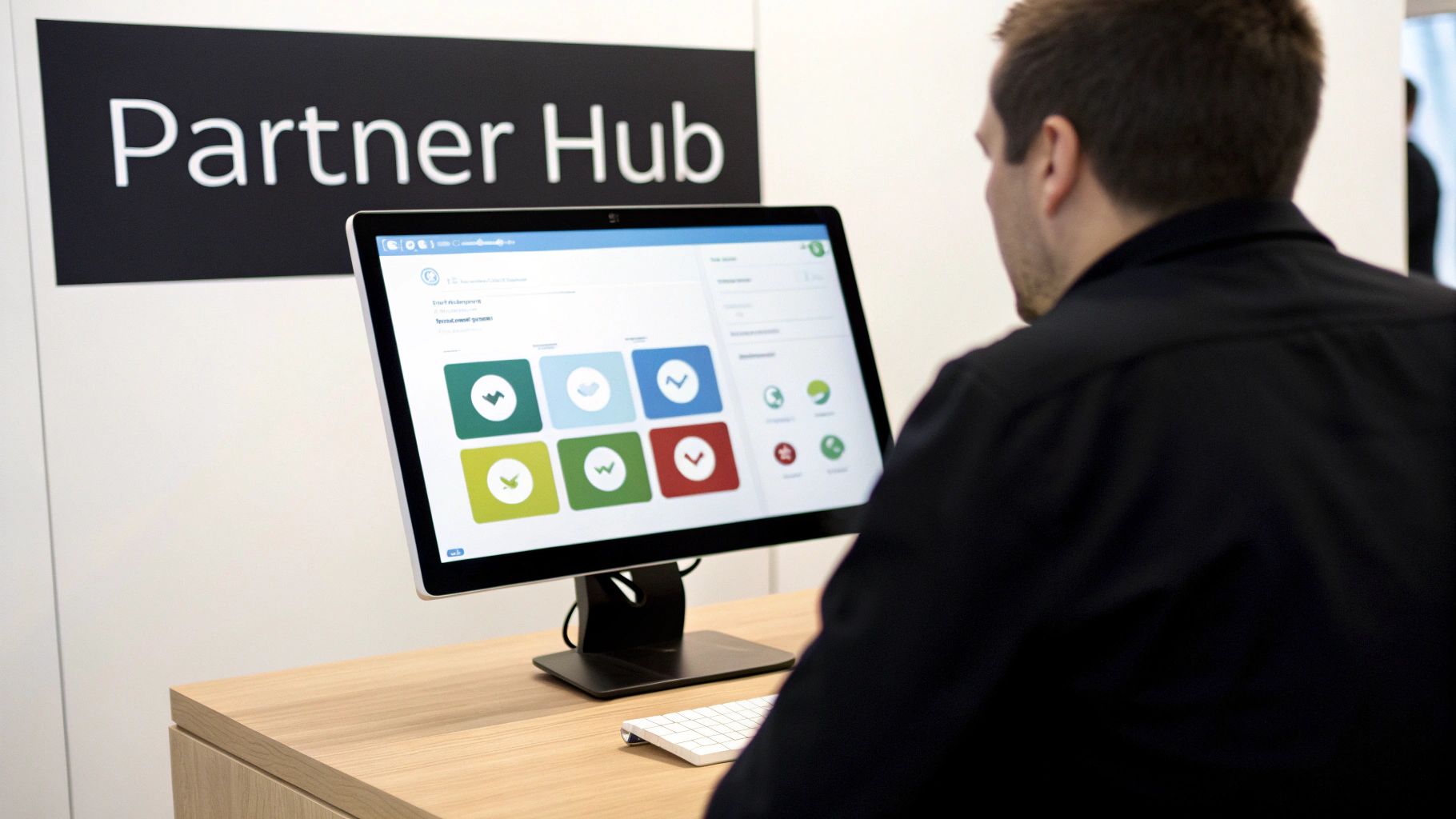
Companies like Figma and Airtable foster vibrant partner ecosystems through dedicated Slack communities, while enterprises often rely on robust portals like PartnerStack. A more integrated approach, however, involves using a native dashboard. Refgrow partners see higher adoption rates by embedding the communication hub directly into their product, creating a seamless experience. This strategy consolidates everything from performance dashboards and commission updates to marketing collateral and training materials in one easily accessible location, transforming your partner portal into an indispensable daily tool.
Actionable Tips for Implementation
- Embed the Hub Natively: Leverage tools like Refgrow to embed your partner dashboard and communication portal directly within your application, keeping partners engaged in your ecosystem.
- Establish a Communication Cadence: Create a predictable schedule for updates, such as weekly newsletters, monthly performance reports, and real-time product announcements, to keep partners informed and engaged.
- Segment Your Messaging: Tailor communications to different partner segments. Send targeted updates about commission changes, new marketing resources, or regional promotions to the relevant groups.
- Celebrate and Inspire: Regularly feature top performers, success stories, and case studies within the hub to create a sense of community, celebrate achievements, and motivate other partners.
4. Establish Performance Metrics and Transparent Tracking
Partners cannot optimize what they cannot measure. Establishing clear Key Performance Indicators (KPIs) and providing transparent, real-time tracking is a fundamental channel partner management best practice that builds trust and empowers partners. When partners have direct visibility into their performance-from clicks and referrals to conversions and commissions-they can make data-driven decisions to improve their strategies. This transparency removes ambiguity and aligns partner activities directly with your business goals.

Platforms like the Amazon Associates dashboard and Stripe Connect excel at this by showing partners live data on clicks, earnings, and transaction schedules. Similarly, Refgrow users can leverage granular tracking parameters and REST API access to offer partners detailed visibility. This approach transforms the relationship from a black box into a collaborative effort, where both sides can see what's working and identify areas for improvement. It fosters a sense of ownership and motivates partners to actively engage in optimizing their promotional efforts.
Actionable Tips for Implementation
- Create a Centralized Dashboard: Prominently display core metrics like total referrals, conversions, revenue generated, and pending payouts in your partner portal.
- Leverage Tracking Parameters: Use Refgrow's custom tracking identifiers or standard UTM parameters to capture campaign-level data, allowing partners to attribute success to specific marketing activities.
- Automate Performance Updates: Send automated weekly performance emails highlighting key metrics and trends to keep partners informed and engaged.
- Ensure Commission Transparency: Clearly show partners exactly how their earnings are calculated for each referral, breaking down the process to build confidence in your payment system.
- Sync Real-Time Data: Use Stripe or LemonSqueezy webhook data to sync transaction information directly to partner dashboards, providing immediate updates on conversions and revenue.
5. Create High-Quality Marketing Resources and Sales Enablement Materials
Equipping your partners with the right tools is as crucial as incentivizing them. Providing a comprehensive library of high-quality marketing assets and sales enablement materials empowers partners to represent your brand accurately and sell effectively. This proactive approach reduces their onboarding time, minimizes the need for constant support, and directly accelerates their path to the first sale. It's a fundamental channel partner management best practice that transforms partners into confident, self-sufficient extensions of your marketing team.
Companies like ConvertKit and Zapier excel at this by offering extensive resource libraries. ConvertKit provides affiliates with proven email swipes and social media templates, while Zapier gives partners access to over 100 email templates and messaging frameworks. This level of support ensures brand consistency and equips partners with proven strategies from day one, removing the guesswork and boosting their performance. Well-resourced partners are not just more effective; they are more engaged and loyal to your program.
Actionable Tips for Implementation
- Organize Resources Intuitively: Segment your asset library by partner type (e.g., agencies, content creators) and by use case. This helps partners quickly find the most relevant materials for their specific audience.
- Provide Versatile Copy: Offer messaging in multiple variations like short-form for social media, medium-form for emails, and long-form for blog posts. This allows partners to adapt content to their preferred channels.
- Create Campaign-in-a-Box Kits: Develop seasonal or event-based campaign kits (e.g., "Holiday Promotion," "Q4 Surge") with all necessary assets, including copy, graphics, and deployment instructions, for easy activation.
- Share Performance Data: Include proven metrics like high-performing subject lines or click-through rates alongside your assets. This builds partner confidence by showing them what a successful campaign looks like.
6. Implement Automated Payouts and Commission Management Systems
Manually calculating commissions and processing payouts is a significant administrative burden that introduces the risk of human error and payment delays. A core channel partner management best practice is to leverage technology to automate these financial workflows. An automated system handles commission calculations, payout scheduling, and financial tracking, ensuring partners are paid accurately and on time, every time. This reliability builds immense trust and boosts partner satisfaction, freeing your team to focus on strategic growth activities instead of tedious spreadsheet management.
Automating payouts directly impacts partner morale and retention. When partners know their compensation is handled promptly and transparently, they are more motivated to promote your products. For example, PartnerStack and Amazon Associates provide automatic monthly payouts with detailed earnings statements, eliminating guesswork. Refgrow users frequently report that implementing automated payouts via Stripe or LemonSqueezy integrations leads to a 30-50% reduction in partner payment disputes and administrative overhead. Automation transforms a potential friction point into a seamless, positive experience that strengthens the partnership.
Actionable Tips for Implementation
- Set a Clear Schedule: Establish a consistent payout schedule, such as the 15th and 30th of each month, and communicate it clearly in your partner portal.
- Integrate Payment Gateways: Use webhook integrations, like those available in Refgrow for Stripe and LemonSqueezy, to automatically sync sales data and trigger commission payouts without manual intervention.
- Provide Detailed Statements: Automatically generate and provide partners with detailed payout statements that break down each transaction, the commission rate applied, and any fees.
- Implement Payout Thresholds: Set a minimum payout threshold, like $50, to balance payment processing efficiency with partner convenience. For more details, you can explore how to set up recurring payments on Refgrow.com.
- Automate Tax Compliance: Use your system to automatically generate and distribute necessary tax documents, such as 1099 forms, to ensure compliance for both you and your partners.
7. Foster Active Partner Communities and Peer Learning Networks
Your partners are a valuable source of knowledge, not just a sales channel. Fostering an active community is one of the most powerful channel partner management best practices because it turns a one-to-many communication model into a vibrant, many-to-many ecosystem. By creating spaces for partners to connect, share successes, and solve problems together, you build a self-sustaining network that boosts engagement and retention. This peer-to-peer support system reduces your support load while creating powerful network effects that make your program more valuable to join.
Zapier’s partner network, with its active community forums and quarterly summits, exemplifies this approach. By facilitating direct interaction, they empower partners to learn from each other's expertise, leading to more innovative and effective strategies. Similarly, Refgrow users often leverage community features to create a 25-40% increase in partner activation rates within the first three months. An engaged community doesn't just sell your product; it becomes a powerful advocate, providing social proof and amplifying your brand’s reach through shared success stories.
Actionable Tips for Implementation
- Create a Dedicated Space: Launch a dedicated Slack channel or Discord server for your partners. Establish clear guidelines to keep conversations focused and productive.
- Host Regular Events: Schedule monthly "office hours" or virtual hangouts where partners can ask questions, share wins, and network with your team and their peers.
- Recognize Top Contributors: Implement a "Partner of the Month" spotlight within the community. Highlight successful campaigns and give public shout-outs to encourage participation.
- Facilitate Peer Learning: Start a dedicated channel like
#wins-and-tipswhere partners can share successful tactics, campaign ideas, and results, creating a living knowledge base.
8. Develop Segment-Specific Partner Strategies and Playbooks
Treating all partners as a monolith is a common mistake that caps your program's potential. An essential channel partner management best practice is to recognize that different partner types, from agencies to influencers, have unique motivations and needs. Creating tailored strategies and playbooks for each segment allows you to provide relevant resources, communication, and incentives, which significantly boosts engagement and effectiveness. This targeted approach ensures each partner feels understood and equipped for success.
Shopify and HubSpot excel at this by offering distinct programs for agencies, developers, and marketing partners, each with specific benefits and resources. For instance, Refgrow clients who differentiate between developer and marketer segments often see a 35% increase in partner-driven revenue. This is because a developer needs API documentation and SDKs, while a content creator needs social media assets and campaign briefs. A segment-specific strategy transforms your partner program from a general offering into a high-performance, specialized engine for growth.
Actionable Tips for Implementation
- Create Detailed Partner Personas: Develop profiles for each major segment, like 'Agency Ally' or 'Creator Chris,' to understand their goals, challenges, and preferred communication styles.
- Build Segment-Specific Playbooks: Craft dedicated guides for each persona that include proven tactics, messaging examples, and performance benchmarks. For agencies, provide white-label materials; for creators, offer social assets.
- Tailor Incentives and Resources: Use a flexible platform to offer segment-specific commission structures. For example, provide higher recurring rates for strategic technology partners versus one-time bonuses for referral affiliates.
- Assign Dedicated Managers: For high-value segments like enterprise consultants or top-tier agencies, assign a dedicated partner manager to provide personalized support and conduct quarterly business reviews.
9. Establish Regular Performance Reviews and Partner Feedback Loops
Leaving partners to operate in a vacuum is a recipe for disengagement and missed opportunities. One of the most critical channel partner management best practices is implementing a consistent cadence of performance reviews and feedback sessions. These structured check-ins transform the relationship from purely transactional to a collaborative partnership, allowing you to celebrate wins, address challenges head-on, and align on future strategies. This proactive communication ensures partners feel valued and supported, leading to greater loyalty and sustained performance.
Many top-tier companies build their programs around this principle. Salesforce, for example, conducts formal quarterly business reviews (QBRs) with its key partners to deep-dive into performance data and strategic planning. Similarly, Refgrow users who establish regular feedback loops report a 35-50% increase in partner retention, as consistent dialogue prevents minor issues from escalating and keeps partners aligned with company goals. This two-way communication is essential for continuous improvement and strengthens the foundation of your entire channel ecosystem.
Actionable Tips for Implementation
- Set a Clear Cadence: Schedule reviews in advance with a clear agenda. Plan for quarterly business reviews with top-tier partners and semi-annual or monthly check-ins for others, depending on their impact.
- Prepare with Data: Before each meeting, prepare a performance dashboard showcasing key metrics like referrals, conversion rates, and revenue generated. This data provides objective context for the conversation.
- Structure the Conversation: Organize reviews around three key themes: a recap of past performance and recent wins, a discussion of current challenges or blockers, and collaborative planning for future opportunities.
- Gather Post-Review Feedback: Send a brief survey after each review to capture partner satisfaction with the process. You can also implement a quarterly partner NPS (Net Promoter Score) to track overall satisfaction trends over time.
10. Implement Proactive Partner Support and Success Management
Moving from a reactive to a proactive support model is a critical channel partner management best practice that transforms the partner relationship. Instead of waiting for partners to encounter issues or ask for help, this approach involves anticipating their needs, offering timely guidance, and removing friction before it impacts their performance. By actively engaging with partners, you demonstrate a vested interest in their success, which significantly boosts engagement, loyalty, and long-term retention.
This strategy is effectively used by industry leaders. For example, Salesforce assigns dedicated partner success managers to high-value accounts, while HubSpot's team proactively sends campaign ideas and coaching to its partners. Similarly, platforms like Stripe Connect use data to identify unusual activity and reach out before a problem escalates. This shift from problem-solving to success-enabling makes partners feel valued and empowered, directly correlating to improved program outcomes and revenue growth.
Actionable Tips for Implementation
- Segment Partners for Support: Assign high-touch, dedicated support to your top-tier partners, moderate-touch engagement for mid-tier, and a light-touch, self-serve model for your entry-level partners.
- Set Up Automated Alerts: Use your CRM or partner platform to create triggers for key events like low activity, high performance (signaling an upsell opportunity), or churn risk, prompting your team to reach out.
- Schedule Proactive Health Checks: If a partner shows declining performance, schedule a call to understand their challenges and offer tactical coaching, sharing best practices and campaign ideas relevant to their situation.
- Celebrate Partner Wins: Acknowledge and publicly celebrate partner milestones, such as their first referral, reaching 10 sales, or earning their first $1,000. This positive reinforcement builds momentum and motivation.
Channel Partner Management: 10 Best Practices Comparison
| Initiative | 🔄 Implementation complexity | ⚡ Resource requirements | 📊 Expected outcomes | ⭐ Ideal use cases | 💡 Key advantages / tips |
|---|---|---|---|---|---|
| Establish Clear Partner Tiering and Incentive Structures | High — rule design, automation, ongoing governance | Medium–High — analytics, dev, program ops | Increased engagement, competition, higher revenue from top partners | Scaling programs that need motivation and differentiation | Aligns incentives; non‑capped earnings; tip: automate tier moves via Refgrow REST API |
| Implement Comprehensive Partner Onboarding Programs | Medium — content and workflow design | Medium — content creators, trainers, embedded tutorials | Faster time-to-productivity, fewer support requests, higher retention | New partner cohorts; varied partner skill levels | Standardize tiers; embed training in Refgrow dashboard; kickoff calls within 48 hrs |
| Build and Maintain a Centralized Partner Communication Hub | Medium — portal setup, governance, notifications | Medium — platform maintenance, content curation | Reduced miscommunication, scalable messaging, transparency | Distributed partners; multi-product programs | Single source of truth; use Refgrow native dashboard and a regular comms calendar |
| Establish Performance Metrics and Transparent Tracking | High — tracking infrastructure, attribution logic | High — analytics, integrations, data engineering | Builds trust, enables optimization, reduces disputes | Data-driven programs and attribution-sensitive sales | Surface core KPIs in dashboard; use Refgrow tracking params and webhooks for real-time data |
| Create High-Quality Marketing Resources and Sales Enablement Materials | Medium — content production & versioning | High — design, copy, localization, asset hosting | Higher partner effectiveness, faster time-to-first-campaign | Non-marketer partners; rapid campaign scaling | Provide ready-to-deploy assets; embed resources in Refgrow dashboard; include performance stats |
| Implement Automated Payouts and Commission Management Systems | High — payment integrations, tax/compliance, rules engine | Medium–High — engineering, finance integrations | Timely payments, fewer errors, lower operational overhead | Large partner bases; frequent or mass payouts | Integrate with Stripe/LemonSqueezy; offer clear payout schedules and detailed statements |
| Foster Active Partner Communities and Peer Learning Networks | Medium — community setup and moderation | Medium — community manager, events, content | Increased engagement, peer support, organic advocacy | Long-term retention, knowledge sharing, advocacy development | Run events, ambassador programs, and monthly challenges; highlight partner wins |
| Develop Segment-Specific Partner Strategies and Playbooks | High — persona research, tailored playbooks | High — dedicated content, managers, differentiated incentives | Better relevance, higher conversion, efficient resource allocation | Programs with diverse partner types (agencies, creators, devs) | Create partner personas and segment-specific playbooks; use Refgrow’s flexible commissions |
| Establish Regular Performance Reviews and Partner Feedback Loops | Medium — scheduling, prep, documented follow-up | Medium — partner managers, dashboards, reporting | Early issue detection, stronger relationships, growth opportunities | Strategic/top-tier partners and high-growth accounts | Use structured agendas (wins, blockers, opportunities); document actions with owners |
| Implement Proactive Partner Support and Success Management | High — monitoring systems, coaching workflows | High — partner success hires, tooling, alerts | Reduced churn, faster optimization, higher partner LTV | High-value partners or churn-sensitive segments | Segment support intensity; set automated alerts via Refgrow API for proactive outreach |
From Management to Partnership: Building Your Growth Ecosystem
Navigating the landscape of channel partner programs can feel complex, but the journey from basic management to a thriving partnership ecosystem is built on a foundation of deliberate, strategic actions. We have explored ten essential pillars, moving beyond generic advice to provide a tactical roadmap for growth. From establishing clear tiering and incentives to implementing comprehensive onboarding and proactive support, each practice serves a singular purpose: to empower your partners to become genuine extensions of your team.
The core theme connecting these strategies is a fundamental shift in perspective. Instead of viewing partners as a simple transactional sales channel, the most successful programs treat them as strategic allies. This means investing in their success through robust enablement materials, fostering collaboration through active communities, and building trust through transparent performance tracking and feedback loops. Effective channel partner management best practices are not about top-down control; they are about creating a mutually beneficial environment where friction is minimized and motivation is maximized.
Key Takeaways for Immediate Action
To transform your program, focus on these critical takeaways:
- Empowerment Over Control: Your primary role is to enable, not to micromanage. Provide the tools, resources, and support your partners need to succeed, and then trust them to execute. High-quality sales enablement and a centralized communication hub are your most powerful tools here.
- Clarity Breeds Confidence: Ambiguity is the enemy of a successful partnership. Ensure every aspect of your program, from commission structures and performance metrics to segment-specific playbooks, is clearly defined, easily accessible, and consistently communicated.
- Automation Unlocks Scale: Manual processes, especially for payouts and performance tracking, are unsustainable. Implementing automated systems frees up your team to focus on high-value activities like strategic planning, relationship building, and proactive partner success management.
- Community is a Competitive Advantage: A connected partner network is a motivated one. Fostering peer-to-peer learning and a sense of shared purpose creates a powerful network effect that strengthens loyalty and drives collective growth.
Your Next Steps to Building a Growth Ecosystem
Moving from theory to practice is the final, most crucial step. Don't attempt to overhaul your entire program overnight. Instead, adopt an iterative approach. Select two or three of the practices outlined in this article that address your most significant pain points. Perhaps that means formalizing your onboarding process or establishing a regular cadence for performance reviews.
Implement these changes, gather feedback directly from your partners, and measure the impact on key metrics like partner activation rates, lead quality, and revenue generated. By consistently applying these channel partner management best practices, you will cultivate a more engaged, productive, and loyal partner network. This network will evolve from a supplementary revenue stream into a powerful, self-sustaining growth engine that becomes a cornerstone of your long-term success.
Ready to embed these best practices directly into your product? Refgrow provides the native infrastructure to automate partner onboarding, tracking, and payouts, transforming your platform into a powerful growth ecosystem. Explore how Refgrow can help you build and scale a world-class partner program today.