

What is an affiliate code? A Clear Guide for SaaS Growth

Think of an affiliate code as a partner's unique signature. It's a special identifier—often a short word or phrase—that customers can use when they sign up or make a purchase. When they do, it instantly tells the business which partner sent them, making sure the right person gets credit for the new customer.
What Exactly Is an Affiliate Code?

At its core, an affiliate code is just a simple, effective way to track referrals that don't come from a click. Imagine your favorite podcaster mentions a SaaS tool they love. Since you can't click a link while listening, they might say, "Use my code PODCAST20 when you sign up." That code, PODCAST20, is the affiliate code.
It builds a direct bridge between the podcaster's recommendation and your action. This is the bedrock of performance-based marketing. Instead of sinking money into ads and hoping for the best, companies only pay a commission when an actual conversion happens. It’s a beautifully simple and efficient system.
A Small Code Powering a Huge Industry
This straightforward tracking mechanism is the engine behind the entire affiliate marketing world. In the US alone, spending is on track to hit a massive $15.8 billion by 2028. That’s a 65% jump from 2023, far outpacing the growth of e-commerce in general. If you're curious, you can dig into more industry statistics on affiliate marketing that show just how big this has become.
To give a clearer picture, let's break down the fundamentals.
Affiliate Code Fundamentals at a Glance
This table summarizes the key components of an affiliate code and how it works within a referral program.
| Component | What It Is | Primary Purpose |
|---|---|---|
| Unique Identifier | A distinct string of text or numbers (e.g., "PARTNER15"). | To connect a specific partner to a specific customer action. |
| Attribution Trigger | An input field at checkout or signup where the code is entered. | To capture the referral information at the point of conversion. |
| Tracking System | The backend logic that recognizes the code and links it to an affiliate's account. | To ensure accurate commission payouts and performance reporting. |
Essentially, these codes create a transparent, results-based partnership where everyone wins. The brand gets a new customer, and the partner gets rewarded for making it happen.
The core function of an affiliate code is to make the invisible visible. It transforms a word-of-mouth recommendation into a trackable, measurable, and compensable event.
For any SaaS or product-led company, this is incredibly valuable. It opens up a whole new world of marketing opportunities. With affiliate codes, you can:
- Track non-clickable referrals from podcasts, YouTube videos, or even conference talks.
- Attribute sales with confidence, knowing exactly which partners are driving results.
- Measure the true ROI of your influencer and community marketing efforts.
- Build a growth channel where your costs are directly tied to your revenue.
In the end, understanding affiliate codes is about grasping one of the most powerful levers for community-driven growth.
How Affiliate Codes Differ From Links and Promo Codes
It's easy to lump affiliate codes, affiliate links, and promo codes together, but they each have a specific job to do in your marketing strategy. While they can and often do work together, knowing what makes them different is crucial for building a referral program that’s both accurate and easy for everyone to use.
Think of it like giving credit to a salesperson at a store.
An affiliate link is like the salesperson walking a customer directly to the product and handing them over to the cashier—the connection is direct and automatic. A promo code is a generic "20% off" coupon from a flyer that anyone can use at the register. But an affiliate code is when you tell the cashier, "Hey, Dave sent me," making sure Dave gets his commission for the referral.
Comparing Tracking Methods Affiliate Code vs Link vs Promo Code
To really see the differences in action, it helps to compare them side-by-side. Each method has a distinct purpose, a unique way of tracking, and a different experience for the customer.
Here’s a breakdown of how they stack up against each other:
| Attribute | Affiliate Code | Affiliate Link | Promo Code |
|---|---|---|---|
| Primary Goal | Affiliate attribution & sales tracking. | Direct traffic & affiliate attribution. | Customer discount & conversion incentive. |
| User Action | Customer manually enters the code at checkout. | Customer clicks a URL to visit the site. | Customer manually enters the code at checkout. |
| Uniqueness | Always unique to a specific affiliate. | Always unique to a specific affiliate. | Often generic and shared widely. |
| Best Use Case | Non-clickable media (podcasts, videos). | Clickable media (blogs, emails, social). | General marketing campaigns and promotions. |
| Commission | Directly triggers an affiliate commission. | Directly triggers an affiliate commission. | Does not inherently trigger a commission. |
While they all look like tools to drive sales, only affiliate codes and links are built from the ground up to track and reward the partners who are actually bringing you new customers.
Affiliate Codes vs Affiliate Links
The biggest difference here is how the referral information is shared and used. Affiliate links are made for the web—they thrive in clickable environments like blog posts, emails, and social media feeds. The tracking info is baked right into the URL, so a user just has to click, and the technology takes care of the rest. If you want to get into the nuts and bolts, we have a whole guide on how to create an affiliate link.
Affiliate codes, on the other hand, shine where links can't go. They're perfect for any medium that isn't clickable.
This makes them incredibly valuable for channels like:
- Podcasts: A host can say, "Use code 'PARTNERPOD' at checkout!" It's simple and memorable.
- YouTube Videos: A creator can flash the code on-screen or mention it out loud.
- Live Events: A speaker can share their code with a live audience, making it easy to remember later.
A code’s real strength is that it’s portable and memorable. It captures referrals from conversations and real-world interactions that a link could never track. Yes, it requires the customer to type it in, but that small step is what bridges the gap and prevents those valuable referrals from getting lost.
An affiliate link is a passive, one-click tracking method. An affiliate code is an active, manual entry method. You really need both to capture referrals across all the different places your brand shows up.
Affiliate Codes vs Promo Codes
This is where the lines can get blurry, but the distinction is critical. A typical promo code—think "SUMMER20" or "SAVE15"—has one job: give the customer a discount to push them over the finish line. It's all about incentivizing that immediate purchase. While you can track how many times "SUMMER20" was used, the code itself tells you nothing about who was responsible for driving those sales.
An affiliate code, like "JANE10," is built differently. It's a two-in-one tool. It usually gives the customer a discount, but its most important function is to attribute that sale back to Jane, the affiliate. That's its entire reason for being. Every time "JANE10" is redeemed, your system knows to credit Jane with the referral and pay out her commission.
For SaaS teams especially, affiliate codes are the only way to build a true performance-based partnership program. It’s what turns a simple discount into a powerful, fully trackable referral engine that ensures your partners are rewarded fairly for every single customer they send your way.
The Technical Lifecycle of an Affiliate Code
So, what really happens when someone uses an affiliate code? It’s not just a simple discount. There's a whole automated journey working behind the scenes, from the second a code is created to the moment a commission lands in your partner's account. Let’s pull back the curtain on this process.
It all starts when a new partner, let's call her Jane, joins your affiliate program. Your system, whether it’s a platform like Refgrow or a custom solution, immediately generates a unique token for her—something memorable like JANE20. This isn't just a random string of characters; it’s a digital key that points directly to Jane's account in your database.
Capturing and Validating the Code
Now, fast-forward to a new customer hitting your checkout page. They type JANE20 into a field, and your system kicks into gear. The front end grabs that input and sends it to your backend to make sure it's legit. This verification usually plays out in one of two ways:
- URL Parameter: The code might be appended to the URL as the customer browses, and your application reads it when the page loads.
- API Call: More commonly, the checkout form makes a quick API call to your server, asking, "Hey, is
JANE20a real, active code?"
Your backend checks its records, confirms JANE20 is an active code tied to a valid partner, and gives the green light. At that point, the system tags the customer’s session with Jane's code, making sure she gets credit when the purchase is finalized. If you want to dive deeper into the nuts and bolts, you can explore the different approaches in our technical documentation on tracking.
This diagram helps visualize how affiliate codes fit into the broader tracking picture alongside links and promo codes.
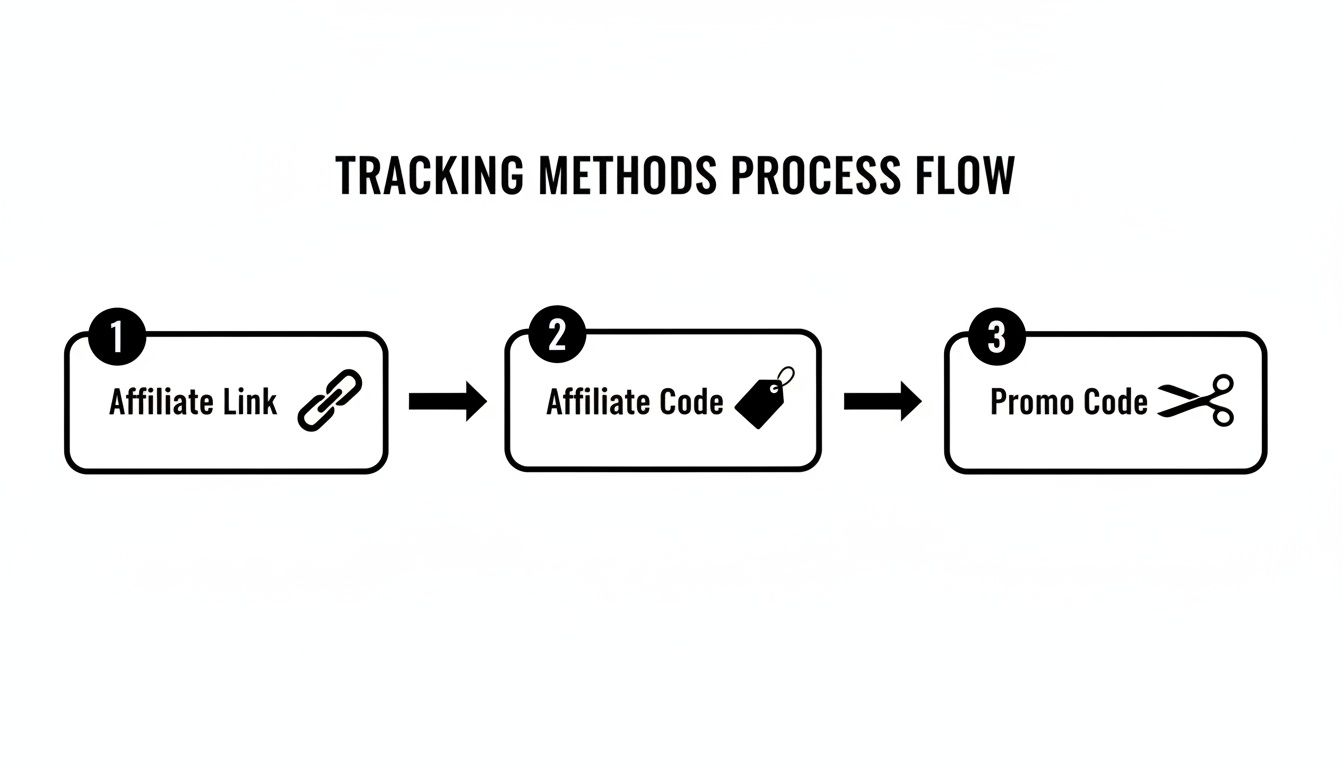
As you can see, affiliate links are a direct path, but codes require a manual entry step. This is precisely what makes them so valuable in places where you can't click a link, like on a podcast or in a video.
Confirming the Conversion with Webhooks
The final piece of the puzzle is confirming the payment went through successfully. This is where a modern payment processor like Stripe is indispensable. The moment the customer's card is charged, Stripe fires off a webhook—an automated message packed with transaction details—straight to your affiliate system.
A webhook is like a digital messenger. It instantly tells your system that a specific event you care about—in this case, a successful payment—has just happened.
Receiving this webhook is the trigger that closes the loop. Your system matches the transaction details to the user session tagged with JANE20. It then officially marks the conversion as complete, calculates the commission, and credits it to Jane’s account. It's a seamless, automated flow that ensures partners get paid accurately and on time, with zero manual work needed.
Why Affiliate Codes Are a Superpower for SaaS and PLG
For any modern SaaS company, especially those with a product-led growth (PLG) mindset, affiliate codes aren't just another tracking tool. They represent a fundamental shift in how you acquire customers. Instead of paying upfront for clicks or impressions and just hoping for results, you only pay for what actually matters: a new paying customer.
This performance-based model is a complete game-changer.
It dramatically lowers your marketing risk and guarantees that every dollar you spend on commissions directly maps back to real revenue. This is precisely why affiliate marketing delivers an average return of $6.50 for every $1 invested, making it one of the most efficient growth channels out there. You can dig into the full research behind these industry findings to see the data for yourself.
Ultimately, this model transforms your most passionate users and trusted creators into an authentic, scalable sales team.
Activating Your Community as a Growth Engine
Just think about it for a second. Who is the absolute best person to promote your product? It’s the people who already use it, understand it, and genuinely love it. Affiliate codes give these advocates a tangible way to share that enthusiasm.
An indie developer can hand a unique code to a popular blogger in their niche, or a PLG company can automatically generate codes for all its power users. Suddenly, that casual word-of-mouth recommendation becomes a measurable, rewarding activity for everyone involved.
An affiliate code is the bridge between a user's love for your product and their ability to be rewarded for sharing it. It makes word-of-mouth marketing trackable.
This approach also builds incredible social proof. A recommendation from a trusted source will always be more powerful than a banner ad. When a potential customer sees an influencer they follow or a peer they respect sharing a code, it comes with a built-in layer of trust and credibility that you just can't buy.
Creating a Seamless In-Product Experience
One of the biggest wins for SaaS companies is the ability to build a referral experience that feels completely native to the product. Let's be honest—clunky, third-party portals that yank users out of your application create a jarring experience and feel disconnected from your brand.
Modern platforms like Refgrow were built to solve this. They let you embed a fully functional affiliate dashboard directly inside your product.
This has a few massive benefits:
- It feels native: Your affiliates can grab their code, track their performance, and see their payouts all within your app's environment. This reinforces your brand and keeps them engaged.
- It reduces friction: Onboarding is instantaneous. A user doesn't have to go sign up for some other service; they can become a partner with a single click.
- It aligns with PLG: The referral program stops being a separate marketing channel and becomes a feature of the product itself, encouraging users to upgrade and share organically.
By weaving the affiliate program into the core product journey, you’re not just tacking something on. You're building a community-driven growth loop that feels like a natural extension of your product, creating a powerful and sustainable way to scale.
How to Launch Your Native Affiliate Program

The idea of building an affiliate program from scratch can feel like a massive engineering lift. But it doesn't have to be. With the right tools, you can get a fully integrated, native affiliate experience up and running in minutes, not months. The aim is to embed everything your partners need right inside your own product.
Believe it or not, the first step is often the easiest. An embeddable platform like Refgrow can integrate a complete affiliate dashboard with a single line of code. This gives your partners a branded portal inside your app where they can find their affiliate code, see their clicks, and track earnings without ever leaving your ecosystem.
Configuring Your Program Rules
With the technical part handled, you get to focus on strategy: defining your commission structure. This is where you decide exactly how you’ll reward partners for bringing you new business. The best rules are simple, competitive, and a perfect match for your business model.
A few proven models for SaaS companies include:
- Recurring Commissions: This is the gold standard. Giving partners a cut (say, 30%) of every subscription payment creates a predictable income stream that keeps them motivated for the long haul.
- One-Time Payouts: Simpler to manage, a fixed payout is great for one-off purchases but can be less appealing for partners promoting subscription products.
- Tiered Rewards: Why not reward your top performers? You can set up tiers that increase the commission percentage as partners hit referral milestones, giving them a clear incentive to send more customers your way.
Automating Tracking and Payments
Next up is connecting your payment system, like Stripe, via webhooks. This is where the magic really happens. When a customer pays, a webhook instantly pings your affiliate platform, which automatically attributes the sale and calculates the commission. This completely eliminates manual tracking, ensuring everything is accurate and saving you a ton of time.
The real power of a native program is in its automation. By connecting your payment gateway, you create a self-sustaining system where conversions, tracking, and commissions all happen in real time—no human intervention needed.
Finally, you’re ready to bring on your first partners. A great place to start is with your most passionate users or by reaching out to a few key influencers in your niche. Get them set up with their unique affiliate code and any marketing materials they might need.
For a more detailed walkthrough, our guide on how to start an affiliate program breaks down every step. And for broader growth strategy ideas to complement your launch, you can find great content over at the domino Blog for Affiliate Program Insights.
Best Practices for Managing a Successful Program
Getting your affiliate program off the ground is one thing, but turning it into a real growth driver takes consistent effort. The secret isn't just in the tech; it's about building strong, trusting relationships with your partners. It all comes down to creating a system that’s transparent, supportive, and fair for everyone.
First things first: your commission structure needs to be dead simple to understand. Your affiliates should know exactly what they’re earning, whether it's a one-time fee or a recurring percentage, and when they can expect to get paid. To keep everything above board, you'll want a rock-solid Affiliate Agreement in place. This document is your best friend for setting clear expectations and protecting both your business and your partners.
Empowering Your Affiliates for Success
Think of your affiliates as an extension of your marketing team. Just handing them a code and wishing them luck won't cut it. You have to arm them with the tools they need to succeed.
Make their job easy by providing a full promotional toolkit:
- Brand Assets: Give them access to high-res logos, polished product screenshots, and ready-to-use banners.
- Key Talking Points: Spell out your core value propositions so their messaging is always on point.
- Product Updates: Keep them in the loop about new features so their content is always fresh and accurate.
Think of your affiliates as trusted collaborators. The more you invest in their success by providing them with the right tools and information, the more effectively they can represent your brand and drive meaningful results.
Protecting Program Integrity and Building Trust
As your program scales, you'll need to keep a close eye on its integrity. Putting some basic fraud prevention in place is non-negotiable. This means watching for red flags, like a sudden, massive spike in sign-ups from one affiliate, which could signal fraudulent activity.
Finally, nothing builds trust faster than getting paid on time, every time. Automating your payouts removes any doubt and shows your partners you value their work. And of course, staying compliant with privacy laws like GDPR is essential. When you nail transparency, support, and security, your affiliate program becomes more than just a sales channel—it becomes a thriving community that drives real growth.
Common Questions About Affiliate Codes
As you start wrapping your head around affiliate codes, a few questions almost always come up. Getting these sorted out helps paint a much clearer picture of how these codes really function in a modern marketing strategy. Let's dive into the most common ones.
A big one is whether an affiliate even needs a website. The short answer? Absolutely not. This is exactly where codes shine. While links need a place to be clicked, codes are perfect for the real world—think podcasts, live streams, or even just word-of-mouth. This opens up your partnership opportunities to a whole new universe of creators.
Do Affiliate Codes Expire?
People also wonder if these codes have a shelf life. Generally, the affiliate code itself—the unique part that links back to the partner—doesn't expire. It’s permanently theirs.
What can expire is the special deal or discount attached to it. For instance, the code JANE20 might give customers 20% off, but only for the month of July. After July, the discount is gone, but the code JANE20 still works perfectly to credit Jane for any sales she sends your way.
The core identifier—the affiliate code—is timeless. It’s the promotional offer attached to it that may have a limited lifespan, giving businesses flexibility for seasonal campaigns.
Can a Customer Use Two Codes at Once?
This is another classic question. Can a customer stack codes for a super discount? In nearly every e-commerce or SaaS platform, the answer is no. The checkout system is almost always built to handle only one code per order.
This setup prevents what's known as "discount stacking," which could otherwise eat away at your margins. So, if a customer tries to use an affiliate code and a separate promo code, the system will almost always just accept the first one they typed in. It’s a standard practice that keeps pricing predictable while still making sure partners get their credit.
Ready to launch a native affiliate program that lives inside your product? Refgrow makes it simple. Embed a fully branded affiliate dashboard with just one line of code and start building your growth engine today.