

What Is a Referral Code and How Does It Drive Growth
A referral code is really just a unique tracking ID that lets your happy customers invite their friends, with a built-in reward for both of them when the new person signs up. Think of it as a digital handshake between your brand, your loyal customer, and a potential new fan. It turns your existing user base into a genuine, powerful acquisition channel.
Decoding the Referral Code
So, what is a referral code at its core? It's a surprisingly simple tool that puts a turbocharger on your word-of-mouth marketing. It isn't just a random jumble of letters and numbers; it's the engine that tracks who sent whom, rewards that loyalty, and helps drive sustainable growth.
From brand-new SaaS startups to e-commerce giants, these codes are a cornerstone of modern growth playbooks.
This simple idea has fueled some incredible expansion. The global referral market was valued at USD 5.0 billion and is on track to more than double, hitting a projected USD 11.15 billion by 2032. The "why" behind this growth is even more compelling: customers who come from a referral have a 16% higher lifetime value (LTV) and convert at a 37% better rate than users from other channels. You can dig into more stats on this trend in this detailed referral market report.
Key Components of a Referral System
To really get how these codes work, it helps to break the whole system down into its moving parts. Each piece has a specific job to do, turning a casual recommendation into a trackable, rewarding event.
Let's quickly summarize the key parts of a referral code system in a table.
Referral Code At a Glance
| Component | What It Is | Primary Goal |
|---|---|---|
| The Advocate | An existing, happy customer who shares your product. | To initiate the referral process by sharing their code. |
| The Unique Code | The special alphanumeric ID assigned to the advocate. | To track the referral back to the specific advocate. |
| The New User | The friend or colleague who receives and uses the code. | To sign up or make a purchase using the provided code. |
| The Reward System | The incentive (e.g., discount, credit) for both parties. | To motivate sharing and encourage the new user to convert. |
Breaking it down this way shows how each element works together to create a seamless loop.
Here’s a slightly deeper look at those components:
The Advocate: This is your current, satisfied customer—the one who genuinely likes your product enough to tell their friends about it. They are the spark that ignites the entire referral loop.
The Unique Code: This is that special string of letters and numbers generated just for the advocate. It acts like a digital fingerprint, making sure any new sign-ups are correctly linked back to the person who sent them.
The New User: Often called the friend or referee, this is the person who gets the code from the advocate. They use it when they sign up or buy something to get their side of the deal.
The Reward System: This is the incentive structure you create. It’s what makes the whole thing worthwhile for everyone involved, whether it's a discount, some account credit, or even unlocking a cool new feature.
How a Referral Code Works from Share to Reward
So, what actually happens when someone uses a referral code? It’s not magic, but it’s close. The whole journey, from a happy customer sharing their code to a new user getting a perk, follows a simple, trackable path.
Think of it like a digital handshake. A unique code is created for your existing customer (the advocate). They pass this code to a friend. When the friend uses it, your system instantly recognizes the code, finds the original advocate, and gives them a high-five for bringing in a new customer. Then, both of them get their reward.
The Step-by-Step Referral Journey
The process behind a referral code can be broken down into four key stages. Each step is crucial for turning a casual recommendation into a measurable win for everyone. It’s all about making sure every action is logged and credited to the right person.
This simple flow shows how the code connects the dots between your advocate, their friend, and your product.
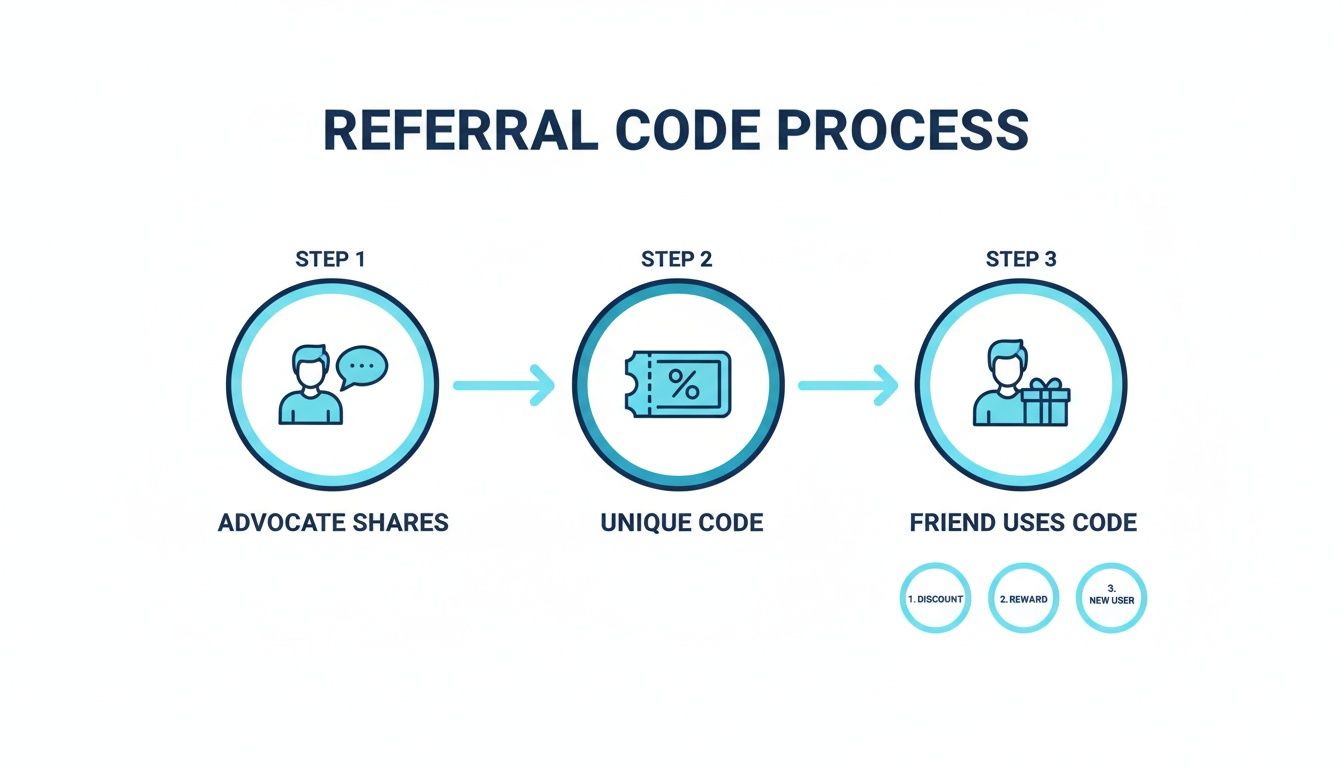
Here's a closer look at how it all unfolds:
Code Generation and Sharing: It starts when an existing user finds their unique code inside your app or on their account page. They can then easily copy and paste it into a text, email, or social media post to share with a friend who they think would love your product.
Code Redemption: The friend signs up or gets to the checkout and pops the referral code into the promo box. This single action is the trigger. It tells your system, "Hey, this new person came from over there!" and links them back to the original advocate.
Attribution and Verification: This is where the behind-the-scenes work happens. Your system checks if the code is valid and confirms the new user meets the rules of your program—for instance, making sure they're a first-time customer or completed a specific action. This step is all about attribution. If you want to dive deeper into how different touchpoints get credit, this Attribution Modeling Guide is a great resource.
Reward Fulfillment: Once everything checks out, the rewards are sent out automatically. The advocate might get a credit applied to their next bill, and the new user instantly sees their discount. No manual work needed.
This entire process hinges on accurate tracking. To get into the nuts and bolts of the technology, check out our guide on referral program tracking.
Key Takeaway: The power of a referral code lies in its ability to automate trust. It transforms a personal recommendation into a measurable marketing event, creating a seamless and rewarding experience that benefits the brand, the advocate, and the new customer.
The Real Business Impact of Referral Programs
Beyond the nuts and bolts, the real magic of a referral code is what it does for your bottom line. For a SaaS company, a referral program isn't just another item on the marketing checklist; it's a strategic engine that can fundamentally change how you grow.
Think about it. Instead of just pouring more money into the unpredictable world of paid ads, you're empowering your best customers to become your most effective sales force. This completely rewrites the economics of your growth model.
Slashing Your Customer Acquisition Costs
One of the first and most powerful benefits you'll see is a nosedive in your Customer Acquisition Cost (CAC). Fighting for attention on paid channels like Google or social media ads is a costly and often brutal game.
A referral program, on the other hand, taps into something far more powerful: trust. Your existing users are doing the hard work of finding and pre-qualifying leads for you. The result? A much lower, more predictable cost to bring on a new customer, freeing up your budget for other critical growth areas.
There's no marketing more powerful than a recommendation from a trusted friend. It cuts through the noise and skepticism of traditional advertising because it comes with built-in social proof.
That inherent trust is the secret sauce. When a friend suggests a tool, the typical sales guards come down. Their endorsement is a shortcut through the entire evaluation process, leading to conversions that are both faster and of higher quality.
Boosting Your Customer Lifetime Value
Here’s where it gets even better. Customers who come in through a referral aren't just cheaper to acquire—they're more valuable over the long haul. The data is clear: they stick around longer and have a higher Customer Lifetime Value (LTV).
It makes perfect sense when you think about it. These new users don't start from zero. They arrive with a positive impression and a good grasp of your product's value because their friend already sold them on it. They begin their journey with a foundation of trust, which translates directly to better engagement and retention.
The proof is in the numbers. The referral market is now valued at a staggering USD 10.3 billion, and it’s growing for a reason. Research shows that referred users consistently deliver:
- A 16% higher LTV
- A 37% better conversion rate
- A churn reduction of 18%
These aren't minor tweaks; they're significant, compounding advantages. You can dive deeper into the growth of the referral market here.
Ultimately, a well-run referral program, driven by a simple code, creates a powerful, self-sustaining growth loop. You attract better customers for less money, who then stay longer, and are more likely to become advocates themselves—kicking off the cycle all over again and fueling real, organic growth for your business.
How to Launch Your First Referral Program
Alright, you see the value in referral codes and you're ready to put them to work. What’s next? Getting your program off the ground comes down to one big question: do you build it yourself, or do you plug in a tool that’s built for the job?
This isn’t just a technical puzzle; it’s a strategic fork in the road. The path you choose will directly affect how quickly you can launch, how much you’ll spend, and who on your team is responsible for keeping it running. Let's dig into what each option really means for your SaaS.
The Two Paths to Implementation
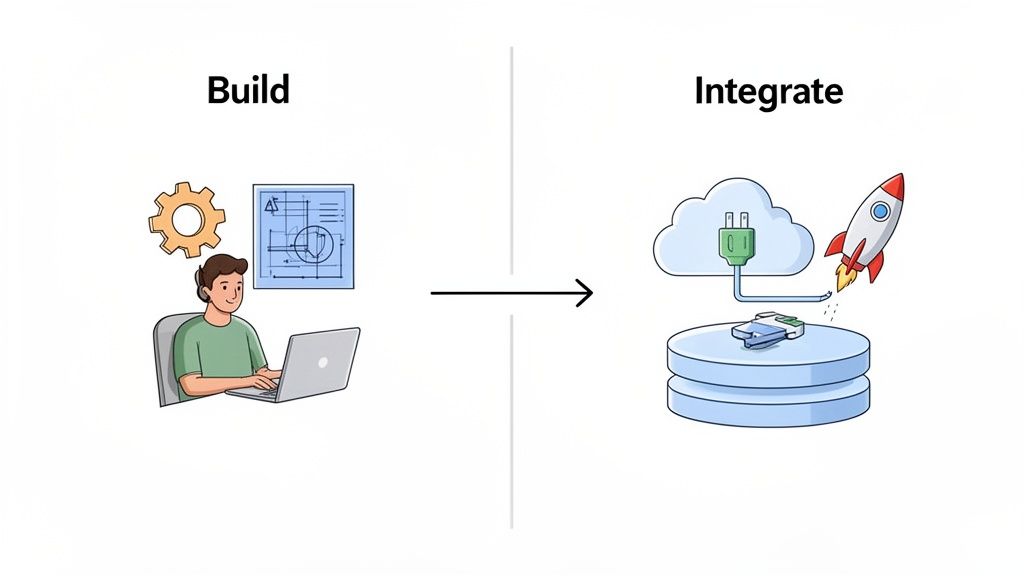
Think of it like this: you can either build a custom car from scratch or lease a high-performance model that’s ready to drive off the lot. Building gives you total control, but leasing gets you on the road immediately with features you might not have time to engineer yourself.
Here's the breakdown of your two main options:
Build It In-House (The Native Solution): This is the DIY route. You task your engineering team with architecting, coding, and launching a referral system from the ground up. The big upside? You get complete control to shape the user experience and tailor every last detail. The downside is that this path demands serious development hours, not to mention the ongoing work of squashing bugs, adding features, and handling things like fraud detection.
Integrate a Third-Party Tool: This is the "plug-and-play" approach. You use a dedicated referral marketing platform like Refgrow that's already solved all the hard problems. These tools come with ready-made dashboards, battle-tested tracking, and advanced security. Implementation is way faster—you can often get a program live with just a few snippets of code.
Building In-House vs Using a Third-Party Platform
So, which path is right for your team? To really make a smart call, you need to see how these two approaches stack up against each other. What works for a large enterprise with a dedicated growth engineering team is probably overkill for an early-stage startup trying to find product-market fit.
This table gives you a head-to-head comparison to help you weigh the pros and cons based on what matters most to your business right now.
| Criteria | Building Native (In-House) | Using a Third-Party Tool (e.g., Refgrow) |
|---|---|---|
| Time to Launch | Months of development and testing. | Hours or days for basic setup. |
| Initial Cost | High (engineering salaries, resources). | Low (a predictable monthly subscription). |
| Ongoing Maintenance | Constant effort for bug fixes and updates. | Included in the service. Zero dev overhead. |
| Feature Set | Limited to what you can afford to build. | Advanced features out of the box (fraud detection, analytics). |
| Customization | Total control, but you have to build it all. | Highly customizable, but within a tested framework. |
A native build gives you the ultimate in control, but a third-party tool delivers speed, advanced features, and reliability from day one. For most SaaS companies, the opportunity cost of pulling engineers away from the core product makes a dedicated platform the smarter, more efficient choice.
Ultimately, this decision comes down to your team’s bandwidth and priorities. If your main focus is on nailing the core product, a third-party solution lets you launch a professional-grade referral program without the distraction. You can start testing ideas and gathering data immediately.
Of course, a smooth launch is only half the battle. You also need to make sure your rewards are compelling enough to get people talking. To get that part right, check out our guide on crafting effective referral program incentives and make sure your program truly motivates users.
Best Practices for a High-Performing Referral Program
Just launching a referral program won't guarantee new sign-ups. The ones that truly move the needle are built with a deep understanding of human psychology—they’re designed to be engaging, trustworthy, and incredibly easy to use.
Think of it like paving a road. If you want people to travel it, you need to make it smooth, clear, and direct. A bumpy, confusing path will just get ignored. These best practices are the paving stones for a frictionless journey to real growth.
Design Irresistible Double-Sided Incentives
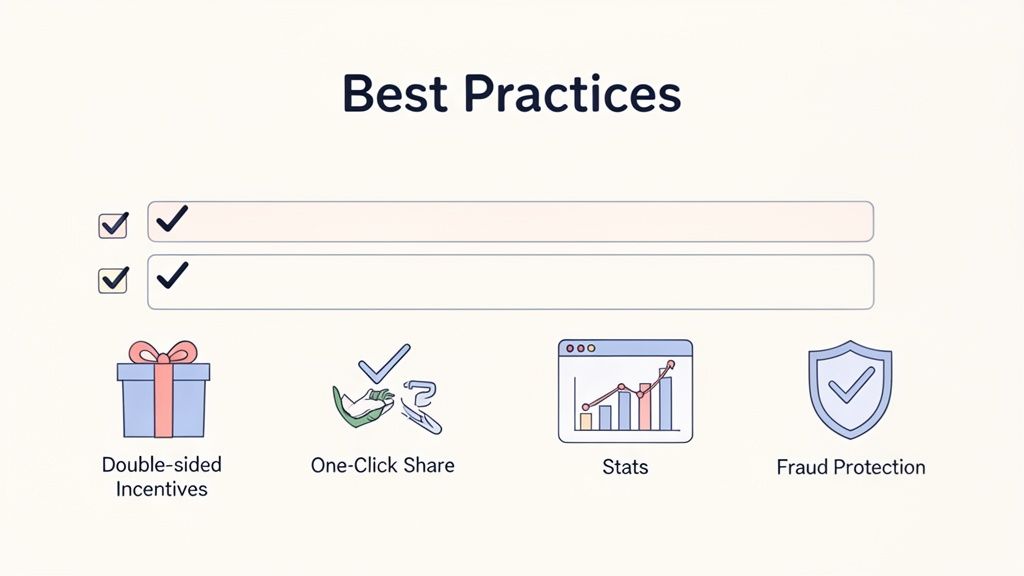
This is the single most powerful strategy you can use: reward both people. A double-sided incentive gives something to your current customer (the advocate) for spreading the word and a little something to their friend for signing up. This completely reframes the interaction from a selfish act ("I get a reward") to a generous one ("We both get a reward").
Suddenly, sharing feels like giving a gift, which dramatically increases the odds of it happening. For a SaaS company, this could look like:
- Advocate: Gets a $20 credit on their next bill.
- New User: Gets an extended 30-day free trial instead of the usual 14.
It’s a classic win-win that makes sharing feel good. You can find plenty of creative examples of successful referral programs to spark ideas for your own incentives.
Make Sharing Absolutely Effortless
Your users are busy. If they have to hunt for their referral code or jump through hoops to share it, they simply won't. The goal should be a frictionless sharing experience—make the code dead simple to find, copy, and send.
Don't bury it. Place the referral option in an obvious, high-traffic spot in your app, like the main dashboard or account menu. Go a step further by providing pre-written messages and one-click share buttons for email, social media, and messaging apps. The less work you make it, the more referrals you'll see.
Promote Your Program in the Right Places
A great referral program that no one knows about is useless. You have to get the word out, especially to your happiest and most engaged users.
Here are a few high-impact places to promote it:
- Welcome Emails: Introduce new users to the program right after they sign up.
- In-App Notifications: Pop up a friendly reminder for active users about the perks of referring.
- Post-Purchase Messages: The perfect time to ask is right after a customer has had a positive experience, like upgrading their plan.
Consistent promotion keeps your program top-of-mind. And the numbers show why it's worth the effort. The referral market hit USD 3.56 billion in 2023 for a reason. Customers who come from a referral have a 37% higher retention rate and are 4x more likely to refer someone else, which kicks off a powerful growth loop. If you're curious, you can discover more insights about the referral management market on snsinsider.com.
Crucial Insight: Your most active users are your best advocates. Time your promotional prompts to moments of high satisfaction—like when a user hits a key milestone in your app—to catch them when they're most likely to share their positive experience.
By focusing on these core principles—great incentives, zero friction, and smart promotion—you can build a referral program that doesn't just exist but becomes a powerful, self-sustaining engine for your business.
Got Questions About Referral Codes? We've Got Answers.
When you start digging into referral programs, the high-level concept is easy to grasp, but the practical questions pop up fast. How do they actually work? What's the difference between a code and a link? How do you stop people from cheating the system?
Let's get into the nitty-gritty. Think of this as the practical FAQ for founders and product teams who are ready to move from idea to execution.
What's the Difference Between a Referral Code and an Affiliate Link?
It's a common point of confusion. At first glance, referral codes and affiliate links seem like they do the same thing, but they're built for different scenarios and user behaviors.
A referral code is that short, easy-to-remember string of text you can tell a friend about, like 'JANE20'. It’s perfect for verbal sharing or quick messages where a long, clunky URL would be a pain. The new user has to manually type it in during signup or at checkout.
An affiliate link, however, is a full-blown URL with special tracking parameters baked in. When someone clicks it, a cookie is dropped in their browser that automatically credits the affiliate for any sale that follows. This is the go-to method for bloggers, partners, and influencers who drive traffic through content.
The Modern Approach: The best referral systems today don't make you choose. They generate a unique shareable link that automatically applies the code when clicked. This gives new users a frictionless experience while still providing a simple code for those "hey, you should check this out" conversations. It's the best of both worlds.
How Do I Choose the Right Reward for My Program?
The secret here is to offer a reward that deepens the user's relationship with your product, not just gives them a generic handout. A great incentive reinforces your product's value and encourages people to stick around.
For a SaaS business, this usually means rewards tied directly to your service. A few ideas that always work well:
- Account Credits: A discount on their next bill is simple, direct, and always appreciated.
- Feature Unlocks: Giving access to a premium feature is a fantastic way to let users experience more of what you offer.
- Upgraded Plans: A free month on a higher-tier plan can get a user hooked on more powerful functionality.
And here’s the most important tip: always use double-sided incentives. That means the referrer and their friend get something. This completely changes the dynamic. It turns sharing from a selfish act into a helpful gift, a move that consistently supercharges conversion rates.
Can Referral Programs Be Gamed or Abused?
Oh, absolutely. Referral fraud is a real thing, but it's totally manageable if you're smart about it. People will try to refer themselves with fake emails or spam their codes on coupon sites against your terms. It happens.
Luckily, you don't need a digital fortress to stop them. A few basic safeguards work wonders. You can implement simple checks like IP address monitoring to catch multiple signups from the same device. It’s also a great practice to delay the reward payout until the new user proves they're legitimate—maybe after they become a paying customer or stay active for 30 days. Most dedicated referral platforms, like Refgrow, also have built-in fraud detection that flags suspicious activity for you automatically.
When Is the Right Time to Launch a Referral Program?
Timing is everything. Jump the gun, and you'll be shouting into the void. Wait too long, and you're leaving growth on the table. The sweet spot is right after you've hit product-market fit.
Remember, a referral program is an accelerator, not a magic fix for a leaky bucket. It amplifies the love that already exists for your product. If you're getting glowing feedback, retention is strong, and you're already seeing some organic word-of-mouth, that's your green light. Those happy users are your future champions—a referral program just gives them the tools and the nudge they need to get started.
Ready to turn your happy customers into your most powerful growth engine? Refgrow makes it easy to launch a fully native, embeddable referral program directly inside your SaaS product with just one line of code. Start building your growth loop today at https://refgrow.com.