

How to Market Your Online Business for Sustainable Growth
Growing an online business that lasts isn't about chasing the latest shiny marketing trend. It's about building a solid, repeatable system that consistently brings in the right kind of customers.
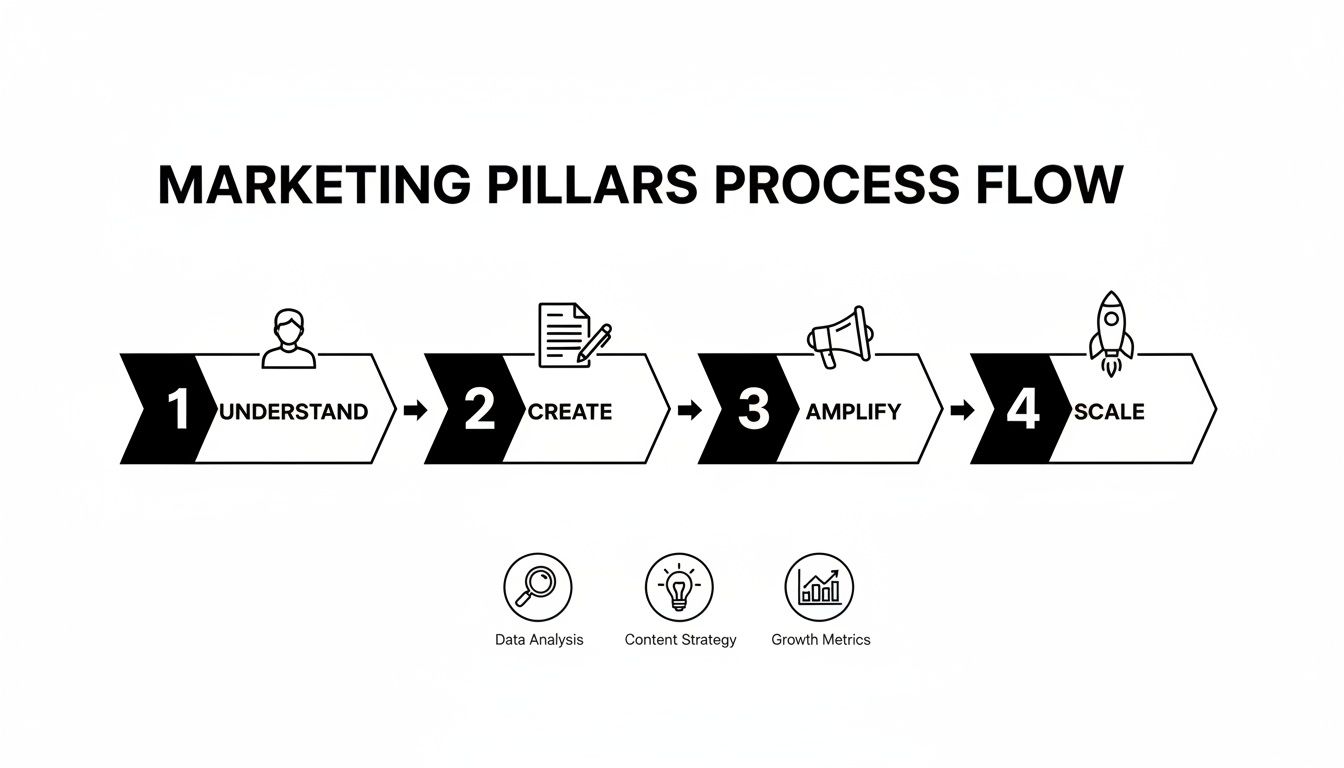
I've seen so many business owners get stuck in a cycle of trying a little of this, a little of that, and never seeing real results. The key is to move past random tactics and build a marketing engine around four core pillars: understanding your audience, creating genuinely valuable content, amplifying your message, and scaling up with smart partnerships.
The Four Pillars of a Winning Marketing Strategy
Think of this not as a checklist, but as a continuous loop. You start by getting inside your customer's head, which tells you exactly what content they need. That content then becomes the fuel for all your marketing—both organic and paid. As you gain traction, you bring in partners to pour gasoline on the fire.
It's a powerful cycle that builds on itself.
A good marketing plan is your operational blueprint for getting and keeping customers without breaking the bank. Of course, a plan is useless without people seeing it, so you'll also need solid strategies to get more traffic to your website to improve your visibility and get those initial eyeballs.
I always tell people the best marketing strategy is the one they can actually stick with. A clear, high-quality plan executed consistently will beat a dozen half-baked ideas every single time. Master one or two channels before you try to be everywhere at once.
To help you get started, here's a quick look at the core marketing pillars we're going to dive into.
Core Marketing Pillars for Online Businesses
| Marketing Pillar | Primary Goal | Key Activities |
|---|---|---|
| Audience Definition | To deeply understand the target customer's needs and pain points. | Creating buyer personas, conducting surveys, and analyzing competitor audiences. |
| Content Marketing | To attract, engage, and convert the target audience with valuable content. | Writing blog posts, creating videos, and designing lead magnets. |
| Paid Advertising | To amplify reach and drive immediate, targeted traffic. | Running PPC campaigns, social media ads, and sponsored content. |
| Affiliate & Partner Marketing | To scale growth by leveraging the audiences of others. | Building an affiliate program, co-marketing with partners, and guest posting. |
Seeing how all these pieces fit together is crucial. If you want a deeper dive into building a cohesive system, it's worth exploring a complete https://refgrow.com/blog/growth-strategy-framework.
In this guide, we'll break down each of these foundational pillars into clear, actionable steps. The goal is to help you build a marketing machine that doesn't just attract customers, but turns them into true fans of your brand.
Finding Your Ideal Customers
Before you spend a single dollar on ads or an hour on content, every smart marketing move you make hinges on one question: Who exactly are you talking to?
Settling for vague descriptions like "small business owners" or "busy moms" is the fastest way to burn through your budget with nothing to show for it. To really succeed online, you need an almost uncomfortably clear picture of your ideal customer.
This goes way beyond basic demographics. It's about getting inside their head—understanding their daily frustrations, their biggest career goals, and the problems that keep them scrolling on their phone at midnight. When you know someone that well, speaking their language becomes second nature.
Stop Guessing and Start Talking
The best insights don't come from a spreadsheet. They come from real conversations.
If you already have customers, reach out to your favorite ones. I'm talking about the people who truly get what you do and sing your praises. A quick 15-minute chat with them is worth more than weeks of sitting in a boardroom trying to guess.
Don't have customers yet? No problem. Find people who fit the profile you think is right and offer them a coffee or a gift card for their time. The goal here is to listen, not to sell. You're on a mission to uncover their actual pain points, not just get them to agree with your own assumptions.
A Few Questions I Always Ask in Customer Interviews:
- Before you found a solution like ours, what was the specific roadblock you were hitting?
- Walk me through what a typical day looks like for you. Where does a tool like ours even fit?
- What other things did you try that just didn't work? Why do you think they failed?
- If you could wave a magic wand, what would make your job 10% easier tomorrow?
Notice how these questions are open-ended? They get people telling stories. In those stories, you'll find the emotional triggers and the exact words they use to describe their problems. This is absolute gold for writing website copy, ads, and emails that feel like you're reading their mind.
Build Your Ideal Customer Profile
Okay, you've had some great conversations and taken a ton of notes. Now it's time to put it all together. An Ideal Customer Profile (ICP)—sometimes called a buyer persona—is essentially a character sketch of your perfect customer.
This isn't just a fluffy marketing exercise. It’s a practical tool that gets your entire team on the same page, ensuring everyone is talking to the same person. A solid persona brings this customer to life.
Building a detailed buyer persona is like giving your marketing a GPS. Without it, you're just driving blind. With it, every decision is sharp, efficient, and moves you directly toward your destination.
Your profile doesn't need to be a novel, but it should cover a few key areas to be truly useful.
The Anatomy of a Great Persona
| Category | What It Is & What It Looks Like |
|---|---|
| Demographics | The basic, factual stuff. Example: Age 35-45, Founder of a B2B SaaS startup, lives in North America. |
| Goals | What they're trying to accomplish, professionally or personally. Example: Grow monthly recurring revenue; stop losing so many customers. |
| Challenges | The real-world obstacles in their way. Example: Doesn't have a big marketing budget; struggling to find a repeatable way to get new users. |
| Watering Holes | Where do they hang out online? Example: Reads Hacker News, listens to the "My First Million" podcast, active in the Indie Hackers community. |
| A Real Quote | Pull a powerful quote directly from one of your interviews. Example: "I know I need to be better at marketing, but I don't have time to become an expert myself." |
This detailed profile becomes your true north. From now on, before you write a blog post, launch an ad, or send an email, you’ll ask one simple question: "Would [Your Persona's Name] actually care about this?"
If the answer is a hard no, you just saved yourself a ton of time and money. This simple check keeps your marketing focused, relevant, and ridiculously effective. It’s the foundation for everything else we're about to cover.
Building Your Content and SEO Engine
Think of great content as the engine for your business's organic growth. It's what pulls in your ideal customers by answering their questions and solving their problems, building a foundation of trust long before they're even thinking about buying. Your website stops being just a sales page and becomes a go-to resource.
The best part? Unlike paid ads that vanish the second you stop funding them, a solid content and SEO strategy is an asset that actually grows in value over time. I've seen a single, well-researched blog post continue to generate traffic and leads for years. It's one of the most powerful, cost-effective marketing plays you can make.

Uncovering What Your Customers Are Actually Searching For
First things first: you need to figure out the exact phrases your audience is typing into Google. This isn't some dark art; it's called keyword research, and it's really more about empathy than technical skill. You're simply trying to get inside your customer's head.
Let's say you run a project management SaaS built for small creative agencies. Your potential customers aren't just searching for "project management tool." Their real-world problems are much more specific. They’re looking for answers to things like:
- "how to manage multiple client projects"
- "best way to track freelance hours"
- "project management software for creative teams"
These longer, more detailed phrases are what we call long-tail keywords. They might have less search traffic than the big, broad terms, but the people searching for them know exactly what they need. Their intent to purchase is sky-high, making these keywords pure gold. When your content directly answers these specific questions, you instantly become the expert they've been hoping to find.
Mapping Your Content to the Customer Journey
Here’s a crucial insight: not everyone who finds your site is ready to buy right now. Some are just starting to realize they have a problem, others are in the middle of comparing options, and a few are ready to pull the trigger. Your content needs to meet them wherever they are.
By mapping your keywords to these different stages, you can make sure you're serving up the right message to the right person at the right time.
Stages of the Customer Journey
- Awareness Stage: The person knows they have a pain point but might not have a name for it. They're searching for information.
- Keyword Example: "why is my business not growing"
- Content Idea: A blog post titled, "5 Hidden Bottlenecks Stalling Your Agency's Growth."
- Consideration Stage: They've defined their problem and are now actively researching solutions.
- Keyword Example: "project management tool vs spreadsheet"
- Content Idea: A detailed comparison guide breaking down the pros and cons of each.
- Decision Stage: They're ready to make a choice and are looking for the final piece of evidence to convince them.
- Keyword Example: "[Your Brand] pricing" or "best project management tool for small business"
- Content Idea: A crystal-clear pricing page, compelling customer case studies, or a product demo video.
This isn't about creating random blog posts; it's about building an intentional funnel that gently guides prospects from "I have a problem" to "You are the solution."
Your blog isn’t a diary for company news. It's a strategic tool designed to intercept customers at every single stage of their decision-making process. Answer their questions, and you'll earn the authority and trust you need to make the sale.
Creating a Practical Content Calendar
Okay, you have your keywords and a clear map of the customer journey. Now it's time to get organized. A content calendar is your best friend here, and it doesn't need to be complicated. A simple spreadsheet is a perfect place to start.
At a minimum, your calendar should track the essentials for each piece of content.
| Content Title | Target Keyword | Stage of Journey | Content Format | Status |
|---|---|---|---|---|
| How to Onboard New Clients Smoothly | client onboarding process | Awareness | Blog Post | In Progress |
| [Your Brand] vs. Asana | asana alternatives | Consideration | Comparison Page | Published |
| Case Study: How Agency X Doubled... | [customer name] | Decision | Case Study | Outline |
A calendar does more than just organize your ideas—it forces consistency. And consistency is exactly what search engines want to see. They reward sites that regularly publish fresh, high-quality content. If you're looking for more inspiration, our guide on organic growth strategies is packed with ideas.
Mastering the On-Page SEO Essentials
Once your masterpiece is written, a few quick on-page SEO tweaks will give it a much better shot at ranking on Google. Think of these as signposts that help search engines understand exactly what your page is about.
You don't need to be an expert, just focus on these three things:
- Title Tag: This is the clickable headline in the search results. Make it intriguing and put your main keyword near the front.
- Meta Description: That little snippet of text under the title. It doesn't directly influence rankings, but a good one can make a huge difference in whether someone clicks on your link or a competitor's.
- Internal Linking: As you write, link to other relevant articles and pages on your own website. This is great for SEO because it helps Google discover your other content, and it keeps visitors engaged and on your site longer.
When you combine smart keyword research with a structured content plan and these basic on-page optimizations, you create a marketing engine that works for you 24/7. It's how you attract the right people and build your business into a trusted authority.
Give Your Growth a Boost with Paid Advertising
While a solid content and SEO strategy is your long-term ticket to success, sometimes you just need to hit the accelerator. Paid advertising lets you jump the line, giving you the speed and precision to get in front of your ideal customers right now. This isn't about blindly "boosting" posts; it's a strategic way to turn ad spend into a predictable stream of traffic and revenue.
Think of it this way: paid ads are the ultimate amplifier. You take what's already working—that killer blog post, that high-converting landing page—and put it directly in front of a hand-picked audience. Instead of waiting for them to find you, you're going straight to them.
First, What’s the Goal of Your Campaign?
Before you even glance at an ad platform, you have to answer one simple question: What do I want to happen? Running an ad campaign without a clear goal is like throwing money into the wind. Every dollar you spend needs to be tied to a specific, measurable business outcome.
This single decision will shape every other choice you make, from the ad platform you pick to the words you write.
Common Goals for Paid Ads:
- Generate Leads: This is all about capturing contact info, usually an email address. It’s perfect for when you're offering a free guide, a webinar spot, or a demo.
- Drive Direct Sales: The goal is simple: get someone to buy something. If you're in e-commerce or have a self-serve SaaS product, your ads will point right to a product or pricing page.
- Build Brand Awareness: This one is a bit harder to track, but the aim is to get your business name and message seen by a wide (but still relevant) audience. The idea is to build trust and familiarity over time.
For most online businesses just dipping their toes into paid advertising, lead generation is the smartest starting point. It helps you build your email list—a massive asset—and nurture relationships, even if someone isn't ready to buy today.
Choosing the Right Place to Advertise
Not all ad platforms are built the same, and your guiding light should always be this: where do my customers actually hang out online? Trying to be everywhere at once is a surefire way to burn through your budget with little to show for it. It's far better to master one or two channels that are a perfect match for your audience.
Paid advertising is a powerful tool, but it isn't magic. Success comes from picking the right battlefield. Go where your customers already are, and you'll find your message hits with far greater impact.
Let's break down the two heavyweights most online businesses will consider.
A Quick Look at the Top Platforms
| Feature | Google Ads | Social Media Ads (Facebook/Instagram) |
|---|---|---|
| User Mindset | High Intent: People are actively searching for a solution to a problem. | Discovery Mode: People are scrolling and browsing, not actively shopping. |
| Targeting Style | Keyword-Based: You target people based on what they're typing into the search bar. | Demographic & Interest-Based: You target people based on who they are and what they like. |
| Best For... | Capturing immediate demand (e.g., someone searching for "best project management tool"). | Building awareness, generating leads with eye-catching offers, and retargeting past website visitors. |
So, a SaaS company might use Google Ads to snag users searching for alternatives to a competitor. On the other hand, an e-commerce brand with a visually striking product could absolutely crush it with highly targeted ads on Instagram.
Crafting Ads That People Actually Click On
A great ad is a perfect mix of a compelling offer, engaging visuals or video, and copy that speaks directly to the customer. It has to stop the scroll in a crowded feed and give someone a crystal-clear, irresistible reason to click.
To get this right, go back to your buyer persona. What words do they use? What keeps them up at night? Your ad copy needs to echo that language and position your offer as the obvious answer to their problem.
The Anatomy of a High-Converting Ad:
- The Hook: A killer first line that grabs attention and makes them feel understood.
- The Value Prop: A simple sentence explaining what you do and why it matters.
- The Offer: The specific thing you're promoting—the lead magnet, the discount, the product.
- The Call to Action (CTA): A direct command that tells them exactly what to do next. Think "Download Your Free Guide" or "Start Your Trial Today."
Remember, the ad's only job is to get the right person to click. It's the landing page that does the heavy lifting of closing the deal. When you pair a strong organic content strategy with a laser-focused paid ad push, you create a powerful system for consistent, scalable growth.
Scaling Growth Through Affiliate Partnerships
Imagine having a dedicated sales force promoting your business, but you only pay them when they deliver a sale. That’s the magic of affiliate and referral marketing. It’s a performance-based model that lets you tap into the established audiences of partners, turning trusted voices into your most effective marketers.
This isn't about slapping a banner on a random blog and hoping for the best. When you do it right, affiliate marketing becomes a scalable, cost-effective engine for bringing in new customers. I've seen it work wonders, especially for SaaS companies and anyone selling digital products. The real key is building a program that's not only attractive to potential partners but also incredibly easy for them to join and win with.
Designing a Program That Attracts Top Partners
The heart and soul of any great affiliate program is its commission structure. Your offer needs to be compelling enough to grab the attention of high-quality partners who genuinely believe in what you're selling. A weak commission sends the wrong signal—it suggests a lack of confidence and won't motivate anyone to put their time and reputation on the line for you.
For SaaS businesses, recurring commissions are the gold standard. When you offer a percentage of the subscription fee for the first year—or even for the lifetime of the customer—you create a powerful long-term incentive. This structure aligns your goals perfectly with your affiliates'. They aren't just chasing a quick sign-up; they're motivated to bring in loyal customers who will stick around.
Common Commission Models for Online Businesses
- Percentage of Sale: This is the most common model. Offering 20-40% of each sale is a strong starting point for digital products.
- Recurring Commission: Perfect for subscriptions. A commission of 10-30% on each recurring payment keeps partners engaged.
- Flat-Fee Payout: A fixed dollar amount for a specific action, like a paid sign-up or a completed demo.
But it’s not just about the money. The best affiliates want to partner with brands that have their back. This means giving them the right tools for the job: a simple dashboard to track their performance, pre-made creative assets like banners and email copy, and a direct line of communication for when they have questions. The easier you make it for them to promote you, the more they will.
Turning Your Customers into Your Best Marketers
While traditional affiliate marketing involves recruiting professional marketers and influencers, there's another source of promotion you can't afford to overlook: your own happy customers. These are the people who already use, love, and get your product. Their recommendations are authentic and carry a ton of weight with their peers.
The problem has always been making it easy for them to share. Clunky, external affiliate portals create friction, and that friction is enough to stop most customers from ever even trying. This is where modern, embeddable solutions completely change the game.
The most powerful marketing doesn't feel like marketing at all. When a recommendation comes from a trusted peer who genuinely uses and benefits from your product, it cuts through the noise in a way no advertisement ever could.
Platforms like Refgrow were built to solve this exact problem. They let you build a referral program directly inside your product’s user experience. With a simple integration, you can create a native, in-app dashboard where customers can grab their unique referral link, track their rewards, and see their impact—all without ever leaving your platform. This frictionless approach makes advocacy a natural part of using your product.
For SaaS businesses, the choice between a traditional network and an embedded platform is a critical one. Here’s a quick breakdown of how they stack up:
Affiliate Marketing Models Comparison
| Feature | Traditional Affiliate Networks | Native Embedded Platforms (e.g., Refgrow) |
|---|---|---|
| User Experience | External portals and dashboards, often with a clunky UI/UX. | Seamless, in-app experience. Users never have to leave your product. |
| Partner Source | Primarily professional affiliates, bloggers, and influencers. | Empowers your existing customers to become brand advocates. |
| Friction | High. Users must sign up on a separate platform, creating a barrier. | Low. It's a natural, integrated part of using your product. |
| Authenticity | Varies. Recommendations can feel transactional. | High. Referrals come from genuine users who love the product. |
| Best For | E-commerce or businesses targeting professional affiliate marketers. | SaaS and subscription businesses looking to activate their user base. |
Ultimately, choosing a native platform means you're not just recruiting affiliates; you're building a community of advocates right where they're most engaged—inside your product.
The Financial Impact of a Well-Run Program
Affiliate marketing isn't just some minor tactic; it's a major growth channel with serious financial backing and impressive returns. The industry is booming for a simple reason: it delivers measurable results.
Consider this: over 80% of brands now run affiliate programs. This contributes to a global market worth $27.8 billion that's projected to soar to $48 billion by 2027. And the ROI? For every dollar spent, this channel can yield a $6.50 return. It's common to see SaaS commissions in the 20-70% range, and some major brands attribute up to 25% of their total sales to this channel alone. You can dive deeper into these affiliate marketing statistics and see why it's a key strategy for growth.
This data highlights a critical point for anyone wondering how to market their online business effectively: partnerships are not an add-on. They are a core component of a modern growth strategy. For a more detailed look, you can also check out our guide on affiliate marketing for startups. By empowering others to share your story, you build a sustainable and efficient acquisition channel that scales right alongside your business.
Measuring What Matters for Growth

You’ve launched your campaigns and your funnels are live. Now for the most important question: Is any of it actually working? If you aren't tracking the right data, you're essentially flying blind, basing huge decisions on gut feelings instead of hard evidence.
To really know if your marketing is moving the needle, you have to measure what matters. This means looking past the "vanity metrics" like social media likes or random page views. Sure, those numbers can give you a temporary ego boost, but they don't pay the bills. The real secret is to zero in on a few Key Performance Indicators (KPIs) that tell you the true story of your business's health.
Identifying Your Core Growth Metrics
For most online businesses, the story of your growth boils down to just three crucial numbers. Get a handle on these, and you'll have a crystal-clear picture of your marketing performance and, more importantly, your profitability.
These are the KPIs that should be on your dashboard:
- Customer Acquisition Cost (CAC): How much do you spend on sales and marketing to get one new customer? This number tells you exactly what it costs to bring someone into your world.
- Customer Lifetime Value (LTV): What's the total revenue you can reasonably expect from a single customer over their entire relationship with you? This reveals the long-term payoff of your efforts.
- Conversion Rate by Channel: Of the people who visit from Google, Facebook, or your email list, what percentage actually takes the action you want them to? This shows you which channels are pulling their weight.
The real insight comes when you see how these numbers interact. For your business to be sustainable, your LTV must be significantly higher than your CAC. A healthy benchmark I always tell my clients to aim for is an LTV:CAC ratio of at least 3:1. If you’re spending $100 to acquire a customer who only ever spends $50, you've got a leaky bucket that needs to be fixed, fast.
Building Your Data-Driven Optimization Loop
Once you're tracking these core metrics—Google Analytics is the perfect place to start—the goal isn't just to watch the numbers. It's to build a system for constant improvement. Think of it as your optimization loop.
The process is straightforward but incredibly powerful:
- Analyze the Data: Jump into your dashboard. Which marketing channel has the highest CAC? Where are your best LTV customers coming from?
- Form a Hypothesis: Based on what you see, make an educated guess. For example, "I bet if I change the headline on my Facebook ad landing page to match the ad copy, the conversion rate will go up."
- Run an A/B Test: Create a variation of the page with your new headline. Use a testing tool to send 50% of traffic to the original page and 50% to the new one.
- Implement the Winner: After enough traffic has run through the test, see which version performed better. Make the winner the new permanent page. Then, start the whole cycle over again with a new hypothesis.
A data-driven mindset turns marketing from a guessing game into a science. Every test, whether it wins or loses, provides a valuable lesson that makes your next move smarter and more efficient.
This iterative approach is how you ensure your marketing gets sharper and more profitable over time. In the end, it all comes down to what you get back for what you put in. To see the full picture, it's essential to learn how to calculate marketing ROI and understand your overall campaign effectiveness.
Frequently Asked Questions About Online Business Marketing
How Much Should a New Online Business Budget for Marketing?
This is the million-dollar question, isn't it? While many experts will tell you to set aside 10-20% of your projected revenue, that's not always realistic when you're just starting out.
A better approach is to think in terms of your growth goals. Start with a small, manageable budget on a single channel where you can closely track your return on investment (ROI). Once you prove that channel works and brings in revenue, you can confidently reinvest those profits to scale your spending. Early on, stick to high-impact, lower-cost strategies like great content and SEO.
Which Marketing Channel Should I Focus On First?
The best channel is simply where your ideal customer hangs out online. There’s no one-size-fits-all answer here. It comes down to doing your homework.
For example, if you run a B2B SaaS company, you’ll likely find your audience reading industry blogs and connecting on LinkedIn. But if you’re selling handmade jewelry, your best bet is probably a visual platform like Instagram paired with highly targeted Google Shopping ads. Always let your audience research guide your decision.
When Is the Right Time to Start an Affiliate Program?
Hold off on launching an affiliate program until you've nailed product-market fit.
What does that mean? It’s that sweet spot where you have a product that customers genuinely love and are already recommending to their friends organically. You need a solid base of happy, enthusiastic users to become your first—and best—advocates. Trying to build an affiliate program before your product is truly dialed in is putting the cart before the horse.