

How Much Can You Make From Affiliate Marketing A Realistic Guide

How much can you really make with affiliate marketing? The honest answer is: it varies wildly. For some, it's a side hustle that brings in a few hundred dollars a month. For seasoned pros, it can be a full-blown business generating well over $10,000 per month.
Your income isn't a fixed salary—it's a direct reflection of your strategy, your chosen niche, and the consistent effort you put in.
What's Your Affiliate Earning Potential?
Let's get one thing straight: affiliate marketing isn't a get-rich-quick scheme. Think of it less like a job and more like building a business from the ground up. Your earning potential is tied directly to how well you can attract the right people and recommend products that genuinely help them.
The beauty of it is the scalability. The work you do today—writing that blog post, creating that video—can continue to earn for you months or even years down the road. It’s all about how to make money selling other people's products in a way that builds trust.
Earning Ranges by Experience Level
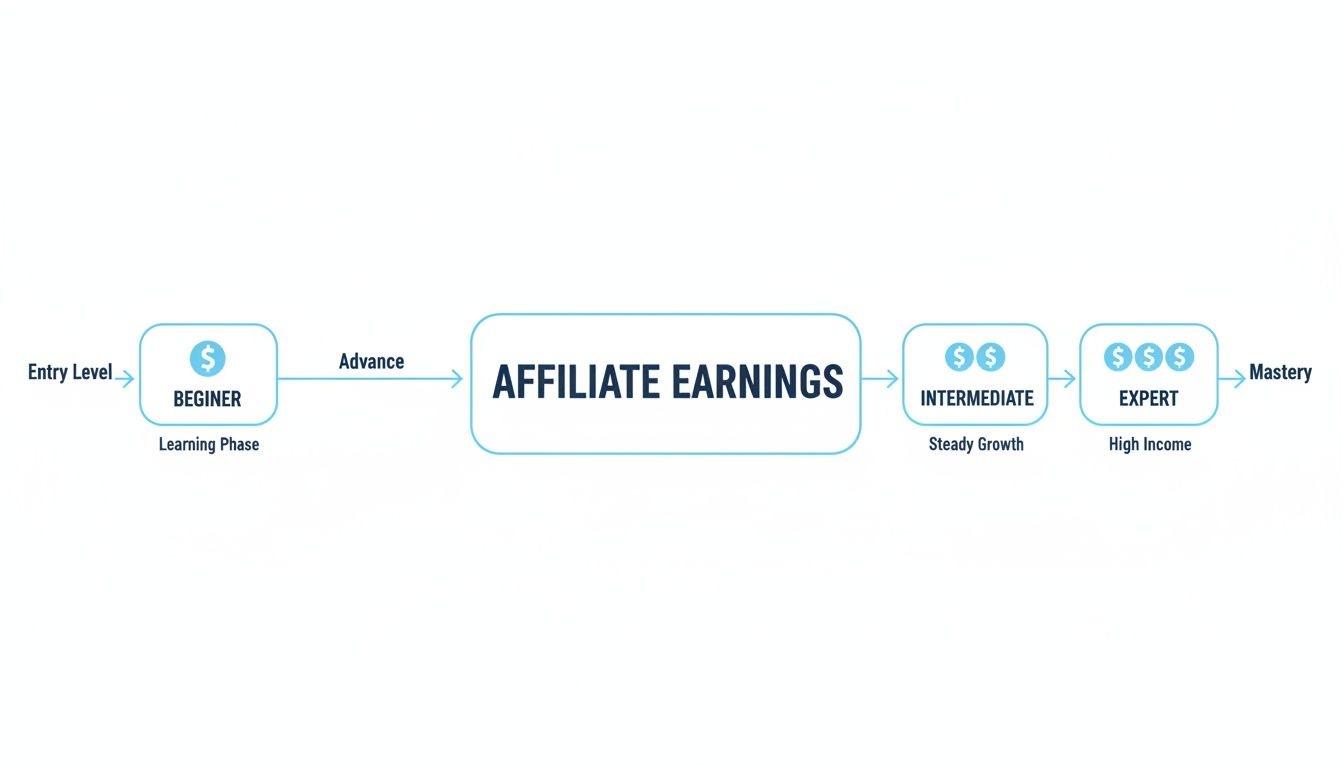
Your path in affiliate marketing will likely follow a few distinct stages, each with its own realistic income expectations. Beginners are busy learning the fundamentals, while experts are running sophisticated, high-revenue systems.
- Beginner (0-1 Year): Your main job is to show up and get noticed. You’ll be focused on creating solid content, getting your first trickles of traffic, and figuring out what your audience actually wants.
- Intermediate (1-3 Years): By now, you've got a steady stream of traffic and you're getting pretty good at turning visitors into buyers. You're probably starting to reinvest your earnings into things like paid ads or new content channels to speed up growth.
- Expert (3+ Years): You're no longer just an affiliate; you're a business owner. You're scaling what works, fine-tuning every step of your funnel, building a powerful brand, and maybe even hiring a team to help you expand.
"Your affiliate income is a lagging indicator of your effort. The consistent work you do in months 1-6 building content and trust is what pays off in month 12 and beyond. It’s about building assets, not just earning commissions."
A Booming Industry
If you're wondering whether you've missed the boat, the answer is a definitive no. Affiliate marketing is growing at a staggering pace as more and more brands pour money into it.
The global market is projected to hit an incredible $71.74 billion by 2034, expanding by 15.2% every year. The opportunity in the B2B SaaS world is particularly massive, where commissions can range from 20-70% on recurring monthly subscriptions. That’s how affiliates build powerful, long-term income streams.
To give you a clearer picture, I've put together a quick summary of what you might expect to earn at each stage. Think of these as guideposts, not guarantees. Your actual success will come down to how well you track and improve your own affiliate marketing metrics.
Affiliate Earning Potential By Experience Level
This table breaks down the realistic monthly income ranges for affiliate marketers as they progress in their careers.
| Experience Level | Typical Monthly Earnings (USD) | Primary Focus |
|---|---|---|
| Beginner | $0 - $1,000 | Building an audience and creating content |
| Intermediate | $1,000 - $10,000 | Optimizing conversions and diversifying traffic |
| Expert | $10,000+ | Scaling operations and building a brand |
As you can see, the journey starts small, focusing on foundational work. But with time and experience, the focus shifts to optimization and scaling, which is where the real income growth happens.
The Four Levers That Control Your Income
Your affiliate income isn't some random number pulled from the sky. It's the direct result of a simple, powerful formula. Once you truly understand this, you can stop guessing and start engineering your earnings.
Think of your affiliate business like a machine with four main controls. Tweak any one of them, and you can dramatically change your results.
The whole game boils down to this one equation:
Earnings = Traffic x Conversion Rate x Commission Rate x Product Price
Let's unpack what each of these levers actually means in practice. Imagine you’re trying to sell a product through a review on your blog. Each part of that formula plays a crucial role in turning your words into cash.
This visual shows how an affiliate’s income grows as they get better at pulling these levers. It's a journey from beginner to expert, and it all comes back to scaling the inputs in that core formula.
Lever 1: Traffic
Simply put, traffic is the number of people who see your affiliate link. For our blog post example, this is every single person who lands on that page. It’s the lifeblood of your entire operation. More eyeballs mean more opportunities to make a sale.
You can crank up this lever by:
- Getting good at SEO so people find you on Google.
- Building an email list you can market to over and over.
- Creating social media content that pulls people back to your site.
Without traffic, nothing else matters. You could write the most convincing review in history, but if nobody reads it, your earnings will be exactly zero.
Lever 2: Conversion Rate
Your conversion rate is the percentage of people who not only click your link but actually follow through and buy something. If 1,000 people read your post and 20 of them make a purchase, your conversion rate is 2%. This lever is all about how persuasive you are.
Improving your conversion rate is often the quickest way to make more money without needing a single extra visitor. You can do this by:
- Writing authentic, genuinely helpful reviews that build trust.
- Placing your affiliate links where they’re most likely to get clicked.
- Using clear, strong calls-to-action (CTAs) that tell people what to do next.
Just think about it: bumping your conversion rate from 1% to 2% literally doubles your income from the exact same amount of traffic.
Lever 3: Commission Rate
The commission rate is the cut you get from each sale. This is set by the company's affiliate program and can be all over the map. You might see 1-5% for physical goods on a site like Amazon, but it's common to find 20-50% (or even more) for digital products like courses or software.
This is where choosing the right partners becomes critical. Promoting a product with a 40% commission will make you four times more per sale than a similar product offering just 10%, assuming the price is the same. It pays to be picky.
Lever 4: Product Price
Finally, the product’s price tag has a massive impact on your bottom line. Your commission is a percentage of this price.
A 10% commission on a $50 product nets you $5. But that same 10% commission on a $1,000 course? That’s a $100 payday.
This is exactly why so many seasoned affiliates hunt for high-ticket offers. It often takes the same amount of work to sell a cheap item as it does an expensive one, but the reward is worlds apart.
The affiliate model works so well that businesses are pouring money into it. The global market shot up to $27.8 billion in 2024 and is projected to hit $48 billion by 2027, with over 80% of brands now running affiliate programs. Why? The ROI is fantastic—companies often report a $6.50 return for every $1 they spend. For a deeper dive, check out the latest affiliate marketing stats and trends from FirstPromoter.
How To Calculate Your Potential Earnings
Knowing the four main levers of affiliate income is great in theory, but the real "aha!" moment comes when you plug in some actual numbers. Let's walk through two classic affiliate strategies to see how you can start forecasting your own potential earnings.
We'll look at the high-volume, low-ticket game versus the low-volume, high-ticket approach. This contrast is perfect for showing how different products and niches can generate surprisingly different results, even with similar effort.
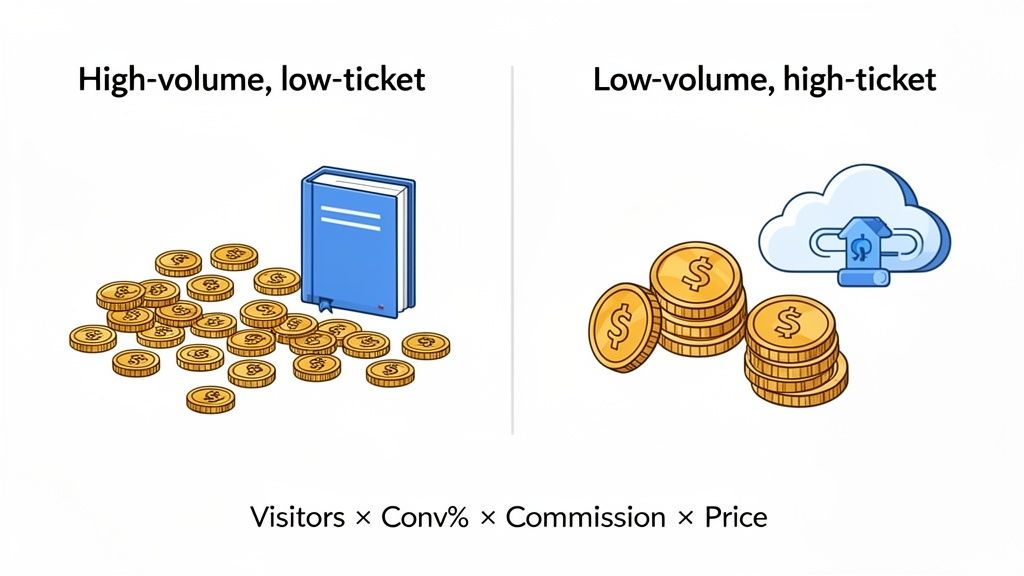
Model 1: The High-Volume, Low-Ticket Strategy
First up, let's imagine you're promoting a popular $40 ebook about productivity. The affiliate program is pretty generous, offering a 50% commission for every sale you send their way. Your main weapon is a blog that pulls in about 10,000 visitors a month to your big review article.
Let's do the math:
- Traffic: 10,000 visitors/month
- Product Price: $40
- Commission Rate: 50% (which works out to $20 per sale)
- Conversion Rate: A respectable 2% (meaning 2 out of every 100 visitors make a purchase)
So, how does that shake out?
10,000 Visitors x 2% Conversion Rate = 200 sales
200 sales x $20 Commission = $4,000 per month
With this model, your entire world revolves around getting eyeballs on your content. You’d be focused on things like SEO and social media to keep a steady stream of traffic coming in. Even a small bump in your conversion rate could mean a huge difference in your monthly payout.
Model 2: The Low-Volume, High-Ticket Strategy
Now, let's completely change gears. Instead of a cheap ebook, you're promoting a premium SaaS tool for businesses that costs $250 per month. The program offers a 30% recurring commission, which is the key here—you get paid every single month the customer stays subscribed.
Your blog is much more specialized, attracting a smaller but highly motivated audience of 2,000 visitors a month.
Here's how the numbers look:
- Traffic: 2,000 visitors/month
- Product Price: $250/month
- Commission Rate: 30% ($75 per sale, per month)
- Conversion Rate: A lower 1% (it's naturally harder to sell a pricier item)
Here’s the calculation for just the first month:
2,000 Visitors x 1% Conversion Rate = 20 new customers
20 customers x $75 Commission = $1,500 in month one
The magic of this model is that your income snowballs. Unlike the one-and-done ebook sale, you don't start from scratch every month. Your revenue compounds over time as you stack up new subscribers.
By month two, you'd earn another $1,500 from that month's new sales plus the original $1,500 from the customers who signed up in month one. Suddenly, you're at $3,000. This compounding effect is exactly why so many affiliates love promoting high-ticket SaaS products.
Of course, a big part of hitting these numbers is knowing what's working. If you're using paid ads or social media to get visitors, you need to know how to measure social media ROI to ensure you're not just throwing money away.
SaaS vs Ecommerce Earning Models
These two models highlight a fundamental choice for affiliates: promoting one-time purchase products or jumping into the world of recurring subscriptions. Each has its own rhythm and financial logic.
Here's a quick breakdown of how they compare:
| Factor | SaaS Affiliate Model | Ecommerce Affiliate Model |
|---|---|---|
| Income Type | Recurring. Earn commissions every month a customer stays subscribed. | One-Time. You get paid once per sale. |
| Growth Model | Compounding. Revenue builds on itself month after month. | Linear. You start from $0 at the beginning of each month. |
| Customer LTV | High. One referral can generate income for years. | Low to Moderate. Value is tied to a single transaction. |
| Conversion Rate | Typically lower due to higher price and commitment. | Often higher due to lower-priced, impulse-friendly items. |
| Best For | Building stable, predictable, long-term income streams. | Generating quick cash flow and capitalizing on high-traffic sites. |
Ultimately, choosing between a SaaS or an ecommerce model comes down to your long-term goals. Do you want the immediate gratification of one-off sales, or are you willing to play the long game for a more stable, compounding income?
Forecasting your earnings isn't about finding some magical, guaranteed number. It's about understanding the levers you can actually pull—your traffic, your conversion skills, and the types of products you choose to promote.
If you want to play around with your own numbers and model out different scenarios, our affiliate marketing calculator is a great tool for the job.
Proven Strategies To Maximize Your Revenue
Understanding the math behind affiliate income is one thing. Actually pulling the levers that make the numbers go up is where the real work—and real money—is. The highest earners don't get there by luck; they build and refine systems designed to attract, convince, and convert their audience.
Making the leap from a few hundred to a few thousand dollars a month means you have to start thinking less like a content creator and more like a strategic marketer. It's all about building clear pathways that guide people from being mildly curious to confidently clicking "buy."
Go Beyond a Single Traffic Source
Relying only on Google for your traffic is like building your house on a single pillar. It's incredibly risky. While SEO is a fantastic long-term strategy, the affiliates who build truly resilient businesses diversify where their visitors come from. This not only creates stability but opens up entirely new pools of potential customers.
Think of each channel as a different door into your world. Some people live in their email inbox, while others scroll social media all day. By showing up where they already are, you radically expand your reach and your chances to earn.
Here are the channels you absolutely need to develop:
- Build an Engaged Email List: Your email list is the single most valuable asset you can own. You don't control search rankings or social media algorithms, but that list is yours. It's your direct line for building relationships, sharing your best stuff, and promoting offers to an audience that already trusts you.
- Create a Thriving Social Community: Platforms like Facebook Groups, TikTok, or Instagram are perfect for building a community around your niche. When you consistently provide value and just talk to people, you build a level of trust that makes your recommendations incredibly powerful.
- Explore Paid Advertising: Once you've found an offer that converts well, paid ads on platforms like Google or Facebook can be like pouring gasoline on a fire. It’s a way to scale your traffic predictably and get your offer in front of a perfectly targeted audience, almost overnight.
Engineer Your Sales Funnel
Top affiliates don't just sprinkle links around and hope for the best. They build intentional sales funnels—a series of steps that guide a visitor on a journey from awareness to decision. Every piece of content has a job to do, moving that person closer to a sale.
A funnel is what turns cold traffic into happy customers by building trust and proving value every step of the way.
A well-designed affiliate funnel meets a user's needs at every stage. It often starts by offering a free solution (a lead magnet), nurtures them with valuable content (like a detailed review), and then presents the affiliate product as the ultimate solution to their problem.
Here’s a simple but incredibly effective funnel you can build:
- The Lead Magnet: Offer a high-value freebie—an ebook, a checklist, a mini-course—in exchange for an email address. This gets genuinely interested people onto your list.
- The Bridge Page: Right after they sign up, send them to a page that introduces the core problem your affiliate product solves. This page "bridges" the gap between their interest in your freebie and the paid solution you're about to recommend.
- The In-Depth Review or Comparison: This is your big sales asset. Create a comprehensive blog post or video that breaks down the product's features, benefits, and real-world applications. Pack it with social proof like testimonials or case studies to build massive credibility.
- The Email Follow-Up Sequence: Not everyone buys right away. A series of automated emails can follow up to handle common objections, highlight key benefits, and even offer a special bonus to nudge them toward making a purchase.
Relentlessly Optimize for Conversions
Getting traffic is only half the job. Conversion Rate Optimization (CRO) is the art and science of getting more of your current visitors to take action, and it’s how elite affiliates multiply their income without needing a single new visitor. Think about it: improving from a 1% to a 2% conversion rate literally doubles your revenue.
You don't have to overhaul everything at once. Just start by testing the most critical parts of your funnel—the places where people make decisions.
- A/B Test Your Calls-to-Action (CTAs): Never assume you know what works. Test button colors, button text ("Buy Now" vs. "Get Started Today"), and where you place them. You'd be shocked at what a small change can do.
- Refine Your Landing Pages: Make sure your pages are clean, load quickly, and are laser-focused on one goal. Kill all the distractions and make it dead simple for the user to do what you want them to do.
- Use Social Proof: People trust other people more than they trust marketers. Weave in screenshots of positive comments, results from a poll in your Facebook group, or customer reviews. This kind of unbiased proof is pure gold and can skyrocket your conversion rates.
By combining diverse traffic sources with a well-engineered funnel and a relentless focus on optimization, you build a powerful, repeatable system for growth. This is the framework that truly answers the question, "How much can you make?" by putting you in the driver's seat.
Why SaaS Affiliate Programs Offer High Potential
If you're asking how much you can really make with affiliate marketing, the world of Software as a Service (SaaS) holds a particularly lucrative answer. While promoting physical products can be great for quick wins, SaaS affiliate programs are built for something far more powerful: stable, long-term, and compounding income.
For many affiliates, this is the turning point where they go from earning sporadic commissions to building a predictable monthly revenue stream.
The magic is in the business model. Most SaaS products run on subscriptions—customers pay a fee every month or year. This completely changes the game for affiliates because it unlocks the power of recurring commissions.
The Power of Recurring Commissions
Think about it this way. Say you promote a great pair of headphones. You write a stellar review, someone clicks your link, and you get a one-time commission. That’s it. To make money again next month, you have to find a brand new customer.
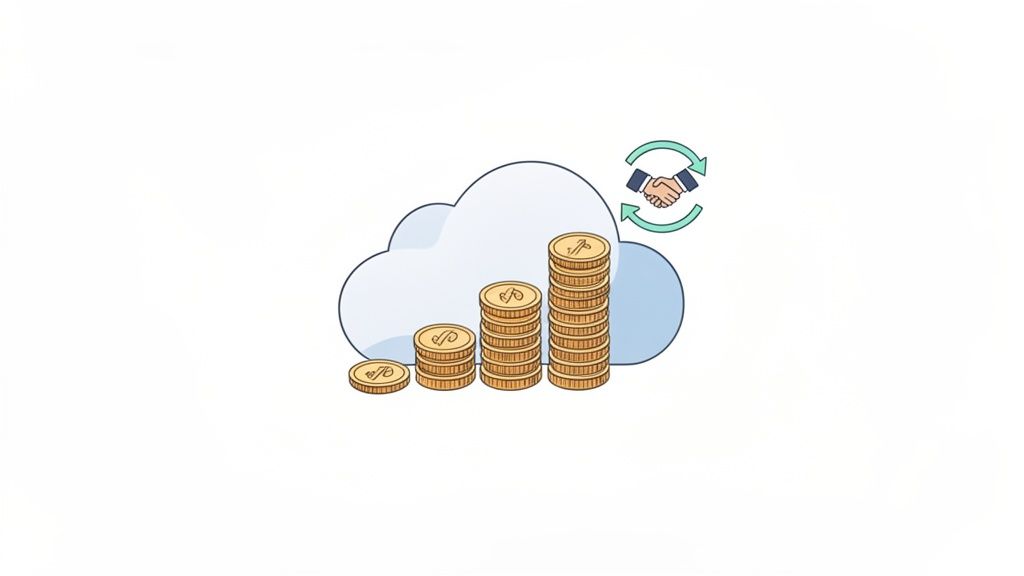
Now, let’s compare that to promoting a SaaS tool that costs $100 per month. With a pretty standard 30% recurring commission, you don’t just earn $30 once. You earn it every single month that customer stays subscribed.
This is the financial engine of SaaS affiliate marketing. Each referral isn't a single transaction; it's an annuity that pays you for months, or even years, from a single conversion event.
This compounding effect is what creates the income snowball. Your earnings from last month's referrals stack on top of this month's, letting your income grow exponentially without you having to double your effort. While your e-commerce counterpart is starting from zero every month, your SaaS income has a growing baseline.
Why Native Programs Convert Better
Another huge leg up in the SaaS world is the rise of native affiliate programs. In the old days, affiliate programs were often clunky, third-party systems that felt completely disconnected from the product. Affiliates had to deal with confusing dashboards and spammy-looking links that just screamed "sales pitch."
Today, smart SaaS companies are building their affiliate programs right into their own apps. A user might find their unique referral link sitting right there in their account settings, making the whole experience feel seamless and authentic.
This integrated approach works so well for a few reasons:
- Higher Trust: When the referral process is part of the core product, it feels more like a genuine recommendation from one user to another. That built-in trust does wonders for conversion rates.
- Reduced Friction: People don't have to jump over to a separate website to sign up or track their links. It all happens in a familiar environment, which makes them far more likely to actually share it.
- Better Alignment: A native program is a clear signal that the company views its affiliates as genuine partners, not just lead-gen tools. This fosters a stronger relationship and encourages affiliates to promote the product with more passion.
This is a huge reason why digging into SaaS affiliate programs can be so rewarding.
High Lifetime Value and Higher Commissions
Finally, the raw numbers in SaaS are just better for affiliates. The Lifetime Value (LTV) of a single SaaS customer can easily run into the thousands of dollars. This gives companies a lot more room to offer generous commissions compared to e-commerce retailers who are often dealing with razor-thin margins.
It's common to find SaaS programs offering:
- High recurring percentages, often between 20% and 50%.
- Large one-time payouts (sometimes called bounties) that can be $150 or more for just one signup.
This financial structure means you can earn serious income even with a smaller, highly-targeted audience. You don't need millions of pageviews when a single referral could be worth hundreds or thousands of dollars over its lifetime. It’s this combination of recurring revenue, seamless programs, and generous payouts that makes SaaS a top-tier niche for any affiliate looking to build a real business.
Your Path From Zero to Affiliate Pro
So, how much can you really make from affiliate marketing? As we've seen, it has almost nothing to do with luck. It all comes down to strategy, a little bit of grit, and truly understanding what makes your income tick. The road from earning your first few dollars to building a reliable, full-time income is paved with constant learning and tweaking.
You now have the playbook. By zeroing in on those four core levers—Traffic, Conversion Rate, Commission, and Price—you have a clear path to growing your earnings methodically.
Remember, the pros separate themselves from the beginners by mastering proven tactics. They build email lists, they engineer smart sales funnels, and they don't put all their traffic eggs in one basket. This isn't just about earning a one-off commission; it's about building a real, sustainable business.
And for SaaS companies thinking about launching a program? The same rules apply. It's all about finding the right partners, giving them the tools they need to succeed, and creating a system that turns your happiest customers into your best salespeople. The potential to build a massive new growth channel is sitting right there.
The journey to becoming a successful affiliate marketer is a marathon, not a sprint. Every piece of content you create, every relationship you build, and every metric you track is an asset that compounds over time.
Whether you're an affiliate just starting out or a founder ready to build a program, you have the foundational principles. The potential is massive for anyone willing to put in the work, test their ideas, and never lose sight of delivering real value.
Go build something.
Frequently Asked Questions
When you're first dipping your toes into affiliate marketing, a million questions pop into your head. Let's tackle some of the most common ones I hear from people who are just starting out.
How Long Does It Take to Start Making Money?
This is the big one, isn't it? While you might get lucky and land your first sale in a few weeks, building a steady, reliable income stream is a different story. Realistically, you should be prepared to put in 6 to 12 months of solid, focused work before you see consistent earnings.
Think of it less like a job and more like building a business from the ground up. Those first several months are all about laying the foundation—creating genuinely helpful content, building trust with an audience, and figuring out how to get eyeballs on your stuff. It’s a marathon, not a sprint, and that initial groundwork is what makes long-term success possible.
Can You Do Affiliate Marketing with No Money?
You absolutely can. While having a budget for paid ads can definitely pour gas on the fire, you don't need a single dollar to get started. Many of the most successful affiliates I know began with nothing but grit and free traffic strategies.
Here are a few ways to get the ball rolling for free:
- Search Engine Optimization (SEO): Write useful articles for a blog. If you solve people's problems, Google will eventually start sending you traffic.
- Social Media: Build a real community on platforms like TikTok, Instagram, or even a dedicated Facebook Group. Share value first, then recommend products.
- YouTube: Create videos that review products, offer tutorials, or answer common questions in your niche.
Once the money starts trickling in, you can then smartly reinvest some of it into paid advertising to really scale things up.
What Is the Best Niche for Affiliate Marketing?
The perfect niche sits at the intersection of three things: what you're passionate about, what you know a lot about, and what people are actually willing to pay for. You're going to be creating a mountain of content, so picking something you genuinely enjoy is non-negotiable if you want to stick with it.
But passion isn’t the whole picture. You need to find a market where people are actively looking for solutions to their problems. Some of the most consistently profitable areas include:
- Software as a Service (SaaS)
- Personal Finance and Investing
- Health and Wellness
- Digital Education and Online Courses
Is Affiliate Marketing Still Profitable?
Without a doubt. In fact, it's more relevant than ever. The industry is growing, and more importantly, brands are shifting bigger chunks of their marketing budgets toward performance-based partnerships like this. That means more programs, better commissions, and bigger opportunities for skilled affiliates.
Ultimately, the answer to how much can you make from affiliate marketing comes down to your ability to provide real value, adapt to changes, and pick the right products for the right audience. Its profitability is only going up as more businesses realize how powerful it is.
Ready to build your own high-converting, native affiliate program? With Refgrow, you can launch a fully customizable affiliate dashboard directly inside your SaaS in minutes. Join over 1,600 businesses and start scaling with a true growth partner. Get started with Refgrow today.