

Affiliate Marketing Without Website: affiliate marketing without website
Absolutely. You can dive headfirst into affiliate marketing without a website by focusing on platforms where your audience already lives, like social media, email newsletters, and niche online communities. These channels let you connect with people and promote products directly, no web development skills required.
Why a Website Is No Longer a Requirement for Affiliate Success
The old affiliate marketing playbook was pretty rigid. Step one was always the same: build a website. While a blog is still a fantastic asset, it’s no longer the only game in town for building a profitable affiliate business.
The truth is, the digital world is now packed with platforms where creators can build huge, loyal followings without ever buying a domain name or fiddling with a single line of code. This has completely leveled the playing field, opening the door for everyone from SaaS founders to indie creators to get started. The focus has shifted from owning a piece of the internet to earning audience attention on channels they already use and trust.
The Modern Affiliate Landscape
The game isn't about pulling traffic to a central blog anymore. It’s about meeting your audience where they are. This website-free approach puts direct engagement and community-building front and center on platforms like:
- Social Media: Instagram, TikTok, and YouTube are goldmines for visual product demos, tutorials, and authentic, off-the-cuff recommendations.
- Email Newsletters: Using a platform like Substack lets you build a direct line to your subscribers, creating a loyal group of people who genuinely trust what you have to say.
- Niche Communities: By actively participating in Reddit, Discord, or Facebook Groups, you can establish yourself as a go-to expert who naturally shares helpful solutions (and affiliate links). We dive deeper into these strategies in our guide on the different types of affiliate marketing.
The growth here is impossible to ignore. The global affiliate marketing industry hit a staggering $27.8 billion in 2024 and is expected to climb to nearly $48 billion by 2027. A huge chunk of that expansion is coming from these website-free strategies, as detailed in this in-depth industry analysis.
The core differences between the old website model and the new platform-driven approach are pretty stark.
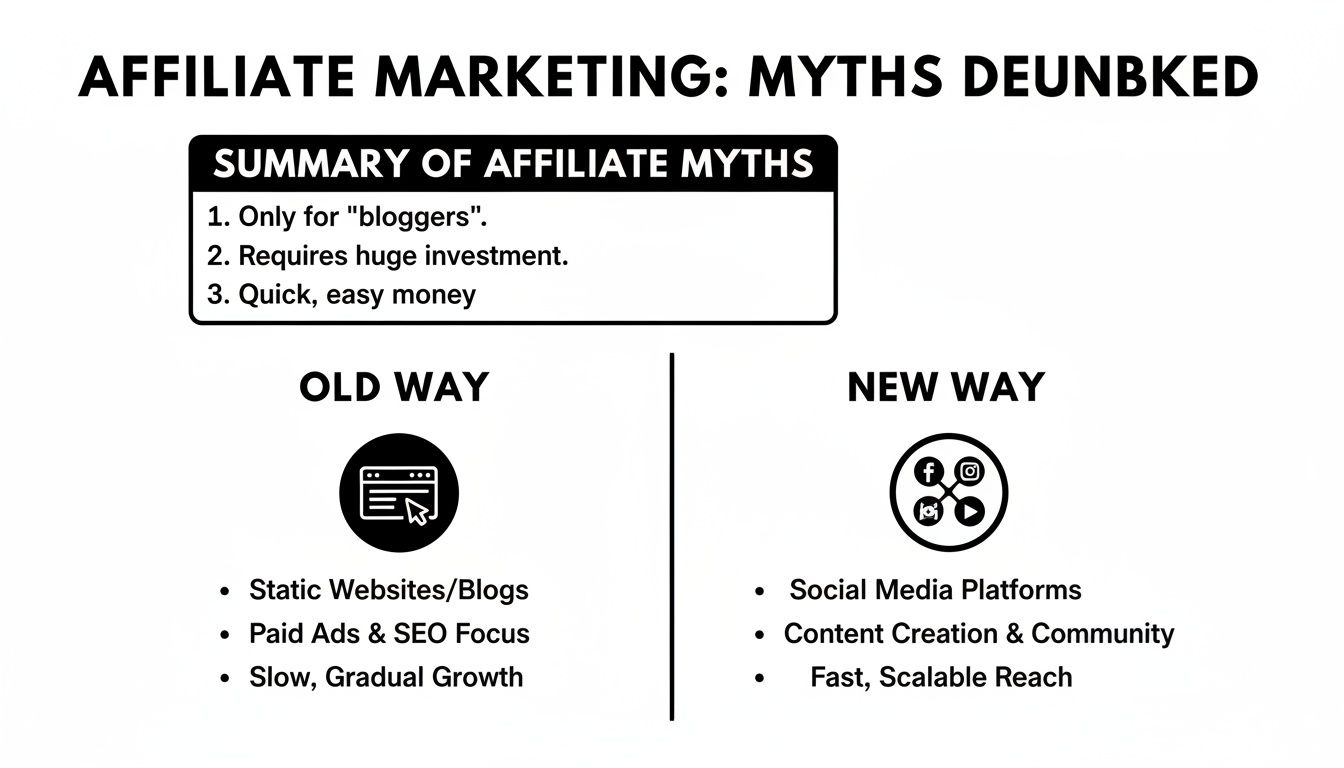
Let's break down how these two worlds stack up against each other.
Comparing Website vs Website-Free Affiliate Channels
| Attribute | Traditional Website Approach | Modern Website-Free Approach |
|---|---|---|
| Setup & Cost | High initial cost (domain, hosting, design). Technically demanding. | Low to no cost. Built on existing free platforms. |
| Speed to Market | Slow. Takes months to build authority and SEO traction. | Fast. Can start engaging an audience from day one. |
| Audience Building | Relies on search engines (SEO) and paid ads. | Focuses on direct, organic engagement within a platform. |
| Content Format | Long-form articles, blog posts, and written reviews. | Short-form video, stories, live streams, and community posts. |
| Engagement | One-way communication (comments, contact forms). | Two-way, real-time conversations and direct messaging. |
| Control | Full ownership of the platform and audience data. | Dependent on platform algorithms and policies (rented land). |
Ultimately, the biggest change is the move away from the slow, patient game of SEO toward the fast-paced, direct engagement found on social and community platforms. You can get in front of people almost immediately, which is a massive advantage for anyone starting out.
Using Social Media as Your Sales Engine
Forget what you’ve been told. Social media isn't just for cat videos and vacation photos anymore. It's a powerhouse for affiliate marketing without a website. Think of your profiles as digital storefronts and your content as the friendly, knowledgeable sales team that guides people inside. This is where you build real trust and drive sales directly.
The real magic kicks in when you stop acting like a walking billboard and start being a trusted resource. Instead of just spamming links, you create content that genuinely solves a problem, offers a smart solution, or highlights a tangible benefit. When you do that, the affiliate link isn't a pushy sales tactic; it’s the natural next step for an audience you’ve already helped.
Choosing the Right Platform for Your Niche
Don't make the mistake of thinking all social platforms are the same. They aren't. The secret is to align the platform’s vibe and content format with the product you’re promoting.
- For SaaS & B2B Tools: Your best bets are LinkedIn and Twitter. A single, well-written LinkedIn post breaking down how a specific software saved you hours of work can generate a surprising number of sign-ups. Think of it as sharing a mini-case study or a quick-tip thread.
- For Physical & Digital Products: This is where Instagram, TikTok, and YouTube Shorts shine. Visuals are king here. A fun, engaging TikTok that shows a product in action will always outperform a boring, static ad.
- For Courses & Info Products: Platforms that let you dive deeper, like YouTube or even detailed Instagram carousels, are fantastic. You can create short tutorials that give people a taste of the value inside the full course.
Let’s say you’re an affiliate for a project management tool. You could post a 30-second YouTube Short showing exactly how you use its features to plan your week. The video is pure value, and the affiliate link is right there in the description for anyone who wants to get organized too.
Key Takeaway: Your goal is to weave your affiliate offers into your content so seamlessly that they feel like a helpful recommendation from a friend, not a hard sell. Authenticity is your most valuable asset.
Crafting Content That Converts
Creating content that actually gets affiliate clicks is part art, part science. It’s all about leading with value. Your audience needs to walk away from your post feeling like they learned something, whether it’s a new hack, a good laugh, or a fresh perspective.
Take a creator on Instagram Stories, for example. Anyone can slap a "link sticker" on a story. The successful ones, however, build a narrative. They might do a "day in the life" segment, naturally featuring the product in their routine, and then link to it after showing why it’s useful. This feels so much more genuine and builds a connection that a simple ad just can't touch. If you're exploring different ways to earn online without a website, you should learn how to monetize social media.
At the end of the day, your social media strategy should be built on community. Jump into the comments, answer questions, and just be present. When your followers see you as a real person offering solid advice, they won’t just follow you—they’ll trust you. And that trust is the bedrock of every single affiliate sale you'll ever make.
Building Direct Connections with Email and Communities
Let's be real: building an audience on social media is like building a house on rented land. You're always one algorithm change away from losing everything. For a more stable, direct approach to affiliate marketing without a website, you can't beat owning your audience with an email list or a dedicated community. These channels give you a direct line to your most loyal followers and almost always convert better than a passing social media post.

An email list is one of your most valuable assets, period. It’s an intimate space where you can land directly in someone’s inbox. Platforms like Substack or ConvertKit make it ridiculously easy to launch a newsletter for free, no website required. Your only job? Create content so genuinely useful that people actually look forward to hearing from you.
Growing and Nurturing Your Email List
The secret to a great newsletter is simple: be consistent and provide real value. Don't just show up in their inbox when you have something to sell. Build a genuine relationship by sharing exclusive tips, behind-the-scenes stories, or curated resources that solve a real-world problem for your audience.
- Offer a Killer Incentive: You need to give people a reason to hand over their email. Think free checklists, a mini-guide, or access to an exclusive video—something that gives them an instant win.
- Promote It Everywhere: Your newsletter link should be in your social media bios, at the end of your YouTube videos, and in your community posts. Make it a no-brainer for people to find and subscribe.
- Give Each Email One Job: Every email should have a single, clear purpose. Whether it's to teach, entertain, or recommend a product, a focused message cuts through the noise and gets people to act.
When you finally pitch an affiliate product, it won't feel like a pitch at all. It'll feel like a natural recommendation. For example, if your niche is productivity, you could share your personal workflow in one email, and in a follow-up, mention the exact software you use to stay organized. Learning how to write emails that convert is a craft, and you can dig into specific strategies for creating powerful affiliate marketing emails to get better at it.
The real power of email is in the numbers. Brands can see a stellar 1400% ROI from email campaigns, with some affiliate plays hitting a 14:1 return on ad spend. It’s no surprise that 57% of marketers are increasing their affiliate budgets. Discover more affiliate marketing statistics to see the full picture.
Becoming a Valued Community Member
Beyond your inbox, online communities on platforms like Reddit, Discord, or private Facebook Groups are goldmines for connecting with a hyper-targeted audience. The golden rule here is non-negotiable: give far more than you take. If you jump into a group and start spamming affiliate links, you’ll be kicked out before you can blink. And you'll deserve it.
Instead, your mission is to become a known, trusted voice. Spend your time genuinely answering questions, sharing your own experiences, and offering solid advice without expecting anything in return. Get involved in conversations and actually help people solve their problems.
Once you’ve built that trust and credibility, you can share your links in a way that feels helpful, not sleazy. Imagine someone in a group is struggling with a specific business problem you've faced. You could chime in with, "I ran into that same issue, and I found that [Product Name] was a game-changer. Here’s a link if you want to check it out." This contextual, value-first approach is the only way to make community-based marketing work.
Finding Affiliate Products and Programs That Actually Convert
Let's be real: your success in affiliate marketing hinges almost entirely on the products you choose to promote. You could have the most engaging content in the world, but if the offer is a dud, it’s going to fall flat. The secret isn't just finding a product—it's finding one you genuinely believe in that solves a real problem for your audience.
Authenticity is your greatest asset here. Chasing a high commission for a product you don't care about is the fastest way to burn the trust you've built with your followers. A better starting point? Look at the tools, software, or products you already use and love. Recommending something from personal experience is always more powerful and feels natural.

High Volume vs. High Ticket Affiliate Programs
Not all affiliate programs are built the same. They generally fall into two camps, and knowing the difference will help you match your efforts to your income goals.
- High-Volume, Low-Commission: Think massive marketplaces like Amazon Associates. These programs deal mostly with physical products, and you'll earn a small cut—often just 1-5%. To make any real money, you have to push a ton of traffic and sales. It’s a numbers game.
- Low-Volume, High-Ticket: This is where digital products, especially SaaS (Software as a Service), shine. The commissions are much juicier, often ranging from 20-70%, and many even offer recurring payouts. Selling just a handful of subscriptions can easily out-earn hundreds of small physical product sales.
For creators and founders, the SaaS space is a goldmine. When you promote software with a recurring commission, you get paid every single month that your referral stays a customer. That’s how you build a stable, predictable income stream. If you're curious, you can find some great affiliate programs for software to get a feel for the opportunities available.
Vetting Potential Affiliate Programs
Okay, so you've got a product in mind. Before you jump in, you need to do a little homework on its affiliate program. Don't let a big commission percentage blind you to the fine print.
Here’s what I always check:
- Commission Structure: Is it a one-off payment, or is it recurring? For building long-term, stable income, recurring is almost always the way to go.
- Cookie Duration: This is the tracking window. How long after someone clicks your link do you get credit for the sale? A 30, 60, or 90-day cookie is fantastic. A 24-hour window? Not so much.
- Payout Reliability: Dig into their payment schedule. Do they pay on time, every time? Is there a minimum payout threshold you have to hit before you see any cash?
- Promotional Support: Do they give you anything to work with? A good partner will provide marketing materials, banners, and helpful content because they want you to succeed.
When looking for programs, think about what fits your audience. For instance, if your community is focused on monetization strategies, something like the Monetized Profiles affiliate program could be a perfect fit.
It's worth remembering just how big this opportunity is. For 31% of content creators, affiliate marketing is their number-one revenue stream—beating both ads and sponsorships. The industry is also growing by about 10% annually, so you're not late to the party.
Thankfully, it's easier than ever for companies to launch their own affiliate programs. Modern tools like Refgrow allow SaaS businesses to embed an affiliate dashboard directly into their app with just a single line of code. This is creating a constant stream of new, high-quality opportunities for creators like you every single day.
So, your organic efforts are starting to pay off. You’ve found a winning combination—the right product, the right audience, the right platform. Now what? It's time to pour a little gasoline on that fire.
Scaling your affiliate marketing without a website usually means making some smart, strategic investments. We're talking about paid advertising and tools that make your life easier. This isn't about having a huge bankroll; it's about being clever with every dollar you put to work.
A lot of affiliates get spooked by the idea of paid ads. They think it's too complicated or that they'll just lose money. But you can run a simple, effective campaign on platforms like Instagram or Facebook, especially if you focus on direct linking. That just means sending people straight from your ad to the affiliate offer, no website or landing page required.
Jumping Into Paid Ads
The golden rule here is to start small and test everything. Forget about launching some massive, nationwide campaign right out of the gate. Your first goal is purely to see what resonates with a tiny budget, learn from the results, and then pump your profits back into the ads that actually work.
Let’s play out a real-world scenario. Say you’ve had some decent success promoting a SaaS tool using Instagram Reels. You could grab your best-performing Reel, throw a $10 per day budget at it, and target a "lookalike" audience that mirrors your current followers. That small investment is all you need to start gathering real data on clicks and conversions.
Key Takeaway: Your initial ad budget isn't for making a profit; it's for buying data. Once you know which ad copy, creative, and audience converts, you can confidently increase your spend.
How to Track and Tune Your Campaigns
The one metric that matters more than any other in affiliate advertising is your Return On Ad Spend (ROAS). It’s simple: for every dollar you spend on ads, how many dollars are you earning back in commissions? If your ROAS is positive, you've got a profitable campaign on your hands—one that's ready to scale.
Here are a few essential tips I've learned for managing those first campaigns:
- Know the Rules: Ad platforms can be notoriously strict about affiliate marketing. Make sure you read and understand their policies inside and out to avoid getting your account flagged or shut down. Transparency is your friend.
- Use Unique Tracking Links: Always create a separate affiliate link for each ad campaign. This is non-negotiable. It's the only way to know for sure which ads are driving sales, allowing you to kill the losers and double down on the winners.
- Pick One Platform: Don't spread yourself thin trying to master Facebook, Google, and TikTok ads all at once. Choose the one platform where you know your audience lives and breathe its system until you're an expert.
The Right Tools to Scale Your Workflow
As you start to grow, your time quickly becomes your most valuable resource. Investing in a few select tools can put repetitive tasks on autopilot, freeing you up to focus on the big picture. This is a game-changer for anyone serious about affiliate marketing without a website.
- Link Trackers: A dedicated tool like Voluum gives you much deeper analytics than the standard affiliate dashboard. You get crystal-clear data on click-through rates and conversions, which is crucial for optimization.
- Social Media Schedulers: Using a platform like Buffer or Later lets you batch-create and schedule your organic social posts weeks ahead of time. It's how you maintain a consistent presence without being chained to your phone.
- Simple Design Tools: You don't need a design degree. A tool like Canva makes it incredibly easy to create professional-looking images and simple video ads that stop the scroll and get people's attention.
Answering Your Top Questions About Going Website-Free
Diving into affiliate marketing without a website can bring up a lot of questions. It’s a path less traveled, and it's smart to wonder what’s around the corner before you commit. Let’s tackle some of the biggest uncertainties I hear all the time so you can move forward with confidence.

A lot of newcomers get stuck on one big question: Is this a legitimate way to earn real money, or is it just a bit of side cash? The answer really comes down to your strategy, but the potential is definitely there.
Is Affiliate Marketing Without a Website Genuinely Profitable?
Absolutely. Profitability in affiliate marketing hinges on your ability to build and connect with an audience, not on whether you own a domain name. Think about it—by using social media, email, or even paid ads, you're meeting potential customers exactly where they already are.
You’re not trying to pull them over to a new website; you’re engaging them in their natural habitat.
High-commission programs, especially in booming sectors like SaaS and digital products, can be incredibly lucrative. Best of all, you get to skip the costs and headaches of hosting, website design, and maintenance. Your entire focus can be on what actually matters: building trust and delivering value on the platforms you know best.
Another common point of confusion is the technical side of things. How do you actually get paid for your referrals?
Key Insight: Profitability isn't about owning a platform; it's about owning an audience's attention and trust. Where you build that trust—be it on TikTok, in a newsletter, or a community—is secondary to the connection itself.
How Do I Track Commissions Without My Own Site?
This part is much simpler than most people think. Every affiliate program worth its salt will give you a unique tracking link, often just called an affiliate link. This link is your money-maker.
Here’s how it works: when someone clicks your special link, the company you're promoting places a small tracking file, known as a cookie, on their browser. This little file tells the company, "Hey, this person came from [Your Name]!" If they make a purchase within a certain timeframe (the "cookie duration"), you get the credit. No website of your own is needed for this process to work flawlessly.
You'll also get access to a personal dashboard from the merchant or affiliate network where you can see everything in real time:
- How many people clicked your links.
- The number of sales or sign-ups you generated.
- Your total commissions earned, down to the penny.
The entire tracking system is built into their platform, making sure you get credit for every single referral you send their way.
What Are the Best Platforms for a Beginner to Start On?
Hands down, the best platform to start on is the one you already use and understand. Don't make the mistake of trying to become a YouTube expert overnight if you’ve never even uploaded a video.
If you've got a growing following on Instagram or TikTok, start right there. Are you a great writer who can craft a compelling email? Fire up a newsletter on a platform like Substack. If you love breaking down complex topics in tutorials, YouTube is your best bet.
The biggest trap for beginners is trying to be everywhere at once. It’s a surefire recipe for burnout and weak content. The winning move is to pick one platform, go deep, and master it. Once you've built an engaged community and a profitable system on that one channel, you can then start thinking about expanding your reach.
Ready to launch your own affiliate program without the technical headaches? With Refgrow, you can embed a fully native referral dashboard directly into your SaaS product in minutes. Join over 1,600 businesses and start scaling your growth today.